VOCABULARY ATI TEAS ENGLISH AND LANGUAGE USAGE VOCABULARY - - PDF document

vocabulary
SMART_READER_LITE
LIVE PREVIEW

VOCABULARY ATI TEAS ENGLISH AND LANGUAGE USAGE VOCABULARY - - PDF document

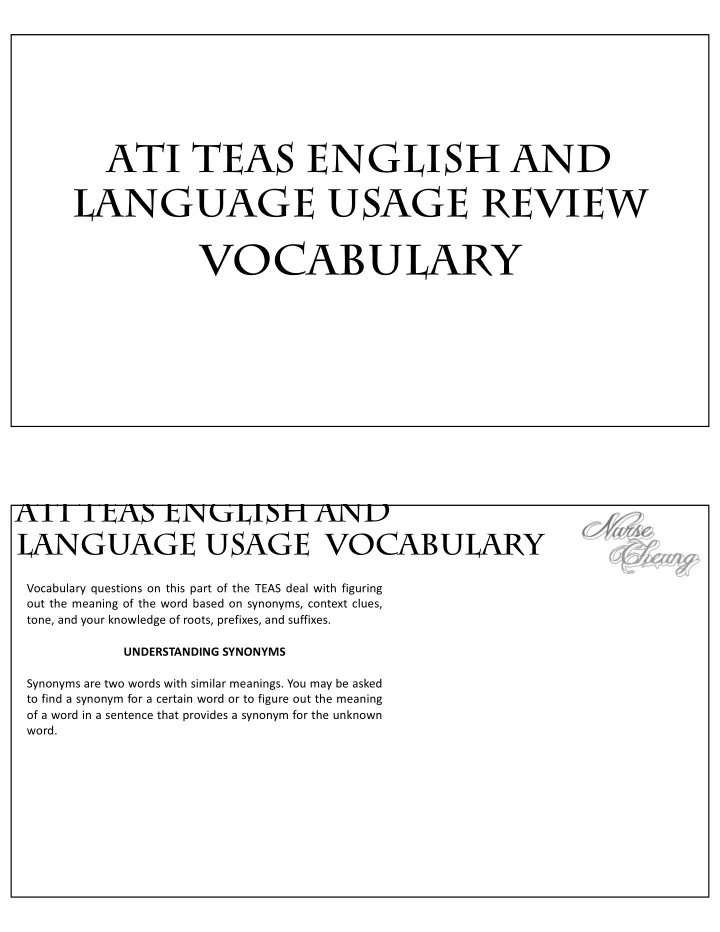
ATI TEAS ENGLISH AND LANGUAGE USAGE REVIEW VOCABULARY ATI TEAS ENGLISH AND LANGUAGE USAGE VOCABULARY Vocabulary questions on this part of the TEAS deal with figuring out the meaning of the word based on synonyms, context clues, tone, and your


slide-1
SLIDE 1

ATI TEAS ENGLISH AND LANGUAGE USAGE REVIEW

VOCABULARY

ATI TEAS ENGLISH AND LANGUAGE USAGE VOCABULARY

Vocabulary questions on this part of the TEAS deal with figuring

  • ut the meaning of the word based on synonyms, context clues,

tone, and your knowledge of roots, prefixes, and suffixes. UNDERSTANDING SYNONYMS Synonyms are two words with similar meanings. You may be asked to find a synonym for a certain word or to figure out the meaning

  • f a word in a sentence that provides a synonym for the unknown

word.

slide-2
SLIDE 2

ATI TEAS ENGLISH AND LANGUAGE USAGE VOCABULARY

UNDERSTANDING CONTEXT CLUES These questions are similar to those in the reading section, but you may be given as little as a single sentence rather than a longer

  • passage. You will need to use that limited context to figure out the

meaning of a word. Look at the surrounding context for the word you are given. Figure out the setting in which the word is used. If the word is part of a series, the other words in the series can provide valuable clues. Review the section on homographs in the chapter on spelling. Questions in this section may use homograph to test whether you are paying attention to context. You should also consider the tone of the passage; it may give you a clue about the meaning of an unknown word.

ATI TEAS ENGLISH AND LANGUAGE USAGE VOCABULARY

UNDERSTANDING WORD ORIGINS You may also be asked questions about root words, prefixes, and

  • suffixes. A root word is the base form of a word. Affixes are the

parts we attach to modify the meaning of the root word. A prefix is attached before the root and a suffix is attached after the root. You should spend some time becoming familiar with common affixes used in the medical profession. Here is a list of common roots to get you started.

  • Abdomin: Abdomen
  • Acous: Hearing
  • Aden: Gland
  • Adip: Fat
  • Adrena: Adrenal
  • Aero: Gas
  • Andr: Male
  • Angi: Vessel
  • Anter: Front
  • Aort: Artery
  • Arthr: Joint
  • Audi: Hearing
  • Bio: Life
  • Bronch: Bronchus
  • Carcin: Cancer
  • Cardi: Heart
  • Cerebr: Cerebrum
  • Chol: Bile
  • Chondr: Cartilage
  • Col: Colon
  • Cor: Pupil
  • Crani: Cranium
  • Cutane: Skin
  • Cyst: Bladder
  • Cyt: Cell
  • Dactyl: Finger or toe
  • Derma: Skin
  • Dors: Back or posterior
  • Encephal: Brain
  • Enter: Intestine
  • Esophag: Esophagus
  • Esthesi: Sensation
slide-3
SLIDE 3

ATI TEAS ENGLISH AND LANGUAGE USAGE VOCABULARY

UNDERSTANDING WORD ORIGINS

  • Faci: Face
  • Fibr: Fiber
  • Gastr: Stomach
  • Gynec: Female
  • Hemat/hemo: Blood
  • Hepat: Liver
  • Hist: Tissue
  • Hyster/metr: Uterus
  • Intestin: Intestine
  • Kerat: Hard
  • Lapar: Abdomen
  • Laryng: Larynx
  • Lipo: Fat
  • Lymph: Lymph
  • Mamm/mast: Breast
  • My: Muscle
  • Myel: Spinal Cord
  • Nasal: Nose
  • Necr: Death
  • Nephr: Kidney
  • Neur: Nerve
  • Ocul/ophthalm: Eye
  • Opt/optic: Seeing or sight
  • Or: Mouth
  • Orchid: Testicle or testis
  • Oste: Bone
  • Ot: Ear
  • Ovari: Ovary
  • Ox/oxy: Oxygen
  • Pancreat: Pancreas
  • Path: Disease
  • Pector: Chest
  • Ped/Pod: Foot
  • Pelv: Pelvis
  • Pharmac/o: Drug
  • Phleb: Vein
  • Pneum: Air or lung
  • Prostat: Prostate gland
  • Pulmon: Lung
  • Ren: Kidney
  • Sept: Infection
  • Somat: Body
  • Stern: Breastbone, sternum
  • Tendin: Tendon
  • Test: Testicle or testis
  • Thorac: Thorax/chest
  • Thromb: Clot
  • Thyr: Thyroid gland
  • Vas: Duct/vessel
  • Ven: Vein
  • Ventr: Front of body

ATI TEAS ENGLISH AND LANGUAGE USAGE VOCABULARY

UNDERSTANDING WORD ORIGINS Many medical terms are formed by combining one or more roots with a prefix and/or suffix, so you need to know the common affixes as well. Here is a list of common prefixes.

Prefix Prefix meaning Example Term Meaning a-/an-/ar- Not, without Amnesia No memory Anti- Against Antipsychotic A mind-altering medicine Dys- Bad or difficult Dysentery Abnormal condition

  • f intestines

Endo- In, within Endoscopy Visual examination inside the body Epi- Over, around Epidural On or around the dura matter Exo-/extra- Outside Exoskeleton External skeleton Hyper- Beyond normal, high Hypertension High blood pressure

slide-4
SLIDE 4

ATI TEAS ENGLISH AND LANGUAGE USAGE VOCABULARY

UNDERSTANDING WORD ORIGINS Many medical terms are formed by combining one or more roots with a prefix and/or suffix, so you need to know the common affixes as well. Here is a list of common prefixes.

Hypo- Low, under Hypoglycemia Low blood sugar Inter- Between Interarticular Between joints Intra- Within Intravenous In a vein Macro- Large, long Macroglossia Having an enlarged tongue Mal- Bad Malaise General sense of being unwell Micro- Small Microscope Instrument for viewing small

  • bjects

Neo- New Neoplasm Abnormal new growth of tissue Per- Through Percutaneous Through the skin Prefix Prefix meaning Example Term Meaning

ATI TEAS ENGLISH AND LANGUAGE USAGE VOCABULARY

UNDERSTANDING WORD ORIGINS Many medical terms are formed by combining one or more roots with a prefix and/or suffix, so you need to know the common affixes as well. Here is a list of common prefixes.

Prefix Prefix meaning Example Term Meaning Peri- Around, surrounding Pericardium Tissue surrounding the heart Poly- Many, much Polydactyly Condition of too many fingers or toes Post- After Postmortem After death Pre- Before Prenatal Before birth Sub- Below, under Subcutaneous Under the skin Super-/Supra- Above Supraorbital Above the eye socket Tachy- Rapid Tachycardia Fast heartbeat Trans- Across, through Translucent Allowing light to shine through Un- Not Unformed Not formed

slide-5
SLIDE 5

ATI TEAS ENGLISH AND LANGUAGE USAGE VOCABULARY

UNDERSTANDING WORD ORIGINS Here is a list of common suffixes used in medical terminology

Suffix Suffix meaning Example Term Meaning

  • ac/-al/-ar/-ary

Pertaining to Cardiac Pertaining to the heart

  • algia

Pain Myalgia Muscle pain

  • ase

Enzyme Lipase Enzyme that digests fats

  • asthenia

Weakness Neurasthenia Weakness of nerves

  • crine

To secrete Endocrine Related to the glands

  • cyte

Cell Leukocyte White blood cell

  • dynia

Pain Gastrodynia Stomach pain

  • ectomy/-tomy

Surgical removal Tonsillectomy Removal of tonsils

  • emia

Blood Anemia Deficiency of red blood cells

ATI TEAS ENGLISH AND LANGUAGE USAGE VOCABULARY

UNDERSTANDING WORD ORIGINS Here is a list of common suffixes used in medical terminology

Suffix Suffix meaning Example Term Meaning

  • gnosis

Knowledge Prognosis Prediction for future

  • gram

Picture or record Cardiogram Record of heart activity

  • ia/-ism

State or condition Tachycardia Condition of a rapid heart rate

  • ic

Pertaining to Therapeutic Pertaining to treatment

  • ist

One who specializes in Gynecologist Specialist in women’s reproduction

  • it is

Inflammation Sinusitis Inflammation of sinus tissues

  • lysis

Breakdown, separate Paralysis Loss of ability to move or feel

  • lpsy

Attack or seizure Epilepsy Neurological seizure disorder

slide-6
SLIDE 6

ATI TEAS ENGLISH AND LANGUAGE USAGE VOCABULARY

UNDERSTANDING WORD ORIGINS Here is a list of common suffixes used in medical terminology

Suffix Suffix meaning Example Term Meaning

  • ole/-ule

Small Molecule Smallest unit of a compound

  • ology

The study of Biology The study of living things

  • oma

Tumor Blastoma Cancer of precursor cells

  • osis

Condition Ankylosis Abnormal joint stiffening

  • pathy

Disease Neuropathy Relating to a nerve disorder

  • penia

Deficiency Osteopenia Low bone mineral density

  • poiesis

Formation Hematopoiesis Formation of blood cellular components

  • rrhage

Excess fluid Hemorrhage Excessive bleeding