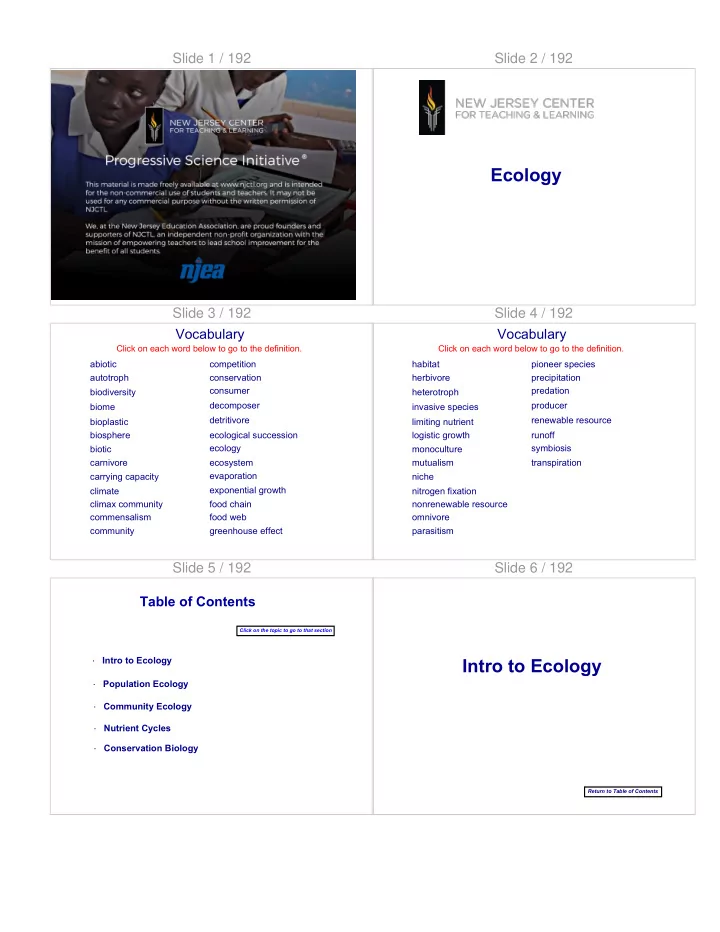
Ecology Slide 3 / 192 Slide 4 / 192 Vocabulary Vocabulary Click - - PDF document

ecology
SMART_READER_LITE
LIVE PREVIEW

Ecology Slide 3 / 192 Slide 4 / 192 Vocabulary Vocabulary Click - - PDF document

Slide 1 / 192 Slide 2 / 192 Ecology Slide 3 / 192 Slide 4 / 192 Vocabulary Vocabulary Click on each word below to go to the definition. Click on each word below to go to the definition. abiotic competition habitat pioneer species


slide-1
SLIDE 1

Slide 1 / 192 Slide 2 / 192

Ecology

Slide 3 / 192 Vocabulary

abiotic Click on each word below to go to the definition. autotroph biodiversity biome bioplastic biosphere biotic carnivore carrying capacity climate climax community commensalism conservation competition consumer decomposer detritivore ecological succession ecology ecosystem evaporation exponential growth community food chain food web greenhouse effect

Slide 4 / 192 Vocabulary

habitat Click on each word below to go to the definition. herbivore heterotroph invasive species limiting nutrient logistic growth monoculture mutualism niche nitrogen fixation nonrenewable resource

  • mnivore

precipitation pioneer species predation producer renewable resource runoff symbiosis transpiration parasitism

Slide 5 / 192 Table of Contents

· Intro to Ecology · Population Ecology · Community Ecology

Click on the topic to go to that section

· Nutrient Cycles · Conservation Biology

Slide 6 / 192

Intro to Ecology

Return to Table of Contents

slide-2
SLIDE 2

Slide 7 / 192

Ecology is the study of the interactions between organisms and their environment.

Ecology

This squirrelfish is being cleaned by a cleaner wrasse. Cleaner wrasse are small fish that eat parasites and debris off of larger fish. An ecologist would see this and think: · Does this harm or benefit the squirrelfish? · Does this behavior lead to higher survival for the cleaner wrasse? · Do cleaner wrasse compete for host fish? · How does this behavior affect predation of the cleaner wrasse?

Slide 8 / 192 Ecology

Acacia ants have a unique relationship with the Acacia tree in which they live. Think like an ecologist. What questions do you have about this behavior? Click the picture to watch a video about Acacia ants.

Slide 9 / 192

Cell Tissue Organ Organism

Levels of Biological Organization

So far, you have studied how cells, tissues and organs interact to create an organism. Ecology studies how organisms interact with

  • ther organisms and variables in their environments.

Slide 10 / 192

Community

Levels of Biological Organization

Ecosystem Population Organism Biosphere Biome

Slide 11 / 192 Population

A population is a group of individuals that live in the same area, can interbreed, and share the same gene pool. Evolution occurs at a population level. Individual

  • rganisms cannot evolve.

Formation of new species happens as individuals within a population undergo changes in genotype and phenotype.

Slide 12 / 192 Community

A community is composed of all the different populations of species that live in a given area. Organisms within a community interact with each other ways that can be both beneficial and harmful. Competition for resources between members of a community is one factor that shapes evolution by natural selection.

slide-3
SLIDE 3

Slide 13 / 192 Ecosystem

An ecosystem includes all of the living and nonliving factors that exist in a community.

Slide 14 / 192 Biomes

A biome is a group of ecosystems that have similar climates, animals and plants. There are both terrestrial and marine biomes. Coral reefs exist in both the Atlantic and Pacific Oceans. However, all reefs are found in shallow, nutrient-rich waters and are inhabited by similar

  • rganisms.

Slide 15 / 192 Terrestrial Biomes

Desert Temperate Forest Rainforest Tundra Temperate Grasslands Savannah Taiga Alpine Chaparral

Slide 16 / 192 Marine Biomes

Freshwater Freshwater Wetlands Marine Coral Reefs Estuaries

Slide 17 / 192 Biosphere

The biosphere is the portion of Earth in which all life exists. This includes the land, water, and air.

Slide 18 / 192

a group of organisms that belong to the same species and live in the same area. different populations that live in the same area. all of the organisms that live in a given area and their physical environment. a group of ecosystems that have the same climate and similar communities. the portion of Earth that contains all ecosystems.

Levels of Biological Organization

Community Biome Biosphere Ecosystem Population

slide-4
SLIDE 4

Slide 19 / 192

1 Which of the following levels of biological

  • rganization includes all of the others?

A Community B Ecosystem C Organism D Population

Slide 19 (Answer) / 192

1 Which of the following levels of biological

  • rganization includes all of the others?

A Community B Ecosystem C Organism D Population

[This object is a pull tab]

Answer B

Slide 20 / 192

Population Ecology

· Factors · Habitats & Niches · Population Growth

Click on the topic to go to that section Return to Table of Contents

Slide 21 / 192 Population Ecology

Population ecology studies the interactions between a population and its environment. The water-holding frog of Australia burrows into the ground during the dry

  • season. It surrounds itself with a water-

tight mucus secretion that acts as a

  • cocoon. When it rains, the frog emerges

to lay eggs. The eggs hatch and the tadpoles develop quickly before the puddle disappears. What types of factors affect the water-holding frog?

Slide 22 / 192

Factors

Populations are affected negatively and positively by a variety

  • f factors in their environment.

The saguaro cactus are desert plants with adaptations that enable it to live in dry conditions. They have one large taproot that extends into the ground with small, shallow roots that quickly absorb any water that falls. Spines help to channel water, redirect the wind, protect the cactus from animals, and insulate the cactus. Some animals, such as pack rats, eat the cactus. Other animals, such as bats, eat the fruit of the cactus, aiding in pollination and dispersal of seeds. Name one positive factor and one negative factor that affects the saguaro.

Slide 23 / 192

Wind Temperature Soil Nutrients

Factors

· Sunlight · Precipitation · Temperature · Wind · Soil type · Nutrient availability Abiotic factors are physical, nonliving factors that shape an ecosystem.

slide-5
SLIDE 5

Slide 24 / 192 Factors

· Plants · Animals · Fungi · Bacteria Biotic factors are the living things that make up an ecosystem.

Slide 25 / 192 Factors

Let's revisit the saguaro cactus... The saguaro cactus are desert plants with have adaptations that enable it to live in dry conditions. They have one large taproot that extends into the ground with small, shallow roots that quickly absorb any water that falls. Spines help to channel water, redirect the wind, protect the cactus from animals, and insulate the cactus. Some animals, such as pack rats, eat the cactus. Other animals, such as bats, eat the fruit of the cactus, aiding in pollination and dispersal of seeds. List two abiotic and two biotic factors that affect the saguaro cactus.

Slide 26 / 192

2 All of the following are abiotic factors except: A microorganisms B pH C temperature D nutrients

Slide 26 (Answer) / 192

2 All of the following are abiotic factors except: A microorganisms B pH C temperature D nutrients

[This object is a pull tab]

Answer A

Slide 27 / 192

3 Which of the following levels of biological organization includes both abiotic and biotic factors? A Species B Population C Community D Ecosystem

Slide 27 (Answer) / 192

3 Which of the following levels of biological organization includes both abiotic and biotic factors? A Species B Population C Community D Ecosystem

[This object is a pull tab]

Answer D

slide-6
SLIDE 6

Slide 28 / 192

4 Sea turtles undergo temperature-dependent sex

  • determination. The prevailing temperature during

embryonic development determines the sex of the turtle. Warm temperatures result in females while cooler temperatures result in males. What type of factor influences the sex of sea turtles? A Biotic B Abiotic

Slide 28 (Answer) / 192

4 Sea turtles undergo temperature-dependent sex

  • determination. The prevailing temperature during

embryonic development determines the sex of the turtle. Warm temperatures result in females while cooler temperatures result in males. What type of factor influences the sex of sea turtles? A Biotic B Abiotic

[This object is a pull tab]

Answer B

Slide 29 / 192 Habitat

The term habitat describes the specific area - including biotic and abiotic factors - where an organism lives within an ecosystem. A habitat is like an

  • rganism's home

within an ecosystem.

Slide 30 / 192 Ecological Niches

An organism's niche is a description of the role it plays in its habitat. A niche includes all aspects of where and how an organism lives including: * the type of food it eats * how it obtains food * where it lives in its environment (tree, nest, hive, etc.) * when and how it reproduces

Slide 31 / 192

Komodo Dragon Niche Komodo dragons live in the Indonesian Islands. They hunt and ambush invertebrates, birds and mammals. They lay up to 20 eggs at a time in self-dug holes. The eggs incubate for eight months. Komodo dragons take nine years to mature and can live up to 30 years.

Ecological Niches Slide 32 / 192 Ecological Niches

A population's habitat answers the question "Where do you live?". A population's niche answers the question "How do you make a living?". Click this picture to watch a video about niches in the North African river plains.

slide-7
SLIDE 7

Slide 33 / 192 Ecological Niches

No two species can occupy the same niche in the same environment at the same time. If this occurs, competition for resources will displace

  • ne of the species.

The figure below shows three different species of warblers that have established different niches in the same tree.

Slide 34 / 192

5 American green tree frogs live in the southeastern United States near bodies of water that have plentiful vegetation. This is the frog's ______. A Habitat B Niche

Slide 34 (Answer) / 192

5 American green tree frogs live in the southeastern United States near bodies of water that have plentiful vegetation. This is the frog's ______. A Habitat B Niche

[This object is a pull tab]

Answer A

Slide 35 / 192

6 Hyenas are carnivorous mammals that live in Africa. They live in clans that are led by females. Hyenas are successful at both hunting and scavenging food. This describes a hyena's ____. A Habitat B Niche

Slide 35 (Answer) / 192

6 Hyenas are carnivorous mammals that live in Africa. They live in clans that are led by females. Hyenas are successful at both hunting and scavenging food. This describes a hyena's ____. A Habitat B Niche

[This object is a pull tab]

Answer B

Slide 36 / 192 Population Growth

Ecologists are interested in how populations change. Population growth is dependent on · the number of births · the number of deaths · the number of individuals who enter or leave the population. Leaving Entering

slide-8
SLIDE 8

Slide 37 / 192

Depending on the availability of resources, populations can follow two main patterns of growth:

Population Growth

Exponential Growth Logistic Growth

Slide 38 / 192

Exponential Growth

Exponential growth occurs when a population reproduces at a constant rate. Exponential growth occurs: · in the absence of predation/ disease · in the presence of unlimited resources (food, habitat, etc.)

Slide 39 / 192

Bacteria can be grown under optimal conditions (unlimited resources) in a laboratory setting. If a bacterial population reproduces every 20 minutes, it can grow to a population size of 4.27 x 10²⁰ bacteria in one day.

Exponential Growth

Bacteria reproduce by binary fission.

Slide 40 / 192

Logistic Growth

Most populations do not have unlimited resources. When a population becomes too large, it exhausts food supply, water supply and shelter and population size stops increasing. As urban development destroys natural habitat, many animal populations become overpopulated. There are not enough resources to support the population.

Slide 41 / 192

Carrying Capacity

Logistic Growth

The population size that can be maintained with a given amount of resources is called the carrying capacity. Populations that are limited in resources experience logistic growth.

Slide 42 / 192

7 A population can grow exponentially under ideal

  • conditions. Which of the following would prevent

exponential growth from continuing? A The population is protected from predators. B The population is protected from disease. C The population runs out of food. D Reproduction occurs at a steady rate.

slide-9
SLIDE 9

Slide 42 (Answer) / 192

7 A population can grow exponentially under ideal

  • conditions. Which of the following would prevent

exponential growth from continuing? A The population is protected from predators. B The population is protected from disease. C The population runs out of food. D Reproduction occurs at a steady rate.

[This object is a pull tab]

Answer C

Slide 43 / 192

8 Exponential growth does not occur for long in nature, and eventually all population growth slows down. A population's maximum size is referred to as its A limiting growth factor. B carrying capacity. C logistic growth. D exponential capacity.

Slide 43 (Answer) / 192

8 Exponential growth does not occur for long in nature, and eventually all population growth slows down. A population's maximum size is referred to as its A limiting growth factor. B carrying capacity. C logistic growth. D exponential capacity.

[This object is a pull tab]

Answer B

Slide 44 / 192

Community Ecology

· Interactions · Energy Flow · Ecological Succession

Click on the topic to go to that section

· Climate

Return to Table of Contents

Slide 45 / 192 Climate

Communities are adapted to the climates of the ecosystems in which they live. Understanding climate and weather is a useful tool when studying communities.

Slide 46 / 192 Weather vs. Climate

Wind Temperature

Weather is the day-to-day condition of the Earth's atmosphere at a particular time and place. Abiotic factors like wind, temperature, and precipitation produce weather.

slide-10
SLIDE 10

Slide 47 / 192

Climate refers to the average weather conditions in a region over a number of years.

Climate is caused by many factors including latitude, the trapping of heat by the atmosphere, the transport of heat by winds and ocean currents, precipitation, altitude, and land masses. World Climate Zones

Weather vs. Climate Slide 48 / 192 The Greenhouse Effect

The intensity of sunlight has a major effect on temperature, but it is not the only factor that determines temperature on Earth. Atmospheric gases like carbon dioxide, methane, and water vapor trap the heat energy of sunlight inside Earth's atmosphere. You can think of the greenhouse gases like a blanket that surrounds the Earth and traps in heat - the thicker the blanket, the hotter the temperatures.

Slide 49 / 192

Circulation

The uneven heating of the Earth's surface causes wind and ocean currents that transport heat through the biosphere.

Slide 50 / 192

Solar radiation is more direct near the equator and less direct near the poles. This uneven heating results in warm air from the equator rising while cold air near the poles sinks towards the ground. The upward movement of warm air and downward movement of cold air create air currents that transfer heat.

Circulation

Slide 51 / 192 Ocean Currents

Similarly, in the ocean cold water sinks towards the bottom near the poles and rises in warmer regions. Surface water is moved by winds. Ocean currents also transfer heat through the biosphere and warm or cool the air above them.

Slide 52 / 192 Climate Change

This NASA image shows 63 years of climate change. Can global climate change affect circulation?

slide-11
SLIDE 11

Slide 53 / 192 Climate and Ecology

The Sonoran desert toad lives in the desert of the southeastern United

  • States. While it requires wet areas to

survive, it is able to hibernate during the dry winters by burrowing underground and living off of stored body fat. Each spring, rain wakes the toad and it emerges to reproduce. · If a change in climate created a shorter wet season, how would this affect the Sonoran desert toad? · What types of adaptations would be beneficial in this new climate?

Slide 54 / 192 Climate and Ecology

Off the coast of South America, prevailing winds move coastal waters away from the shore. When this happens, cold nutrient-rich waters from the seafloor rise up to replace the wind- driven water. This is called upwelling. The nutrients brought to the surface from upwelling support a large ecosystem in the surface waters of the ocean. Off the coast of South American, upwelling supports a large anchovy fishery.

Slide 55 / 192 Climate and Ecology

Every 2-7 years, the El Nino Southern Oscillation (ENSO) affects Pacific waters. This is a phenomenon in which atmospheric and

  • ceanic circulation patterns are distrupted.

Wind patterns reverse and wind blows water onto the shore. This creates downwelling, instead of upwelling. How would this change in circulation affect abiotic factors in the surface waters?

Slide 55 (Answer) / 192 Climate and Ecology

Every 2-7 years, the El Nino Southern Oscillation (ENSO) affects Pacific waters. This is a phenomenon in which atmospheric and

  • ceanic circulation patterns are distrupted.

Wind patterns reverse and wind blows water onto the shore. This creates downwelling, instead of upwelling. How would this change in circulation affect abiotic factors in the surface waters?

[This object is a pull tab]

Answer Upwelling increases nutrients to the surface waters. Downwelling would prevent this from happening and the area would experience a decrease in nutrients.

Slide 56 / 192

Climate and Ecology

How would an ENSO event affect anchovy fisheries? What would the anchovies have to do to survive?

Slide 56 (Answer) / 192

Climate and Ecology

How would an ENSO event affect anchovy fisheries? What would the anchovies have to do to survive?

[This object is a pull tab]

Answer ENSO decreases nutrients and makes it harder for anchovies to find food. To survive, anchovies must migrate to areas with more

  • food. This causes the anchovy

fishery to collapse.

slide-12
SLIDE 12

Slide 57 / 192

9 "Today's high will reach the mid-80s with a 20% chance of afternoon precipitation." This is an example of A weather. B climate.

Slide 57 (Answer) / 192

9 "Today's high will reach the mid-80s with a 20% chance of afternoon precipitation." This is an example of A weather. B climate.

[This object is a pull tab]

Answer A

Slide 58 / 192

10 Greenhouse gases in the atmosphere A act as a shield, protecting Earth from harmful UV rays. B decrease Earth's overall temperature. C act as a blanket, trapping the sun's radiation and increasing Earth's temperature. D affect a region's weather but not the climate.

Slide 58 (Answer) / 192

10 Greenhouse gases in the atmosphere A act as a shield, protecting Earth from harmful UV rays. B decrease Earth's overall temperature. C act as a blanket, trapping the sun's radiation and increasing Earth's temperature. D affect a region's weather but not the climate.

[This object is a pull tab]

Answer C

Slide 59 / 192

11 The surface of the Earth is heated unevenly. What does this cause? A Wind currents B The seasons C The tides D Global warming

Slide 59 (Answer) / 192

11 The surface of the Earth is heated unevenly. What does this cause? A Wind currents B The seasons C The tides D Global warming

[This object is a pull tab]

Answer A

slide-13
SLIDE 13

Slide 60 / 192

12 The tropical climate zone is extremely wet and is known for its dense forests. What type of plant adaptation is probably not found in this climate zone? A Vines that climb up trees to reach sunlight. B Drip tips on leaves to quickly shed excess water. C Large leaves to absorb as much sunlight as possible. D Waxy coverings to protect against dessication.

Slide 60 (Answer) / 192

12 The tropical climate zone is extremely wet and is known for its dense forests. What type of plant adaptation is probably not found in this climate zone? A Vines that climb up trees to reach sunlight. B Drip tips on leaves to quickly shed excess water. C Large leaves to absorb as much sunlight as possible. D Waxy coverings to protect against dessication.

[This object is a pull tab]

Answer D

Slide 61 / 192 Community Interactions

Communities interact in a variety of different ways that enable the

  • rganisms within them to establish a niche and shape the

ecosystem in which they live. The following are types of interactions within communities: Competition Predation Symbiosis Mutualism Commensalism Parasitism

Slide 62 / 192 Competition

When different organisms try to obtain resources in the same place at the same time, competition occurs. The ability to compete for resources is dependent upon whether an

  • rganism has adaptations that enable it to thrive in

its environment. Competition in nature drives evolution. Trees in this forest are in competition for light. The tall, broad-leafed trees outcompete the smaller trees for sunlight.

Slide 63 / 192 Predation

Predation occurs when one organism (predator) captures and feeds on another organism (prey). Ladybird beetle eating aphid Cheetah stalking gazelle Great white shark capturing prey

Slide 64 / 192 Predation

Predation is a driving factor in co-evolution. The prey evolves to better escape the predator. In turn the predator evolves to better capture the prey.

slide-14
SLIDE 14

Slide 65 / 192 Symbiosis

The term symbiosis means "living together." When two species live closely together they are said to be in a symbiotic relationship. There are three main categories of symbiotic relationships: Mutualism Commensalism Parasitism

Slide 66 / 192 Mutualism

In mutualism, both species benefit from the relationship. In this example, the flower provides the hummingbird with nectar and the hummingbird helps the flower reproduce by transporting pollen from one flower to the next. Mutualism: a win/win situation

Slide 67 / 192 Commensalism

In commensalism, one species benefits from the relationshipwhile the other is neither helped nor harmed by it. Barnacles attach to the whale and help themselves to small amounts of plankton (whale food). This behavior does not benefit or harm the whale. Commensalism: a win/neutral situation

Slide 68 / 192 Parasitism

In parasitism, one organism benefits while the other organism is harmed. Parasites are organisms that obtain all or most of their nutrients from

  • ther organisms, called hosts. The host-parasite relationship benefits

the parasite at the cost of the host. Mosquitoes feed off of the blood of

  • ther organisms. Mosquitoes also

carry various types of parasites and viruses that causediseases like yellow fever and malaria. Parasitism: a win/lose situation

Slide 69 / 192

13 When there are not enough resources for all the

  • rganisms in a community, what is the result?

A Commensalism B Symbiosis C Competition D Mutualism

Slide 69 (Answer) / 192

13 When there are not enough resources for all the

  • rganisms in a community, what is the result?

A Commensalism B Symbiosis C Competition D Mutualism

[This object is a pull tab]

Answer C

slide-15
SLIDE 15

Slide 70 / 192

14 Tapeworms live in the intestines of mammals and "steal" nutrients from them. This is an example of A competition. B mutualism. C commensalism. D parasitism.

Slide 70 (Answer) / 192

14 Tapeworms live in the intestines of mammals and "steal" nutrients from them. This is an example of A competition. B mutualism. C commensalism. D parasitism.

[This object is a pull tab]

Answer D

Slide 71 / 192

15 Which of the following types of community interactions leads to co-evolution? A Predation B Mutualism C Parasitism D All of the above

Slide 71 (Answer) / 192

15 Which of the following types of community interactions leads to co-evolution? A Predation B Mutualism C Parasitism D All of the above

[This object is a pull tab]

Answer A

Slide 72 / 192

16 A relationship in which one organism is helped and another organism is neither helped nor hurt is called A competition. B mutualism. C commensalism. D parasitism.

Slide 72 (Answer) / 192

16 A relationship in which one organism is helped and another organism is neither helped nor hurt is called A competition. B mutualism. C commensalism. D parasitism.

[This object is a pull tab]

Answer C

slide-16
SLIDE 16

Slide 73 / 192

17 E. coli live in the human colon where they absorb nutrients and produce vitamin K and sodium that benefit their human hosts. This is an example of A competition. B mutualism. C commensalism. D parasitism.

Slide 73 (Answer) / 192

17 E. coli live in the human colon where they absorb nutrients and produce vitamin K and sodium that benefit their human hosts. This is an example of A competition. B mutualism. C commensalism. D parasitism.

[This object is a pull tab]

Answer B

Slide 74 / 192 Energy Flow

All living systems rely on a constant source of energy. The primary source of energy for life on Earth is the sun.

Slide 75 / 192

Energy from the sun is transformed from radiant energy to chemical energy by the process of photosynthesis and from chemical energy to thermal energy (heat) by cellular respiration.

Energy Flow Slide 76 / 192

Recall the chemical equation for photosynthesis: Light energy is used to produce glucose sugar and oxygen And in cellular respiration: Glucose sugar is broken down to release energy.

C6H12O6 + 6O2 6CO2 + 6H2O + ATP (Energy) 6CO2 + 6H2O + Light Energy C6H12O6 + 6O2 Energy Flow Slide 77 / 192

plant

In ecosystems, organisms that obtain energy from sunlight or chemicals to produce food are called autotrophs (auto means self; troph means nourish). Since autotrophs make their own food they are known as producers.

Photosynthetic bacteria contain chloroplasts. Chemoautotrophs

  • btain energy

from inorganic chemicals and do not contain chloroplasts.

Autotrophs

slide-17
SLIDE 17

Slide 78 / 192 Heterotrophs

Organisms that rely on other organisms for food and energy are called heterotrophs (hetero means different). Heterotrophs are also referred to as consumers.

Slide 79 / 192

There are several types of heterotrophs: Herbivores - obtain energy by eating only plants Omnivores - eat plants and animals Carnivores - eat animals Detrivores - feed on plant and animal remains Decomposers - break down organic matter

Heterotrophs Slide 80 / 192

18 The primary source of energy for all biological life is A glucose sugar. B the sun. C photosynthesis. D cellular respiration.

Slide 80 (Answer) / 192

18 The primary source of energy for all biological life is A glucose sugar. B the sun. C photosynthesis. D cellular respiration.

[This object is a pull tab]

Answer B

Slide 81 / 192

19 Radiant energy from the sun can be directly used as an energy source by all organisms. True False

Slide 81 (Answer) / 192

19 Radiant energy from the sun can be directly used as an energy source by all organisms. True False

[This object is a pull tab]

Answer False

slide-18
SLIDE 18

Slide 82 / 192

20 All autotrophs obtain energy from the sun via photosynthesis. True False

Slide 82 (Answer) / 192

20 All autotrophs obtain energy from the sun via photosynthesis. True False

[This object is a pull tab]

Answer False

Slide 83 / 192

21 Which of the following is an example of a consumer? A Photosynthetic bacteria B Blue-green algae C Mushroom D Water lily

Slide 83 (Answer) / 192

21 Which of the following is an example of a consumer? A Photosynthetic bacteria B Blue-green algae C Mushroom D Water lily

[This object is a pull tab]

Answer C

Slide 84 / 192

22 Detritivores like snails and earthworms are

  • rganisms that

A produce their own food. B have parasitic relationships. C obtain energy by only eating plants. D consume plant and animal remains and other dead matter.

Slide 84 (Answer) / 192

22 Detritivores like snails and earthworms are

  • rganisms that

A produce their own food. B have parasitic relationships. C obtain energy by only eating plants. D consume plant and animal remains and other dead matter.

[This object is a pull tab]

Answer D

slide-19
SLIDE 19

Slide 85 / 192

The flow of energy in an ecosystem can be traced along a food chain - a series of steps in which organisms transfer energy by eating and being eaten.

Energy Flow Slide 86 / 192 Energy Flow

A food web is a diagram that shows the complex interactions and feeding relationships between all organisms in an ecosystem. In most communities, feeding relationships are more complex than can be shown in a single food chain and energy flows in more than one direction.

Slide 87 / 192

23 In this food chain, how many groups of consumers are there? A 1 B 2 C 3 D 4

Slide 87 (Answer) / 192

23 In this food chain, how many groups of consumers are there? A 1 B 2 C 3 D 4

[This object is a pull tab]

Answer D

Slide 88 / 192

24 Which biotic component of this food web is a producer? A Bacteria B Algae C Decayed Material D Daphnia

Slide 88 (Answer) / 192

24 Which biotic component of this food web is a producer? A Bacteria B Algae C Decayed Material D Daphnia

[This object is a pull tab]

Answer B

slide-20
SLIDE 20

Slide 89 / 192

25 A food chain shows one pathway of energy in a community while a food web shows all pathways of energy in a community. True False

Slide 89 (Answer) / 192

25 A food chain shows one pathway of energy in a community while a food web shows all pathways of energy in a community. True False

[This object is a pull tab]

Answer True

Slide 90 / 192 Use the information below to complete the food web for an arctic ecosystem

Organism Trophic Type Prey/Food Predators/Grazers algae

primary producer

  • krill, fish, blue whales

birds

carnivorous consumer krill, fish seals, killer whales

blue whales

planktivorous consumer algae, krill killer whales

fish

  • mnivorous consumer

algae, krill birds, seals, killer whales

killer whales

top consumer blue whales, fish, birds, seals

  • krill

herbivorous consumer algae fish, blue whales, birds

seals

carnivorous consumer fish, birds killer whales

Slide 91 / 192

Algae Fish Birds Blue whales Killer Whales Krill Seals

Complete the Food Web Slide 92 / 192 Energy Flow in Ecosystems

As energy flows from the more numerous producers to the decreasing numbers of primary, secondary, and tertiary consumers, some energy is lost as heat. Only 10% of the energy at each level is transferred up to the next highest level in the food chain.

Slide 93 / 192

26 As energy flows through an ecosystem A Only 10% of energy available in one trophic level is passed to the next level B Very little energy is lost as heat C From producer to consumer the amount of energy within each trophic level increases D All of the above

slide-21
SLIDE 21

Slide 94 / 192

27 As energy flows through an ecosystem A Only 10% of energy available in one trophic level is passed to the next level B Very little energy is lost as heat C From producer to consumer the amount of energy within each trophic level increases D All of the above

Slide 95 / 192 Ecological Succession

Change is inevitable within communities - older members die, new organisms immigrate, sudden disturbances force change, etc. Ecological succession is the term used to describe the series of expected changes that occur within the community of an ecosystem

  • ver time.

The first photo shows a forest one year after a forest fire. The second picture is the same forest two years after the fire.

Slide 96 / 192 Primary Succession

Primary succession refers to the founding of new communities in environments that initially had no living organisms, like rocks or new surfaces formed by volcanic eruptions or the movements of glaciers. The retreat of a glacier left behind this bare rock that can now undergo primary succession.

Slide 97 / 192 Pioneer Species

In primary ecological succession, the first organisms to populate an uninhabited environment are called the pioneer species. Lichen is the first organism to grow on the bare rock. It is the pioneer species.

Bare rock left after retreat of a glacier.

Time

Lichens, followed by moss, begin growing on the rock. As they die, the decaying matter is added to the rock, producing soil.

Pioneer Species

Slide 98 / 192 Primary Succession

Bare rock left after retreat of a glacier.

Time

Lichens, followed by moss, begin growing

  • n the rock. As they

die, the decaying matter is added to the rock, producing soil.

Grasses and small plants start to grow. Nutrients supplied by decaying organic matter support the growth of grasses and small plants. These add more organic nutrients, which form deeper more fertile soil.

Slide 99 / 192 Primary Succession

Decaying organic matter create deeper soils that can hold

  • water. This allows shrubs to grow.

Bare rock left after retreat of a glacier.

Time

Lichens, followed by moss, grow on the rock. As they die, the decaying matter is added to the rock, producing soil. Grasses and small plants start to grow.

Small shrubs colonize.

slide-22
SLIDE 22

Slide 100 / 192 Climax Communities

Finally, larger trees can grow, and climax communities form. Climax communities are the organisms that remain stable in an ecosystem over time.

Time

Climax communities develop on mature soils.

Bare rock left after retreat of a glacier. Lichens, followed by moss, grow on the

  • rock. As they die, the

decaying matter is added to the rock, producing soil. Grasses and small plants start to grow. Small shrubs colonize.

Slide 101 / 192

Secondary Succession

After ecosystems are dramatically altered by fires, floods, disease,

  • r human activity, community interactions often restore

ecosystems to their original condition. The reestablishment of climax communities in an ecosystem is called secondary succession. Ground is cleared

  • f existing

community to grow a single crop. Ground is abandoned and new species begin to grow. Small shrubs again colonize. New climax community forms.

Slide 102 / 192

28 The progression from rock lichen moss grasses pine trees deciduous trees in an ecosystem is an example of A evolution. B a food web. C primary succession. D secondary succession.

Slide 102 (Answer) / 192

28 The progression from rock lichen moss grasses pine trees deciduous trees in an ecosystem is an example of A evolution. B a food web. C primary succession. D secondary succession.

[This object is a pull tab]

Answer C

Slide 103 / 192

29 The first species to move into an uninhabited environment is called the A pioneer species. B climax community. C ancestral species. D divergent species.

Slide 103 (Answer) / 192

29 The first species to move into an uninhabited environment is called the A pioneer species. B climax community. C ancestral species. D divergent species.

[This object is a pull tab]

Answer A

slide-23
SLIDE 23

Slide 104 / 192

30 Secondary succession follows what kind of an event? A Fire B Human alteration C Flood D All of the above

Slide 104 (Answer) / 192

30 Secondary succession follows what kind of an event? A Fire B Human alteration C Flood D All of the above

[This object is a pull tab]

Answer D

Slide 105 / 192

31 A climax community A continually changes. B remains stable over time.

Slide 105 (Answer) / 192

31 A climax community A continually changes. B remains stable over time.

[This object is a pull tab]

Answer B

Slide 106 / 192

Nutrient Cycles

Return to Table of Contents

Slide 107 / 192 Nutrient Cycles

Energy constantly radiates from the sun to the earth and is transformed into forms of energy living organisms can use to sustain life. However, organisms need more than energy to survive - they need water, minerals, and the chemical compounds like carbon dioxide and oxygen that allow photosynthesis, respiration, and

  • ther essential chemical reactions to

take place.

slide-24
SLIDE 24

Slide 108 / 192

32 The cycling of nutrients through an ecosystem would be considered what type of factor? A Abiotic B Biotic

Slide 108 (Answer) / 192

32 The cycling of nutrients through an ecosystem would be considered what type of factor? A Abiotic B Biotic

[This object is a pull tab]

Answer A

Slide 109 / 192 Nutrient Cycles

Biogeochemical cycles refer to to the pathways through which a chemical moves through the biosphere. The primary biogeochemical cycles studied in ecology are: Water Cycle Carbon Cycle Nitrogen Cycle Phosphorous Cycle

Slide 110 / 192

Primary producers like plants typically obtain nutrients from their environment. Consumers obtain nutrients by eating other organisms. Carbon, nitrogen, and phosphorous are all key nutrients that cycle through the biosphere.

Nutrient Cycles Slide 111 / 192 The Water Cycle

Water is essential to living organisms. Click the picture above to watch a video about the water cycle.

Slide 112 / 192

Most water molecules are taken up into the clouds by evaporation and transpiration. The water returns to the oceans, lands, and lakes by precipitation. Water that enters the soil returns to the

  • ceans through runoff.

The Water Cycle

slide-25
SLIDE 25

Slide 113 / 192

33 Describe the direction of water molecules during transpiration. A oceans to atmosphere B atmosphere to oceans C atmosphere to plants D plants to atmosphere

Slide 113 (Answer) / 192

33 Describe the direction of water molecules during transpiration. A oceans to atmosphere B atmosphere to oceans C atmosphere to plants D plants to atmosphere

[This object is a pull tab]

Answer D

Slide 114 / 192

34 Water that enters the soil returns to the ocean via what process? A Precipitation B Runoff C Condensation D Transpiration

Slide 114 (Answer) / 192

34 Water that enters the soil returns to the ocean via what process? A Precipitation B Runoff C Condensation D Transpiration

[This object is a pull tab]

Answer B

Slide 115 / 192 The Carbon Cycle

Click the picture above to watch a video about the carbon cycle.

Slide 116 / 192

Carbon is moved through the biosphere in four main ways:

The Carbon Cycle

slide-26
SLIDE 26

Slide 117 / 192

Summary: · Most carbon is found in the atmosphere. · Carbon is used by plants to form sugars, which are eaten by animals. · Carbon is recycled to the atmosphere by cellular respiration. · Human activities like burning of fossil fuels also release carbon into the atmosphere.

The Carbon Cycle Slide 118 / 192

35 Most carbon is found A as carbon dioxide. B in plants. C in fossil fuels. D as glucose.

Slide 118 (Answer) / 192

35 Most carbon is found A as carbon dioxide. B in plants. C in fossil fuels. D as glucose.

[This object is a pull tab]

Answer A

Slide 119 / 192

36 How is carbon returned to the atmosphere? A Organisms release it during respiration. B It is released during the burning of fossil fuels. C It is released during volcanic activity. D All of the above.

Slide 119 (Answer) / 192

36 How is carbon returned to the atmosphere? A Organisms release it during respiration. B It is released during the burning of fossil fuels. C It is released during volcanic activity. D All of the above.

[This object is a pull tab]

Answer D

Slide 120 / 192 The Nitrogen Cycle

Nitrogen is the an important nutrient found in all amino acids. All organisms from bacteria to humans require nitrogen to make proteins.

slide-27
SLIDE 27

Slide 121 / 192

Most nitrogen is found as a gas in the atmosphere, but this form is unavailable for protein synthesis. Bacteria in soil fix nitrogen so that it can be used by plants and

  • animals. This is

called nitrogen fixation.

The Nitrogen Cycle Slide 122 / 192

The process of nitrogen fixation

  • ccurs due to an amazing symbiotic

relationship between a genus of bacteria called Rhizobium and legumes (bean and pea plants). The bacteria live inside plant roots, where they cause the formation of root nodules. They receive nutrients from the plants and, in return, they fix atmospheric nitrogen into a form that can be used by the plants.

The Nitrogen Cycle Slide 123 / 192 The Nitrogen Cycle Slide 124 / 192

37 Animals obtain nitrogen via A ingestion of bacteria. B ingestion of plants. C direct absorption of atmospheric nitrogen. D denitrification.

Slide 124 (Answer) / 192

37 Animals obtain nitrogen via A ingestion of bacteria. B ingestion of plants. C direct absorption of atmospheric nitrogen. D denitrification.

[This object is a pull tab]

Answer B

Slide 125 / 192

38 Nitrogen fixation occurs when A plants release nitrogen into the atmosphere. B bacteria convert nitrates into atmospheric nitrogen. C bacteria convert atmospheric nitrogen into ammonium. D decomposers release nitrogen into the soil.

slide-28
SLIDE 28

Slide 125 (Answer) / 192

38 Nitrogen fixation occurs when A plants release nitrogen into the atmosphere. B bacteria convert nitrates into atmospheric nitrogen. C bacteria convert atmospheric nitrogen into ammonium. D decomposers release nitrogen into the soil.

[This object is a pull tab]

Answer C

Slide 126 / 192 The Phosphorous Cycle Slide 127 / 192

Phosphorous is an essential nutrient because it is a building block for RNA, DNA, and ATP. Unlike carbon and nitrogen, phosphorous is not abundant in the atmosphere and is mostly found on land in rocks, soil, and ocean sediment.

The Phosphorous Cycle Slide 128 / 192

Most phosphorous is stored in the form of inorganic phosphate within rocks and sediment until they eventually wear down and release the phosphate. Phosphate molecules can be washed into rivers, streams, and eventually the ocean where they are used by marine organisms. Phosphate that remains in the soil is absorbed into plants that convert them into organic compounds to be useful to living organisms.

The Phosphorous Cycle Slide 129 / 192

39 Most phosphorous is found A in the atmosphere. B in plants and animals. C in rocks and sediments. D in bacteria.

Slide 129 (Answer) / 192

39 Most phosphorous is found A in the atmosphere. B in plants and animals. C in rocks and sediments. D in bacteria.

[This object is a pull tab]

Answer C

slide-29
SLIDE 29

Slide 130 / 192 Nutrient Limitation

All of the nutrients discussed are necessary to maintain a healthy, productive ecosystem. When a organism's productivity is slowed by one nutrient that is in limited supply, that nutrient is referred to as the limiting nutrient.

Slide 131 / 192 Nutrient Limitation: Fertilizers

Nitrogen and phosphorous are limiting nutrients for most plants. To ensure the highest productivity from crops, farmers apply fertilizers that contain nitrogen and phosphorous. If too much fertilizer is applied, however, the extra nutrients are not absorbed by the plants and they remain in the soil. This negatively affects the environment.

Slide 132 / 192

When extra nutrients run out of farmland and into the water supply, it can cause algal blooms. Like plants, algae are also limited in growth by nitrogen and phosphorous availability. When fertilizers run into the water, they are able to grow at higher levels than normal. An algal bloom picture in the Bay of Biscay as seen from a satellite.

Nutrient Limitation: Fertilizers Slide 133 / 192

Rain Fertilized soil runs off field and into aquatic ecosystem (lake). Extra nutrients in fertilized soil stimulate the rapid growth of producers like algae. If there are not enough consumers to eat the algae, algal bloom can occur. The amount of algae in the water reduces the oxygen supply. Reduced oxygen supply results in lower numbers of more complex plants and consumers like fish. Ecosystems can be damaged by runoff.

Nutrient Limitation: Fertilizers Slide 134 / 192

40 A low supply of nitrogen in soil prevents certain crops from

  • growing. In other words, nitrogen is the

A limiting reagent. B organic compound. C limiting nutrient. D abundant nutrient.

Slide 134 (Answer) / 192

40 A low supply of nitrogen in soil prevents certain crops from

  • growing. In other words, nitrogen is the

A limiting reagent. B organic compound. C limiting nutrient. D abundant nutrient.

[This object is a pull tab]

Answer C

slide-30
SLIDE 30

Slide 135 / 192

41 Why would an algal bloom result in lowered fish populations? A Fish have no limiting nutrients. B The fish population is overcrowded. C Algae compete with fish for food. D Fish cannot survive in the reduced oxygen levels created by increased algae.

Slide 135 (Answer) / 192

41 Why would an algal bloom result in lowered fish populations? A Fish have no limiting nutrients. B The fish population is overcrowded. C Algae compete with fish for food. D Fish cannot survive in the reduced oxygen levels created by increased algae.

[This object is a pull tab]

Answer D

Slide 136 / 192

Conservation Biology

Return to Table of Contents

· Biodiversity · Human Impact · Conservation · Sustainable Development

Click on the topic to go to that section

Slide 137 / 192 Biodiversity

The constant flow of energy from the Sun and the cyclic flow of matter through the biosphere make the Earth a self-sustaining system able to support a diverse array of life. Biodiversity refers to the variation

  • f life. The earth is home to an

amazing range of biodiversity with an estimated +1.7 million species in existence today.

Slide 138 / 192 Disturbance

Fire

A disturbance is an event that changes the biodiversity of a community by removing organisms or altering resource availability. Some disturbances are positive while others are negative. Examples of disturbances: Fire Human Activity Flood Drought

Slide 139 / 192 42 Earlier in the chapter, you learned that weather and climate are important to understand when studying ecology. · What type of disturbances could weather and climate cause? · How could weather/climate disturbances affect biodiversity?

Students type their answers here

slide-31
SLIDE 31

Slide 140 / 192 Ecosystem Resiliency

Some ecosystems are very resilient and can bounce back from disturbances over relatively short periods of time. Forest fires and secondary succession that follows a fire are often healthy disturbances that benefit the ecosystem in a positive way.

Slide 141 / 192 Ecosystem Resiliency

Other ecosystems take a long time to recover from damage and may never be fully restored. Many species are not able to survive the degradation of their habitat, which leads to a reduction in biodiversity within ecosystems. Water pollution in a wetland.

Slide 142 / 192 Human Impact

Humans are active participants in food webs and chemical cycles within the biosphere. Like all living organisms, we depend upon the natural environment for food, water, and shelter. How we do so impacts our surroundings.

Slide 143 / 192

The Industrial Revolution dramatically altered how humans impacted their environments. Science and technological innovations led to the development of machines and the ability to harness energy to power them. James Watt invented a steam engine powered by coal that could be used to run textile factories. Click here to watch a video about the Industrial Revolution.

Industrial Revolution Slide 144 / 192

Products that were made by hand and considered luxuries enjoyed by only a small group of humans became mass produced by machines in factories so that more people could buy and use them. This lead to an increased demand for raw materials - the natural resources used to make products.

Industrial Revolution

Rubber Tree Crude Oil Copper Cotton

Slide 145 / 192 Natural Resources

Natural resources include abiotic and biotic factors that naturally

  • ccur in an environment and can be used by organisms for food,

shelter, and survival. Natural resources fall into two major categories: Renewable Resource Nonrenewable Resource Bamboo forest Coal

slide-32
SLIDE 32

Slide 146 / 192 Renewable Resources

Renewable resources can be regenerated or replenished by the cycling of matter. Although these types of resources are replaceable, there are limits to how much is available at a given time.

Slide 147 / 192 Renewable Resources

Most fresh water consumed by humans is found deep below the ground. Fresh water supplies may be limited by drought, overuse, and pollution.

Slide 148 / 192 Nonrenewable Resources

Nonrenewable resources are mined from the Earth and cannot be replenished. Fossil fuels - coal, oil, and natural gas - formed over hundreds of millions of years as

  • rganic matter decayed under

pressure. Once used, they are gone forever.

Coal

Oil drilling platform

Slide 149 / 192 Urban Growth

Industrial development demanded increased use of renewable and nonrenewable resources. It also provided access to new goods and services and a new niche for humans. Urban areas became centers of industry and people began leaving agrarian societies to work and live in cities.

Slide 150 / 192 Human Population Growth

Human population growth has exploded over the past 200 years due to improvements in agriculture, medicine, sanitation, energy use, and technology. Current world population:

  • approx. 6,913,828,260

Slide 151 / 192

43 Which of the following is not a result of the Industrial Revolution? A It increased urban growth. B It made goods more accessible to humans. C It decreased the use of renewable resources. D It allowed people to leave the agrarian world.

slide-33
SLIDE 33

Slide 151 (Answer) / 192

43 Which of the following is not a result of the Industrial Revolution? A It increased urban growth. B It made goods more accessible to humans. C It decreased the use of renewable resources. D It allowed people to leave the agrarian world.

[This object is a pull tab]

Answer C

Slide 152 / 192

44 Renewable resources are always available. True False

Slide 152 (Answer) / 192

44 Renewable resources are always available. True False

[This object is a pull tab]

Answer False

Slide 153 / 192

45 Current human population growth most closely resembles which pattern of population growth? A Logistic B Exponential C Linear D Energetic

Slide 153 (Answer) / 192

45 Current human population growth most closely resembles which pattern of population growth? A Logistic B Exponential C Linear D Energetic

[This object is a pull tab]

Answer B

Slide 154 / 192 Human Impact

Due to our high consumption of natural resources and rapid population growth, humans currently use as much energy and transport nearly as many materials as all of the other multicellular

  • rganisms in the biosphere combined.

Our ecological footprint - measure of demand on ecosystems - is huge and our activities have an increasingly large impact on the biosphere. Click here to determine your ecological footprint. Humanity is currently using the resources of 1.5 Earths to meet our needs.

slide-34
SLIDE 34

Slide 155 / 192 Human Impact

There are several human activities that impact the biosphere in a negative way.

Slide 156 / 192 Hunting

In the early 20th century, hunting and habitat destruction led to the extinction

  • f the passenger pigeon.

Due to overfishing, bluefin tuna are the 6th most endangered species in the world. They are currently considered critically endangered.

Slide 157 / 192 Agriculture

Humans began growing crops and raising animals 11,000 years ago. Farming provided a stable and predictable food supply, encouraging development of human societies.

Slide 158 / 192 Agriculture

Farming has changed considerably over the past 200 years. Food production has increased due to the use

  • f:

*machinery *irrigation systems *fertilizers *monoculture - planting a single crop in a large field Can you think of one way each of the above affect the ecosystem?

Slide 159 / 192 Environmental Degradation

Human activities have polluted land, water, and air as well as physically altered habitats, resulting in habitat degradation and displacement or death of species. For example, air pollution has led to acid rain that negatively affects habitats.

Slide 160 / 192 Environmental Degradation

Clearing land for agriculture or urban development destroys natural habitats, reduces primary production and affects air quality . Accessing fossil fuels requires invasive and dangerous extraction practices. This pelican is a victim of an oil spill. Burning of fossil fuels releases toxic chemicals into the air. This leads to health issues and air pollution. Toxic waste is material produced by industry that can kill or harm living organisms.

slide-35
SLIDE 35

Slide 161 / 192 Global Climate Change

Burning fossil fuels emits high amounts of carbon dioxide and methane gas into the atmosphere - thickening the layer of greenhouse gases surrounding Earth. Explain the effect increased greenhouse gases would have on Earth's climate.

Slide 162 / 192

Increasing levels of atmospheric CO2 are correlated with increasing temperatures.

Global Climate Change Slide 163 / 192 Global Climate Change

Consequences of global warming: · melting of polar ice caps · rising sea levels · flooding of coastal areas · disruption of habitat resulting in migration and extinction Click here to watch a video about global warming.

Slide 164 / 192

46 How would global warming affect ocean currents?

Students type their answers here

Slide 164 (Answer) / 192

46 How would global warming affect ocean currents?

Students type their answers here

[This object is a pull tab]

Answer Ocean currents exist as a result of differences in density due to varying temperatures. As global warming causes the ice caps to melt and ocean temperatures to increase, the ocean currents would slowly cease to exist.

Slide 165 / 192 Invasive Species

Globalization means that natural resources all over the world are being used and transported from place to place. These resources include plants, animals, bacteria, and fungi. When humans transport species to new habitats, they can become invasive species . The kudzu plant was brought to the US from Japan. Its uncontrolled growth can cover entire areas.

slide-36
SLIDE 36

Slide 166 / 192 Invasive Species

Invasive species are non-native species that adversely affect their new habitat. Invasive species often reproduce rapidly because their new habitats do not have the same predators or parasites that regulated their population size in their original habitats. Effects of invasive species · prey on native species ·

  • utcompete native species

for resources · carry diseases · disrupt reproduction of native species Zebra mussels arrived in the US from Eurasia via ship ballast water. They outcompete native species for food and habitat.

Slide 167 / 192

47 Acid rain results when A fertilizers run into the rivers and oceans. B toxic waste evaporates into the atmosphere. C global warming decreases CO2 in the atmosphere. D acidic gases dissolve in rain water.

Slide 167 (Answer) / 192

47 Acid rain results when A fertilizers run into the rivers and oceans. B toxic waste evaporates into the atmosphere. C global warming decreases CO2 in the atmosphere. D acidic gases dissolve in rain water.

[This object is a pull tab]

Answer D

Slide 168 / 192

48 Which of the following is not a result of deforestation? A Increased biodiversity. B Decreased habitat. C Decreased primary production. D Increase in air quality issues.

Slide 168 (Answer) / 192

48 Which of the following is not a result of deforestation? A Increased biodiversity. B Decreased habitat. C Decreased primary production. D Increase in air quality issues.

[This object is a pull tab]

Answer A

Slide 169 / 192

49 The use of fossil fuels negatively affects the environment. Which is not an result linked to fossil fuels? A Oil spills B Air pollution C Drought D Health issues

slide-37
SLIDE 37

Slide 169 (Answer) / 192

49 The use of fossil fuels negatively affects the environment. Which is not an result linked to fossil fuels? A Oil spills B Air pollution C Drought D Health issues

[This object is a pull tab]

Answer C

Slide 170 / 192

50 If global warming continues, which of the following will result? A Sea levels will rise. B Biodiversity will increase as habitat is destroyed. C Polar ice caps will refreeze. D Ocean currents will intensify.

Slide 170 (Answer) / 192

50 If global warming continues, which of the following will result? A Sea levels will rise. B Biodiversity will increase as habitat is destroyed. C Polar ice caps will refreeze. D Ocean currents will intensify.

[This object is a pull tab]

Answer A

Slide 171 / 192

51 Cogongrass is native to Asia. It has spread to the US, where it outcompetes native grasses for resources. Some areas have started using herbicide as a method for eradication of the grass. How has cogongrass affected the local environment? A It displaces native grasses. B It increases regional biodiversity. C It causes increased runoff due to the use of herbicides. D All of the above. E Both A and C.

Slide 171 (Answer) / 192

51 Cogongrass is native to Asia. It has spread to the US, where it outcompetes native grasses for resources. Some areas have started using herbicide as a method for eradication of the grass. How has cogongrass affected the local environment? A It displaces native grasses. B It increases regional biodiversity. C It causes increased runoff due to the use of herbicides. D All of the above. E Both A and C.

[This object is a pull tab]

Answer E

Slide 172 / 192

52 What would cogongrass be considered? A Endemic species B Invasive species C Native species D Primary species

slide-38
SLIDE 38

Slide 172 (Answer) / 192

52 What would cogongrass be considered? A Endemic species B Invasive species C Native species D Primary species

[This object is a pull tab]

Answer B

Slide 173 / 192

As human populations continue to increase, we will continue to impact the biosphere in negative ways. The study of ecology has helped humans to understand how healthy ecosystems function to supply the Earth with resources needed to support life. We must use principles of conservation and sustainable development to care for and maintain our home.

Conservation and Sustainable Development Slide 174 / 192 Conservation

Conservation involves the management of natural resources and the protection of communities in order to preserve healthy functioning ecosystems. Conservation practices include regulating the use of resources, restoring damaged environments, and protecting habitats from human alteration.

Slide 175 / 192 Land Conservation

Methods for land and soil conservation: · Plant windbreaks · Rotate crops · Terrace farming or contour plowing · Leave roots and stems in the ground · Replant forests This red pine forest was replanted 21 years ago.

Slide 176 / 192 Water Conservation

Methods of water conservation: · Preserve the fresh water supply by preventing pollutants from being dumped into rivers and streams · Restore wetlands that help purify water · Employ methods that prevent the waste

  • f freshwater like drip irrigation

· Reuse "graywater" (dirty water) for flushing toilets or watering gardens · Use low flow shower heads and toilets and high efficiency washing machines

Slide 177 / 192 Atmosphere Conservation

Methods of conserving air resources: · Reduce use of chemicals that pollute or damage the atmosphere · Remove pollutants by using afterburners or catalytic converters when burning fossil fuels · Reduce the amount of fossil fuels used This is a public bicycle rental station in Lyon, France. Decreasing automobile use decreases fossil fuels in the atmosphere.

slide-39
SLIDE 39

Slide 178 / 192 Biodiversity Conservation

Methods of conserving biodiversity: · Protect habitats by banning dumping of waste or urban development · Reserve land for national parks, forests, marine sanctuaries · Help prevent species extinction by establishing breeding programs for endangered species

Slide 179 / 192 Energy Conservation

Methods of conserving energy: · Reduce energy consumption by walking, biking, or taking public transportation · Increase use of energy efficient products and building design

Slide 180 / 192

53 Choose one aspect of conservation and construct three guidelines for your school to follow.

Students type their answers here

Slide 181 / 192 Sustainable Development

In order for ecosystems to maintain a healthy balance, consumption of natural resources must equal the environment's ability to replenish them. Sustainable development is a pattern of resource use and production that meets human needs while preserving the well- being of the environment.

Slide 182 / 192 Sustainable Development

Alternative energy resources must be developed to meet our energy requirements sustainably. Some options include: Wind Biofuel Solar Hydro Nuclear

Slide 183 / 192

Biofuels are fuels derived from biomass like agricultural

  • crops. They include ethanol and other forms of biodiesel.

Pros: · Renewable · Emit less carbon dioxide than fossil fuels Cons: · Growing biofuel crops reduces world food supply. · Producing biofuels requires large amounts of energy.

Sustainable Development

slide-40
SLIDE 40

Slide 184 / 192

Nuclear energy is energy produced by nuclear fission. Pros: · Produces high amounts of energy · Reduces carbon emissions Cons: · Can expose humans and

  • ther organisms to harmful

nuclear radiation · Nuclear waste takes thousands of years to degrade and must be safely stored

Sustainable Development Slide 185 / 192

In addition to utilizing sustainable forms of energy, sustainable materials that support our lifestyle must also be developed. Biomimicry refers to the use of natural models, systems, and processes to design products and solve problems. For example, velcro was inspired by the tiny hooks found on cockleburs.

Sustainable Development Slide 186 / 192

Green building design creates buildings with innovative design ideas that minimize energy

  • usage. Many of these

innovations are inspired by nature.

Sustainable Development Slide 187 / 192

Source: Environmental Health Watch, www.ehw.org

Slide 188 / 192

Some types of waste are biodegradable and can be naturally broken down by

  • rganisms that live in the soil.

One aspect of sustainable development involves creating new products that are biodegradable so that permanent waste does not accumulate and degrade the environment.

Sustainable Development Slide 189 / 192

Bioplastics are plastics that are made from organic materials instead of oil and can, therefore, be broken down in a compost environment .

Sustainable Development

slide-41
SLIDE 41

Slide 190 / 192

Micromidas is a biotechnology company in California that is using organic material from waste water treatment plants as feedstock for bacteria that can naturally metabolize it and create bioplastics as a bi-product.

Sustainable Development Slide 191 / 192

54 What is one drawback to using biofuels as an alternative energy source? A Biofuels reduce carbon dioxide emissions. B Biofuels reduce the amount of organic matter in an ecosystem. C Biofuels require high amounts of energy to produce. D Biofuels are not renewable.

Slide 191 (Answer) / 192

54 What is one drawback to using biofuels as an alternative energy source? A Biofuels reduce carbon dioxide emissions. B Biofuels reduce the amount of organic matter in an ecosystem. C Biofuels require high amounts of energy to produce. D Biofuels are not renewable.

[This object is a pull tab]

Answer C

Slide 192 / 192

55 What barriers do you think exist that might prevent wide-scale implementation of sustainable practices?

Students type their answers here