ATI TEAS MATH applicants ability to add, subtract, multiply, and - - PDF document

ati teas math
SMART_READER_LITE
LIVE PREVIEW

ATI TEAS MATH applicants ability to add, subtract, multiply, and - - PDF document

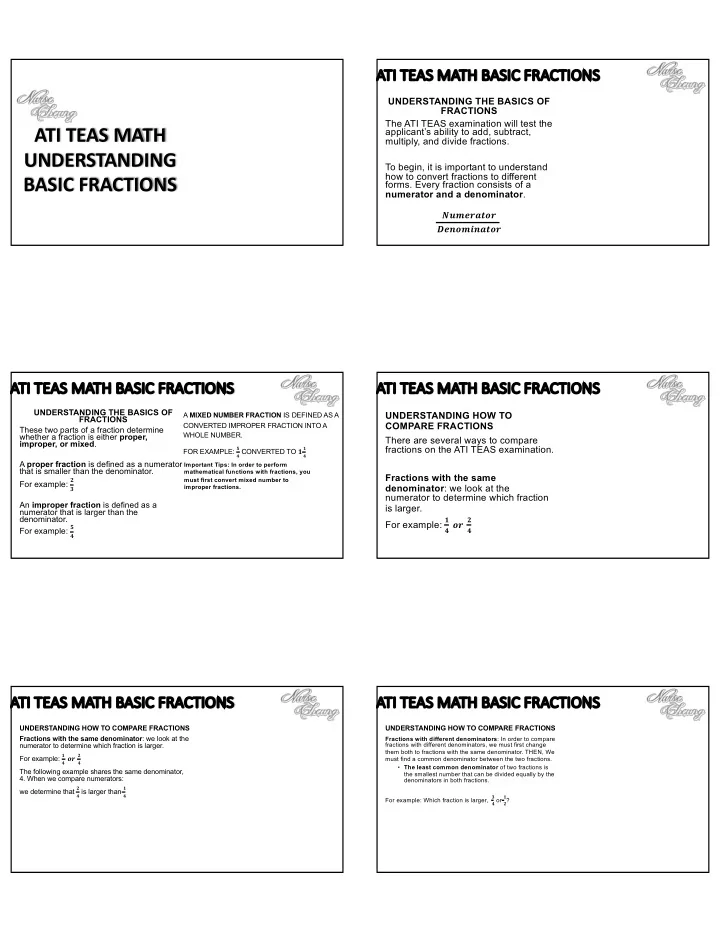
AT ATI TEAS MAT ATH BA BASIC FRACTIONS UNDERSTANDING THE BASICS OF FRACTIONS The ATI TEAS examination will test the ATI TEAS MATH applicants ability to add, subtract, multiply, and divide fractions. UNDERSTANDING To begin, it is


slide-1
SLIDE 1

ATI TEAS MATH UNDERSTANDING BASIC FRACTIONS

AT ATI TEAS MAT ATH BA BASIC FRACTIONS

UNDERSTANDING THE BASICS OF FRACTIONS The ATI TEAS examination will test the applicant’s ability to add, subtract, multiply, and divide fractions. To begin, it is important to understand how to convert fractions to different

  • forms. Every fraction consists of a

numerator and a denominator. !"#$%&'(% )$*(#+*&'(%

AT ATI TEAS MAT ATH BA BASIC FRACTIONS

UNDERSTANDING THE BASICS OF FRACTIONS These two parts of a fraction determine whether a fraction is either proper, improper, or mixed. A proper fraction is defined as a numerator that is smaller than the denominator. For example:

! "

An improper fraction is defined as a numerator that is larger than the denominator. For example:

# $ Important Tips: In order to perform mathematical functions with fractions, you must first convert mixed number to improper fractions.

A MIXED NUMBER FRACTION IS DEFINED AS A CONVERTED IMPROPER FRACTION INTO A WHOLE NUMBER. FOR EXAMPLE:

# $ CONVERTED TO % % $

AT ATI TEAS MAT ATH BA BASIC FRACTIONS

UNDERSTANDING HOW TO COMPARE FRACTIONS There are several ways to compare fractions on the ATI TEAS examination. Fractions with the same denominator: we look at the numerator to determine which fraction is larger. For example:

! " #$ % "

AT ATI TEAS MAT ATH BA BASIC FRACTIONS

UNDERSTANDING HOW TO COMPARE FRACTIONS Fractions with the same denominator: we look at the numerator to determine which fraction is larger. For example:

! " #$ % "

The following example shares the same denominator,

  • 4. When we compare numerators:

we determine that

% " is larger than ! "

AT ATI TEAS MAT ATH BA BASIC FRACTIONS

UNDERSTANDING HOW TO COMPARE FRACTIONS

Fractions with different denominators: In order to compare fractions with different denominators, we must first change them both to fractions with the same denominator. THEN, We must find a common denominator between the two fractions.

  • The least common denominator of two fractions is

the smallest number that can be divided equally by the denominators in both fractions. For example: Which fraction is larger, !

" or # $?

slide-2
SLIDE 2

AT ATI TEAS MAT ATH BA BASIC FRACTIONS

UNDERSTANDING HOW TO COMPARE FRACTIONS

Fractions with different denominators For example: Which fraction is larger, !

" or # $?

The least common denominator in this equation is 4. We know this because 4 can be divided by both 4 and 2. We begin by converting the second fraction over 4. # $ = " # $ & $ $ = $ "

AT ATI TEAS MAT ATH BA BASIC FRACTIONS

UNDERSTANDING HOW TO COMPARE FRACTIONS

Fractions with different denominators For example: Which fraction is larger, !

" or # $?

# $ = " # $ & $ $ = $ " Once the fractions are converted, we can determine that !

" is

larger than $

".

AT ATI TEAS MAT ATH BA BASIC FRACTIONS

UNDERSTANDING HOW TO PERFORM ADDITION WITH FRACTIONS Fractions with the same denominator: SIMPLY add the numerators together. ! " + ! " = " " = !

AT ATI TEAS MAT ATH BA BASIC FRACTIONS

UNDERSTANDING HOW TO PERFORM ADDITION WITH FRACTIONS

Fractions with the different denominators: You must first convert the fractions to fractions with the same denominator.

! " + $ %

We cannot SIMPLY add the numerators since the denominators are different. We must first find the least common denominator. The smallest number that can be divided by both 4 and 2 is 4.

AT ATI TEAS MAT ATH BA BASIC FRACTIONS

UNDERSTANDING HOW TO PERFORM ADDITION WITH FRACTIONS

First, we must convert one of the fractions with 4 as the denominator: ! " # " " = " %

Next, we can add the numerators:

& % + " % = ( % (improper fraction) or 1 ! %

(Mixed Number)

AT ATI TEAS MAT ATH BA BASIC FRACTIONS

UNDERSTANDING HOW TO PERFORM SUBTRACTION WITH FRACTIONS Fractions with the same denominator: SIMPLY subtract the numerators. ! " − $ " = & "

slide-3
SLIDE 3

AT ATI TEAS MAT ATH BA BASIC FRACTIONS

UNDERSTANDING HOW TO PERFORM SUBTRACTION WITH FRACTIONS

Fractions with the different denominators: You must first convert the fractions to fractions with the same denominator. ! " − $ % We cannot SIMPLY subtract the numerators since the denominators are different. We must first find the least common denominator. The smallest number that can be divided by both 4 and 2 is 4. $ % & % % = % "

AT ATI TEAS MAT ATH BA BASIC FRACTIONS

UNDERSTANDING HOW TO PERFORM SUBTRACTION WITH FRACTIONS

Fractions with the different denominators: Next, we can subtract the numerators:

! " − $ " = & " (proper fraction)

AT ATI TEAS MAT ATH BA BASIC FRACTIONS

UNDERSTANDING HOW TO PERFORM MULTIPLICATION WITH FRACTIONS Unlike addition and subtraction fractions, multiplication fractions are comparatively simple. This is because you no longer need to convert fractions, even if the denominators are different. SIMPLIFY the following expression:

! " # $ %

AT ATI TEAS MAT ATH BA BASIC FRACTIONS

UNDERSTANDING HOW TO PERFORM MULTIPLICATION WITH FRACTIONS SIMPLIFY the following expression: !

" # $ %

The following fractions have different denominators, but this does not matter when multiplying fractions. We can SimpLy multiply them together to get the result. ! " # $ % = ! # $ " # % = $ '( The correct answer $

'(.

AT ATI TEAS MAT ATH BA BASIC FRACTIONS

UNDERSTANDING HOW TO PERFORM DIVISION WITH FRACTIONS

Dividing fractions is faintly more complicated than multiplying

  • fractions. To divide fractions, you must first turn the fraction

from division into multiplication. Then, multiple as shown previously. Simplify the following expression: !

" ÷ $ %

AT ATI TEAS MAT ATH BA BASIC FRACTIONS

UNDERSTANDING HOW TO PERFORM DIVISION WITH FRACTIONS

Simplify the following expression: !

" ÷ $ %

When dividing fractions, you must turn the divisor upside down and then you can multiple the divisor by the remaining fraction. The divisor is the fraction that is being divided by the first fraction.

$ % = % $ divisor flipped upside down

slide-4
SLIDE 4

AT ATI TEAS MAT ATH BA BASIC FRACTIONS

UNDERSTANDING HOW TO PERFORM DIVISION WITH FRACTIONS

Simplify the following expression: !

" ÷ $ %

Now multiply the fraction ! " & % $ = ! & % " & $ = % () The correct answer is

% ().

This can be reduced to

* !).