
SLIDE 1
ICS3U
- Mr. Emmell
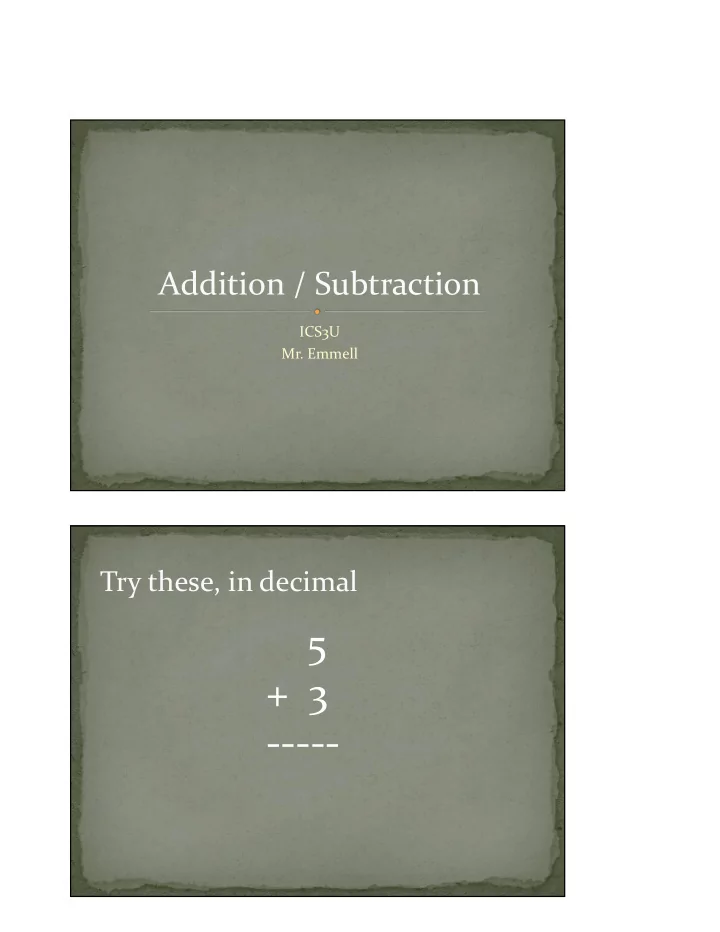
5 + 3 ----- Try these, in decimal 5 + 3 ----- 8 Try these, - - PDF document
Addition / Subtraction ICS3U Mr. Emmell Try these, in decimal 5 + 3 ----- Try these, in decimal 5 + 3 ----- 8 Try these, in decimal 8 + 4 ----- Try these, in decimal 8 + 4 ----- 1 2 How did you do that? When one column
ICS3U
When one column overflowed…. It incremented the next column
When one column… tried to have a higher value than our number system allowed!
Then you
That’s too much This is base 8 so… 10 – 8 = 2
In decimal, this is: 9 + 10 = 19
Good news! We can’t… Not really. We need to learn about complements first
If it is 11:00 now, then three hours later it will be 2:00
Consider a 12 hour clock.
Similarly, if it is 1:00, then 4 hours ago it was 9 since
Notice that subtracting 4 hours on the clock is the same as adding 8 hours (12 – 4). In particular, we could have computed it as follows:
Use an 8-bit number as an example Those numbers range from 0-255 If we have 255 and add one, then we get zero because it ‘cycles back’.
How do we find the complement for a number in binary? We know that 200 – 50 is the same as 200 + (255-50) (Because we roll over after 255!)
⚫ Define how many bits you are using! 8-bit?
⚫ Always need to have leading zeroes.
⚫ Invert all the bits ⚫ Add one ⚫ BOOM – Two’s complement. Add normally
using binary addition.
Remember! 8-bits What about -58?
2 100 2 50 0 2 25 0 2 12 1 2 6 0 2 3 0 2 1 1 0 1
Remember! 8-bits What about -58?
2 58 2 29 0 2 14 1 2 7 0 2 3 1 2 1 1 0 1
//FLIP
If there is a leading one, we drop it (remember! 8-bits) Answer = 001010102