Quantization of Spatial (Orbital) Angular Momentum of Electrons in - - PowerPoint PPT Presentation

quantization of spatial orbital angular momentum of
SMART_READER_LITE
LIVE PREVIEW

Quantization of Spatial (Orbital) Angular Momentum of Electrons in - - PowerPoint PPT Presentation

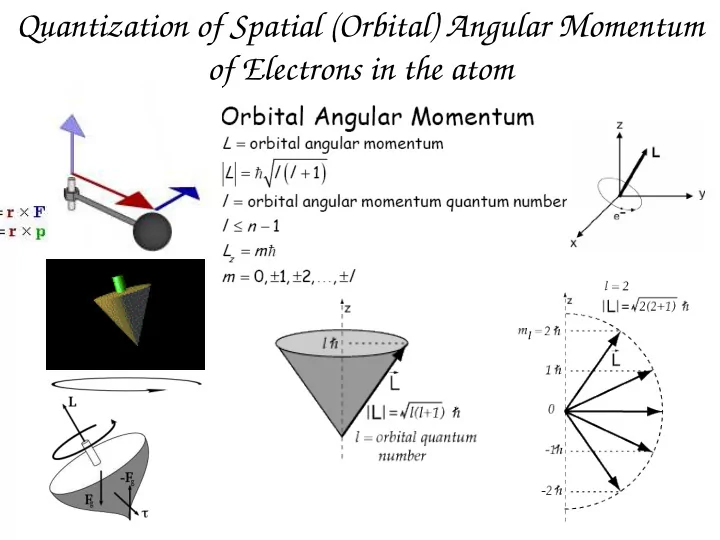
Quantization of Spatial (Orbital) Angular Momentum of Electrons in the atom Na/Ag atoms: ns1: l=0: Zero Orbital Momentum For 1S electrons If electrons are classical, "spinning" particles, then distribution of their spin If electrons


slide-1
SLIDE 1

Quantization of Spatial (Orbital) Angular Momentum

  • f Electrons in the atom
slide-2
SLIDE 2

Na/Ag atoms: ns1: l=0: Zero Orbital Momentum For 1S electrons

If electrons are classical, "spinning" particles, then distribution of their spin If electrons are classical, "spinning" particles, then distribution of their spin angular momentum vectors is taken to be truly random and each particle would angular momentum vectors is taken to be truly random and each particle would be deflected up or down by a different amount, producing an even distribution. be deflected up or down by a different amount, producing an even distribution. But electrons are deflected either up or down by a specific amount. But electrons are deflected either up or down by a specific amount.

slide-3
SLIDE 3

Intrinsic angular momentum or “Spin” of an electron is quantized

This can only mean that spin angular momentum is quantized!!!

Electrons are spin­1∕2 particles. Only two possible spin angular momentum, referred to as “spin­up” (or α) and “spin­down” (or β). The exact value in the z direction is ms= +ħ/2 or −ħ/2. If this value arises as a result of the rotating particles, then they would have to be spinning impossibly fast Spin S(ω); ω is unknown (internal) coordinate (NON­CLASSICAL)

slide-4
SLIDE 4

Implication of “Spin” on Hydrogen 1­e wavefunctions: Spin Orbitals

Introduction of spin results in the 4th quantum number For each electron: 3 spatial, and one for spin (4 th coordinate)

Introduce a “spin” component to each of the 1e WFs along with spatial components. This doubles the degeneracy of each level in hydrogenic atoms. 1e WFs with the inclusion of spin are now called SPIN ORBITALS.

slide-5
SLIDE 5

2e’ Spin­orbitals: Indistinguishability

Wavefunctions must reflect the indistinguishability of electrons: No known experiments can differentiate between two electrons in the same spatial orbital; No

  • bservables of the system can change if coordinates of the two electrons are

interchanged.

µ µ [

]

2 2

( ) (1,2) (2,1) (1,2) (2,1) (1,2) Indistinguishibility Exchange of coordinates ℜ

Ψ = Ψ ⇒ ℜ Ψ ≡ Ψ = ±Ψ

:

(1) (2) (1) (2) α α β β (1) (2) (1) (2) α β β α

Two­Electron Spin Functions for a pair of electrons in 1s (spatial orbital)?

[ ] [ ] [ ]

(1) (2) (2) (1) (1) (2) α α α α α α ℜ = = +

[ ] [ ] [ ]

(1) (2) (2) (1) (1) (2) α β α β α β ℜ = ±

slide-6
SLIDE 6

Acceptable Spin Wavefunctions

(1) (2) (1) (2) α α β β

(1) (2) (1) (2) ( ) (1) (2) (1) (2) (1) (2) (1) (2)

  • ( )

symmetric even f n anti symmetric

  • dd f n

α α β β α β β α α β β α     −     +   − −

[ ] [ ] [ ] [ ] [ ] [ ]

(1) (2) (1) (2) (2) (1) (2) (1) (1) (2) (1) (2) (1) (2) (1) (2) (2) (1) (2) (1) (1) (2) (1) (2) α β β α α β β α α β β α α β β α α β β α α β β α + = + ≡ + − = − ≡ − +

ℜ ℜ

(1) (2) (1) (2)? What about α β β α ±

Both α(1)β(2) and α(2)β(1) distinguishes between electrons – CAN NOT BE ACCEPTABLE Spin functions

(1) (2) (1) (2) α β β α ⊗ ⊗

slide-7
SLIDE 7

Postulate 6: Complete wavefunctions describing a Many­electron system must be antisymmetric under the exchange of coordinates of any two electrons.

6th Postulate in Quantum Mechanics

Complete wavefunction (spatial and spin) of system of identical fermions (electrons) must be anti­symmetric with respect to interchange of the coordinates (spatial and spin) of any two particles. (Pauli’s) Exclusion Principle: Independently derived by Dirac and Heisenberg