SLIDE 1
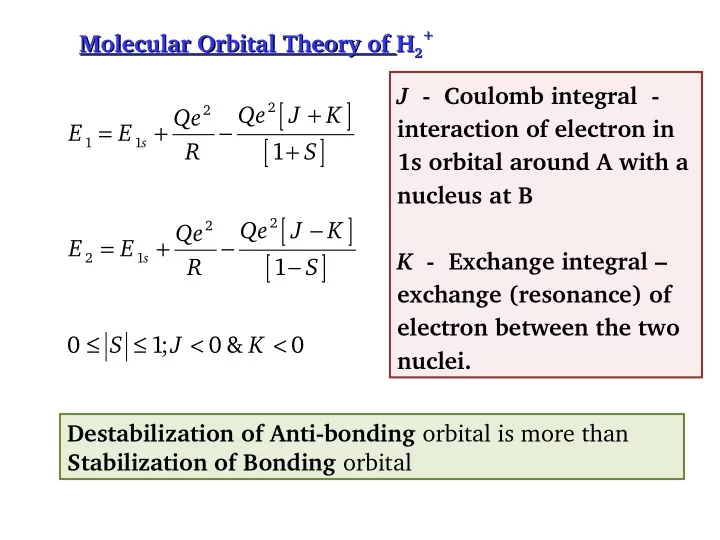
Molecular Orbital Theory of Molecular Orbital Theory of H H2
2 + +
[ ] [ ] [ ] [ ]
+ = + − + − = + − − ≤ ≤ < <
2 2 1 1 2 2 2 1
1 1 1 ; 0 &
s s
Qe J K Qe E E R S Qe J K Qe E E R S S J K Destabilization of Anti-bonding orbital is more than Stabilization of Bonding orbital J - Coulomb integral - interaction of electron in 1s orbital around A with a nucleus at B K - Exchange integral – exchange (resonance) of electron between the two nuclei.
SLIDE 2 Molecular Orbital Theory of Molecular Orbital Theory of H H2
2 + +
E1
1
E2
SLIDE 3
Molecular Orbital Theory of Molecular Orbital Theory of H H2
2
µ (
) = −
∇ − ∇ − ∇ − ∇ − − − + + h h h h
2 2 2 2 2 2 2 2 2 1 2 2 2 2 2 2 2 1 1 2 2 12
2 2 2 2
A B e e A B e e A B A B
H H m m m m e e e e e e Q Q Q Q Q Q r r r r r R
µ (
)
µ (
)
µ (
)
µ (
)
µ (
)
= − ∇ − ∇ − − − + + = − ∇ + − ∇ + − + + = + − − + + h h h h
2 2 2 2 2 2 2 2 2 2 2 1 2 1 1 2 2 12 2 2 2 2 2 2 2 2 2 2 2 1 2 1 2 1 2 12 2 2 2 2 2 1 2 1 2 12
2 2 2 2
e e e e A B A B e e e A e B B A e e B A
e e e e e e H H Q Q Q Q Q Q m m r r r r r R e e e e e e H H Q Q Q Q Q Q m r m r r r r R e e e e H H H H H H Q Q Q Q r r r R
ignore
Cannot be Solved
SLIDE 4 Molecular Orbital Theory of Molecular Orbital Theory of H H2
2
[ ]
( ) ψ ψ φ φ = = + +
1 1 1
1 2 2
A B
bonding s s
S
Place the second electron in the bonding orbital to get H2
[ ]
( )
[ ]
( )
[ ]
ψ ψ ψ φ φ φ φ α β β α = × = + × + − + +
2 1 2 1 1 2 2 1 1 1 1
( ) 1 1 1 (1) (2) (1) (2) 2 2 2 2 2
A B A B
bonding s s s s
H S S
SLIDE 5 Molecular Orbital Theory of Molecular Orbital Theory of H H2
2
[ ] (
) ( )
[ ]
ψ φ φ φ φ α β β α = + × + − +
2 1 1 2 2 1 1 1 1
( ) 1 1 (1) (2) (1) (2) 2 1 2
A B A B
bonding s s s s
H S
[ ] [ ] [ ]
ψ φ φ φ φ φ φ φ φ = + + + + × + × + × + × +
1 2 1 2 1 2 1 2 1 1 1 1 1 1 1 1
1 2 1 1 1 (1) 1 (2) 1 (1) 1 (2) 1 (1) 1 (2) 1 (1) 1 (2) 2 1
A A B B A B B A
bonding s s s s s s s s A A B B A B B A
S s s s s s s s s S
Spatial Part
SLIDE 6 Molecular Orbital Theory of Molecular Orbital Theory of H H2
2
[ ] (
) ( )
[ ]
ψ φ φ φ φ α β β α
−
= − × − − −
2 1 1 2 2 1 1 1 1
( ) 1 1 (1) (2) (1) (2) 2 1 2
A B A B
anti bonding s s s s
H S
[ ] [ ] [ ]
ψ φ φ φ φ φ φ φ φ
−
= + − − − × + × − × − × −
1 2 1 2 1 2 1 2 1 1 1 1 1 1 1 1
1 2 1 1 1 (1) 1 (2) 1 (1) 1 (2) 1 (1) 1 (2) 1 (1) 1 (2) 2 1
A A B B A B B A
anti bonding s s s s s s s s A A B B A B B A
S s s s s s s s s S
Spatial Part
SLIDE 7 Molecular Orbital Theory of Molecular Orbital Theory of H H2
2
[ ] [ ] [ ]
ψ φ φ φ φ φ φ φ φ = + + + + × + × + × + × +
1 2 1 2 1 2 1 2 1 1 1 1 1 1 1 1
1 2 1 1 1 (1) 1 (2) 1 (1) 1 (2) 1 (1) 1 (2) 1 (1) 1 (2) 2 1
A A B B A B B A
bonding s s s s s s s s A A B B A B B A
S s s s s s s s s S
[ ] [ ] [ ]
ψ φ φ φ φ φ φ φ φ
−
= + − − − × + × − × − × −
1 2 1 2 1 2 1 2 1 1 1 1 1 1 1 1
1 2 1 1 1 (1) 1 (2) 1 (1) 1 (2) 1 (1) 1 (2) 1 (1) 1 (2) 2 1
A A B B A B B A
anti bonding s s s s s s s s A A B B A B B A
S s s s s s s s s S
SLIDE 8
Molecular Orbital Theory of Molecular Orbital Theory of H H2
2
Effective nuclear charge changes the absolute energy Levels and the size of orbitals! Matching of energies of AOs important for LCAO-MO If energies are not close to each other, they would Not interact to form MOs.
SLIDE 9
Diatoms of First Row: Diatoms of First Row: H H2
2 + +, H
, H2
2 ,He
,He2
2, He
, He2
2 + +
SLIDE 10
Molecular Orbital Theory of Molecular Orbital Theory of H H2
2
Effective nuclear charge changes the absolute energy levels and the size of orbitals! Matching of energies of AOs important for LCAO-MO, if the energies of two Aos are not close they will not interact to form MOs.
SLIDE 11
Matching of AO energies for MO Matching of AO energies for MO Due to large difference in energy of 1s(H) and 1s(F), LCAO-MO for both 1S is not feasible in HF. Rather, 2pz(F) and 1s(H) form a sigma bond. Both symmetry and energy Matching is required for MO. Valence electrons are most important
SLIDE 12
Bonding in First-Row Homo-Diatomic Molecules Bonding in First-Row Homo-Diatomic Molecules 1s 2s 2p 1s 2s 2p The orbital energies of the two approaching atoms are identical before they start interacting to form a BOND
SLIDE 13
Bonding in First-Row Homo-Diatomic Molecules Bonding in First-Row Homo-Diatomic Molecules 1s 2s 2p 1s 2s 2p 1σ 1σ* 2σ 2σ* 3σ 3σ* 1π 1π* The interaction between the energy and symmetry matched orbitals leads to various types of BONDs
SLIDE 14
MO Energies of Dinitrogen MO Energies of Dinitrogen Experiments tell us this picture is incorrect!
SLIDE 15 Bonding in First-Row Homo-Diatomic Molecules Bonding in First-Row Homo-Diatomic Molecules 1s 2s 2p 1s 2s 2p The 2s and 2p orbitals are degenerate in Hydrogen. However in the many electron atoms these two sets of
- rbitals are no longer degenerate.
SLIDE 16
Bonding in First-Row Homo-Diatomic Molecules Bonding in First-Row Homo-Diatomic Molecules 1s 2s 2p 1s 2s 2p The difference in the energies of the 2s and 2p orbitals increases along the period. Its is minimum for Li and maximum for Ne
SLIDE 17
MO Energies of Dinitrogen MO Energies of Dinitrogen
Mixing of 2s and 2p orbital occur because of small energy gap between them 2s and 2p electrons feels not so different nuclear charge. Note how the MO of 2s→σ have p-type looks, while π-levels are clean
SLIDE 18
s-p Mixing: Hybridization of MO s-p Mixing: Hybridization of MO Mixing of 2s and 2p orbital occur because of small energy gap between them 2s and 2p electrons feels not so different nuclear charge
SLIDE 19
s-p Mixing: Hybridization of MO s-p Mixing: Hybridization of MO B2 is paramagnetic. This can only happen if the two electrons with parallel spin are placed in the degenerate π-orbitals and if π orbitals are energetically lower than the σ orbital Incorrect!
SLIDE 20
MO diagram of F MO diagram of F2
2: No s-p Mixing
: No s-p Mixing No Mixing of s and p orbital because of higher energy Gap between 2s and 2p levels in Oxygen and Fluorine! 2s and 2p electrons feels very different nuclear charge
SLIDE 21
MO Energy Level Diagram for Homo-Diatomics MO Energy Level Diagram for Homo-Diatomics Upto N2 Beyond N2
SLIDE 22
Bond-Order and Other Properties Bond-Order and Other Properties N2 : (1σg)
2 (1σ*u) 2 (2σg) 2 (2σ*u) 2 (1πux) 2 (1πuy) 2 (3σg) 2
BO = 3 All spins paired: diamagnetic O2 : (1σg)
2 (1σ*u) 2 (2σg) 2 (2σ*u) 2 (3σg) 2 (1πux) 2 (1πuy) 2 (1πux) 1
(1π*uy)
1
BO = 2 2 spins unpaired: paramagnetic
SLIDE 23
MO Contours and Electron Density MO Contours and Electron Density
SLIDE 24 Hetero-Diatomics: HF Hetero-Diatomics: HF Due to higher electronegativity
distribution is lopsided
SLIDE 25
Hetero-Diatomics: CO Hetero-Diatomics: CO
SLIDE 26
Hybridization Hybridization Linear combination of atomic orbitals within an atom leading to more effective bonding 2s 2pz 2px 2py 2px 2py α 2s-β 2pz α 2s+β 2pz The coefficients α and β depend on field strength
Hybridization is close to VBT approach. Use of experimental information All hybridized orbitals are equivalent and are ortho-normal to each other