Economics 2 Professor Christina Romer Spring 2019 Professor David - - PDF document

economics 2 professor christina romer spring 2019
SMART_READER_LITE
LIVE PREVIEW

Economics 2 Professor Christina Romer Spring 2019 Professor David - - PDF document

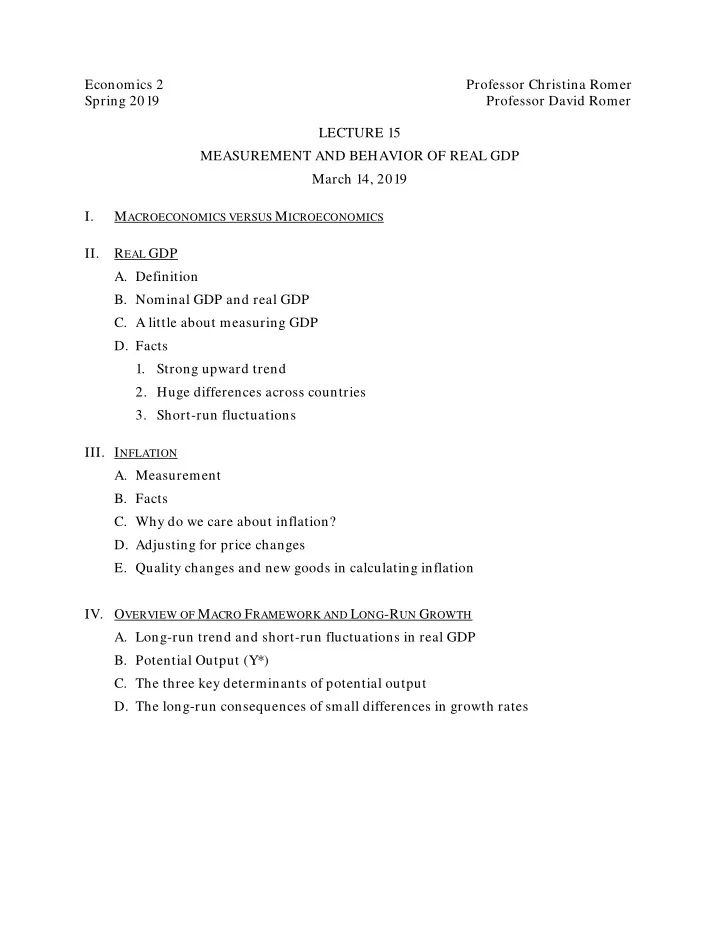
Economics 2 Professor Christina Romer Spring 2019 Professor David Romer LECTURE 15 MEASUREMENT AND BEHAVIOR OF REAL GDP March 14, 2019 I. M ACROECONOMICS VERSUS M ICROECONOMICS II. R EAL GDP A. Definition B. Nominal GDP and real GDP C. A


slide-1
SLIDE 1

Economics 2 Professor Christina Romer Spring 2019 Professor David Romer LECTURE 15 MEASUREMENT AND BEHAVIOR OF REAL GDP March 14, 2019 I. MACROECONOMICS VERSUS MICROECONOMICS

  • II. REAL GDP
  • A. Definition
  • B. Nominal GDP and real GDP
  • C. A little about measuring GDP
  • D. Facts
  • 1. Strong upward trend
  • 2. Huge differences across countries
  • 3. Short-run fluctuations
  • III. INFLATION
  • A. Measurement
  • B. Facts
  • C. Why do we care about inflation?
  • D. Adjusting for price changes
  • E. Quality changes and new goods in calculating inflation
  • IV. OVERVIEW OF MACRO FRAMEWORK AND LONG-RUN GROWTH
  • A. Long-run trend and short-run fluctuations in real GDP
  • B. Potential Output (Y*)
  • C. The three key determinants of potential output
  • D. The long-run consequences of small differences in growth rates
slide-2
SLIDE 2

LECTURE 15

Measurement and Behavior of Real GDP

March 14, 2019

Economics 2 Christina Romer Spring 2019 David Romer

slide-3
SLIDE 3

Announcements

  • Research reading for Tuesday, March 19 (by

William Nordhaus):

  • Read only the assigned pages.
  • Read for approach and findings; think about

relevance for the measurement of inflation and growth in standards of living.

slide-4
SLIDE 4
  • I. MACROECONOMICS VERSUS MICROECONOMICS
slide-5
SLIDE 5

Macroeconomics

  • Definition:
  • The study of the aggregate economy.
  • Concerned with:
  • Total output.
  • Aggregate price level and inflation.
  • The unemployment rate.
  • The overall level of interest rates; the

exchange rate; overall exports and imports.

slide-6
SLIDE 6
  • II. REAL GDP
slide-7
SLIDE 7

Real Gross Domestic Product (Real GDP)

  • The market value of the final goods and services

newly produced in a country during some period

  • f time, adjusted for price changes.
slide-8
SLIDE 8

Economists’ Definition of “Real”

  • Measured in terms of goods and services, rather

than dollars.

  • Equivalently: Adjusted for changes in prices.
  • In contrast, “nominal” means measured in terms
  • f dollars.
slide-9
SLIDE 9

Nominal GDP

  • Nominal GDP: The market value of the final goods

and services newly produced in a country during some period of time, not adjusted for price changes.

  • Thus, for the United States, it is measured in dollars.
  • Example:
  • Note that we use 2018 prices in computing 2018

nominal GDP, 2017 prices in computing 2017 nominal GDP, ….

slide-10
SLIDE 10

Calculating Real GDP

  • Choose a base year (for example, 2012), and

always use prices from the base year to multiply the quantities.

  • Example:
  • That is, if 2012 is the base year, 2018 real GDP is

the answer to the question, “How much would all the final goods and services newly produced in the United States in 2018 have been worth at 2012 prices?”

slide-11
SLIDE 11

Growth Rate of Real GDP

  • The percentage change in real GDP from one year

to the next.

  • Note: The percentage change in some variable, X,

from period t − 1 to period t is defined as: Xt − Xt−1 Xt

  • 100.
slide-12
SLIDE 12

A Little about Measuring GDP

  • Key points:
  • Final goods and services.
  • Newly produced.
  • Within the country.
  • In some period of time.
slide-13
SLIDE 13

3 Approaches to Measuring GDP

  • Expenditure: Use market prices and the quantities of

final goods.

  • Can divide into consumption (C), investment (I),

government purchases (G), and net exports (NX).

  • Production (value added): follow goods through each

stage of production.

  • Income: Income from producing new goods and

services within the country.

  • Can divide into labor income and capital

income.

slide-14
SLIDE 14

Real GDP in the United States, 1950–2018

Source: FRED (Federal Reserve Economic Data); data from Bureau of Economic Analysis.

slide-15
SLIDE 15

Real GDP per Capita in the U.S., 1950–2018

Source: FRED; data from Bureau of Economic Analysis.

slide-16
SLIDE 16

Real GDP per Capita over Time and Regions

Source: Bloom and Sachs, “Geography, Demography, and Economic Growth in Africa.”

slide-17
SLIDE 17

U.S. Real GDP, 2004–2011

Source: FRED; data from Bureau of Economic Analysis.

slide-18
SLIDE 18

U.S. Real GDP, 1929–1940

Source: FRED; data from Bureau of Economic Analysis.

slide-19
SLIDE 19

U.S. Real GDP, 2011–2018

Source: FRED; data from Bureau of Economic Analysis.

slide-20
SLIDE 20

The U.S. Unemployment Rate, 1948–2019

Source: FRED; data from Bureau of Labor Statistics.

slide-21
SLIDE 21
  • III. INFLATION
slide-22
SLIDE 22

Calculating the Consumer Price Index

  • Choose a base year (for example, 1983), and find the

basket of goods and services households purchased in 1983.

  • Then the CPI in 2018 is:
  • That is, if 1983 is the base year, the 2018 CPI is the

answer to the question, “By what ratio would households’ spending have to be higher in 2018 than it was in 1983 for them to buy the same things they bought in 1983?”

slide-23
SLIDE 23

Calculating the Consumer Price Index— Algebra

  • Choose a base year (for example, 1983), and

always use quantities from the base year to multiply the prices.

  • Then the CPI in 2018 is:
slide-24
SLIDE 24

Inflation

  • The percent change in a price index.
  • Example: the inflation rate from 2017 to 2018 is:
  • Note: If inflation is negative, we say there is

“deflation.”

slide-25
SLIDE 25

U.S. Inflation (Percent Change in the Price Index for Personal Consumption Expenditures), 1953–2018

Source: FRED; data from Bureau of Economic Analysis.

slide-26
SLIDE 26

U.S. Inflation (Percent Change in the Price Index for Personal Consumption Expenditures), 1930–1933

Source: FRED; data from Bureau of Economic Analysis.

slide-27
SLIDE 27

Why Do We Care about Inflation?

slide-28
SLIDE 28

Adjusting Variables for Price Changes – Example

  • Example: What was Richard Nixon’s final salary

equivalent to in today’s dollars?

  • His salary was $200,000; the CPI in August

1974 was 49.9; the CPI now is 253.1. Thus, $X•(PA/PB) is:

slide-29
SLIDE 29

Quality Changes and New Goods in Calculating Inflation

  • If the quality of a good improves and its price

rises, we try to take out the part of the price increase that is due to the quality improvement (and count only the remainder in calculating inflation).

  • If there are new goods, we try to account for the

fact that they give households a new way of

  • btaining utility.
slide-30
SLIDE 30

Quality Changes, New Goods, and Real GDP

  • We can think of real GDP as nominal GDP divided by a

price index:

  • If 2012 is the base year, define:

GDP Price Indext = ∑ P

i,t • Qi,t i

∑ P

i,2012 • Qi,t i

. (∗)

  • Then our earlier definition of real GDP implies:

Real GDP

t =

Nominal GDP

t

GDP Price Indext .

  • In practice, rather than using a simple price index like

(*), we use a price index that tries to account for quality changes and new goods.

slide-31
SLIDE 31
  • IV. OVERVIEW OF MACRO FRAMEWORK AND LONG-

RUN GROWTH

slide-32
SLIDE 32

Two Key Topics of Macroeconomics

  • The long-run trend in output.
  • Short-run fluctuations (booms and recessions).
slide-33
SLIDE 33

Real GDP in the United States, 1950–2018

Source: FRED (Federal Reserve Economic Data); data from Bureau of Economic Analysis.

slide-34
SLIDE 34

In the Long Run, Output Is Determined by the Economy’s Available Resources

  • Although recessions can cause resource use to be

lower than normal, the economy does not remain depressed forever.

  • Potential output (Y*): The amount of output that

the economy produces when using its resources at normal rates.

  • A better name for potential output might be

“normal output.”

slide-35
SLIDE 35

The Three Key Determinants of Potential Output

  • Labor
  • Capital
  • Technology
slide-36
SLIDE 36

Issues Relating to Potential Output

  • The level of potential output per person.
  • This is an indicator of standards of living.
  • Why is potential output per person so much

higher in some countries than in others?

  • The growth rate of potential output per person
  • ver time.
  • Small differences in normal growth can have

large impacts on standards of living over time.

slide-37
SLIDE 37

The Long-Run Consequences of Small Differences in Growth Rates

  • Suppose countries A and B start with the same

real income per capita.

  • But annual growth in real income per capita is 1

percentage point higher in A than in B (for example, 1% vs. 0, or 2% vs. 1%).

slide-38
SLIDE 38

Real Income per Capita in Country A Relative to Country B

  • After 1 year:
  • After 2 years:
  • After 70 years:
  • After 2 centuries:
slide-39
SLIDE 39

In the Short Run, Output Does Not Depend Just on the Economy’s Available Resources

  • “Aggregate demand”—the total amount that

people in the economy want to spend—plays a crucial role.

  • We’ll discuss not only what determines output in

the short run, but also fiscal and monetary policy, interest rates, inflation, and interactions between economies at the aggregate level (exchange rates and the trade deficit or surplus).