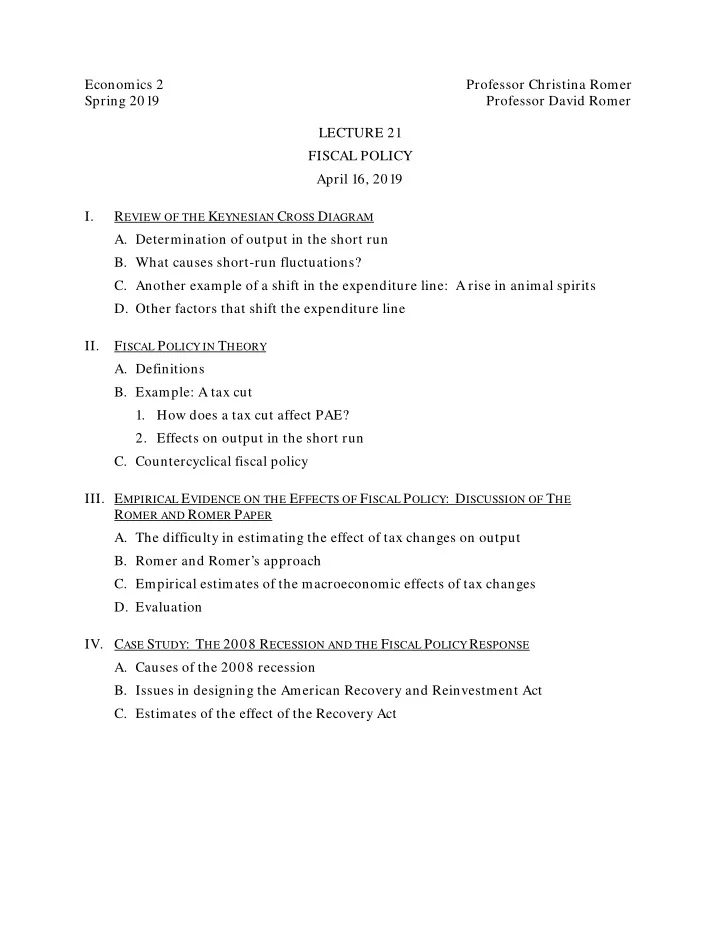
SLIDE 1 Economics 2 Professor Christina Romer Spring 2019 Professor David Romer LECTURE 21 FISCAL POLICY April 16, 2019 I. REVIEW OF THE KEYNESIAN CROSS DIAGRAM
- A. Determination of output in the short run
- B. What causes short-run fluctuations?
- C. Another example of a shift in the expenditure line: A rise in animal spirits
- D. Other factors that shift the expenditure line
- II. FISCAL POLICY IN THEORY
- A. Definitions
- B. Example: A tax cut
- 1. How does a tax cut affect PAE?
- 2. Effects on output in the short run
- C. Countercyclical fiscal policy
- III. EMPIRICAL EVIDENCE ON THE EFFECTS OF FISCAL POLICY: DISCUSSION OF THE
ROMER AND ROMER PAPER
- A. The difficulty in estimating the effect of tax changes on output
- B. Romer and Romer’s approach
- C. Empirical estimates of the macroeconomic effects of tax changes
- D. Evaluation
- IV. CASE STUDY: THE 2008 RECESSION AND THE FISCAL POLICY RESPONSE
- A. Causes of the 2008 recession
- B. Issues in designing the American Recovery and Reinvestment Act
- C. Estimates of the effect of the Recovery Act
SLIDE 2 LECTURE 21
Fiscal Policy
April 16, 2019
Economics 2 Christina Romer Spring 2019 David Romer
SLIDE 3 Announcements
- We have handed out Problem Set 5.
- It is due at the start of lecture on Thursday,
April 18th.
SLIDE 4
- I. REVIEW OF THE KEYNESIAN CROSS DIAGRAM
SLIDE 5 Determination of Short-Run Output
Y = PAE
- Y is output and PAE is planned aggregate
expenditure.
- Output responds to demand in the short run.
- Referred to as the 45-degree line.
SLIDE 6 Determination of Short-Run Output (Continued)
- Planned spending is a function of output:
PAE = C + Ip + G + NX
- Where C depends on positively on Y−T.
- Referred to as the expenditure line.
- Short-run output is determined by the
intersection of the 45-degree line and the expenditure line.
SLIDE 7
Determination of Short-Run Output
Y PAE
SLIDE 8 What Causes Short-Run Fluctuations?
- Anything that shifts the expenditure line will cause
- utput to change in the short run.
SLIDE 9 Example: A Rise in Animal Spirits
- Suppose that something causes firms throughout
the economy to raise their expectations of the future MRPK.
- This will make firms want to do more investment.
- This will shift up the expenditure line.
SLIDE 10
A Rise in Animal Spirits
Y PAE1 PAE Y=PAE Y*
SLIDE 11
What Shifts the Expenditure Line?
SLIDE 12 Two Types of Macroeconomic Policy
- Fiscal policy: Actions taken by the government to
change the budget surplus.
- Monetary policy: Actions taken by the central
bank to affect nominal and real interest rates.
SLIDE 13
- II. FISCAL POLICY IN THEORY
SLIDE 14 Fiscal Policy Terminology
- Government budget surplus:
- Tax revenues − Government purchases (T−G)
- Contractionary fiscal policy: Actions that increase
the government budget surplus.
- Will decrease PAE at a given level of Y.
- Expansionary fiscal policy: Actions that decrease
the government budget surplus.
- Will increase PAE at a given level of Y.
SLIDE 15 Federal Budget Surplus and the Bush Tax Cuts
Source: Congressional Budget Office.
1 2 3
1997 1998 1999 2000 2001 2002 2003 2004 2005 2006
Percent of GDP
SLIDE 16
Short-Run Effects of a Tax Cut
Y PAE1 PAE Y=PAE Y1 (Y*)
SLIDE 17
Substituting the Consumption Function into PAE C = C + c·(Y−T) PAE = C + Ip + G + NX = C + c·(Y−T) + Ip + G + NX = C + cY – cT + Ip + G + NX = (C – cT + Ip + G + NX) + cY
PAE Intercept Term
SLIDE 18
Combining the Effects of a Fall in Autonomous Consumption and a Tax Cut
Y PAE1 PAE Y=PAE Y*
SLIDE 19 Countercyclical Fiscal Policy
- Changes in the budget surplus (through changes in
taxes or government purchases) to try to counteract other factors likely to cause a short-run fluctuation.
SLIDE 20
- III. EMPIRICAL EVIDENCE ON THE EFFECTS OF FISCAL
POLICY: DISCUSSION OF THE ROMER AND ROMER PAPER
SLIDE 21
Difficulty in Estimating the Effect of Tax Changes
SLIDE 22
How do Romer and Romer try to deal with this difficulty?
SLIDE 23 Exogenous Tax Changes
Source: Romer and Romer, “The Macroeconomic Effects of Tax Changes.”
SLIDE 24
SLIDE 25 Specification
- ΔY is the percentage change in real GDP.
- ΔT is the new measure of exogenous tax changes
(as a percent of GDP).
- The regression estimates the relationship between
- utput growth and the contemporaneous and
lagged values of tax changes.
- We expect a negative relationship.
SLIDE 26 Baseline Estimates
Source: Romer and Romer, “The Macroeconomic Effects of Tax Changes.”
SLIDE 27 Evaluation
- Do you trust the narrative sources?
- Is narrative analysis reproducible?
- Does this approach deal with omitted variable bias
successfully?
SLIDE 28
- IV. CASE STUDY: THE 2008 RECESSION AND THE
FISCAL POLICY RESPONSE
SLIDE 29 House Prices, 1987–2015
Source: Federal Reserve Bank of St. Louis, FRED.
50 100 150 200 250
Jan-87 Jan-89 Jan-91 Jan-93 Jan-95 Jan-97 Jan-99 Jan-01 Jan-03 Jan-05 Jan-07 Jan-09 Jan-11 Jan-13 Jan-15
Case-Shiller House Price Index, January 2000 = 100
April 2006
SLIDE 30 Effects of the Housing Bubble
- Increased both Ip and C, so raised PAE relative to
what it otherwise would have been.
- Some debate among economists about whether
this increase in PAE counteracted other forces lowering PAE, or pushed Y above Y*.
- Large increase in household debt.
SLIDE 31 U.S. Household Debt
Source: Mian and Sufi, “Consumers and the Economy, Part II: Household Debt and the Weak U.S. Recovery.”
SLIDE 32
What happened when the bubble burst?
SLIDE 33 Single-Family Housing Starts
Source: Economic Report of the President, February 2010.
SLIDE 34 Source: http://www.housingviews.com.
SLIDE 35 Credit Spreads during the Financial Crisis
Source: Economic Report of the President, February 2010.
SLIDE 36 Stock Prices during the Financial Crisis
Source: Economic Report of the President, February 2010.
SLIDE 37 What happened to PAE in 2008?
- Decline in investment (particularly in housing)
- Housing bust reduced expected future MRPK
- f housing (which is a kind of capital).
- Financial crisis hurt animal spirits and made it
hard for firms to get credit.
- Decline in consumption
- Housing bust and stock market decline
destroyed wealth.
- Financial crisis hurt consumer confidence and
made it hard for households to get credit.
SLIDE 38
Effect of the Housing Bust and the Financial Crisis on Output
Y PAE1 PAE Y=PAE Y*
SLIDE 39 Percentage Change in Real GDP
Source: Federal Reserve Bank of St. Louis, FRED
0.0 2.0 4.0 6.0 8.0 10.0
2000-I 2001-I 2002-I 2003-I 2004-I 2005-I 2006-I 2007-I 2008-I 2009-I 2010-I 2011-I 2012-I 2013-I 2014-I 2015-I
Percent Change (at an Annual Rate)
SLIDE 40 Issues in Designing the 2009 Fiscal Stimulus
SLIDE 41 Issues in Designing the 2009 Fiscal Stimulus
- What should the composition be?
SLIDE 42 Fiscal Stimulus in the Recovery Act through August 2009
Source: CEA, “The Economic Impact of the ARRA of 2009, First Quarterly Report.”
SLIDE 43 Issues in Designing the 2009 Fiscal Stimulus
SLIDE 44
Effect of the Recovery Act on Output
Y PAE1 PAE Y=PAE Y* PAE2 Y2
SLIDE 45 Estimates of the Impact of the Recovery Act
Source: CBO, “Estimated Impact of the American Recovery and Reinvestment Act
- n Employment and Economic Output,” February 2011.