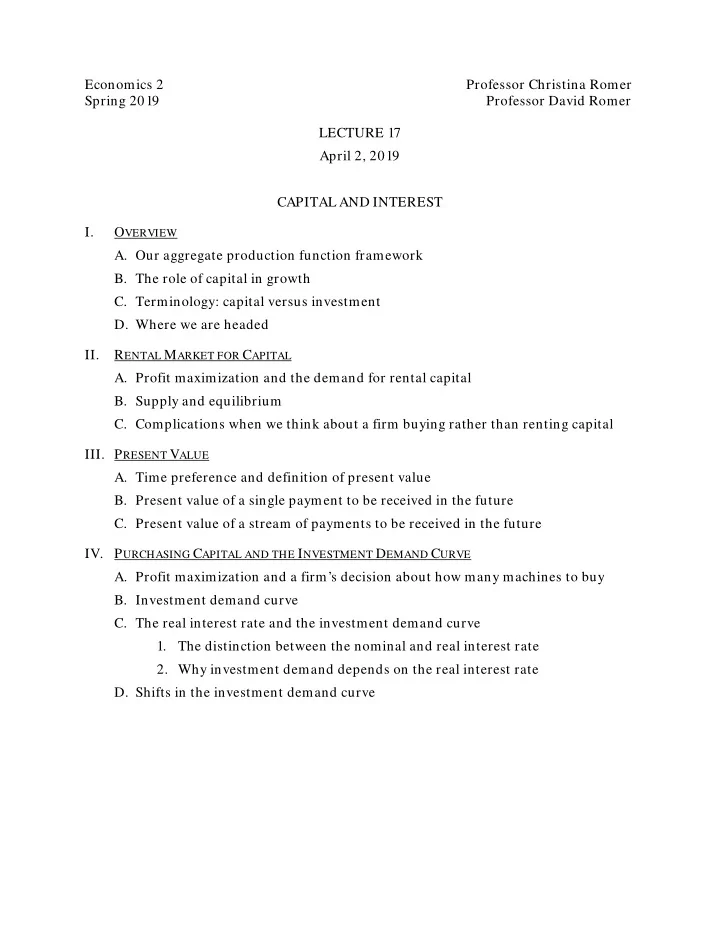
SLIDE 1 Economics 2 Professor Christina Romer Spring 2019 Professor David Romer LECTURE 17 April 2, 2019 CAPITAL AND INTEREST I. OVERVIEW
- A. Our aggregate production function framework
- B. The role of capital in growth
- C. Terminology: capital versus investment
- D. Where we are headed
- II. RENTAL MARKET FOR CAPITAL
- A. Profit maximization and the demand for rental capital
- B. Supply and equilibrium
- C. Complications when we think about a firm buying rather than renting capital
- III. PRESENT VALUE
- A. Time preference and definition of present value
- B. Present value of a single payment to be received in the future
- C. Present value of a stream of payments to be received in the future
- IV. PURCHASING CAPITAL AND THE INVESTMENT DEMAND CURVE
- A. Profit maximization and a firm’s decision about how many machines to buy
- B. Investment demand curve
- C. The real interest rate and the investment demand curve
- 1. The distinction between the nominal and real interest rate
- 2. Why investment demand depends on the real interest rate
- D. Shifts in the investment demand curve
SLIDE 2 LECTURE 18
Capital and Interest
April 2, 2019
Economics 2 Christina Romer Spring 2019 David Romer
SLIDE 3 Announcements
- You should have handed in Problem Set 4.
- Midterm 2:
- Tuesday, April 9th, 2:10–3:30.
- You do not need a blue book.
SLIDE 4 Announcements (continued)
- Midterm 2 Format: Similar to Midterm 1.
- Midterm 2 Coverage:
- Everything up to and including lecture on
Thursday, April 4 (Saving and Investment in the Long Run).
- Lecture, section, textbook, and additional
readings.
- There will be no questions solely about
material from before Midterm 1.
SLIDE 5 Announcements (continued)
- Hints for Studying:
- Start now!
- Review lecture notes and slides; study
problem set suggested answers.
- Pose yourself problems.
- Do the sample midterm by yourself.
SLIDE 6 Announcements (continued)
- Places to Get Help:
- Professor and GSI office hours.
- Review session: Friday, April 5, 6–8 p.m. in
the usual lecture room (2050 VLSB).
SLIDE 7 LECTURE 17
Employment and Unemployment in the Long Run (concluded)
Economics 2 Christina Romer Spring 2019 David Romer
SLIDE 8 Recall: Long-Run Labor Market Diagram
S D (MRPL/P) Real Wage, w* w1
∗
N* N1
∗
SLIDE 9 Recall: Long-Run Labor Market Diagram with a Wage Floor and Job Rationing
S D (MRPL/P) Real Wage,w* N* ND
∗ NS ∗
w
unemployment
SLIDE 10
- IV. APPLICATION OF OUR LONG-RUN LABOR MARKET
FRAMEWORK: EUROPEAN UNEMPLOYMENT
SLIDE 11 Unemployment in the Euro Area, Germany, and Italy
Source: FRED; data from the OECD.
SLIDE 12
SLIDE 13 Some Candidate Sources of High Natural Rates
SLIDE 14
SLIDE 15
A Wage Floor
Real Wage, w* N*
SLIDE 16 Payroll Taxes, Selected Countries
Source: Wall Street Journal.
SLIDE 17 Higher Payroll Taxes in the Presence of Job Rationing
S1 D1 Real Wage, w* N* ND1
∗ NS ∗
w
SLIDE 18 Firing Costs: The Example of France (until recently)
“In France it is not possible to hire employees ‘at will.’ In other words, once you have taken on an employee you may only dismiss him or her for a specific reason. “The reason or ground must be one which is recognised by French Statute …. “The dismissal procedure on disciplinary grounds is very formalised and failure to follow the procedural steps, even where the dismissal is manifestly justified on the merits, may result in the Courts overturning the dismissal and ordering the reinstatement
“Virtually all disciplinary measures are required to be in writing and generally need to be brought to the employee's attention by a registered letter sent to his or her home address ….”
Source: http://www.frenchlaw.com/employment_law.htm.
SLIDE 19 Excerpt from France’s Code du Travail
“If, in the case of the definitive and total closing of the company, the judge cannot, without being unaware of the autonomy of this reason for the firing, deduce the fault or the blameworthy frivolity from the sole absence of economic difficulties, or, in the contrary case, deduce the absence of fault from the existence of such difficulties, it is not forbidden to him to take into account the economic situation of the company in
- rder to evaluate the conduct of the employer.”
Source: “Macron Takes On France’s Labor Code, 100 Years in the Making,” NYT, 8/4/2017.
SLIDE 20 Firing Costs (in the Presence of Job Rationing)
S1 D1 Real Wage, w* N* ND1
∗ NS ∗
w
SLIDE 21 LECTURE 18
Capital and Interest
Economics 2 Christina Romer Spring 2019 David Romer
SLIDE 23
Aggregate Production Function
(1) (2) (3)
SLIDE 24 Capital and Investment
- Capital: The accumulated stock of aids to the
production process that were created in the past.
- Investment:
- Changes in the capital stock.
- That is, the construction or purchases of
new machines and structures.
SLIDE 25
Where We’re Headed: The Long-Run Saving and Investment Diagram
Here S is saving, I is investment, and r is the real interest rate (and * denotes a long-run value).
SLIDE 26 Other Reasons for Being Interested in These Issues
- Helps us understand the determination of the
long-run or normal real interest rate.
- Helps us understand the determination of capital
income.
- The investment demand function is important to
understanding short-run macroeconomic fluctuations.
SLIDE 27
- II. THE RENTAL MARKET FOR CAPITAL
SLIDE 28 How much capital does a firm want to rent?
- Its decision will be based on profit maximization.
- The firm looks at the MRP of another machine:
MRPK = MPK • MR
- MRPK declines as more machines are rented.
- The firm wants to rent machines up to the point
where MRPK = Rental Price.
SLIDE 29
A Firm’s Demand Curve for Rental Capital
k Rental Price
SLIDE 30
Rental Market for Capital
K Rental Price
SLIDE 31 Two Limitations of This Analysis
- It doesn’t help us understand how many new
machines are purchased—that is, investment.
- It ignores the fact that firms typically buy
machines than rent them.
SLIDE 33 Present Value
- What something to be received in the future is
worth today.
- Note: To start with, let’s assume that there is no
inflation or deflation, so that the amount of goods and services that can be purchased with a dollar is the same in the future as it is today.
SLIDE 34 Present Value of a Single Payment to Be Received in the Future
- In general: The present value is how much you
would need to put in the bank to get the amount
- f that payment in the future.
SLIDE 35 Example: $1000 to be received a year from now, assuming the interest rate is 3% per year
- The present value, x, is the solution to:
SLIDE 36
Example: Present value of $1000 one year from now, assuming the interest rate is 8% per year
SLIDE 37
Example: Present value of $1000 two years from now, assuming the interest rate is 3% per year
SLIDE 38
Present value of a single payment in the future
SLIDE 39
Example: Present value of $1000 each of the next three years, assuming the interest rate is 3% per year
SLIDE 40 Present Value of a Constant Stream of Payments
PV(Stream of F’s) =
- F = future payment in each year
- r = annual interest rate (expressed as a decimal)
- t = number of years in the future the last
payment is made
SLIDE 41 Present Value of a Stream of Payments That’s Different in Different Years
PV(Stream of F’s) = F1 F2 F3 Ft + + + … + (1 + r)1 (1 + r)2 (1 + r)3 (1 + r)t
- Fn = future payment in year n
- r = annual interest rate (expressed as a decimal)
- t = number of years in the future the last
payment is made
SLIDE 42
- IV. PURCHASING CAPITAL AND THE INVESTMENT
DEMAND CURVE
SLIDE 43 What a machine is worth to a firm:
PV(Stream of MRPK’s) =
- MRPK = marginal revenue product of capital in
each year
- r = annual interest rate (expressed as a decimal)
- t = lifespan of the machine
SLIDE 44 Profit Maximization Implies:
- Firms want to purchase capital up to the point
where:
- Note: If we want to be precise, since firms don’t
know exactly what the MRPK’s will be, it’s really what they expect the MRPK’s to be that enters the condition for profit maximization.
SLIDE 45 Important Relationship
- We focus on the relationship between purchases
- f new capital and the interest rate.
- Why?
- We refer to purchases of new capital (additions to
the capital stock) as investment.
SLIDE 46 Why is there a negative relationship between purchase of new capital and the interest rate?
- Recall the condition for how much capital a firm
wants to buy: PV(Stream of MRPK’s) = Purchase Price
- A decrease in r causes PV(Stream of MRPK’s) to
rise.
- This makes firms want to buy more capital.
SLIDE 47
Investment Demand Curve
Investment (I) Interest Rate (r)
SLIDE 48 The Real Interest Rate and the Nominal Interest Rate
- Now, let’s allow for the possibility of inflation.
- Recall:
- “Nominal” means measured in terms of dollars.
- “Real” means measured in terms of goods and
- services. (Equivalently, adjusted for changes in
prices.)
- If the nominal interest rate goes up only because
inflation goes up, the real interest rate is unchanged.
SLIDE 49 The Relation between the Real Interest Rate (r) and the Nominal Interest Rate (i)
- The nominal interest rate has two components,
compensation for inflation and the real interest rate: where π is the inflation rate.
- We can rearrange this as:
- Aside: If we want to be precise, the relevant inflation
variable is in fact the expected rate of inflation, not the actual rate of inflation.
SLIDE 50 The Relation between the Real Interest Rate (r) and the Nominal Interest Rate (i)
- The nominal interest rate has two components,
compensation for inflation and the real interest rate: i = r + π, where π is the inflation rate.
- We can rearrange this as:
r = i − π.
- Aside: If we want to be precise, the relevant inflation
variable is in fact the expected rate of inflation, not the actual rate of inflation.
SLIDE 51 The Relation between the Real Interest Rate (r) and the Nominal Interest Rate (i)—Example
- Suppose i = 10% and π = 10%.
- Then the nominal interest rate (the percent return you
get in dollars) is 10%.
SLIDE 52 Nominal and Real Interest Rates (1-year nominal interest rate, and 1-year nominal rate minus 1-year inflation rate)
Source: FRED.
Nominal Real
SLIDE 53 The Real Interest Rate and the Nominal Interest Rate—Computing Present Values of Nominal Amounts to Be Received in the Future
- To compute the present value of a nominal amount
to be received in the future, you need to use the nominal interest rate.
- Example: What is the present value of $10,000
lottery winnings that will be paid a year from now?
SLIDE 54 Why Investment Demand Depends on the Real Interest Rate—Version 1
- Recall: the firm buys new capital until:
PV(Stream of MRPK’s) = Purchase Price
- Think of measuring everything in real (that is, inflation
adjusted) terms.
- Then, since we are computing prevent values of real
amounts, the right interest rate to use in computing present values is the real interest rate.
- Thus, if i rises only because π rises, nothing in this
expression changes, and so investment demand does not change. So, investment demand depends on the real interest rate.
SLIDE 55 Why Investment Demand Depends on the Real Interest Rate—Version 2
- For a competitive firm, PV(Stream of Future MRPK’s)
MPK•P1 MPK•P2 MPK•P3 MPK•Pt
= + + + … + (1 + i)1 (1 + i)2 (1 + i)3 (1 + i)t
- Recall that i = r + π.
- If i rises only because π rises, PV won’t change
because the P’s will also rise.
- Only if i changes because r changes will PV change.
- Thus: Investment demand depends on the real
interest rate.
SLIDE 56
Investment Demand Curve
Investment (I) Real Interest Rate (r)
SLIDE 57
Shifts in the Investment Demand Curve (Fall in the Purchase Price of Capital)
I1 Investment (I) Real Interest Rate (r)
SLIDE 58
I1 Investment (I) Real Interest Rate (r)
Shifts in the Investment Demand Curve (Pessimism about Future MRPK’s)