Economics 2 Professor Christina Romer Spring 2019 Professor David - - PDF document

economics 2 professor christina romer spring 2019
SMART_READER_LITE
LIVE PREVIEW

Economics 2 Professor Christina Romer Spring 2019 Professor David - - PDF document

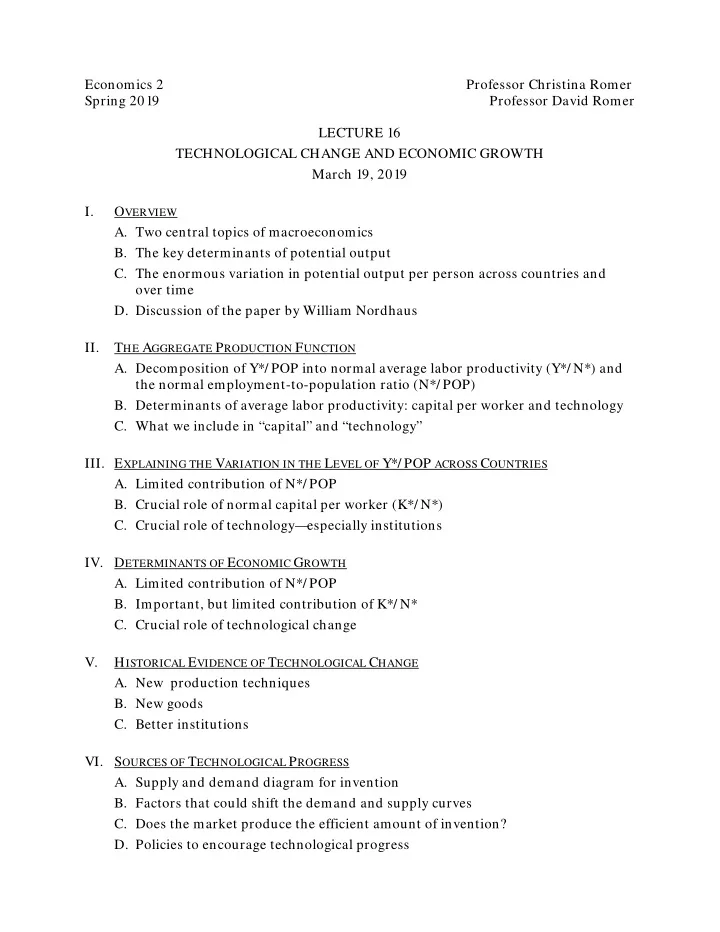
Economics 2 Professor Christina Romer Spring 2019 Professor David Romer LECTURE 16 TECHNOLOGICAL CHANGE AND ECONOMIC GROWTH March 19, 2019 I. O VERVIEW A. Two central topics of macroeconomics B. The key determinants of potential output C. The


slide-1
SLIDE 1

Economics 2 Professor Christina Romer Spring 2019 Professor David Romer LECTURE 16 TECHNOLOGICAL CHANGE AND ECONOMIC GROWTH March 19, 2019 I. OVERVIEW

  • A. Two central topics of macroeconomics
  • B. The key determinants of potential output
  • C. The enormous variation in potential output per person across countries and
  • ver time
  • D. Discussion of the paper by William Nordhaus
  • II. THE AGGREGATE PRODUCTION FUNCTION
  • A. Decomposition of Y*/ POP into normal average labor productivity (Y*/ N*) and

the normal employment-to-population ratio (N*/ POP)

  • B. Determinants of average labor productivity: capital per worker and technology
  • C. What we include in “capital” and “technology”
  • III. EXPLAINING THE VARIATION IN THE LEVEL OF Y*/ POP ACROSS COUNTRIES
  • A. Limited contribution of N*/ POP
  • B. Crucial role of normal capital per worker (K*/ N*)
  • C. Crucial role of technology—especially institutions
  • IV. DETERMINANTS OF ECONOMIC GROWTH
  • A. Limited contribution of N*/ POP
  • B. Important, but limited contribution of K*/ N*
  • C. Crucial role of technological change

V. HISTORICAL EVIDENCE OF TECHNOLOGICAL CHANGE

  • A. New production techniques
  • B. New goods
  • C. Better institutions
  • VI. SOURCES OF TECHNOLOGICAL PROGRESS
  • A. Supply and demand diagram for invention
  • B. Factors that could shift the demand and supply curves
  • C. Does the market produce the efficient amount of invention?
  • D. Policies to encourage technological progress
slide-2
SLIDE 2

LECTURE 16

Technological Change and Economic Growth March 19, 2019

Economics 2 Christina Romer Spring 2019 David Romer

slide-3
SLIDE 3

Announcements

  • Problem Set 4 is being handed out.
  • It is due at the beginning of lecture on Tuesday,

April 2.

  • The ground rules are the same as on previous

problem sets.

  • Optional problem set work session: Thursday,

March 21, 5:00–7:00, in 648 Evans.

  • Research reading for Thursday, March 21 (by Claudia

Goldin and Lawrence Katz) :

  • Read only the assigned pages.
  • Read for approach and findings.
slide-4
SLIDE 4
  • I. OVERVIEW
slide-5
SLIDE 5

Real GDP per Capita in the U.S., 1950–2018

Source: FRED; data from Bureau of Economic Analysis.

slide-6
SLIDE 6

Two Key Topics of Macroeconomics

  • The long-run trend in output.
  • Short-run fluctuations (booms and recessions).
  • In the short run, the economy’s use of its available

resources can be above or below normal; this is central to short-run fluctuations.

  • In the long run, output is determined by the

economy’s available resources.

slide-7
SLIDE 7

Potential Output (Y*)

  • The amount of output that the economy produces

when using its resources at normal rates.

  • The three key determinants of potential output:
  • Labor
  • Capital
  • Technology
slide-8
SLIDE 8

Variation in Potential Output per Person

  • Differs enormously across countries.
  • In many (but not all) countries, it has grown

enormously over time.

slide-9
SLIDE 9

GDP per Capita in 8 Countries since 1870

Source: Frank, Bernanke, Antonovics, and Heffetz, Principles of Economics.

slide-10
SLIDE 10

Paper by William Nordhaus

  • Argues that growth of real GDP in U.S. over the

last two centuries may have been faster than conventionally measured.

  • Related to mismeasurement in price indexes.
slide-11
SLIDE 11

Consumer Price Index

  • A measure of the overall or aggregate level of

prices. CPIt = Price of market basket in year t Price of market basket in base year

slide-12
SLIDE 12

Paper by William Nordhaus

  • What problems does Nordhaus see with typical

price measures?

  • There may be quality changes.
  • New goods are being introduced all the time.
  • What example does he use to illustrate the likely

importance of these problems?

  • Lighting.
slide-13
SLIDE 13

Source: Nordhaus, “Do Real-Output and Real-Wage Measures Capture Reality?”

slide-14
SLIDE 14

Alternative Light Prices

Source: Nordhaus, “Do Real-Output and Real-Wage Measures Capture Reality?”

True Price

slide-15
SLIDE 15

Why Mismeasurement of Inflation Leads to Mismeasurement of Growth

Real GDP in year t2 Real GDP in year t1 = Nominal GDP

t2

GDP Price Indext2 Nominal GDP

t1

GDP Price Indext1 = Nominal GDP

t2

Nominal GDP

t1

  • GDP Price Indext1

GDP Price Indext2

  • If the growth of the price index from year t1 to year t2

is overstated, the growth of real GDP is understated.

  • The same argument applies to the growth of real

wages.

slide-16
SLIDE 16

Were You Persuaded by Nordhaus?

slide-17
SLIDE 17
  • II. THE AGGREGATE PRODUCTION FUNCTION
slide-18
SLIDE 18

Decomposition of Potential Output per Person

where:

  • Y* is potential output;
  • POP is population;
  • N* is normal employment.
  • is the normal employment-to-population ratio.
  • is normal average labor productivity.
slide-19
SLIDE 19

Determinants of Average Labor Productivity

  • is normal capital per worker.
  • T is technology.
slide-20
SLIDE 20

Capital

  • Aids to the production process that were created

in the past.

  • Components of Capital:
  • Conventional physical capital (machines,

buildings, computers).

  • Infrastructure (roads, telecommunications

systems, dams) is also part of physical capital.

  • Human capital (education, job training).
slide-21
SLIDE 21

Technology

  • The methods for producing things.
  • Components of Technology:
  • Production techniques
  • Management techniques
  • Economic institutions
  • Local culture
slide-22
SLIDE 22

Aggregate Production Function

(1) (2) (3)

slide-23
SLIDE 23

What This Is Saying in Words

  • Normal output per person is the product of the

normal employment-to-population ratio and normal

  • utput per worker.
  • One implication: For a given level of normal
  • utput per worker, normal output per person is

proportional to the normal employment-to- population ratio.

  • Normal output per worker depends on two main

things:

  • Normal capital per worker.
  • Technology.
slide-24
SLIDE 24
  • III. EXPLAINING THE VARIATION IN THE LEVEL OF

POTENTIAL OUTPUT PER PERSON ACROSS COUNTRIES

slide-25
SLIDE 25

Contribution of the Employment-to-Population Ratio

  • It can certainly matter, but its effects are limited.
  • It doesn’t vary that much across countries.
slide-26
SLIDE 26

Source: Charles Jones and Dietrich Vollrath, Economic Growth.

slide-27
SLIDE 27

Contribution of Capital per Worker

  • Physical and human capital does vary a lot across

countries.

slide-28
SLIDE 28

GDP Statistics for Selected Countries

Source: Jones and Vollrath, Economic Growth, and Penn World Tables.

Physical Capital Human Capital GDP per Capita per Worker per Worker (Index) “Rich” countries U.S.A 43,326 292,614 3.62 Japan 33,735 297,337 3.27 France 31,980 327,397 3.04 U.K. 35,345 222,377 2.82 “Poor” countries China 6,415 57,700 2.58 India 3,078 20,373 1.93 Nigeria 1,963 8,516 n.a. Uganda 1,122 n.a. 1.98 “Growth miracles” Hong Kong 37,834 293,414 3.01 Singapore 49,987 309,148 2.77 Taiwan 29,645 179,589 3.21 South Korea 25,539 234,288 3.35 “Growth disasters” Venezuela 9,762 91,882 2.34 Zimbabwe 135 1,288 2.48

slide-29
SLIDE 29

Contribution of Technology

  • The types of technology that vary significantly

across countries are probably not knowledge, but institutions and culture.

  • And this variation is an important source of the

variation in normal output per capita.

slide-30
SLIDE 30

Three Key Features of Institutions that Contribute to High Normal Output per Person

  • A market-based system for allocating resources.
  • Government protection of property from others.
  • Protection of property from government

corruption, theft, arbitrary taxation, ….

slide-31
SLIDE 31

Average Labor Productivity and Social Infrastructure

Source: Hall and Jones, “Why Do Some Countries Produce So Much More Output per Worker than Others?”

slide-32
SLIDE 32

Messages about Cross-Country Income Differences

  • Differences in the normal employment-to-

population ratio are not very important.

  • Variations in normal capital per worker (both

physical and human) and in technology are both very important.

  • The most important type of variation in

technology is not variation in knowledge or know- how, but variation in institutions.

slide-33
SLIDE 33
  • IV. DETERMINANTS OF ECONOMIC GROWTH
slide-34
SLIDE 34

Aggregate Production Function

(1) (2) (3)

slide-35
SLIDE 35

Employment-to-Population Ratio in the U.S. (percent)

Source: FRED; data from Bureau of Labor Statistics.

slide-36
SLIDE 36

Labor Force Participation Rate for Women in the U.S.

Source: FRED; data from Bureau of Labor Statistics.

slide-37
SLIDE 37

Can Increases in N*/POP Explain Growth?

  • An increase in N*/POP will raise Y*/POP, and there

have been periods when rises in N*/POP had a noticeable impact on growth.

  • But, N*/POP doesn’t tend to change much, and it

can’t rise indefinitely.

  • And its contribution is limited by diminishing

returns: When N*/POP rises, K*/N* tends to fall, and so Y*/POP rises less than proportionally with N*/POP.

slide-38
SLIDE 38

Aggregate Production Function

(1) (2) (3)

slide-39
SLIDE 39

Can Increases in K*/N* Explain Growth? The Case of Physical Capital

  • An increase in K*/N* will raise Y*/POP, and there

have been periods when capital accumulation was important to growth.

  • But, diminishing returns means that doubling

K*/N* less than doubles Y*/POP.

  • Observed increases in K*/N* are not large enough

to account for much of the observed rise in Y*/POP over time.

slide-40
SLIDE 40

Can Increases in K*/N* Explain Growth? The Case of Human Capital

  • Human capital has increased substantially over the

past 100+ years.

  • The increases probably account for a moderate

amount of the observed rise in Y*/POP over time.

slide-41
SLIDE 41

Source: Economic Report of the President 2010.

slide-42
SLIDE 42

Technological change is a key determinant of economic growth

  • Argument by elimination: If it is not N*/POP or

K*/N*, it must be T.

slide-43
SLIDE 43

Messages about Economic Growth

  • Changes in the normal employment-to-population

ratio are not very important.

  • Increases in normal capital per worker (both

physical and human) are somewhat important.

  • Improvements in technology are crucial.
slide-44
SLIDE 44
  • V. HISTORICAL EVIDENCE OF TECHNOLOGICAL CHANGE
slide-45
SLIDE 45

New Production Techniques

  • New machines (electric motor, tractor).
  • New methods of organization and management

(assembly line, accounting).

slide-46
SLIDE 46

Early Textile Mill

slide-47
SLIDE 47

Modern Textile Factory

slide-48
SLIDE 48

Social Savings from the Farm Tractor in 1954

Source: Steckel and White, “Engines of Growth.”

slide-49
SLIDE 49

New Products

  • Another way to create improvements in the

standard of living.

slide-50
SLIDE 50
slide-51
SLIDE 51

Better Institutions

  • Example: Opening up to trade.
  • Example: More reliance on market forces.
slide-52
SLIDE 52
  • VI. SOURCES OF TECHNOLOGICAL PROGRESS
slide-53
SLIDE 53

D1 Q P S1 P1 Q1

Market for Inventions

slide-54
SLIDE 54

Factors Increasing the Demand for Inventions

Q P D1

P1 Q1

S1

  • 1. More secure

property rights

  • 2. Increased

competition

  • 3. National

emergencies

  • 4. Others?

P2 Q2

D2

slide-55
SLIDE 55

Factors Increasing the Supply of Inventions

Q P D1

P1 Q1

S1 S2

  • 1. Education
  • 2. Culture
  • 3. Luck
  • 4. Others?

P2 Q2

slide-56
SLIDE 56

Does the Free Market Produce the Efficient Amount of Inventive Activity?

  • Almost certainly not: Inventions appear to have

large positive externalities.

  • This is especially true for basic science.
slide-57
SLIDE 57

D1,PMB1 Q P S1,PMC1, SMC1 Q1 Q*

Market for Inventions

SMB1

slide-58
SLIDE 58

Policies to Encourage Technological Progress

  • Increase education.
  • Subsidize research and development, particularly

for basic science.

  • Make property rights more secure.
  • And remember that better institutions are a form
  • f technological progress—which is especially

relevant to poor countries.