= + l 2 ij i F = FF = I E Cov( ) ( ) j = 1 0 - - PowerPoint PPT Presentation

l 2 ij i f ff i e cov j 1 0 e
SMART_READER_LITE
LIVE PREVIEW

= + l 2 ij i F = FF = I E Cov( ) ( ) j = 1 0 - - PowerPoint PPT Presentation

Factor rotation (cf. section 9.4 ) The model implies that An observable random vector X of dimension p has mean = X = X X E = LL + cov( ) {( )( ) } vector and covariance matrix We consider


slide-1
SLIDE 1

An observable random vector X of dimension p has mean vector and covariance matrix Σ Factor rotation (cf. section 9.4 )

− = + X

  • LF

ε

We consider the factor model

1

( ) Cov( ) ( ) E E = ′ = = F F FF I

where

1 2

( ) Cov( ) ( ) diag{ , , , }

p

E E ψ ψ ψ = ′ = = = ε ε εε Ψ … Cov( , ) = ε F

The model implies that

cov( ) {( )( ) } E ′ = = − − Σ X X X

= + LL Ψ

In particular:

Var( ) X σ =

2

Var( )

ii i

X σ =

2 1 m ij i j

l ψ

=

= +

2

communality specific variance (uniqueness)

i i

h ψ = +

  • If T is a m x m orthogonal matrix, the factor model may be

reformulated as

− = + X

  • LF

ε

where

* *

and ′ = = L LT F T F ′ = + LTT F ε

* *

= + L F ε

The covariance matrix remains unchanged:

′+ LL Ψ ′ ′ = + LTT L Ψ

* *′

= + L L Ψ

3

Thus it is impossible on the basis of observations to distinguish the loadings L from the loadings L*, so the factor loadings L are determined only up to an

  • rthogonal matrix T (corresponding to a rotation)

′+ LL Ψ ′ ′ = + LTT L Ψ

* *′

= + L L Ψ

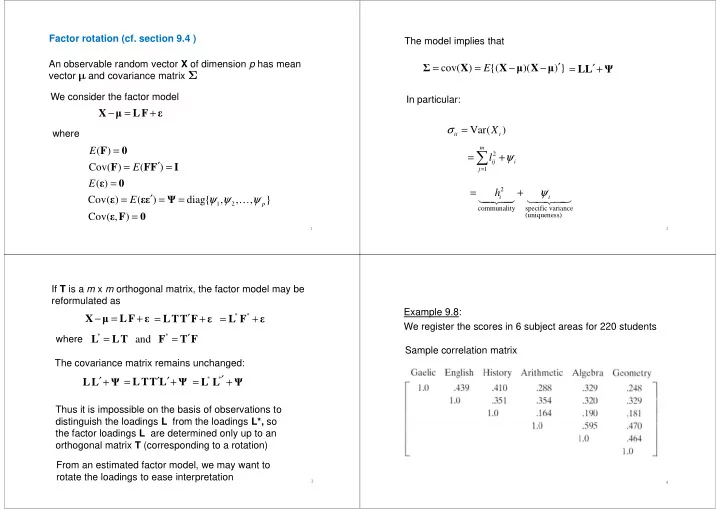
From an estimated factor model, we may want to rotate the loadings to ease interpretation Example 9.8: We register the scores in 6 subject areas for 220 students Sample correlation matrix

4

slide-2
SLIDE 2

Maximum likelihood solution for two factors (R commands are given on the course web-page)

5

Plot factor loading pairs ; cf. Fig 9.1

1 2

ˆ ˆ ( , )

i i

l l

Ga E H

Original factors:

  • First factor: “general intelligence”
  • Second factor: “nonmath-math”

6

Ar Al Ge

Rotated factors:

  • First factor: “mathematical ability”
  • Second factor: “verbal ability”

(subjectively rotate -20 degrees)

where the are the rotated loadings scaled by the square root of the communalities The VARIMAX criterion for chooses the rotation matrix T that maximizes

2 *4 *2 1 1 1

1 1

p p m ij ij j i i

V l l p p

= = =

    = −          

∑ ∑ ∑

ɶ ɶ

* *

ˆ ˆ /

ij ij i

l l h = ɶ

After the rotation the are multiplied by to

*

l ɶ ˆ h

7

After the rotation the are multiplied by to preserve the original communalities

* ij

l ɶ ˆ

i

h

Note that

1

variance of squares of (scaled) loadings for th factor

m j

j

V

=

  ∝    

The criterion aims at “spreading out” the (square of) the loadings on each factor as much as possible Example 9.9: In a consumer preference study a random sample of customers were asked to rate several attributes of a new product using a 7-point scale Sample correlation matrix

8

slide-3
SLIDE 3

Principal component solution with two factors and varimax rotated factors (R commands are given on the course web-page)

9

Rotated factors:

  • First factor: “nutritional”
  • Second factor: “taste”

10

Example 9.10 (and more) We have found a two factor principal component solution as well as a maximum likelihood solution for the stock-price data (cf. examples 9.4 and 9.5)

11

The loadings are quite different Maximum likelihood F1 F2 morgan 0.763 0.029 Principal components F1 F2 0.852 0.036 Using the varimax criterion, we obtain the following rotated loadings (R commands are given on the course web-page)

12

morgan 0.763 0.029 citi 0.819 0.232 fargo 0.668 0.108 shell 0.112 0.994 exxon 0.109 0.675 0.852 0.036 0.849 0.220 0.812 0.085 0.126 0.912 0.078 0.910 The rotated loadings are quite similar