Drawing Maps that Will Stand Up in Court Reapportionment and - - PDF document

drawing maps that will stand up in court
SMART_READER_LITE
LIVE PREVIEW

Drawing Maps that Will Stand Up in Court Reapportionment and - - PDF document

Introduction Drawing Maps that Will Stand Up in Court Reapportionment and Redistricting Peter S. Wattson Senate Counsel State of Minnesota Introduction


slide-1
SLIDE 1

Drawing Maps that Will Stand Up in Court

Peter S. Wattson Senate Counsel State of Minnesota

Introduction

Reapportionment and Redistricting

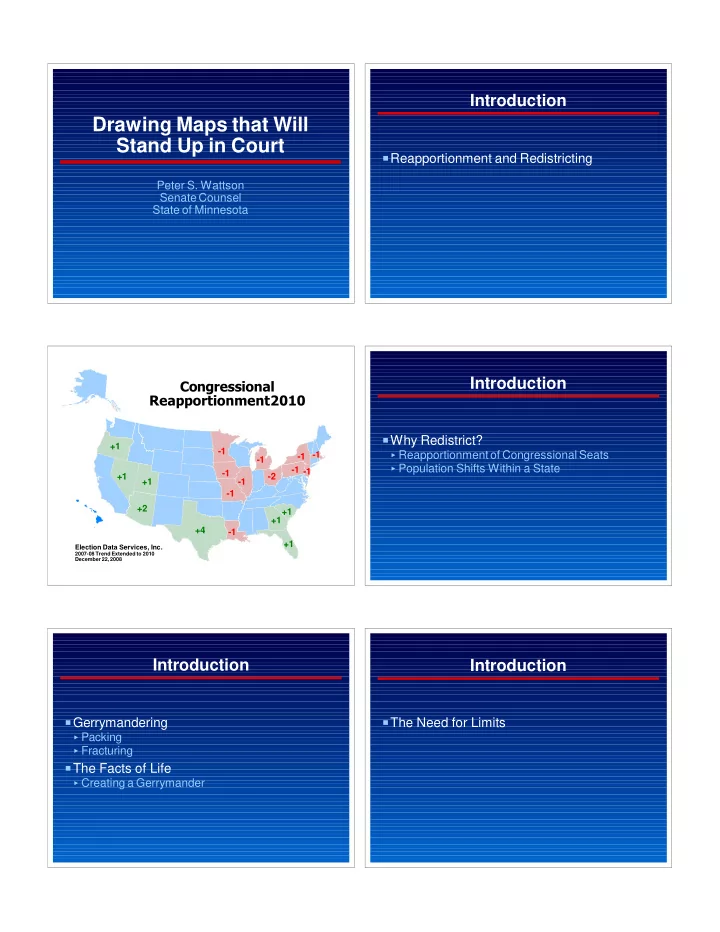
+2 +1 +1

  • 1
  • 1
  • 1
  • 1
  • 1
  • 1
  • 1
  • 1
  • 1
  • 2
  • 1

+1 +1 +1 +4 +1

  • Election Data Services, Inc.

2007-08 Trend Extended to 2010 December 22, 2008

Introduction

Why Redistrict?

Reapportionment of Congressional Seats Population Shifts Within a State

Introduction

Gerrymandering

Packing Fracturing

The Facts of Life

Creating a Gerrymander

Introduction

The Need for Limits

slide-2
SLIDE 2

The Census

Use Official Census Bureau Population Counts

Equal Population

Measuring Population Equality Among Districts

Ideal Population Deviation Average Deviation Overall Range

Equal Population

The Facts of Life

Absolute Numbers are Less Important than Relative Numbers Growth Slower than Average

Area Will Grow

Growth Faster than Average

Area Will Shrink

Congressional Districts

Strict Equality Unless Necessary to Achieve “Some Legitimate State Objective”

Preserve Political Subdivisions Contiguous Territory Compact Preserve Communities of Interest Preserve the Cores of Prior Districts Avoid Contests Between Incumbents

Legislative Districts

An Overall Range of Less than 10 Percent

Unless Proof of Intentional Discrimination

Unless Necessary to Achieve Some “Rational State Policy”

Affording Representation to Political Subdivisions Other State Policies

slide-3
SLIDE 3

Racial and Language Minorities

Voting Rights Act § 2

No Discriminatory Effect Three Gingles Preconditions

Minority Population Sufficiently Large and Geographically Compact Minority is Politically Cohesive Bloc Voting by White Majority Usually Defeats Minority’s Preferred Candidate

Totality of the Circumstances Draw Districts the Minority has a Fair Chance to Win

Voting Rights Act § 5

“Covered Jurisdictions” Preclearance

Justice Department U.S. District Court for District of Columbia

Do Not Regress

Ability to Elect a Candidate of Choice

Do Not Violate § 2 of Voting Rights Act You Need Not Maximize the Number of Minority Districts

Equal Protection Clause of the 14th Amendment

You May Consider Race in Drawing Districts Avoid Drawing a Racial Gerrymander

Racial Gerrymanders

Don’t Draw Districts With Bizarre Shapes

North Carolina

Congressional District 12 - 1992

Election Data Services Inc..

slide-4
SLIDE 4

“Reapportionment is one area in which appearances do matter.”

Racial Gerrymanders

Draw Districts that are “Reasonably Compact”

North Carolina

Congressional District 12 - 1998

North Carolina

Congressional District 12 - 2000 (1997)

Racial Gerrymanders

Don’t Let Race Be Your Dominant Motive

Georgia

Congressional District 11 - 1992

Atlanta Augusta Savannah

slide-5
SLIDE 5

Georgia

Congressional District 4 - 1996

Strict Scrutiny

A Compelling Governmental Interest Narrowly Tailored to Achieve that Interest

Remedying Past Discrimination Avoiding Retrogression Under § 5 Avoiding a Violation

  • f

§ 2

Illinois

Congressional District 4

  • 1992

Traditional Districting Principles

Contiguous Territory Compact Preserve Political Subdivisions Preserve Communities of Interest Protect Incumbents

Preserve Cores of Prior Districts Avoid Contests Between Incumbents

Nest House Districts within Senate Districts

Drawing Maps that Will Stand Up in Court

Peter S. Wattson Senate Counsel State of Minnesota

http://www.senate.leg.state.mn.us/departments/scr/REDIST/Draw/Draw.pdf