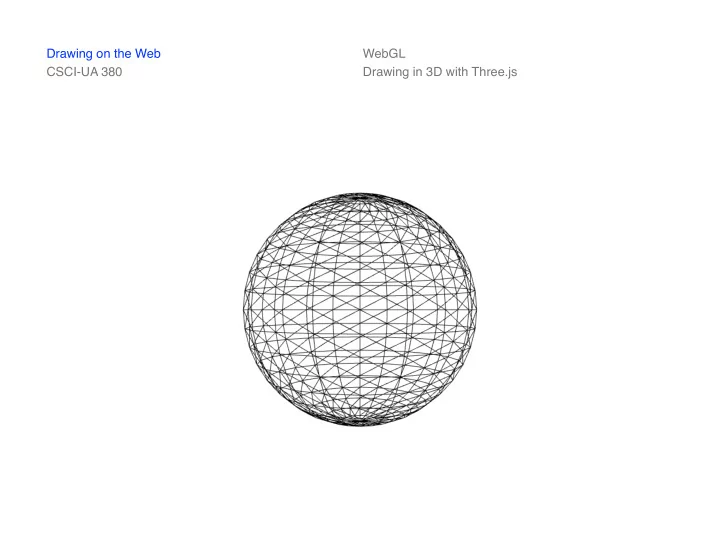
SLIDE 1
Drawing on the Web CSCI-UA 380 WebGL Drawing in 3D with Three.js
SLIDE 2
Drawing on the Web CSCI-UA 380 WebGL Drawing in 3D with Three.js
3D Graphics
We experience the world in three dimensions and, increasingly, screen- based media is rendered in 3D 3D graphics have been around since the 1960s but required advanced computers with special software Today, 3D processing hardware is integrated with virtually every new computer and mobile device Moreover, software for rendering 3D
is now ubiquitous: the web browser
Programming 3D Applications
with HTML5 and WebGL Tony Parisi
SLIDE 3 Drawing on the Web CSCI-UA 380 WebGL Drawing in 3D with Three.js
3D Graphics Coordinate System
3D graphic data is represented in a Cartesian coordinate system In addition to “x” and “y” values, an additional “z” value describes depth The primary difference between 2D Canvas (and CSS) coordinates and WebGL is that “y” starts at the bottom
- f the window, increasing to the top
This distinction stems from historical convention of WebGL being y-up and HTML being y-down
Programming 3D Applications
with HTML5 and WebGL Tony Parisi
SLIDE 4
Drawing on the Web CSCI-UA 380 WebGL Drawing in 3D with Three.js
3D Graphics Mesh
The most common way to draw 3D graphics is with a mesh A mesh is composed of one or more polygon shapes, constructed of vertices (x, y, z), defining coordinate positions in space The polygons most often used in meshes are triangles and rectangles 3D meshes are often referred to as “models”
Programming 3D Applications
with HTML5 and WebGL Tony Parisi
SLIDE 5
Drawing on the Web CSCI-UA 380 WebGL Drawing in 3D with Three.js Image source:
wikipedia.org/wiki/File:Dolphin_triangle_mesh.png
SLIDE 6 Drawing on the Web CSCI-UA 380 WebGL Drawing in 3D with Three.js
3D Graphics Material
Material is generally used to describe the surface attributes of a mesh This can be as simple as a solid color
- r more complex, such as a a shiny,
reflective surface Surface information can also be applied using bitmap images to create textures
Programming 3D Applications
with HTML5 and WebGL Tony Parisi
SLIDE 7
Drawing on the Web CSCI-UA 380 WebGL Drawing in 3D with Three.js
3D Graphics Light
Light defines how a surface is illuminated Without a light source, it is difficult to perceive 3D attributes such as depth 3D graphics can have one or more light sources in a given scene
Programming 3D Applications
with HTML5 and WebGL Tony Parisi
SLIDE 8
Drawing on the Web CSCI-UA 380 WebGL Drawing in 3D with Three.js
3D Graphics Camera
3D scenes require a point of view from which to experience them The “camera” defines where, relative to the scene, a viewer is positioned Additional camera properties include field of view, which defines perspective The final 3D image is rendered into a 2D “viewport”—the window or canvas
Programming 3D Applications
with HTML5 and WebGL Tony Parisi
SLIDE 9 Drawing on the Web CSCI-UA 380 WebGL Drawing in 3D with Three.js Image source:
SLIDE 10
Drawing on the Web CSCI-UA 380 WebGL Drawing in 3D with Three.js
3D Graphics Shader
Your computer’s graphics hardware understands vertices and textures, but that’s about it Other aspects of a 3D scene— material, light, cameras—need to be interpreted A “shader” is the part of your program that gets the pixels for a mesh onto the screen Shaders are very powerful but we will rely on a JavaScript library for this part
Programming 3D Applications
with HTML5 and WebGL Tony Parisi
SLIDE 11
Drawing on the Web CSCI-UA 380 WebGL Drawing in 3D with Three.js
WebGL
WebGL is the standard 3D graphics API for the Web, initiated by Mozilla engineer, Vladimir Vukićević, in 2006 It allows developers to utilize the power of a computer’s 3D rendering hardware from within the browser, using JavaScript WebGL is supported in all current, major, desktop browsers; increasingly, WebGL is also supported in mobile browsers WebGL is a low-level drawing API
Programming 3D Applications
with HTML5 and WebGL Tony Parisi
SLIDE 12
Drawing on the Web CSCI-UA 380 WebGL Drawing in 3D with Three.js
WebGL Three.js
Three.js is a JavaScript toolkit for WebGL that provides higher-level access to the API It was initially released via GitHub in 2010 by Ricardo Cabello, also known as “Mr.doob” and is actively maintained with additional three.js authors Three.js is governed with an MIT free software license for use and reuse within diverse types of projects threejs.org
SLIDE 13
WebGL Drawing in 3D with Three.js Drawing on the Web CSCI-UA 380