
SLIDE 1
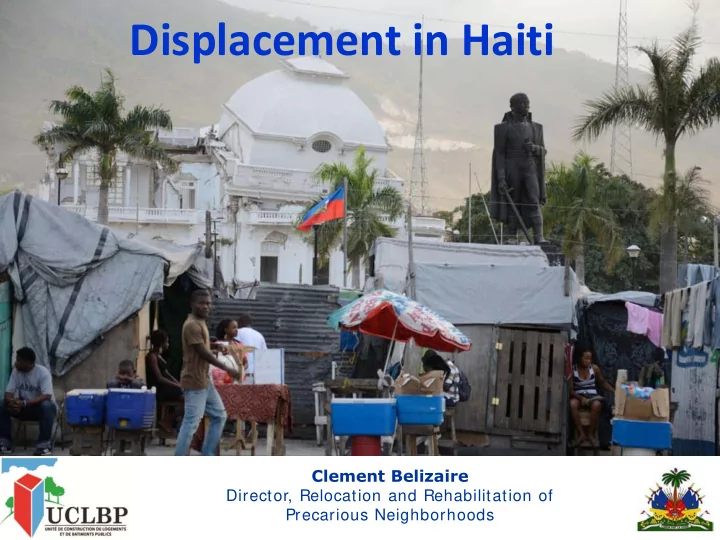
Displacement in Haiti
Clement Belizaire Director, Relocation and Rehabilitation of Precarious Neighborhoods
Displacement in Haiti Challenges are particularly acute when there - - PowerPoint PPT Presentation
Displacement in Haiti Clement Belizaire Director, Relocation and Rehabilitation of Precarious Neighborhoods Displacement in Haiti Challenges are particularly acute when there is a combination of: Poverty Political instability History of weak
Clement Belizaire Director, Relocation and Rehabilitation of Precarious Neighborhoods
Jan 2010 earthquake has caused severe damage:
IDP camps represent a high sanitary risk The Reconstruction has to be launched The camps are blocking reconstruction
efforts
The camps are absorbing precious financial
ressources
The government commits to bring back the
IDP’s home
Ongoing Displacement Crisis:
[Source: IOM Data Management Team]
coordination for reconstruction
– Multiple Government agencies, – Multiple UN agencies, – International Organizations – hundreds of NGOs
– Camp management – Housing construction – Urban Planning – Water – Sanitation – Basic services…etc
and Reconstruction Agency to coordinate reconstruction and the policy on assisting IDPs called UCLBP
“Unite de Construction de Logements et des Batiments Publics”
DIVISION BATIMENTS PUBLICS DIVISION LOGEMENTS DIVISION REHABILITATION ET RELOGEMENT
The Housing UCLBP has three main divisions:
16 Neighborhood 6 camps project
575 families lived in Place Saint Pierre Even apart from the families living there there is huge cultural value to this site : where young and old poor and rich come together to breathe and relax All the services around this camp:
Year 1
Transitional Shelters Yellow House Repairs Permanent Housing
Year 1 Year 2 – 16/6 Approach
The reasons for displacement are varied Therefore every family was offered the choice 3 options:
– $500 Rental support – $25 Transport – $125 6-12 weeks later
IFRC World Vision J/P HRO Concern CRS Zoranje USAID 15,000 CARMEN
Camp Closure Reconstruction
Government of Haiti Return and Reconstruction Policy
Housing Support Project Gymnasium 16 / 6 Champs de Mars Place Jeremie NFI Returns
Registration Choice of 3 housing solutions
Yellow, Red, Rental $500
Communications Monitoring & Evaluation Visit ($125) Yellow House Red House - Permanent Community Infrastructure Income Generation Community Planning Risk Mapping Professional Training Camp
“16/6 Methodology”
Community
What is the “16/6 Methodology” ?
Rental Support
An approach to camp closure based
solutions including but not limited to Rental Support of $500
Registration Choice of 3 housing solutions
Yellow, Red, Rental $500
Communications Monitoring & Evaluation Visit ($125) Yellow House Red House - Permanent Community Infrastructure Income Generation Community Planning Risk Mapping Professional Training Camp
“16/6 Methodology”
Community
What is the “16/6 Methodology” ?
A large scale investment in housing, infrastructure and economic development in neighborhoods
and
Rebuilding Neighborhoods Rental Support
An approach to camp closure based
solutions including but not limited to Rental Support of $500
Registration Choice of 3 housing solutions
Yellow, Red, Rental $500
Communications Monitoring & Evaluation Visit ($125) Yellow House Red House - Permanent Community Infrastructure Income Generation Community Planning Risk Mapping Professional Training Camp
“16/6 Methodology”
Community
$ 7.7 million $ 77 million
Because there is a 1:10 cost ratio
using the 16/6 budget as a guide
Financial Focus on the Neighborhoods
Risk reduction in the neighborhoods Choices of Housing solutions Basic Services accessible Job and economic
creation
Permanent Return Of IDP’s in their neighborhoods
infrastructure will not be possible for every camp and every neighborhood
explored in IOM’s paper Many Roads Lead Home
http://www.eshelter-cccmhaiti.info/
Housing Needs Analysis Rental Support Cash Grants Lessons Learned 16/6 Camp Closure Process