Disclosures I have nothing to disclose. An update on ancillary - - PowerPoint PPT Presentation

disclosures
SMART_READER_LITE
LIVE PREVIEW

Disclosures I have nothing to disclose. An update on ancillary - - PowerPoint PPT Presentation

5/24/2014 Disclosures I have nothing to disclose. An update on ancillary techniques in the diagnosis of soft tissue tumors. Andrew Horvai, MD, PhD Clinical Professor, Pathology Ancillary techniques Introduction Bone and soft tissue


slide-1
SLIDE 1

5/24/2014 1

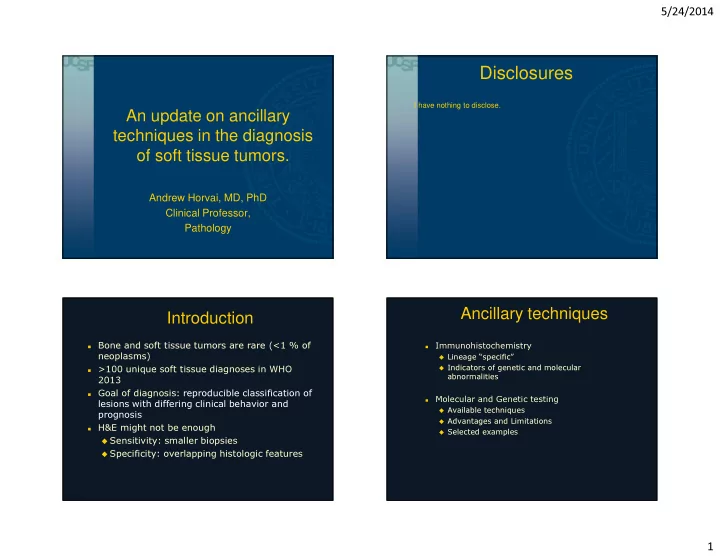
An update on ancillary techniques in the diagnosis

  • f soft tissue tumors.

Andrew Horvai, MD, PhD Clinical Professor, Pathology

Disclosures

I have nothing to disclose.

Introduction

Bone and soft tissue tumors are rare (<1 % of

neoplasms)

>100 unique soft tissue diagnoses in WHO

2013

Goal of diagnosis: reproducible classification of

lesions with differing clinical behavior and prognosis

H&E might not be enough

Sensitivity: smaller biopsies Specificity: overlapping histologic features

Ancillary techniques

  • Immunohistochemistry

Lineage “specific” Indicators of genetic and molecular

abnormalities

  • Molecular and Genetic testing

Available techniques Advantages and Limitations Selected examples

slide-2
SLIDE 2

5/24/2014 2

Immunohistochemistry (IHC)

  • 1. Lineage specific proteins
  • 2. Indicators of genetic and molecular

abnormalities (amplifications, deletions, translocations, point mutations)

IHC: Lineage “specific” proteins

Classic approach

Cytoplasmic: Desmin, keratin, actins, S-100,

CD34, CD31

Nuclear transcription factors

Skeletal muscle: Myogenin Neural crest: SOX10 Others: SOX9, ERG, SATB2

Gene expression profiling

MUC4 Others: DOG1, TLE1

Myogenin

  • Master regulator of skeletal muscle differentiation
  • ~100% specific (myf4 monoclonal) for

rhabdomyoblastic differentiation

Rhabdomyosarcoma (all types) Heterologous rhabdomyoblastic differentiation

Triton tumor, dedifferentiated liposarcoma, myxoid

liposarcoma, Wilms tumor

  • Can help distinguish subtypes of

rhabdomyosarcoma

Alveolar RMS Embryonal RMS Myogenin Myogenin

Myogenin

slide-3
SLIDE 3

5/24/2014 3

SOX10

  • SRY-related HMG box transcription factor
  • Sensitive for neural crest-derived tumors

Melanoma Schwannoma, neurofibroma (>99%) Malignant peripheral nerve sheath tumor (50%,

focal)

  • Specificity

Negative in synovial sarcoma, GIST, smooth muscle Positive in astrocytomas, myoepitheliomas, breast

carcinoma (10%)

SOX10

MPNST SOX10 Synovial sarcoma SOX10

IHC: Lineage specific proteins, gene expression profiling

MUC4 Glycoprotein on glandular epithelium Highly expressed in

Low-grade fibromyxoid sarcoma Hyalanizing spindle cell tumor with giant

rosettes

Sclerosing epithelioid fibrosarcoma t(7;16)

positive

Negative

Perineurioma, MPNST, desmoid,

myxofibrosarcoma

MUC4

Low-grade fibromyxoid sarcoma MUC4

slide-4
SLIDE 4

5/24/2014 4

IHC: Indicators of genetic changes

Amplification

MDM2, CDK4

Chromosomal translocations

STAT6 Others: FLI1, TFE3

Deletion

INI1 Rb

Point mutation

β-Catenin Others: IDH1, BRAF

  • Liposarcoma

Well-differentiated Dedifferentiated

  • Osteosarcoma

Parosteal Central low-grade

IHC: Amplification

MDM2 / CDK4

Well-differentiated liposarcoma De-differentiated liposarcoma MDM2, CDK4 MDM2, CDK4

MDM2 / CDK4

Parosteal osteosarcoma MDM2, CDK4

slide-5
SLIDE 5

5/24/2014 5 IHC: Chromosomal translocation

STAT6 Transcription factor, moves to nucleus

when activated (phosphorylated)

Fusion NAB2-STAT6 in solitary fibrous

tumor abnormal nuclear localization of STAT6

Sensitivity 98% Specificity >90%

Dedifferentiated liposarcoma

STAT6

Solitary fibrous tumor STAT6

STAT6

  • Dedifferentiated liposarcoma

STAT6

Doyle LA et al. Mod Pathol 2014; 1-7.

Dedifferentiated liposarcoma STAT6

slide-6
SLIDE 6

5/24/2014 6

INI1 (SNF5/SMARCB1) Chromatin remodeling, tumor

suppressor, constitutively expressed

Loss of expression

Epithelioid sarcoma (gene deletion) Atypical teratoid rhabdoid tumor

(inactivation)

Rhabdoid tumor (inactivation) Poorly differentiated chordoma (?)

IHC: Gene deletion

INI1 (loss)

Epithelioid sarcoma INI 1

INI1 (loss)

Extrarenal rhabdoid tumor INI 1

Rb Retinoblastoma gene 13q14 Tumor suppressor Deleted or mutated

Spindle cell lipoma Pleomorphic lipoma Mammary type myofibroblastoma Cellular angiofibroma

Retained in

Other benign and malignant lipomatous tumors Solitary fibrous tumor

IHC: Gene deletion or mutation

24

slide-7
SLIDE 7

5/24/2014 7

Rb (complete loss)

Spindle cell lipoma

Rb

IHC: Point mutation

β-catenin Encoded by CTNNB1 gene, Wnt

signaling pathway

Desmoid tumor: mutations in CTNNB1

(sporadic) or APC (Gardner syndrome) abnormal localization

Normal cells: membrane Scar, GIST, smooth muscle: membrane Desmoid fibromatosis: nuclear (+

cytoplasm) (70-90%)

Nuclear β-catenin

Desmoid fibromatosis

Genetic and molecular testing

Purpose

Classification:

Separation of tumors into clinically meaningful

categories based on reproducible changes

Prognostic:

Alveolar versus embryonal rhabdomyosarcoma Myxoid versus well-differentiated liposarcoma

Predictive:

Therapeutic target from fusion gene product Techniques

Cytogenetic: Karyotype, FISH Molecular: RT-PCR, Sanger sequencing, MLPA, array

slide-8
SLIDE 8

5/24/2014 8

Cytogenetics

Karyotype FISH Tissue source Fresh, dividing cells FFPE, cyto smears, frozen Turnaround >1 wk ~ 1 wk Specificity Shotgun approach Directed approach Advantages Direct correlation between morphology and genetics Disadvantages Low resolution

Cytogenetics: 33 year old woman, knee mass

Karyotyping: Synovial sarcoma

t(X;18)

Cytogenetics: FISH

Source: National human genome research institute

slide-9
SLIDE 9

5/24/2014 9 77 year old man, left femur mass, cough

Small cell carcinoma Ewing/PNET Lymphoma (DLBCL)

FISH: Ewing sarcoma

EWSR1 rearrangement

slide-10
SLIDE 10

5/24/2014 10

EWSR1 rearrangements

Partner Diagnosis FLI1, ERG, ETV1, EIAF, FEV, others Ewing sarcoma family of tumors ATF1, CREB1 Clear cell sarcoma Angiomatoid fibrous histiocytoma NR4A3 Extraskeletal myxoid chondrosarcoma WT1 Desmoplastic small round cell tumor DDIT3 Myxoid liposarcoma POU5F1 Myoepithelial tumors

Molecular genetics

RT-PCR Next gen sequencing Tissue source Frozen > FFPE Frozen, + normal control Turnaround < 1-2 days > 1 wk Specificity Highly directed Shotgun approach Advantages High specificity Disadvantages No correlation between morphology and genetics

43 year old woman, thigh mass

Synovial sarcoma

Extraskeletal myxoid chondrosarcoma

SYT-SSX fusion EWSR1-NR4A3 fusion

slide-11
SLIDE 11

5/24/2014 11

PCR: translocation

Vergara-Lluir M, et al. Am J Surg Pathol 2012; 36:1093

“High throughput” assays

Pavlopoulos GA, et al.. BioData Min. 2013 25;6(1):13.

  • Array based sequencing

New markers identified by high throughput methods

Genetics Diagnosis MYH9-USP6 Nodular fasciitis NAB2-STAT6 Solitary fibrous tumor t(1;10)(p22;q24) Myxoinflammatory fibroblastic sarcoma Hemosiderotic fibrolipomatous tumor HEY1-NCOA2 Mesenchymal chondrosarcoma CIC-DUX4 Ewing-like sarcoma BCOR-CCNB3 Ewing-like sarcoma 10 20 30 40 50 60 70 80 90 1960 1970 1980 1990 2000 2010 2020 # of tumors characterized # of genetic /molecular aberrations

Molecular genetics of sarcoma

Time

slide-12
SLIDE 12

5/24/2014 12

Take-home messages

  • Lineage-specific is a relative term
  • IHC for nuclear transcription factors offer

advantages over older cytoplasmic proteins

  • IHC can indirectly detect tumor-specific genetic and

molecular abnormalities

  • Gene and molecular abnormalities can be detected

directly by more specialized methods

  • High throughput methods can rapidly screen an

entire tumor genome and may allow personalized medicine

Solid Tumors Test Directory

http://www.amptestdirectory.org/directory/st_test_list.php