Retroperitoneal Sarcoma Case presentation Surgical Management of - - PowerPoint PPT Presentation

retroperitoneal sarcoma
SMART_READER_LITE
LIVE PREVIEW

Retroperitoneal Sarcoma Case presentation Surgical Management of - - PowerPoint PPT Presentation

Retroperitoneal Sarcoma Case presentation Surgical Management of Soft Tissue Sarcoma: Retroperitoneal Masses Eric K. Nakakura Division of Surgical Oncology UCSF Department of Surgery UCSF Hellen Diller Family Comprehensive Cancer Center San


slide-1
SLIDE 1

1

Surgical Management of Soft Tissue Sarcoma: Retroperitoneal Masses

Eric K. Nakakura

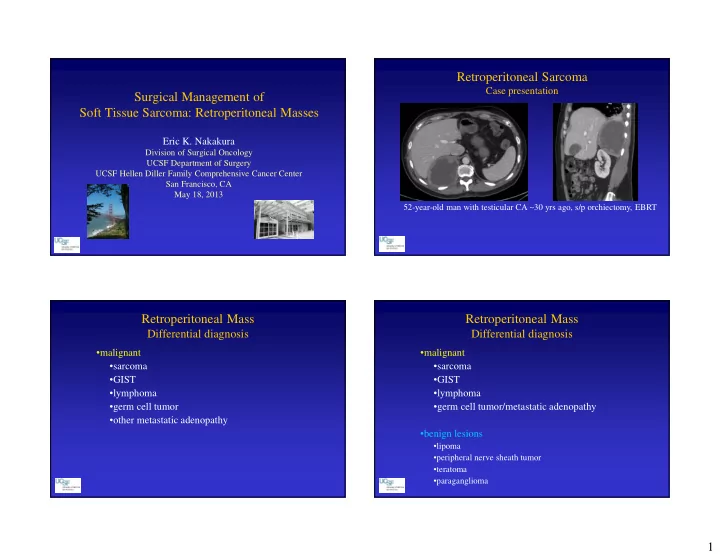
Division of Surgical Oncology UCSF Department of Surgery UCSF Hellen Diller Family Comprehensive Cancer Center San Francisco, CA May 18, 2013 52-year-old man with testicular CA ~30 yrs ago, s/p orchiectomy, EBRT

Retroperitoneal Sarcoma

Case presentation

Retroperitoneal Mass

Differential diagnosis

  • malignant
  • sarcoma
  • GIST
  • lymphoma
  • germ cell tumor
  • other metastatic adenopathy
  • malignant
  • sarcoma
  • GIST
  • lymphoma
  • germ cell tumor/metastatic adenopathy
  • benign lesions
  • lipoma
  • peripheral nerve sheath tumor
  • teratoma
  • paraganglioma

Retroperitoneal Mass

Differential diagnosis

slide-2
SLIDE 2

2

  • malignant
  • sarcoma
  • GIST
  • lymphoma
  • germ cell tumor
  • desmoid
  • benign lesions
  • lipoma
  • peripheral nerve sheath tumor
  • teratoma
  • paraganglioma

Retroperitoneal Mass

Differential diagnosis

38-year-old man with back, hip, thigh pain for 2 years

Retroperitoneal Mass

Differential diagnosis

38-year-old man with back, hip, thigh pain for 2 years s/p resection RP neoplasm pathology: 8.1 cm benign peripheral nerve sheath tumor (schwannoma)

Retroperitoneal Mass

Differential diagnosis

44-year-old man with HTN (4 anti-hypertensive medications) and abdominal pain.

Retroperitoneal Mass

Differential diagnosis

slide-3
SLIDE 3

3

Multifocal functional paraganglioma of the retroperitoneum and bladder

Retroperitoneal Mass

Differential diagnosis

Retroperitoneal Mass

Differential diagnosis

A 44-year-old obese woman underwent a laparoscopic Roux-en-Y gastric bypass developed abdominal pain. A CT-guided core needle biopsy: well- differentiated neuroendocrine tumor.

Retroperitoneal Mass

Differential diagnosis

She underwent a Whipple procedure (pylorus-preserving), cholecystectomy, and extensive retroperitoneal lymphadenectomy; all gross disease removed. Path: well-differentiated PNET, 8 cm, invasion of duodenum/peripancreatic tissues, < 2 mitoses/10 hpf; no necrosis, 47/49 lymph nodes. 43-year-old man with abdominal pain for 6 months

Retroperitoneal Mass

Differential diagnosis

slide-4
SLIDE 4

4

43-year-old man with abdominal pain for 6 months s/p resection RP neoplasm, en-bloc ileocecectomy, right nephrectomy pathology: 8.5 cm fibromatosis (desmoid tumor)

Retroperitoneal Mass

Differential diagnosis

30-year-old man with enlarging right abdominal mass for 1 year

Retroperitoneal Mass

Differential diagnosis

30-year-old man with enlarging right abdominal mass for 1 year s/p resection RP neoplasm with en-bloc IVC PTFE tube graft pathology: 18 cm leiomyosarcoma (grade 1), arising from IVC

Retroperitoneal Mass

Differential diagnosis

IVC

Retroperitoneal Mass

Case presentation

53-year-old woman with abdominal pain.

slide-5
SLIDE 5

5

Retroperitoneal Mass

Case presentation

Resection of RP neoplasm with en-bloc infrarenal IVC Pathology: 11.5 cm leiomyosarcoma, grade I, margins negative

Retroperitoneal Mass

Case presentation

Right ureter Aorta PTFE bypass graft

Retroperitoneal Mass

60-year-old man with increasing abdominal girth for 8 months. For 2 weeks, he had bilateral lower extremity edema refractory to lasix. He gained more than 30 pounds.

Retroperitoneal Mass

60-year-old man with increasing abdominal girth for 8 months.

slide-6
SLIDE 6

6

Retroperitoneal Mass

60-year-old man with increasing abdominal girth for 8 months. s/p resection RP neoplasm, right hemicolectomy, right nephrectomy pathology: 45 cm dedifferentiated liposarcoma (grade 2), 70 pounds

Retroperitoneal Mass

Waist size: preoperative 48 inches; postoperative 34 inches.

Retroperitoneal Mass

60-year-old man underwent resection of a RP well differentiated

  • liposarcoma. Her most likely cause of death in the future will be due to:

A) lung metastases B) liver metastases C) multifocal bowel obstruction

What is the preferred imaging modality to evaluate a retroperitoneal mass?

Retroperitoneal Mass

Imaging

slide-7
SLIDE 7

7

Retroperitoneal Mass

Imaging

Bastiaannet et al. Cancer Treat Rev 2004. Schwarzbach et al. Ann Surg 2005.

  • CT: retroperitoneal/intra-abdominal
  • MRI: suspect nerve root involvement
  • 18FDG-PET: ???

When might a PET scan be useful for the evaluation of patients with cancer?

  • clinical uses evolving:

1) diagnosis (evaluate solitary pulmonary nodules) 2) staging (recurrent disease, nodal disease for epithelioid or angiosarcomas) 3) prognostic assessment 4) monitoring response to therapy

Podoloff et al. J Natl Compr Canc Netw 2007.

Retroperitoneal Mass

Imaging

Retroperitoneal Mass

Imaging

64-year-old woman

  • 15 months prior underwent resection of RP sarcoma,

left nephrectomy, splenectomy, colectomy

  • pathology: 34 cm well-differentiated liposarcoma
  • surveillance CT: recurrent RP mass

PET/CT revealed: numerous hypermetabolic masses

Retroperitoneal Mass

Imaging

slide-8
SLIDE 8

8

Retroperitoneal Mass

Role of biopsy?

46-year-old woman who developed abdominal pain after a fall 46-year-old woman who developed abdominal pain after a fall The next step in her management should be: A) CT-guided biopsy B) measure plasma-free metanephrines then biopsy C) measure plasma-free metanephrines and surgical evaluation

Retroperitoneal Mass

Role of biopsy?

46-year-old woman who developed abdominal pain after a fall s/p resection RP neoplasm, en-bloc right adrenalectomy pathology: 10.1 cm paraganglioma (extra-adrenal pheochromocytoma)

Retroperitoneal Mass

Role of biopsy?

Retroperitoneal Mass

Biopsy

Heslin et al. Ann Surg Oncol 1997. Hoeber et al. Ann Surg Oncol 2001.

  • None: resectable retroperitoneal/intra-abdominal

If it will change management:

  • Fine-needle aspiration: recurrent or metastatic disease
  • Core-needle biopsy: equivalent to incisional biopsy
  • Incisional biopsy: less common
  • Experienced pathologist
slide-9
SLIDE 9

9

Retroperitoneal Sarcoma

Treatment

  • Challenges
  • Large size
  • Proximity to/invasion of adjacent structures
  • bowel, vessels, nerves, bones, kidney, ureter, bladder
  • Complete resection difficult
  • High local recurrence rate/poor survival

Soft Tissue Sarcoma

Surgery

Rosenberg et al. Ann Surg 1982. NCCN 2005.

  • Principals of surgery
  • Optimal margins and oncologic control
  • Maximal function and minimal morbidity
  • Limb sparing generally preferable
  • Consider preoperative cytotoxic therapy (chemotherapy, RT),

if unable to achieve the above.

Retroperitoneal Neoplasm

Intraoperative neurophysiological monitoring

Guo et al. Ann Surg Oncol. (2008).

Soft Tissue Sarcoma

Primary retroperitoneal

classification system

Low grade High grade 5-year survival (%) Complete resection Incomplete resection Distant metastasis I 70-90 II 40-45 III 25 IV 0-15 I II III IV

van Dalen et al. Ann Surg Oncol. 2004.

slide-10
SLIDE 10

10

Retroperitoneal Sarcoma

Outcome

1Ann Surg. 1998.

  • 2Cancer. 2001.

3Eur J Surg Oncol. 2001.

  • 4Cancer. 2004.

5Ann Surg. 2004. 6J Surg Oncol. 2005. 7Ann Surg Oncol. 2006.

5-year complete resection local recurrence metastasis survival

Lewis et al. (MSKCC)1 67% 41% 21% 54% Stoeckle et al. (France)2 65% 57% 33% 46% van Dalen et al. (Netherlands)3 54% 42% ** 22%** 37% Gronchi et al. (Milan)4* 88% 54% 11% 54% Hassan et al. (Mayo)5 78% 42% 15% 45% Erzen et al. (Slovenia)6* 95% 45% ND 52% Pawlik et al. (MDACC/Toronto)7* 95% 40% 15% 61%

*primary and recurrent ** > 5-years

Retroperitoneal Sarcoma

Radiation therapy: IORT

  • Rationale: 5-year local recurrence rates 37-75%
  • > 55 Gy necessary to control microscopic residual disease
  • Prohibitive toxicity to small intestine, liver, kidneys
  • Single-dose IORT = 1.5-2.5 same total dose of EBRT
  • 15 Gy IORT + 45 Gy EBRT = 75-87.5 Gy EBRT

Pawlik et al. Curr Opin Oncol. 2007.

Retroperitoneal Sarcoma

Intraoperative radiotherapy (IORT)

NCI randomized controlled trial

Sindelar et al. Arch Surg. 1993.

IORT/low dose EBRT high dose EBRT P (n = 15) (n = 20)

median survival (mo.) 45 52 NS local recurrence (%) 40 80 < 0.05 median time to local recurrence (mo.) >127 38 < 0.05 enteritis (%) 13 50 < 0.05 peripheral neuropathy (%) 47 < 0.01 (moderate to severe)

Retroperitoneal Sarcoma

Role of incomplete resection?

Lewis et al. Ann Surg 1998. Shibata et al. J Am Coll Surg 2001.

  • No significant difference in survival between patients

whose disease is unresectable and those who undergo incomplete resection Complete resection is goal for curative intent

  • Possible roles for debulking surgery
  • Palliation of symptoms
  • Unresectable retroperitoneal liposarcoma
slide-11
SLIDE 11

11

Soft Tissue Sarcoma

Advanced disease

NCCN 2005.

  • Consider metastasectomy
  • Chemotherapy
  • Radiotherapy
  • Ablative procedures
  • Palliative surgery
  • Supportive care

Soft Tissue Sarcoma

Resection of liver metastases

DeMatteo et al. Ann Surg 2001. Pawlik et al. Arch Surg 2006.

Institution Years N Overall Survival Disease-free survival Recurrence MSKCC 1982-2000 56 30% 20% 84% MDACC 1996-2005 66* 27% 16% 67% *Resection and/or ablation 5-year

Soft Tissue Sarcoma

Resection of pulmonary metastases

Billingsley et al. Ann Surg 1999.

Institution Years N Overall Survival Disease-free survival Recurrence MSKCC 1982-1997 161 37% ? 65% 5-year 52-year-old man with testicular CA ~30 yrs ago, s/p orchiectomy, EBRT

Retroperitoneal Sarcoma

Intraoperative radiotherapy (IORT)

slide-12
SLIDE 12

12

52-year-old man with testicular CA ~30 yrs ago, s/p orchiectomy, EBRT s/p resection RP neoplasm, en-bloc diaphragm, IORT pathology: 12.3 cm undifferentiated pleomorphic sarcoma

Retroperitoneal Sarcoma

Intraoperative radiotherapy (IORT)

Retroperitoneal Mass

IORT

Liposarcoma (54%) Other (15%) MPNST (12%) Leiomyosarcoma (19%) A Desmoid (11%) Myelipoma (11%) Lipoma (11%) Paraganglioma (11%) Schwannoma (22%) Other (34%) B

UCSF Experience

Malignant 43/60 (72) Benign 17/60 (28) Liposarcoma 23/43 (53) Schwannoma 4/17 (24) Leiomyosarcoma 8/43 (19) Paraganglioma 2/17 (12)

Malign Periph Nerve Sheath Tumor

5/43 (12) Lipoma 2/17 (12) Metastatic Colon Ca 1/43 (2) Myelolipoma 2/17 (12) Spindle Cell Sarcoma 1/43 (2) Fibroma 1/17 (6)

Undiff Pleomorphic Sarcoma

1/43 (2) Desmoid tumor 1/17 (6) Renal Cell Sarcoma 1/43 (2) Epithelioid tumor 1/17 (6) Solitary Fibrous Tumor 1/43 (2) Capillary hemangioma 1/17 (6) Chondrosarcoma 1/43 (2) Teratoma 1/17 (6) Ewing's sarcoma 1/43 (2) Muscular vessel with thrombus 1/17 (6) Hematoma 1/17 (6)

  • No. of Patients (%)
  • No. of Patients (%)

MPNST Other

Leiomyosarcoma

Liposarcoma Schwannoma Paraganglioma Lipoma Myelolipoma Other

UCSF Experience

slide-13
SLIDE 13

13

UCSF Experience

IVC

Ureteral stent 22/60 (36) Femoral nerve monitoring 7/60 (12) Major complications 10/60 (17) Abscess 6/60 (10) Atrial fibrillation 4/60 (7) Enterocutaneous fistula 1/60 (2) Death 1/60 (2)

  • No. of Patients (%)

Complete resection 56/60 (93) Multi-organ resection 31/56 (55) Kidney 18/56 (32) Colon 9/56 (16) Pancreas 4/56 (7) Small Bowel 3/56 (5) Adrenal 3/56 (5) Bladder 2/56 (4) Liver 1/56 (2) Spleen 1/56 (2) Diaphragm 1/56 (2) Iliac wing 1/56 (2) Major vascular resection 5/56 (9) IVC 4/56 (7) iliac artery, vein 1/56 (2) Posterior laminotomy 3/56 (5) Preoperative embolization 2/56 (4)

  • No. of Patients (%)

Soft Tissue Sarcoma: Retroperitoneal Masses

Summary

  • Complete and safe resection feasible
  • Preoperative planning important
  • Anticipate potential intraoperative findings
  • Large sizedifficult resection and high risk local recurrence
  • IORT and EBRT when anticipate close focal margin