Families of Domain Specific Languages Prof. Jean-Marc Jzquel - - PDF document

families of domain specific languages
SMART_READER_LITE
LIVE PREVIEW

Families of Domain Specific Languages Prof. Jean-Marc Jzquel - - PDF document

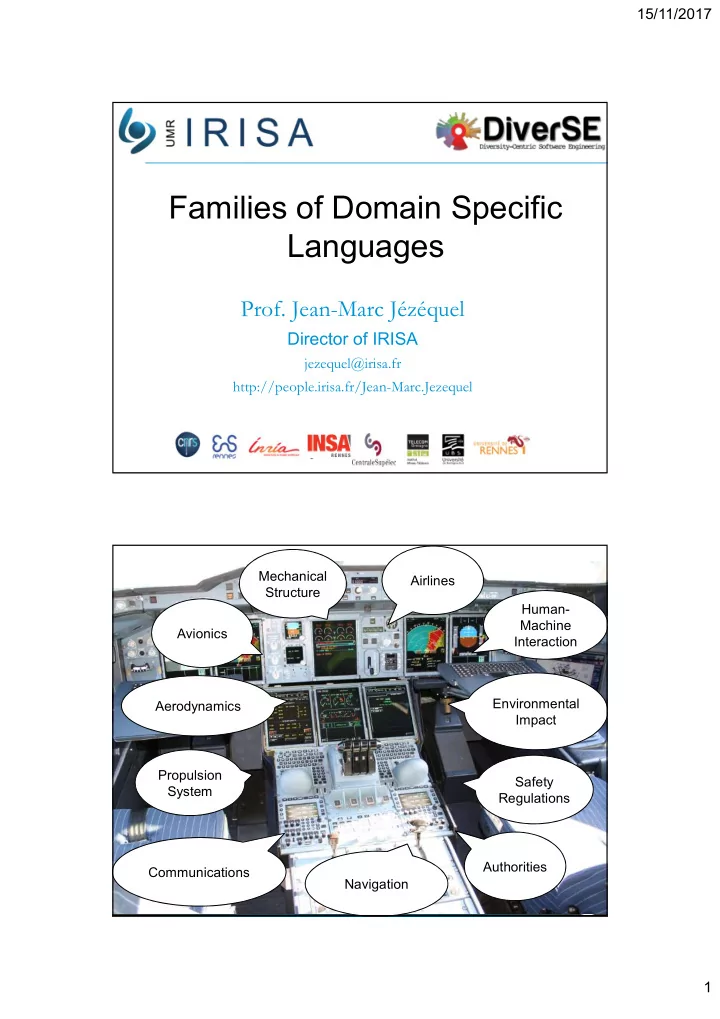
15/11/2017 Families of Domain Specific Languages Prof. Jean-Marc Jzquel Director of IRISA jezequel@irisa.fr http://people.irisa.fr/Jean-Marc.Jezequel Mechanical Airlines Structure Human- Machine Avionics Interaction Environmental


slide-1
SLIDE 1

15/11/2017 1

Families of Domain Specific Languages

  • Prof. Jean-Marc Jézéquel

Director of IRISA

jezequel@irisa.fr http://people.irisa.fr/Jean-Marc.Jezequel

2 15/11/2017

INSTITUT DE RECHERCHE EN INFORMATIQUE ET SYSTEMES ALEATOIRES

Aerodynamics Authorities Avionics Safety Regulations Airlines Propulsion System Mechanical Structure Environmental Impact Navigation Communications Human- Machine Interaction

slide-2
SLIDE 2

15/11/2017 2

3 15/11/2017

INSTITUT DE RECHERCHE EN INFORMATIQUE ET SYSTEMES ALEATOIRES

3 Aerodynamics Authorities Avionics Safety Regulations Airlines Propulsion System Mechanical Structure Environmenta l Impact Navigation Communications Human- Machine Interaction

Heterogeneous Modeling Languages

4 15/11/2017

INSTITUT DE RECHERCHE EN INFORMATIQUE ET SYSTEMES ALEATOIRES

  • Multiple concerns
  • Multiple viewpoints & stakeholders
  • Multiple domains of expertise
  • => Need languages to express them!
  • In a meaningful way for experts
  • With tool support (analysis, code gen., V&V..)
  • Which is still costly to build
  • At some point, all these concerns must be

integrated

Complex Software Intensive Systems

slide-3
SLIDE 3

15/11/2017 3

5 15/11/2017

INSTITUT DE RECHERCHE EN INFORMATIQUE ET SYSTEMES ALEATOIRES

Limits of General Purpose Languages (1)

  • Abstractions and notations used are not

natural/suitable for the stakeholders

  • Even with the best OO languages, impossible to

keep all concerns separated down to the implemeation

5

6 15/11/2017

INSTITUT DE RECHERCHE EN INFORMATIQUE ET SYSTEMES ALEATOIRES

  • Not targeted to a particular kind of problem,

but to any kinds of software problem.

6

Limits of General Purpose Languages (2)

slide-4
SLIDE 4

15/11/2017 4

7 15/11/2017

INSTITUT DE RECHERCHE EN INFORMATIQUE ET SYSTEMES ALEATOIRES

« Another lesson we should have learned from the recent past is that the development of 'richer' or 'more powerful' programming languages was a mistake in the sense that these baroque monstrosities, these conglomerations of idiosyncrasies, are really unmanageable, both mechanically and mentally.

I see a great future for very systematic and very modest programming languages »

7

aka Domain- Specific Languages General-Purpose Languages

1972

ACM Turing Lecture, « The Humble Programmer » Edsger W. Dijkstra

8 15/11/2017

INSTITUT DE RECHERCHE EN INFORMATIQUE ET SYSTEMES ALEATOIRES

  • Targeted to a particular kind of

problem

  • with dedicated notations (textual or

graphical), support (editor, checkers, etc.)

  • Promises: more « efficient » languages

for resolving a set of specific problems in a domain

  • Each concern described in its own

language => reduce abstraction gap

8

Domain Specific Languages

slide-5
SLIDE 5

15/11/2017 5

9 15/11/2017

INSTITUT DE RECHERCHE EN INFORMATIQUE ET SYSTEMES ALEATOIRES

Problem Space Solution Space Assembler C, Java

DSLs

Abstraction Gap

10 15/11/2017

INSTITUT DE RECHERCHE EN INFORMATIQUE ET SYSTEMES ALEATOIRES

  • Long history: used for almost as long as

computing has been done.

  • You’re using DSLs in a daily basis
  • Even if you do not recognize them as DSLs

(yet), because they have many different forms

  • More and more people are building

DSLs

  • Ho can we help them?

10

Domain Specific Languages (DSLs)

slide-6
SLIDE 6

15/11/2017 6

11 15/11/2017

INSTITUT DE RECHERCHE EN INFORMATIQUE ET SYSTEMES ALEATOIRES

HTML

Domain: web (markup)

11

12 15/11/2017

INSTITUT DE RECHERCHE EN INFORMATIQUE ET SYSTEMES ALEATOIRES

CSS

Domain: web (styling)

12

slide-7
SLIDE 7

15/11/2017 7

13 15/11/2017

INSTITUT DE RECHERCHE EN INFORMATIQUE ET SYSTEMES ALEATOIRES

SQL

Domain: database (query)

13

14 15/11/2017

INSTITUT DE RECHERCHE EN INFORMATIQUE ET SYSTEMES ALEATOIRES

Makefile

Domain: software building

14

slide-8
SLIDE 8

15/11/2017 8

15 15/11/2017

INSTITUT DE RECHERCHE EN INFORMATIQUE ET SYSTEMES ALEATOIRES

Lighthttpd configuration file

Domain: web server (configuration)

15

16 15/11/2017

INSTITUT DE RECHERCHE EN INFORMATIQUE ET SYSTEMES ALEATOIRES

Graphviz

Domain: graph (drawing)

16

slide-9
SLIDE 9

15/11/2017 9

17 15/11/2017

INSTITUT DE RECHERCHE EN INFORMATIQUE ET SYSTEMES ALEATOIRES

PGN (Portable Game Notation)

Domain: chess (games)

17

18 15/11/2017

INSTITUT DE RECHERCHE EN INFORMATIQUE ET SYSTEMES ALEATOIRES

Regular expression

Domain: strings (pattern matching)

18

slide-10
SLIDE 10

15/11/2017 10

19 15/11/2017

INSTITUT DE RECHERCHE EN INFORMATIQUE ET SYSTEMES ALEATOIRES

Issues of DSL Engineering

  • Versions
  • Variants
  • Separation of concerns / Composition

19

20 15/11/2017

INSTITUT DE RECHERCHE EN INFORMATIQUE ET SYSTEMES ALEATOIRES

  • Starts as a simple ‘configuration’ mecanism
  • for a complex framework, e.g.; video processing
  • Grows more and more complex over time
  • ffmpeg -i input.avi -b:v 64k -bufsize 64k output.avi
  • Cf https://www.ffmpeg.org/ffmpeg.html
  • Evolves into a more complex language
  • ffmpeg config file
  • A preset file contains a sequence of option=value pairs, one for each line,

specifying a sequence of options. Lines starting with the hash (#) character are ignored and are used to provide comments.

  • Add macros, if, loops,…
  • might end up into a Turing-complete language!

Versions of a DSL: a Typical Lifecycle

slide-11
SLIDE 11

15/11/2017 11

21 15/11/2017

INSTITUT DE RECHERCHE EN INFORMATIQUE ET SYSTEMES ALEATOIRES

  • Abstract syntax variability
  • functional variability
  • E.g. Support for super states in StateCharts

– 50+ variants of StateCharts Syntax have been reported!

  • Concrete syntax variability
  • representation variability
  • E.g. Textual/Graphical/Color…
  • Semantics variability
  • interpretation variability
  • E.g. Inner vs outer transition priority

Variants of a DSL

22 15/11/2017

INSTITUT DE RECHERCHE EN INFORMATIQUE ET SYSTEMES ALEATOIRES

Variants Also at Semantic Level

Event “e” leads to S4 (UML), S5 (Rhapsody), or (S6) Stateflow

"UML vs. Classical vs. Rhapsody Statecharts: Not All Models are Created Equal ", Michelle Crane, Juergen Dingel

slide-12
SLIDE 12

15/11/2017 12

23 15/11/2017

INSTITUT DE RECHERCHE EN INFORMATIQUE ET SYSTEMES ALEATOIRES

A (Simplified) State Machine Language Family

SSMLF SSMLF Simple Simple Hierarchical Hierarchical OuterPriority OuterPriority hasFinalState hasFinalState InnerPriority InnerPriority Mandatory Mandatory Optional Optional Semantics Semantics InitialState InitialState Many Many Structure Structure Textual Textual Graphical Graphical Syntax Syntax

24 15/11/2017

INSTITUT DE RECHERCHE EN INFORMATIQUE ET SYSTEMES ALEATOIRES

  • External DSLs with their own syntax and domain-

specific tooling

  • Nice for the non-programmers
  • Good for separation of concerns
  • Bad for integration
  • Example: SQL

Different shapes for a DSL: External

slide-13
SLIDE 13

15/11/2017 13

25 15/11/2017

INSTITUT DE RECHERCHE EN INFORMATIQUE ET SYSTEMES ALEATOIRES

  • Internal/Embedded DSLs, blending their syntax and

semantics into host language (C++, Scala, C#)

  • Splendid for the gurus
  • Hard for the rest of us
  • Excellent integration
  • Example: SQL in LINQ/C#

Different shapes for a DSL: Internal/Embedded

26 15/11/2017

INSTITUT DE RECHERCHE EN INFORMATIQUE ET SYSTEMES ALEATOIRES

  • Implicit = from plain-old API to more fluent APIs
  • Good for Joe the Programmer
  • Bad for separation of concerns, V&V
  • Good for integration
  • Example: SQL

Different shapes for a DSL: Implicit

slide-14
SLIDE 14

15/11/2017 14

27 15/11/2017

INSTITUT DE RECHERCHE EN INFORMATIQUE ET SYSTEMES ALEATOIRES

SoC: Modeling and Weaving

Design Model Use Case Model Security Model QoS Model Reliability Model Data Model Test Model UI Model

Platform Model

Code Model tester Challenges:

  • Product Families
  • Reuse of

Weaving Process

  • Automatic Weaving

Challenges:

  • Product Families
  • Reuse of

Weaving Process

  • Automatic Weaving

28 15/11/2017

INSTITUT DE RECHERCHE EN INFORMATIQUE ET SYSTEMES ALEATOIRES

Gemoc Initiative

Focuses on SLE tools and methods for interoperable, collaborative, and composable modeling languages

➠Visit http://gemoc.org

slide-15
SLIDE 15

15/11/2017 15

29 15/11/2017

INSTITUT DE RECHERCHE EN INFORMATIQUE ET SYSTEMES ALEATOIRES

  • From supporting a single DSL…
  • Concrete syntax, abstract syntax, semantics, pragmatics
  • Editors, Parsers, Simulators, Compilers…
  • But also: Checkers, Refactoring tools, Converters…
  • …To supporting Multiple DSLs
  • Interacting altogether
  • Each DSL with several flavors(variants)
  • And evolving over time (versions)
  • Product Lines of DSLs!
  • Safe reuse of the tool chains?
  • Backward compatibility, Migration of artifacts?

DSL: From Craft to Engineering

30 15/11/2017

INSTITUT DE RECHERCHE EN INFORMATIQUE ET SYSTEMES ALEATOIRES

My Goal

  • Ease the definition of tool-supported DSL families
  • How to ease and validate the definition of new

DSLs/tools?

  • How to correctly reuse existing tools?

Bring external DSL design abilities to the masses

⇒Use abstractions that are familiar to the OO Programmer to define languages

⇒ set of DSL to build DSLs

⇒ Leverage static typing to foster safe reuse

⇒With a appropriate definition of type

slide-16
SLIDE 16

15/11/2017 16

34 15/11/2017

INSTITUT DE RECHERCHE EN INFORMATIQUE ET SYSTEMES ALEATOIRES

Kermeta: Executable Meta-Modeling for the masses

// MyKermetaProgram.kmt // An E-MOF metamodel is an OO program that does nothing require "StateMachine.ecore" // to import it in Kermeta // Kermeta lets you weave in aspects // Contracts (OCL WFR) require “StaticSemantics.ocl” // Method bodies (Dynamic semantics) require “DynamicSemantics.xtend” // Transformations

run() reset()

FSM

name: EString step()

State

input: EString

  • utput: EString

fire()

Transition

initialState 1

  • wningFSM

1

  • wnedState

* currentState 0..1 source 1

  • utgoingTransition

* target 1 incomingTransition 0..1

Context FSM inv: ownedState->forAll(s1,s2| s1.name=s2.name implies s1=s2) class FSM { public def void reset() { currentState = initialState }}

class Minimizer { public def FSM minimize (source: FSM) {…} }

35 15/11/2017

INSTITUT DE RECHERCHE EN INFORMATIQUE ET SYSTEMES ALEATOIRES

  • A tool (aka Model Transformation) is just a

program working with specific OO data structures (aka meta-models) representing abstract syntax trees (graphes).

  • Kermeta approach: organize the program along the

OO structure of the meta-model

  • Any software engineer can now build a DSL toolset!
  • No longer just for genius…
  • Product Lines of DSLs = SPL of OO programs
  • Safe reuse of the tool chains -> Static typing
  • Backward compatibility, Migration of artifacts -> Adaption

Tools built with MDE

slide-17
SLIDE 17

15/11/2017 17

36 15/11/2017

INSTITUT DE RECHERCHE EN INFORMATIQUE ET SYSTEMES ALEATOIRES

Type Systems

  • Type systems provide unified frameworks

enabling many facilities:

  • Abstraction
  • Reuse and safety
  • Impact analyses
  • Auto-completion
  • What about a model-oriented type system?

36

37 15/11/2017

INSTITUT DE RECHERCHE EN INFORMATIQUE ET SYSTEMES ALEATOIRES

  • Motivating example: model transformation [SoSyM'07]

takes as input a state machine and produces a lookup table showing the correspondence between the current state, an arriving event, and the resultant state

⇒ side-effect free

Model Type – motivation

Finite State Machine

<<conformsTo>>

lookup table

When can we reuse such a transformation?

slide-18
SLIDE 18

15/11/2017 18

38 15/11/2017

INSTITUT DE RECHERCHE EN INFORMATIQUE ET SYSTEMES ALEATOIRES

  • Issue when considering a model as a set of objects:
  • addition of a property to a class is a common evolution

seen in metamodels

  • property = pair of accessor/mutator methods

⇒ subtyping for classes requires invariance of property types!!! ⇒ Indeed: adding a property will cause a covariant property type redefinition somewhere in the metamodel.

Model Type – motivation

39 15/11/2017

INSTITUT DE RECHERCHE EN INFORMATIQUE ET SYSTEMES ALEATOIRES

Guy et al. – On Model Subtyping

Class Matching [Bruce et al., ENTCS 1999]

  • Substitutability of type groups cannot be

achieved through object subtyping

Animal a = Animal.new Food f = Food.new a.eat(f) Animal a = Cow.new Food f = Food.new a.eat(f) Animal a = Cow.new Food f = Grass.new a.eat(f) Animal a = Cow.new Food f = Hamburger.new a.eat(f) Animal a = Animal.new Food f = Food.new a.eat(f) Cow a = Cow.new Grass f = Grass.new a.eat(f) Animal a = Animal.new Food f = Food.new a.eat(f)

slide-19
SLIDE 19

15/11/2017 19

40 15/11/2017

INSTITUT DE RECHERCHE EN INFORMATIQUE ET SYSTEMES ALEATOIRES

Model Type – motivation

  • Some (other) differences for objects in MOF:
  • Multiplicities on properties
  • Properties can be combined to form associations:

makes checking cyclical

  • Need to check whether properties are reflexive or not
  • Containment (or not) on properties

41 15/11/2017

INSTITUT DE RECHERCHE EN INFORMATIQUE ET SYSTEMES ALEATOIRES

Model Type – initial implementation

  • Bruce has defined the matching relation (<#)

between two type groups as a function of the

  • bject types which they contain
  • Generalizing his definition to the matching

relation between model type:

  • matching ≅ subtyping (by group)
slide-20
SLIDE 20

15/11/2017 20

42 15/11/2017

INSTITUT DE RECHERCHE EN INFORMATIQUE ET SYSTEMES ALEATOIRES

Application to MOF-Class Matching

  • C1 matches C2 (C1 <# C2) iff:
  • Same names
  • If C1 is abstract, it can only match another abstract class
  • ∀ C2 operation, C1 must have a corresponding operation
  • With the same name
  • With covariant return type
  • With corresponding parameters

– In the same order – With contravariant types – With the same multiplicities – With the same isUnique attribute

  • ∀ C2 property, C1 must have a corresponding property
  • With the same name
  • With covariant type
  • With the same multiplicities
  • With the sames isUnique and isComposite attributes
  • With an opposite with the same name (if any)
  • If C1 property is read only, it can only correspond to

another read only property

  • Every mandatory property in C1 must correspond to a C2

property

<# ?

MT1 MT2

Same names If C1 is abstract, it can only match another abstract class ∀ C2 operation, C1 must have a corresponding operation ∀ C2 operation, C1 must have a corresponding operation

  • With the same name

∀ C2 operation, C1 must have a corresponding operation

  • With the same name
  • With covariant return type

∀ C2 operation, C1 must have a corresponding operation

  • With the same name
  • With covariant return type
  • With corresponding parameters
  • In the same order
  • With contravariant types
  • With same multiplicities
  • With the same isUnique

∀ C2 operation, C1 must have a corresponding operation

  • With the same name
  • With covariant return type
  • With corresponding parameters
  • In the same order
  • With contravariant types
  • With same multiplicities

∀ C2 operation, C1 must have a corresponding operation

  • With the same name
  • With covariant return type
  • With corresponding parameters
  • In the same order
  • With contravariant types

∀ C2 operation, C1 must have a corresponding operation

  • With the same name
  • With covariant return type
  • With corresponding parameters
  • In the same order

∀ C2 property, C1 must have a corresponding property

  • With the same name
  • With covariant type
  • With the same multiplicities
  • With the same isUnique
  • With the same isComposite
  • With an opposite with the

same name

  • If C1 property is read only, it

can only corresponds to another read only property

∀ C2 property, C1 must have a corresponding property

  • With the same name
  • With covariant type
  • With the same multiplicities
  • With the same isUnique
  • With the same isComposite
  • With an opposite with the

same name

Every mandatory property in C1 must correspond to a C2 property ∀ C2 operation, C1 must have a corresponding operation

  • With the same name
  • With covariant return type
  • With corresponding parameters

∀ C2 property, C1 must have a corresponding property

  • With the same name
  • With covariant type
  • With the same multiplicities
  • With the same isUnique
  • With the same isComposite

∀ C2 property, C1 must have a corresponding property

  • With the same name
  • With covariant type
  • With the same multiplicities

∀ C2 property, C1 must have a corresponding property

  • With the same name
  • With covariant type

∀ C2 property, C1 must have a corresponding property

  • With the same name

∀ C2 property, C1 must have a corresponding property

43 15/11/2017

INSTITUT DE RECHERCHE EN INFORMATIQUE ET SYSTEMES ALEATOIRES

Model Type – initial implementation

Match ?

<<match>> <<match>> <<match>> <<match>>
slide-21
SLIDE 21

15/11/2017 21

44 15/11/2017

INSTITUT DE RECHERCHE EN INFORMATIQUE ET SYSTEMES ALEATOIRES

A Basic FSM Operation Applied on a Final States FSM

Model Type – initial implementation

modeltype basic_fsm_type { basic_fsm :: FSM , basic_fsm :: State , basic_fsm :: Transition } modeltype finalstates_fsm_type { finalstates_fsm :: FSM , finalstates_fsm :: State , finalstates_fsm :: Transition , finalstates_fsm :: FinalState } class Serializer<MT : basic_fsm_type> {

  • peration printFSM(fsm : MT :: FSM) is do

fsm.ownedState.each{s| stdio.writeln(“State :" + s.name) s.outgoingTransition.each{t| var outputText : String if (t.output != void and t.output != “”) then

  • utputText := t.output

else

  • utputText := "NC“

end stdio.writeln(“Transition :" + t.source.name + “-(“ + t.input + "/" + outputText + ") ->" + t.target.name) } } end }

Basic FSM Model Type Final States FSM Model Type

45 15/11/2017

INSTITUT DE RECHERCHE EN INFORMATIQUE ET SYSTEMES ALEATOIRES

  • Supports:
  • the addition of new classes (FinalState)
  • the tightening of multiplicity constraints (Mandatory)
  • the addition of new attributes (indirectly with Composite

State Charts, via the added inheritance relationship) ⇒ Match-bounded polymorphism

  • Does not support:
  • multiple initial states: accessing the initialStateproperty in

Basic state machine will return a single element typed by State while in Multiple state machine it will return a Collection<State> => technical nightmare!

Model Type – initial implementation

2 1

slide-22
SLIDE 22

Diapositive 45 2 ne peut-il pas être détecté et générer automatiquement les adapteur ?

Benoit Combemale; 19/09/2011

1 comment inférer si l'addition n'a pas d'impact ? Par exemple si l'ajout est obligatoire dans un objet instancié par la transformation. ==> exception !

Benoit Combemale; 21/09/2011

slide-23
SLIDE 23

15/11/2017 22

46 15/11/2017

INSTITUT DE RECHERCHE EN INFORMATIQUE ET SYSTEMES ALEATOIRES

Model Type – enhancing matching relation

  • Issues:
  • metamodel elements (e.g., classes, methods,

properties) may have different names.

  • types of elements may be different.
  • additional or missing elements in a metamodel

compared to another.

  • opposites may be missing in relationships.
  • the way metamodel classes are linked together may be

different from one metamodel to another

47 15/11/2017

INSTITUT DE RECHERCHE EN INFORMATIQUE ET SYSTEMES ALEATOIRES

Model Type – enhancing matching relation

  • Motivating example: model refactoring [MODELS'09]

PULL UP METHOD: moving methods to the superclass when methods with

identical signatures and results are located in sibling subclasses.

⇒ Model refining (with side-effect)

How to reuse such transformation?

slide-24
SLIDE 24

15/11/2017 23

48 15/11/2017

INSTITUT DE RECHERCHE EN INFORMATIQUE ET SYSTEMES ALEATOIRES

Model Type – enhancing matching relation

  • In practice to specify generic model refactorings:

1. specify a lightweight metamodel (or model type) that contains the minimum required elements for refactorings. 2. specify refactorings based on the lightweight metamodel. 3. adapt the target metamodels using Kermeta for weaving aspects adding derived properties and opposites that match with those of the generic metamodel. 4. apply the refactoring on the target metamodels

49 15/11/2017

INSTITUT DE RECHERCHE EN INFORMATIQUE ET SYSTEMES ALEATOIRES

1 Generic Model Type for the Pull Up Method Refactoring 2 Kermeta Code for the Pull Up Method Refactoring

Model Type – enhancing matching relation

slide-25
SLIDE 25

15/11/2017 24

50 15/11/2017

INSTITUT DE RECHERCHE EN INFORMATIQUE ET SYSTEMES ALEATOIRES

Model Type – enhancing matching relation

3 Kermeta Code for Adapting the Java Metamodel

51 15/11/2017

INSTITUT DE RECHERCHE EN INFORMATIQUE ET SYSTEMES ALEATOIRES

Model Type – enhancing matching relation

4 Kermeta Code for Applying the Pull Up Method

slide-26
SLIDE 26

15/11/2017 25

52 15/11/2017

INSTITUT DE RECHERCHE EN INFORMATIQUE ET SYSTEMES ALEATOIRES

Bottom Line: Model Subtyping Relations

  • Are models typed by MT1 substitutable to models

typed by MT2?

  • Two criterions to be considered
  • Structural heterogeneities between the model types
  • Context in which the subtyping relation is used

53 15/11/2017

INSTITUT DE RECHERCHE EN INFORMATIQUE ET SYSTEMES ALEATOIRES

Structural heterogeneities

  • Isomorphic
  • MT1 possesses the same structure as

MT2

  • Comparison using class matching
  • Non-isomorphic
  • Same information can be represented

under different forms

  • Model adaptation from MT1 to MT2

MT2 MT1

slide-27
SLIDE 27

15/11/2017 26

54 15/11/2017

INSTITUT DE RECHERCHE EN INFORMATIQUE ET SYSTEMES ALEATOIRES

Context of use

  • Total
  • We can safely use a model typed by MT1

everywhere a model typed by MT2 is expected

  • Partial
  • We can safely use a model typed by MT1 in a

given context where a model typed by MT2 is expected

  • I.e., reuse of a given model manipulation m
  • MT1 must possess all the information needed

for m

  • I.e., the effective model type of m from MT2

MT2 MT1 MT2’

55 15/11/2017

INSTITUT DE RECHERCHE EN INFORMATIQUE ET SYSTEMES ALEATOIRES

4 Model Subtyping Relations

  • Total isomorphic

Matching

  • Partial isomorphic

+ Pruning

  • Total non-isomorphic

+ Adaptation

  • Partial non-isomorphic

+ Pruning + Adaptation

B1 <# B2 A1 <# A2 <<totalIso>> <<totalIso>> <<partialIso>> A1’ <# A2 <<totalIso>> B1 <# B2 f(A1) <<totalIso>> <<totalNoniso>> <<partialNoniso>>

slide-28
SLIDE 28

15/11/2017 27

56 15/11/2017

INSTITUT DE RECHERCHE EN INFORMATIQUE ET SYSTEMES ALEATOIRES

Conclusion on Model Sub-Typing

  • Current state in model typing
  • reuse of model transformations between isomorphic

graphs

  • deal with structure deviation by weaving derived

properties ⇒ Statically checked in Kermeta!!

57 15/11/2017

INSTITUT DE RECHERCHE EN INFORMATIQUE ET SYSTEMES ALEATOIRES

Model Type – Further Needs in a Model Type

System

  • Issues:
  • New DSLs are not created from scratch

⇒ DSLs family (e.g., graph structure)

  • Model transformations cannot yet be specialized

⇒ call to super and polymorphism

  • Reuse through model type matching is limited by

structural conformance

⇒ use of (metamodel) mapping

  • Chains of model transformations are fixed & hardcoded

⇒ partial order inference of model transformations

3

slide-29
SLIDE 29

Diapositive 57 3 a voir pourquoi ?

Benoit Combemale; 19/09/2011

slide-30
SLIDE 30

15/11/2017 28

58 15/11/2017

INSTITUT DE RECHERCHE EN INFORMATIQUE ET SYSTEMES ALEATOIRES

Hypothesis on LANGUAGE DEFINITION

Melange: a Meta-language for Modular and Reusable Development of DSLs 6

  • A metamodel

specifies the AS

59 15/11/2017

INSTITUT DE RECHERCHE EN INFORMATIQUE ET SYSTEMES ALEATOIRES

LANGUAGE DEFINITION

Melange: a Meta-language for Modular and Reusable Development of DSLs 6

  • A metamodel

specifies the AS

  • Sem consists
  • f

computation steps and runtime data

slide-31
SLIDE 31

15/11/2017 29

60 15/11/2017

INSTITUT DE RECHERCHE EN INFORMATIQUE ET SYSTEMES ALEATOIRES

LANGUAGE DEFINITION

Melange: a Meta-language for Modular and Reusable Development of DSLs 6

  • A metamodel

specifies the AS

  • Sem consists
  • f

computation steps and runtime data

Jézéquel et al., Mashup of metalanguages and its implementation in the kermeta language workbench, SoSyM, 2013 Jézéquel et al., Mashup of metalanguages and its implementation in the kermeta language workbench, SoSyM, 2013

61 15/11/2017

INSTITUT DE RECHERCHE EN INFORMATIQUE ET SYSTEMES ALEATOIRES

  • Melange: a Meta-language for Modular and Reusable Development of DSLs
  • Melange: a Meta-language for Modular and Reusable Development of DSLs
slide-32
SLIDE 32

15/11/2017 30

62 15/11/2017

INSTITUT DE RECHERCHE EN INFORMATIQUE ET SYSTEMES ALEATOIRES

Melange: a Meta-language for Modular and Reusable Development of DSLs

62

63 15/11/2017

INSTITUT DE RECHERCHE EN INFORMATIQUE ET SYSTEMES ALEATOIRES

Approach Overview

7

slide-33
SLIDE 33

15/11/2017 31

64 15/11/2017

INSTITUT DE RECHERCHE EN INFORMATIQUE ET SYSTEMES ALEATOIRES

Approach Overview

7

65 15/11/2017

INSTITUT DE RECHERCHE EN INFORMATIQUE ET SYSTEMES ALEATOIRES

Approach Overview

7

Inspired by eg. Erdweg et al., Language Composition Untangled, LDTA, 2012 Inspired by eg. Erdweg et al., Language Composition Untangled, LDTA, 2012

slide-34
SLIDE 34

15/11/2017 32

66 15/11/2017

INSTITUT DE RECHERCHE EN INFORMATIQUE ET SYSTEMES ALEATOIRES

TOOL REUSE THROUGH MODEL TYPING

8

67 15/11/2017

INSTITUT DE RECHERCHE EN INFORMATIQUE ET SYSTEMES ALEATOIRES

TOOL REUSE THROUGH MODEL TYPING

8

Steel et al., On Model Typing, SoSyM, 2007 Guy et al., On Model Subtyping, ECMFA, 2012 Steel et al., On Model Typing, SoSyM, 2007 Guy et al., On Model Subtyping, ECMFA, 2012

slide-35
SLIDE 35

15/11/2017 33

68 15/11/2017

INSTITUT DE RECHERCHE EN INFORMATIQUE ET SYSTEMES ALEATOIRES

LANGUAGE DEFINITION

9

69 15/11/2017

INSTITUT DE RECHERCHE EN INFORMATIQUE ET SYSTEMES ALEATOIRES

LANGUAGE DEFINITION

9 language Fsm { syntax ‘FSM.ecore’ }

slide-36
SLIDE 36

15/11/2017 34

70 15/11/2017

INSTITUT DE RECHERCHE EN INFORMATIQUE ET SYSTEMES ALEATOIRES

9

LANGUAGE DEFINITION

language Fsm { syntax ‘FSM.ecore’ with ExecutableFsm with ExecutableState with ExecutableTransition }

  

71 15/11/2017

INSTITUT DE RECHERCHE EN INFORMATIQUE ET SYSTEMES ALEATOIRES

9 language Fsm { syntax ‘FSM.ecore’ with ExecutableFsm with ExecutableState with ExecutableTransition exactType FsmMT }

LANGUAGE DEFINITION

slide-37
SLIDE 37

15/11/2017 35

72 15/11/2017

INSTITUT DE RECHERCHE EN INFORMATIQUE ET SYSTEMES ALEATOIRES

10 language GuardedFsm { syntax ‘FSM.ecore’ with ExecutableFsm with ExecutableState with ExecutableTransition exactType GuardedFsmMT }

SYNTAX MERGING

73 15/11/2017

INSTITUT DE RECHERCHE EN INFORMATIQUE ET SYSTEMES ALEATOIRES

10 language GuardedFsm { syntax ‘FSM.ecore’ syntax ‘Guard.ecore’ with ExecutableFsm with ExecutableState with ExecutableTransition exactType GuardedFsmMT }

SYNTAX MERGING

slide-38
SLIDE 38

15/11/2017 36

74 15/11/2017

INSTITUT DE RECHERCHE EN INFORMATIQUE ET SYSTEMES ALEATOIRES

11

SEMANTICS WEAVING

language GuardedFsm { syntax ‘FSM.ecore’ syntax ‘Guard.ecore’ with ExecutableFsm with ExecutableState with ExecutableTransition with EvaluateGuard exactType GuardedFsmMT }

75 15/11/2017

INSTITUT DE RECHERCHE EN INFORMATIQUE ET SYSTEMES ALEATOIRES

11

SEMANTICS WEAVING

language GuardedFsm { syntax ‘FSM.ecore’ syntax ‘Guard.ecore’ with ExecutableFsm with ExecutableState with ExecutableTransition with EvaluateGuard with OverrideTransition exactType GuardedFsmMT }

slide-39
SLIDE 39

15/11/2017 37

76 15/11/2017

INSTITUT DE RECHERCHE EN INFORMATIQUE ET SYSTEMES ALEATOIRES

12

LANGUAGE MERGING

language Building { syntax ‘Building.ecore’ with SimulatorAspect... exactType BuildingMT }

77 15/11/2017

INSTITUT DE RECHERCHE EN INFORMATIQUE ET SYSTEMES ALEATOIRES

12

LANGUAGE MERGING

language Building { syntax ‘Building.ecore’ with SimulatorAspect... merge Fsm exactType BuildingMT }

slide-40
SLIDE 40

15/11/2017 38

78 15/11/2017

INSTITUT DE RECHERCHE EN INFORMATIQUE ET SYSTEMES ALEATOIRES

12 language Building { syntax ‘Building.ecore’ with SimulatorAspect... merge Fsm with GlueDeviceToFsm exactType BuildingMT }

LANGUAGE MERGING

79 15/11/2017

INSTITUT DE RECHERCHE EN INFORMATIQUE ET SYSTEMES ALEATOIRES

13

LANGUAGE INHERITANCE

language TimedFsm inherits Fsm { exactType TimedFsmMT }

slide-41
SLIDE 41

15/11/2017 39

80 15/11/2017

INSTITUT DE RECHERCHE EN INFORMATIQUE ET SYSTEMES ALEATOIRES

Melange: a Meta-language for Modular and Reusable Development of DSLs 13

LANGUAGE INHERITANCE

language TimedFsm inherits Fsm { syntax ‘Clocks.ecore’ exactType TimedFsmMT }

81 15/11/2017

INSTITUT DE RECHERCHE EN INFORMATIQUE ET SYSTEMES ALEATOIRES

Melange: a Meta-language for Modular and Reusable Development of DSLs 13

LANGUAGE INHERITANCE

language TimedFsm inherits Fsm { syntax ‘Clocks.ecore’ with ClockTick with OverrideFsm with OverrideTransition exactType TimedFsmMT }

  

slide-42
SLIDE 42

15/11/2017 40

82 15/11/2017

INSTITUT DE RECHERCHE EN INFORMATIQUE ET SYSTEMES ALEATOIRES

Melange: a Meta-language for Modular and Reusable Development of DSLs 14

LANGUAGE SLICING

language Expressions { syntax ‘Expressions.ecore’ with EvaluateBoolean with EvaluateInteger exactType ExpressionsMT }

83 15/11/2017

INSTITUT DE RECHERCHE EN INFORMATIQUE ET SYSTEMES ALEATOIRES

Melange: a Meta-language for Modular and Reusable Development of DSLs 14

LANGUAGE SLICING

language Expressions { syntax ‘Expressions.ecore’ with EvaluateBoolean with EvaluateInteger exactType ExpressionsMT } language BooleanExpressions { slice Expressions on [‘BoolExpr’] exactType BooleanExpressionsMT }

slide-43
SLIDE 43

15/11/2017 41

84 15/11/2017

INSTITUT DE RECHERCHE EN INFORMATIQUE ET SYSTEMES ALEATOIRES

14

LANGUAGE SLICING

language GuardedFsm inherits Fsm { with ... merge BooleanExpressions with AttachGuardToTransition exactType GuardedFsmMT }

Melange

A Language Workbench

slide-44
SLIDE 44

15/11/2017 42

86 15/11/2017

INSTITUT DE RECHERCHE EN INFORMATIQUE ET SYSTEMES ALEATOIRES

MELANGE

  • An open-source (EPL) language workbench
  • r… a language-based, model-oriented language for DSL engineering
  • An implementation of the algebra
  • Supported by a model-oriented type sytem
  • Based on Xtext
  • Seamlessly integrated with the EMF ecosystem
  • Bundled as a set of Eclipse plug-ins

15

87 15/11/2017

INSTITUT DE RECHERCHE EN INFORMATIQUE ET SYSTEMES ALEATOIRES

Implementation Choices

  • Abstract syntax: Ecore (EMOF)
  • Merging: Customized UML PackageMerge1
  • Trading UML specificities with EMOF specificities
  • Support for renaming
  • Slicing: Kompren2
  • Operational semantics: K3 (Xtend on steroids)

16

Dingel et al., Understanding and Improving UML PackageMerge, SoSyM, 2008 Blouin et al., Kompren: Modeling and generating model slicers, SoSyM, 2012 Dingel et al., Understanding and Improving UML PackageMerge, SoSyM, 2008 Blouin et al., Kompren: Modeling and generating model slicers, SoSyM, 2012

1 2

slide-45
SLIDE 45

15/11/2017 43

89 15/11/2017

INSTITUT DE RECHERCHE EN INFORMATIQUE ET SYSTEMES ALEATOIRES

Compilation Scheme

17

90 15/11/2017

INSTITUT DE RECHERCHE EN INFORMATIQUE ET SYSTEMES ALEATOIRES

  • Reuse
  • language constructs, grammars, editors or tool chains

(model transformations, compilers…)

  • Substitutability
  • replacement of one software artifact (e.g. code,
  • bject, module) with another one under certain

conditions

  • Extension
  • introduction of new constructs, abstractions, or tools

Wrap-up: Challenges

slide-46
SLIDE 46

15/11/2017 44

91 15/11/2017

INSTITUT DE RECHERCHE EN INFORMATIQUE ET SYSTEMES ALEATOIRES

  • Modularity and composability
  • structure software applications as sets of interconnected

building blocks

  • How to breakdown a language?
  • how the language units should be defined so they can be

reused in other contexts

  • What is the correct level of granularity?
  • What are the services a language unit should offer to be reusable?
  • What is the meaning of a service in the context of software languages?
  • What is the meaning of a services composition in the context of software

languages?

Challenges for DSL Modularity

92 15/11/2017

INSTITUT DE RECHERCHE EN INFORMATIQUE ET SYSTEMES ALEATOIRES

  • How can language units be specified?
  • not only about implementing a subset of the language
  • but also about specifying its boundary

– the set of services it offers to other language units and the set of services it requires from other language units.

  • classical idea of required and provided interfaces

– introduced by components-based software engineering approaches. – But... What is the meaning of “provided and required services" in the context of software languages?

  • composability & substitutability

– Extends vs. uses

Challenges for DSL Modularity

slide-47
SLIDE 47

15/11/2017 45

93 15/11/2017

INSTITUT DE RECHERCHE EN INFORMATIQUE ET SYSTEMES ALEATOIRES

Big Picture: Variability Everywhere

  • Variability in

Metamodeling:

  • Semantic variation point
  • DSML Families
  • Knowledge capitalization
  • Language Engineering
  • Variability in Modeling:
  • Support positive and

negative variability

  • Derivation semantics must

take into account the assets language semantics Variability Variability

95 15/11/2017

INSTITUT DE RECHERCHE EN INFORMATIQUE ET SYSTEMES ALEATOIRES

  • From supporting a single DSL…
  • Concrete syntax, abstract syntax, semantics, pragmatics
  • Editors, Parsers, Simulators, Compilers…
  • But also: Checkers, Refactoring tools, Converters…
  • …To supporting Multiple DSLs
  • Interacting altogether
  • Each DSL with several flavors: families of DSLs
  • And evolving over time
  • Product Lines of DSLs
  • Share and reuse assets: metamodels and transformations

Conclusion

slide-48
SLIDE 48

15/11/2017 46

96 15/11/2017

INSTITUT DE RECHERCHE EN INFORMATIQUE ET SYSTEMES ALEATOIRES

  • All these ideas have been developed with my

colleagues of the DiverSE team at IRISA/Inria

Formely known as Triskell

Acknowledgement