Complexity in nonlinear delay dynamics for chimera states Laurent - - PowerPoint PPT Presentation

complexity in nonlinear delay dynamics for chimera states
SMART_READER_LITE
LIVE PREVIEW

Complexity in nonlinear delay dynamics for chimera states Laurent - - PowerPoint PPT Presentation

Complexity in nonlinear delay dynamics for chimera states Laurent Larger FEMTO-ST institute / Optics Dpt CNRS / University Bourgogne Franche-Comt Besanon, France May 8, 2019 / Trieste, Italy ICPT School and Workshop on Patterns of


slide-1
SLIDE 1

Complexity in nonlinear delay dynamics for chimera states

Laurent Larger

FEMTO-ST institute / Optics Dpt CNRS / University Bourgogne Franche-Comté Besançon, France
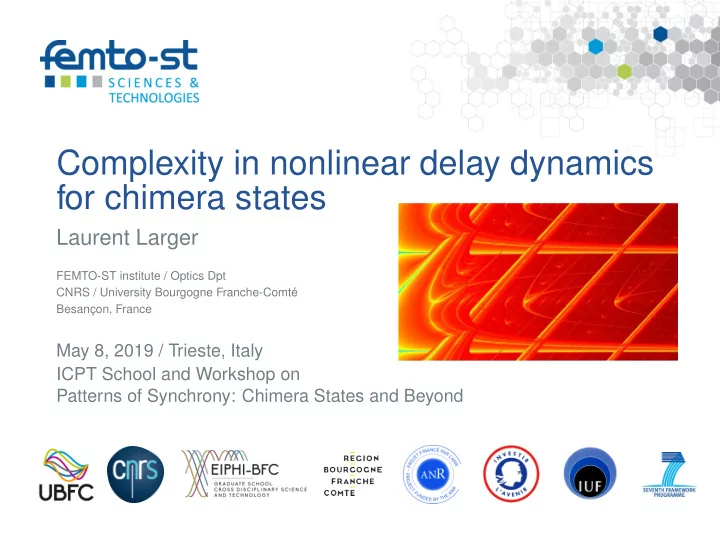
May 8, 2019 / Trieste, Italy ICPT School and Workshop on Patterns of Synchrony: Chimera States and Beyond

slide-2
SLIDE 2

Complexity in nonlinear delay dynamics for chimera states

Laurent Larger

FEMTO-ST institute / Optics Dpt CNRS / University Bourgogne Franche-Comté Besançon, France

May 8, 2019 / Trieste, Italy ICPT School and Workshop on Patterns of Synchrony: Chimera States and Beyond

slide-3
SLIDE 3

Complexity in nonlinear delay dynamics for chimera states

Laurent Larger

FEMTO-ST institute / Optics Dpt CNRS / University Bourgogne Franche-Comté Besançon, France

May 8, 2019 / Trieste, Italy ICPT School and Workshop on Patterns of Synchrony: Chimera States and Beyond

slide-4
SLIDE 4

Many collaborators, many disciplines

FEMTO-ST Y.K. Chembo, M. Jacquot, D. Brunner, J.M. Dudley

PhD students: R. Martinenghi, B. Penkovskyi, B. Marquez

LMB J.-P

. Ortega (Sankt Gallen), L. Grigoryeva (Konstanz)

TU Berlin E. Schöll, Y. Maistrenko, R. Levchenko IFISC I. Fischer, P

. Colet, C.R. Mirasso, M.C. Soriano PhD student: R.M. Nguimdo, N. Oliver

ULB T. Erneux

PhD student: L. Weicker

  • U. Maryland R. Roy, T.E. Murphy, Y.K. Chembo

PhD student: J.D. Hart

VUB J. Danckaert, G. Van der Sande

PhD student: L. Appeltant

IFCAS L. Pesquera

PhD student: S. Ortin

School and Workshop on Patterns of Synchrony: Chimera States and Beyond, May 2019 2 / 34

slide-5
SLIDE 5

Take-home message

Delay dynamics can be lovely simple in their equation of

  • motion. . .

School and Workshop on Patterns of Synchrony: Chimera States and Beyond, May 2019 3 / 34

slide-6
SLIDE 6

Take-home message

Delay dynamics can be lovely simple in their equation of

  • motion. . .

. . . They can also be amazingly complex in their solutions

School and Workshop on Patterns of Synchrony: Chimera States and Beyond, May 2019 3 / 34

slide-7
SLIDE 7

Outline

Introduction NLDDE in theory and practice Space-Time analogy: From DDE to Chimera DDE Apps: chaos communications, µwave radar, photonic AI Hidden bonus slides

School and Workshop on Patterns of Synchrony: Chimera States and Beyond, May 2019 4 / 34

slide-8
SLIDE 8

How familiar are we with delays?

School and Workshop on Patterns of Synchrony: Chimera States and Beyond, May 2019 5 / 34

slide-9
SLIDE 9

How familiar are we with delays?

Actually every day, everywhere!

  • Living systems (population dynamics, blood cell

regulation mechanisms, people reaction after perception and neural system processing,. . . )

School and Workshop on Patterns of Synchrony: Chimera States and Beyond, May 2019 5 / 34

slide-10
SLIDE 10

How familiar are we with delays?

Actually every day, everywhere!

  • Living systems (population dynamics, blood cell

regulation mechanisms, people reaction after perception and neural system processing,. . . )

  • Traffic jam, accordeon car flow

School and Workshop on Patterns of Synchrony: Chimera States and Beyond, May 2019 5 / 34

slide-11
SLIDE 11

How familiar are we with delays?

Actually every day, everywhere!

  • Living systems (population dynamics, blood cell

regulation mechanisms, people reaction after perception and neural system processing,. . . )

  • Traffic jam, accordeon car flow
  • Distant control of satelites or rockets in space

School and Workshop on Patterns of Synchrony: Chimera States and Beyond, May 2019 5 / 34

slide-12
SLIDE 12

How familiar are we with delays?

Actually every day, everywhere!

  • Living systems (population dynamics, blood cell

regulation mechanisms, people reaction after perception and neural system processing,. . . )

  • Traffic jam, accordeon car flow
  • Distant control of satelites or rockets in space
  • Game of vertical stick control at the tip of a finger

School and Workshop on Patterns of Synchrony: Chimera States and Beyond, May 2019 5 / 34

slide-13
SLIDE 13

How familiar are we with delays?

Actually every day, everywhere!

  • Living systems (population dynamics, blood cell

regulation mechanisms, people reaction after perception and neural system processing,. . . )

  • Traffic jam, accordeon car flow
  • Distant control of satelites or rockets in space
  • Game of vertical stick control at the tip of a finger
  • Human stand-up position control (and effects of

increased perception delay after alcoolic drinks)

School and Workshop on Patterns of Synchrony: Chimera States and Beyond, May 2019 5 / 34

slide-14
SLIDE 14

How familiar are we with delays?

Actually every day, everywhere!

  • Living systems (population dynamics, blood cell

regulation mechanisms, people reaction after perception and neural system processing,. . . )

  • Traffic jam, accordeon car flow
  • Distant control of satelites or rockets in space
  • Game of vertical stick control at the tip of a finger
  • Human stand-up position control (and effects of

increased perception delay after alcoolic drinks)

School and Workshop on Patterns of Synchrony: Chimera States and Beyond, May 2019 5 / 34

slide-15
SLIDE 15

How familiar are we with delays?

Actually every day, everywhere!

  • Living systems (population dynamics, blood cell

regulation mechanisms, people reaction after perception and neural system processing,. . . )

  • Traffic jam, accordeon car flow
  • Distant control of satelites or rockets in space
  • Game of vertical stick control at the tip of a finger
  • Human stand-up position control (and effects of

increased perception delay after alcoolic drinks)

  • Hot and cold oscillations at shower start

. . . Any time when information transport occurs (at finite speed), thus resulting in longer propagation time compared to intrinsic dynamical time scales

School and Workshop on Patterns of Synchrony: Chimera States and Beyond, May 2019 5 / 34

slide-16
SLIDE 16

Delay equations, complexity & apps

ε˙ x(t) = −x(t) + β sin2[x(t − 1) + Φ0]

School and Workshop on Patterns of Synchrony: Chimera States and Beyond, May 2019 6 / 34

slide-17
SLIDE 17

Delay equations, complexity & apps

ε˙ x(t) = −x(t) + β sin2[x(t − 1) + Φ0]

School and Workshop on Patterns of Synchrony: Chimera States and Beyond, May 2019 6 / 34

slide-18
SLIDE 18

Delay equations, complexity & apps

ε˙ x(t) = −x(t) + β sin2[x(t − 1) + Φ0]

School and Workshop on Patterns of Synchrony: Chimera States and Beyond, May 2019 6 / 34

slide-19
SLIDE 19

Delay equations, complexity & apps

ε˙ x(t) = −x(t) + β sin2[x(t − 1) + Φ0]

School and Workshop on Patterns of Synchrony: Chimera States and Beyond, May 2019 6 / 34

slide-20
SLIDE 20

Outline

Introduction NLDDE in theory and practice NLDDE modeling through signal theory Implementation of NLDDE in Photonic Space-Time analogy: From DDE to Chimera DDE Apps: chaos communications, µwave radar, photonic AI Hidden bonus slides

School and Workshop on Patterns of Synchrony: Chimera States and Beyond, May 2019 7 / 34

slide-21
SLIDE 21

NLDDE modeling through signal theory

Linear first order scalar dynamics τ dx

dt (t) + x(t) = 0,

τ: response time

˙ x = −γ · x,

γ = 1/τ: rate of change

Simplest modeling of the un-avoidable continuous time (finite speed, or rate) physical transients School and Workshop on Patterns of Synchrony: Chimera States and Beyond, May 2019 8 / 34

slide-22
SLIDE 22

NLDDE modeling through signal theory

Linear first order scalar dynamics τ dx

dt (t) + x(t) = 0,

τ: response time

˙ x = −γ · x,

γ = 1/τ: rate of change

Simplest modeling of the un-avoidable continuous time (finite speed, or rate) physical transients

Time and Fourier domains (FT≡ Fourier Transform)

H(ω) =

H0 1+iωτ = X(ω) E(ω) with X(ω) =FT[x(t)], and E(ω) =FT[e(t)], & ωc = 1/τ School and Workshop on Patterns of Synchrony: Chimera States and Beyond, May 2019 8 / 34

slide-23
SLIDE 23

NLDDE modeling through signal theory

Linear first order scalar dynamics τ dx

dt (t) + x(t) = 0,

τ: response time

˙ x = −γ · x,

γ = 1/τ: rate of change

Simplest modeling of the un-avoidable continuous time (finite speed, or rate) physical transients

Time and Fourier domains (FT≡ Fourier Transform)

H(ω) =

H0 1+iωτ = X(ω) E(ω) with X(ω) =FT[x(t)], and E(ω) =FT[e(t)], & ωc = 1/τ

(1 + iωτ) · X(ω) = H0 · E(ω) FT−1 − − − →

School and Workshop on Patterns of Synchrony: Chimera States and Beyond, May 2019 8 / 34

slide-24
SLIDE 24

NLDDE modeling through signal theory

Linear first order scalar dynamics τ dx

dt (t) + x(t) = 0,

τ: response time

˙ x = −γ · x,

γ = 1/τ: rate of change

Simplest modeling of the un-avoidable continuous time (finite speed, or rate) physical transients

Time and Fourier domains (FT≡ Fourier Transform)

H(ω) =

H0 1+iωτ = X(ω) E(ω) with X(ω) =FT[x(t)], and E(ω) =FT[e(t)], & ωc = 1/τ

(1 + iωτ) · X(ω) = H0 · E(ω) FT−1 − − − → x(t) + τ dx

dt (t) = H0 · e(t) (remember FT−1[iω × (·)] =

d dt FT−1[(·)])

School and Workshop on Patterns of Synchrony: Chimera States and Beyond, May 2019 8 / 34

slide-25
SLIDE 25

NLDDE modeling through signal theory

Linear first order scalar dynamics τ dx

dt (t) + x(t) = 0,

τ: response time

˙ x = −γ · x,

γ = 1/τ: rate of change

Simplest modeling of the un-avoidable continuous time (finite speed, or rate) physical transients

Time and Fourier domains (FT≡ Fourier Transform)

H(ω) =

H0 1+iωτ = X(ω) E(ω) with X(ω) =FT[x(t)], and E(ω) =FT[e(t)], & ωc = 1/τ

(1 + iωτ) · X(ω) = H0 · E(ω) FT−1 − − − → x(t) + τ dx

dt (t) = H0 · e(t) (remember FT−1[iω × (·)] =

d dt FT−1[(·)])

h(t) =FT−1[H(ω)]

[(causal) impulse reponse]

→ x(t) = t

−∞ h(t − ξ) · e(ξ) dξ School and Workshop on Patterns of Synchrony: Chimera States and Beyond, May 2019 8 / 34

slide-26
SLIDE 26

Solutions, initial conditions, phase space

Autonomous case (e(t) = e0, ⇔ e ≡ 0 with z = x − e0) τ ˙ x + x = 0,

0: (dead) fixed point (˙ x = 0)

⇒ x(t) = x0 e−t/τ = x0 e−γt,

γ: convergence rate → 0, ∀x0

−γ : < 0 eigenvalue (stable); Size of the init. cond., dim x0 = 1 ⇒ 1D dynamics (or phase space) School and Workshop on Patterns of Synchrony: Chimera States and Beyond, May 2019 9 / 34

slide-27
SLIDE 27

Solutions, initial conditions, phase space

Autonomous case (e(t) = e0, ⇔ e ≡ 0 with z = x − e0) τ ˙ x + x = 0,

0: (dead) fixed point (˙ x = 0)

⇒ x(t) = x0 e−t/τ = x0 e−γt,

γ: convergence rate → 0, ∀x0

−γ : < 0 eigenvalue (stable); Size of the init. cond., dim x0 = 1 ⇒ 1D dynamics (or phase space)

Feedback (e(t) = f[x(t)]): stability, multi-stability

Fixed point(s): {xF | x = f[x]}

(Graphics: intersect(s) between y = f[x] and y = x)

Stability @ xF: linearization for x(t) − xF = δx(t) ≪ 1, f[x] = xF + δx · f ′[xF] ⇒ ˙ δx = −γ(1 − f ′

xF) · δx = −γfb · δx f ′

xF < 0 ≡ negative feedback, speed up the rate; f ′ xF > 0, slow down the rate, possibly unstable if > 1

School and Workshop on Patterns of Synchrony: Chimera States and Beyond, May 2019 9 / 34

slide-28
SLIDE 28

Solutions, initial conditions, phase space

Autonomous case (e(t) = e0, ⇔ e ≡ 0 with z = x − e0) τ ˙ x + x = 0,

0: (dead) fixed point (˙ x = 0)

⇒ x(t) = x0 e−t/τ = x0 e−γt,

γ: convergence rate → 0, ∀x0

−γ : < 0 eigenvalue (stable); Size of the init. cond., dim x0 = 1 ⇒ 1D dynamics (or phase space)

Feedback (e(t) = f[x(t)]): stability, multi-stability

Fixed point(s): {xF | x = f[x]}

(Graphics: intersect(s) between y = f[x] and y = x)

Stability @ xF: linearization for x(t) − xF = δx(t) ≪ 1, f[x] = xF + δx · f ′[xF] ⇒ ˙ δx = −γ(1 − f ′

xF) · δx = −γfb · δx f ′

xF < 0 ≡ negative feedback, speed up the rate; f ′ xF > 0, slow down the rate, possibly unstable if > 1

Delayed feedback (e(t) = f[x(t − τD)]): ∞−dimensional

Fixed point(s): {xF | x = f[x]} Stability: δx(t) = a · eσt, eigenvalues: {σ ∈ C | 1 + στ = e−στD · f ′

xF},

Size of initial conditions: {x(t), t ∈ [−τD; 0]} ⇒ ∞D phase space

School and Workshop on Patterns of Synchrony: Chimera States and Beyond, May 2019 9 / 34

slide-29
SLIDE 29

Discrete time dynamics: Mapping

Large delay case (τ/τD → 0): simplified to a 1D (Map)!!!

  • Logistic map (feedback + sample & hold) xn+1 = λ xn(1 − xn)

School and Workshop on Patterns of Synchrony: Chimera States and Beyond, May 2019 10 / 34

slide-30
SLIDE 30

Discrete time dynamics: Mapping

Large delay case (τ/τD → 0): simplified to a 1D (Map)!!!

  • Logistic map (feedback + sample & hold) xn+1 = λ xn(1 − xn)
  • DDE (large, but finite, delay with a feedback loop)

School and Workshop on Patterns of Synchrony: Chimera States and Beyond, May 2019 10 / 34

slide-31
SLIDE 31

Discrete time dynamics: Mapping

Large delay case (τ/τD → 0): simplified to a 1D (Map)!!!

  • Logistic map (feedback + sample & hold) xn+1 = λ xn(1 − xn)
  • DDE (large, but finite, delay with a feedback loop)
  • Similarities, but still strong differences (singular limit map)

School and Workshop on Patterns of Synchrony: Chimera States and Beyond, May 2019 10 / 34

slide-32
SLIDE 32

Design tips for an NLDDE in Optics

Concepts of the first chaotic optical setup A closed loop oscillator architecture:

  • All-optical Ikeda ring cavity

School and Workshop on Patterns of Synchrony: Chimera States and Beyond, May 2019 11 / 34

slide-33
SLIDE 33

Design tips for an NLDDE in Optics

Concepts of the first chaotic optical setup A closed loop oscillator architecture:

  • All-optical Ikeda ring cavity
  • Generic bloc diagram setup

School and Workshop on Patterns of Synchrony: Chimera States and Beyond, May 2019 11 / 34

slide-34
SLIDE 34

Design tips for an NLDDE in Optics

Concepts of the first chaotic optical setup A closed loop oscillator architecture:

  • All-optical Ikeda ring cavity
  • Generic bloc diagram setup

Modeling, DDE τ dx dt (t) = −x(t) + FNL[x(t − τD)]

School and Workshop on Patterns of Synchrony: Chimera States and Beyond, May 2019 11 / 34

slide-35
SLIDE 35

Design tips for an NLDDE in Optics

Concepts of the first chaotic optical setup A closed loop oscillator architecture:

  • All-optical Ikeda ring cavity
  • Generic bloc diagram setup

Modeling, DDE τ dx dt (t) = −x(t) + FNL[x(t − τD)]

  • Instantaneous part (linear filter): atomic level life time, Kerr time scale

τ dx dt (t) + x(t) = z(t) ↔ H(f) = FT[h(t)] = X(f) Z(f) = 1 1 + i2πfτ

School and Workshop on Patterns of Synchrony: Chimera States and Beyond, May 2019 11 / 34

slide-36
SLIDE 36

Design tips for an NLDDE in Optics

Concepts of the first chaotic optical setup A closed loop oscillator architecture:

  • All-optical Ikeda ring cavity
  • Generic bloc diagram setup

Modeling, DDE τ dx dt (t) = −x(t) + FNL[x(t − τD)]

  • Instantaneous part (linear filter): atomic level life time, Kerr time scale

τ dx dt (t) + x(t) = z(t) ↔ H(f) = FT[h(t)] = X(f) Z(f) = 1 1 + i2πfτ

  • Time delayed feedback: τD, time of flight of the light in the cavity

School and Workshop on Patterns of Synchrony: Chimera States and Beyond, May 2019 11 / 34

slide-37
SLIDE 37

Design tips for an NLDDE in Optics

Concepts of the first chaotic optical setup A closed loop oscillator architecture:

  • All-optical Ikeda ring cavity
  • Generic bloc diagram setup

Modeling, DDE τ dx dt (t) = −x(t) + FNL[x(t − τD)]

  • Instantaneous part (linear filter): atomic level life time, Kerr time scale

τ dx dt (t) + x(t) = z(t) ↔ H(f) = FT[h(t)] = X(f) Z(f) = 1 1 + i2πfτ

  • Time delayed feedback: τD, time of flight of the light in the cavity
  • Nonlinear delayed driving force: input and feedback interference

z(t) = FNL[x(t − τD)] = β cos2[x(t − τD) + Φ]

School and Workshop on Patterns of Synchrony: Chimera States and Beyond, May 2019 11 / 34

slide-38
SLIDE 38

A paradigm for the study of NLDDE complexity

From an Optics Gedanken experiment. . . . . . to flexible and powerful photonic systems

  • The Ikeda ring cavity

(Ikeda, Opt.Commun. 1979). School and Workshop on Patterns of Synchrony: Chimera States and Beyond, May 2019 12 / 34

slide-39
SLIDE 39

A paradigm for the study of NLDDE complexity

From an Optics Gedanken experiment. . . . . . to flexible and powerful photonic systems

  • The Ikeda ring cavity

(Ikeda, Opt.Commun. 1979).

  • Bulk electro-optic

(Gibbs et al., Phys.Rev.Lett. 1981). School and Workshop on Patterns of Synchrony: Chimera States and Beyond, May 2019 12 / 34

slide-40
SLIDE 40

A paradigm for the study of NLDDE complexity

From an Optics Gedanken experiment. . . . . . to flexible and powerful photonic systems

  • The Ikeda ring cavity

(Ikeda, Opt.Commun. 1979).

  • Bulk electro-optic

(Gibbs et al., Phys.Rev.Lett. 1981).

  • Integrated optics Mach-Zehnder

(Neyer and Voges, IEEE J.Quant.Electron. 1982; Yao and Maleki, Electr. Lett. 1994). School and Workshop on Patterns of Synchrony: Chimera States and Beyond, May 2019 12 / 34

slide-41
SLIDE 41

A paradigm for the study of NLDDE complexity

From an Optics Gedanken experiment. . . . . . to flexible and powerful photonic systems

  • The Ikeda ring cavity

(Ikeda, Opt.Commun. 1979).

  • Bulk electro-optic

(Gibbs et al., Phys.Rev.Lett. 1981).

  • Integrated optics Mach-Zehnder

(Neyer and Voges, IEEE J.Quant.Electron. 1982; Yao and Maleki, Electr. Lett. 1994).

  • Wavelength & EO intensity

(or phase) delay dynamics

(Larger et al., IEEE J.Quant.Electron. 1998; Lavrov et al., Phys. Rev. E 2009). School and Workshop on Patterns of Synchrony: Chimera States and Beyond, May 2019 12 / 34

slide-42
SLIDE 42

Laser wavelength dynamics

2-wave imbalanced interferometer: fNL(x) = β sin2[x + Φ]

School and Workshop on Patterns of Synchrony: Chimera States and Beyond, May 2019 13 / 34

slide-43
SLIDE 43

Laser wavelength dynamics

2-wave imbalanced interferometer: fNL(x) = β sin2[x + Φ] Fabry-Pérot interferometer: fNL(x) = β/[1 + m · sin2(x + Φ)] with x = π∆/λ

School and Workshop on Patterns of Synchrony: Chimera States and Beyond, May 2019 13 / 34

slide-44
SLIDE 44

Laser wavelength dynamics

2-wave imbalanced interferometer: fNL(x) = β sin2[x + Φ] Fabry-Pérot interferometer: fNL(x) = β/[1 + m · sin2(x + Φ)] with x = π∆/λ

  • Nicely matched exp. & num.

bifurcation diagrams (increasing Φ0)

  • Record non linearity strength

up to 14 extrema

School and Workshop on Patterns of Synchrony: Chimera States and Beyond, May 2019 13 / 34

slide-45
SLIDE 45

Laser wavelength dynamics

2-wave imbalanced interferometer: fNL(x) = β sin2[x + Φ] Fabry-Pérot interferometer: fNL(x) = β/[1 + m · sin2(x + Φ)] with x = π∆/λ

  • Nicely matched exp. & num.

bifurcation diagrams (increasing Φ0)

  • Record non linearity strength

up to 14 extrema

  • FM chaos: operating principles

transfered to electronics → 1st bandpass delay dynamics

School and Workshop on Patterns of Synchrony: Chimera States and Beyond, May 2019 13 / 34

slide-46
SLIDE 46

Summary about DDE physics & concepts

Mackey–Glass- or Ikeda-like DDE τ · dx dt (t) = −x(t) + fNL[x(t − τD)]

School and Workshop on Patterns of Synchrony: Chimera States and Beyond, May 2019 14 / 34

slide-47
SLIDE 47

Summary about DDE physics & concepts

Mackey–Glass- or Ikeda-like DDE τ · dx dt (t) = −x(t) + fNL[x(t − τD)]

Non-delayed (instantaneous) terms:

  • Linear differential equation, rate of change γ = 1/τ
  • Stable linear Fourier filter, frequency cut-off (2πτ)−1
  • A few degrees of freedom ≡ filter or diff.eq. order

School and Workshop on Patterns of Synchrony: Chimera States and Beyond, May 2019 14 / 34

slide-48
SLIDE 48

Summary about DDE physics & concepts

Mackey–Glass- or Ikeda-like DDE τ · dx dt (t) = −x(t) + fNL[x(t − τD)]

Non-delayed (instantaneous) terms:

  • Linear differential equation, rate of change γ = 1/τ
  • Stable linear Fourier filter, frequency cut-off (2πτ)−1
  • A few degrees of freedom ≡ filter or diff.eq. order

Delayed (feedback) term:

  • Non-linearity (slope sign, # extrema, multi-stability),
  • Delay (infinite degrees of freedom, stability)
  • Large delay case, τD ≫ τ

School and Workshop on Patterns of Synchrony: Chimera States and Beyond, May 2019 14 / 34

slide-49
SLIDE 49

Summary about DDE physics & concepts

Mackey–Glass- or Ikeda-like DDE

Non-delayed (instantaneous) terms:

  • Linear differential equation, rate of change γ = 1/τ
  • Stable linear Fourier filter, frequency cut-off (2πτ)−1
  • A few degrees of freedom ≡ filter or diff.eq. order

Delayed (feedback) term:

  • Non-linearity (slope sign, # extrema, multi-stability),
  • Delay (infinite degrees of freedom, stability)
  • Large delay case, τD ≫ τ

Unusual features for DDE models

  • Bandpass Fourier filter, or integro-differential delay equation

τ·dx dt (t)+1 θ t

t0

x(ξ) dξ = −x(t)+fNL[x(t−τD)]

School and Workshop on Patterns of Synchrony: Chimera States and Beyond, May 2019 14 / 34

slide-50
SLIDE 50

Summary about DDE physics & concepts

Mackey–Glass- or Ikeda-like DDE

Non-delayed (instantaneous) terms:

  • Linear differential equation, rate of change γ = 1/τ
  • Stable linear Fourier filter, frequency cut-off (2πτ)−1
  • A few degrees of freedom ≡ filter or diff.eq. order

Delayed (feedback) term:

  • Non-linearity (slope sign, # extrema, multi-stability),
  • Delay (infinite degrees of freedom, stability)
  • Large delay case, τD ≫ τ

Unusual features for DDE models

  • Bandpass Fourier filter, or integro-differential delay equation

τ · dx dt (t) = −x(t)−y(t) + fNL[x(t − τD)] θ · dy dt (t) = x(t)

School and Workshop on Patterns of Synchrony: Chimera States and Beyond, May 2019 14 / 34

slide-51
SLIDE 51

Summary about DDE physics & concepts

Mackey–Glass- or Ikeda-like DDE

Non-delayed (instantaneous) terms:

  • Linear differential equation, rate of change γ = 1/τ
  • Stable linear Fourier filter, frequency cut-off (2πτ)−1
  • A few degrees of freedom ≡ filter or diff.eq. order

Delayed (feedback) term:

  • Non-linearity (slope sign, # extrema, multi-stability),
  • Delay (infinite degrees of freedom, stability)
  • Large delay case, τD ≫ τ

Unusual features for DDE models

  • Bandpass Fourier filter, or integro-differential delay equation
  • Positive slope operating point

τ · dx dt (t) = −x(t)−y(t) + fNL[x(t − τD)] θ · dy dt (t) = x(t)

School and Workshop on Patterns of Synchrony: Chimera States and Beyond, May 2019 14 / 34

slide-52
SLIDE 52

Summary about DDE physics & concepts

Mackey–Glass- or Ikeda-like DDE

Non-delayed (instantaneous) terms:

  • Linear differential equation, rate of change γ = 1/τ
  • Stable linear Fourier filter, frequency cut-off (2πτ)−1
  • A few degrees of freedom ≡ filter or diff.eq. order

Delayed (feedback) term:

  • Non-linearity (slope sign, # extrema, multi-stability),
  • Delay (infinite degrees of freedom, stability)
  • Large delay case, τD ≫ τ

Unusual features for DDE models

  • Bandpass Fourier filter, or integro-differential delay equation
  • Positive slope operating point
  • Carved nonlinear function profile (e.g. min/max assymmetry)

τ · dx dt (t) = −x(t)−y(t) + fNL[x(t − τD)] θ · dy dt (t) = x(t)

School and Workshop on Patterns of Synchrony: Chimera States and Beyond, May 2019 14 / 34

slide-53
SLIDE 53

Summary about DDE physics & concepts

Mackey–Glass- or Ikeda-like DDE

Non-delayed (instantaneous) terms:

  • Linear differential equation, rate of change γ = 1/τ
  • Stable linear Fourier filter, frequency cut-off (2πτ)−1
  • A few degrees of freedom ≡ filter or diff.eq. order

Delayed (feedback) term:

  • Non-linearity (slope sign, # extrema, multi-stability),
  • Delay (infinite degrees of freedom, stability)
  • Large delay case, τD ≫ τ

Unusual features for DDE models

  • Bandpass Fourier filter, or integro-differential delay equation
  • Positive slope operating point
  • Carved nonlinear function profile (e.g. min/max assymmetry)
  • Multiple delay architectures

τ · dx dt (t) = −x(t)−y(t) + fNL[x(t − τD)] θ · dy dt (t) = x(t)

School and Workshop on Patterns of Synchrony: Chimera States and Beyond, May 2019 14 / 34

slide-54
SLIDE 54

Outline

Introduction NLDDE in theory and practice Space-Time analogy: From DDE to Chimera DDE Apps: chaos communications, µwave radar, photonic AI Hidden bonus slides

School and Workshop on Patterns of Synchrony: Chimera States and Beyond, May 2019 15 / 34

slide-55
SLIDE 55

Space-Time representation of DDE

Normalization wrt Delay τD: s = t/τD, and ε = τ/τD ε ˙ x(s) = −x(s) + fNL[x(s − 1)], where ˙ x = dx ds.

Large delay case: ε ≪ 1, potentially high dimensional attractor ∞−dimensional phase space, initial condition: x(s), s ∈ [−1, 0]

School and Workshop on Patterns of Synchrony: Chimera States and Beyond, May 2019 16 / 34

slide-56
SLIDE 56

Space-Time representation of DDE

Normalization wrt Delay τD: s = t/τD, and ε = τ/τD ε ˙ x(s) = −x(s) + fNL[x(s − 1)], where ˙ x = dx ds.

Large delay case: ε ≪ 1, potentially high dimensional attractor ∞−dimensional phase space, initial condition: x(s), s ∈ [−1, 0]

Space-time representation

  • Virtual space variable σ,

σ ∈ [0; 1 + γ] with γ = O(ε).

School and Workshop on Patterns of Synchrony: Chimera States and Beyond, May 2019 16 / 34

slide-57
SLIDE 57

Space-Time representation of DDE

Normalization wrt Delay τD: s = t/τD, and ε = τ/τD ε ˙ x(s) = −x(s) + fNL[x(s − 1)], where ˙ x = dx ds.

Large delay case: ε ≪ 1, potentially high dimensional attractor ∞−dimensional phase space, initial condition: x(s), s ∈ [−1, 0]

Space-time representation

  • Virtual space variable σ,

σ ∈ [0; 1 + γ] with γ = O(ε).

  • Discrete time n

n → (n + 1) s = n(1 + γ) + σ → s = (n + 1)(1 + γ) + σ

School and Workshop on Patterns of Synchrony: Chimera States and Beyond, May 2019 16 / 34

slide-58
SLIDE 58

Space-Time representation of DDE

Normalization wrt Delay τD: s = t/τD, and ε = τ/τD ε ˙ x(s) = −x(s) + fNL[x(s − 1)], where ˙ x = dx ds.

Large delay case: ε ≪ 1, potentially high dimensional attractor ∞−dimensional phase space, initial condition: x(s), s ∈ [−1, 0]

Space-time representation

  • Virtual space variable σ,

σ ∈ [0; 1 + γ] with γ = O(ε).

  • Discrete time n

n → (n + 1) s = n(1 + γ) + σ → s = (n + 1)(1 + γ) + σ

F.T. Arecchi, et al. Phys. Rev. A, 1992 School and Workshop on Patterns of Synchrony: Chimera States and Beyond, May 2019 16 / 34

slide-59
SLIDE 59

Space-Time representation of DDE

Normalization wrt Delay τD: s = t/τD, and ε = τ/τD ε ˙ x(s) = −x(s) + fNL[x(s − 1)], where ˙ x = dx ds.

Large delay case: ε ≪ 1, potentially high dimensional attractor ∞−dimensional phase space, initial condition: x(s), s ∈ [−1, 0]

Space-time representation

  • Virtual space variable σ,

σ ∈ [0; 1 + γ] with γ = O(ε).

  • Discrete time n

n → (n + 1) s = n(1 + γ) + σ → s = (n + 1)(1 + γ) + σ

  • G. Giacomelli, et al. EPL, 2012

School and Workshop on Patterns of Synchrony: Chimera States and Beyond, May 2019 16 / 34

slide-60
SLIDE 60

Space-time analogy: analytical support

Convolution product involving the linear impulse response, h(t) = FT−1[H(ω)]

x(s) = s

−∞ h(s − ξ) · fNL[x(ξ − 1)] dξ

with s = n(1 + γ) + σ

LL, Penkovsky, Maistrenko, Nat. Commun. 2015, DOI: 10.1038/ncomms8752 School and Workshop on Patterns of Synchrony: Chimera States and Beyond, May 2019 17 / 34

slide-61
SLIDE 61

Space-time analogy: analytical support

Convolution product involving the linear impulse response, h(t) = FT−1[H(ω)]

x(s) = s

−∞ h(s − ξ) · fNL[x(ξ − 1)] dξ

with s = n(1 + γ) + σ . . . partitioning the time domain: ]−∞; s] = ]−∞ ; n(1 + γ) + σ ] ∪ ]n(1 + γ) + σ ; (n + 1)(1 + γ) + σ ]

LL, Penkovsky, Maistrenko, Nat. Commun. 2015, DOI: 10.1038/ncomms8752 School and Workshop on Patterns of Synchrony: Chimera States and Beyond, May 2019 17 / 34

slide-62
SLIDE 62

Space-time analogy: analytical support

Convolution product involving the linear impulse response, h(t) = FT−1[H(ω)]

x(s) = s

−∞ h(s − ξ) · fNL[x(ξ − 1)] dξ

with s = n(1 + γ) + σ . . . partitioning the time domain: ]−∞; s] = ]−∞ ; n(1 + γ) + σ ] ∪ ]n(1 + γ) + σ ; (n + 1)(1 + γ) + σ ] and make a change of integration variable ξ ↔ ξ − (n + 1)(1 + γ) + γ

LL, Penkovsky, Maistrenko, Nat. Commun. 2015, DOI: 10.1038/ncomms8752 School and Workshop on Patterns of Synchrony: Chimera States and Beyond, May 2019 17 / 34

slide-63
SLIDE 63

Space-time analogy: analytical support

Convolution product involving the linear impulse response, h(t) = FT−1[H(ω)]

x(s) = s

−∞ h(s − ξ) · fNL[x(ξ − 1)] dξ

with s = n(1 + γ) + σ . . . partitioning the time domain: ]−∞; s] = ]−∞ ; n(1 + γ) + σ ] ∪ ]n(1 + γ) + σ ; (n + 1)(1 + γ) + σ ] and make a change of integration variable ξ ↔ ξ − (n + 1)(1 + γ) + γ ⇒ xn+1(σ) = Iǫ(n, σ) + σ+γ

σ−1

h(σ + γ − ξ) · fNL[xn(ξ)] dξ, with Iǫ ≪ xn(σ)

LL, Penkovsky, Maistrenko, Nat. Commun. 2015, DOI: 10.1038/ncomms8752 School and Workshop on Patterns of Synchrony: Chimera States and Beyond, May 2019 17 / 34

slide-64
SLIDE 64

Space-time analogy: analytical support

Convolution product involving the linear impulse response, h(t) = FT−1[H(ω)]

x(s) = s

−∞ h(s − ξ) · fNL[x(ξ − 1)] dξ

with s = n(1 + γ) + σ . . . partitioning the time domain: ]−∞; s] = ]−∞ ; n(1 + γ) + σ ] ∪ ]n(1 + γ) + σ ; (n + 1)(1 + γ) + σ ] and make a change of integration variable ξ ↔ ξ − (n + 1)(1 + γ) + γ ⇒ xn+1(σ) = Iǫ(n, σ) + σ+γ

σ−1

h(σ + γ − ξ) · fNL[xn(ξ)] dξ, with Iǫ ≪ xn(σ) ∂φ ∂t = ω − π

−π

G(x − x′) · sin[φ(x, t) − φ(x′, t) + α] dx

  • LL, Penkovsky, Maistrenko, Nat. Commun. 2015, DOI: 10.1038/ncomms8752

School and Workshop on Patterns of Synchrony: Chimera States and Beyond, May 2019 17 / 34

slide-65
SLIDE 65

Space-time analogy: analytical support

Convolution product involving the linear impulse response, h(t) = FT−1[H(ω)]

x(s) = s

−∞ h(s − ξ) · fNL[x(ξ − 1)] dξ

with s = n(1 + γ) + σ . . . partitioning the time domain: ]−∞; s] = ]−∞ ; n(1 + γ) + σ ] ∪ ]n(1 + γ) + σ ; (n + 1)(1 + γ) + σ ] and make a change of integration variable ξ ↔ ξ − (n + 1)(1 + γ) + γ ⇒ xn+1(σ) = Iǫ(n, σ) + σ+γ

σ−1

h(σ + γ − ξ) · fNL[xn(ξ)] dξ, with Iǫ ≪ xn(σ) ∂φ ∂t = ω − π

−π

G(x − x′) · sin[φ(x, t) − φ(x′, t) + α] dx

  • Remark: the NL dynamics and coupling features of each virtual oscillator are by construction identical at any position σ!!!

School and Workshop on Patterns of Synchrony: Chimera States and Beyond, May 2019 17 / 34

slide-66
SLIDE 66

Chimera states. . .

  • Y. Kuramoto and D. Battogtokh, Nonlinear Phenom. Complex Syst. 5, 380 (2002); D. M. Abrams and S. H. Strogatz,
  • Phys. Rev. Lett. 93, 174102 (2004); I. Omelchenko et al. Phys. Rev. Lett. 106 234102 (2011); A. M. Hagerstrom et al. &
  • M. Tinsley et al., Nat. Phys. 8, 658 & 662 (2012)

School and Workshop on Patterns of Synchrony: Chimera States and Beyond, May 2019 18 / 34

slide-67
SLIDE 67

Chimera states. . .

What is a Chimera state?

  • Network of coupled oscillators with clusters of incongruent motions
  • Predicted numerically in 2002, derived for a particular case in 2004, and

1st observed experimentally in 2012

  • Not observed (initially) with local coupling, neither with global one
  • Y. Kuramoto and D. Battogtokh, Nonlinear Phenom. Complex Syst. 5, 380 (2002); D. M. Abrams and S. H. Strogatz,
  • Phys. Rev. Lett. 93, 174102 (2004); I. Omelchenko et al. Phys. Rev. Lett. 106 234102 (2011); A. M. Hagerstrom et al. &
  • M. Tinsley et al., Nat. Phys. 8, 658 & 662 (2012)

School and Workshop on Patterns of Synchrony: Chimera States and Beyond, May 2019 18 / 34

slide-68
SLIDE 68

Chimera states. . .

What is a Chimera state?

  • Network of coupled oscillators with clusters of incongruent motions
  • Predicted numerically in 2002, derived for a particular case in 2004, and

1st observed experimentally in 2012

  • Not observed (initially) with local coupling, neither with global one

Features allowing for Chimera states?

  • Network of coupled identical oscillators, spatio-temporal dynamics
  • Requires non-local nonlinear coupling between oscillator nodes
  • Important parameters: coupling strength, and coupling distance
  • Y. Kuramoto and D. Battogtokh, Nonlinear Phenom. Complex Syst. 5, 380 (2002); D. M. Abrams and S. H. Strogatz,
  • Phys. Rev. Lett. 93, 174102 (2004); I. Omelchenko et al. Phys. Rev. Lett. 106 234102 (2011); A. M. Hagerstrom et al. &
  • M. Tinsley et al., Nat. Phys. 8, 658 & 662 (2012)

School and Workshop on Patterns of Synchrony: Chimera States and Beyond, May 2019 18 / 34

slide-69
SLIDE 69

Chimera states. . .

What is a Chimera state?

  • Network of coupled oscillators with clusters of incongruent motions
  • Predicted numerically in 2002, derived for a particular case in 2004, and

1st observed experimentally in 2012

  • Not observed (initially) with local coupling, neither with global one

Features allowing for Chimera states?

  • Network of coupled identical oscillators, spatio-temporal dynamics
  • Requires non-local nonlinear coupling between oscillator nodes
  • Important parameters: coupling strength, and coupling distance
  • Y. Kuramoto and D. Battogtokh, Nonlinear Phenom. Complex Syst. 5, 380 (2002); D. M. Abrams and S. H. Strogatz,
  • Phys. Rev. Lett. 93, 174102 (2004); I. Omelchenko et al. Phys. Rev. Lett. 106 234102 (2011); A. M. Hagerstrom et al. &
  • M. Tinsley et al., Nat. Phys. 8, 658 & 662 (2012)

School and Workshop on Patterns of Synchrony: Chimera States and Beyond, May 2019 18 / 34

slide-70
SLIDE 70

DDE recipe for chimera states

Symmetric fNL[x]: Similar σ−“clusters” for x < 0 and x > 0 Asymmetric fNL[x]: Distinct σ−clusters for x < 0 and x > 0 And i DDE

δ s

s0

x(ξ) dξ + x(s) + ε dx ds (s) = fNL[x(s − 1)]

School and Workshop on Patterns of Synchrony: Chimera States and Beyond, May 2019 19 / 34

slide-71
SLIDE 71

Laser based delay dynamics experiment

Tunable SC Laser setup, for i DDE Chimera

LL, Penkovsky, Maistrenko, Nat. Commun. 2015, DOI: 10.1038/ncomms8752 School and Workshop on Patterns of Synchrony: Chimera States and Beyond, May 2019 20 / 34

slide-72
SLIDE 72

Laser based delay dynamics experiment

Tunable SC Laser setup, for i DDE Chimera fNL[x]: the Airy function of a Fabry-Pérot interferometer

⇒ fNL[λ] =

β 1+m sin2(2πne/λ) = β 1+m sin2(x+Φ0)

with x = 2πne

λ2

0 δλ

and Φ0 =

2πne λ0+Stun. iDBR0 LL, Penkovsky, Maistrenko, Nat. Commun. 2015, DOI: 10.1038/ncomms8752 School and Workshop on Patterns of Synchrony: Chimera States and Beyond, May 2019 20 / 34

slide-73
SLIDE 73

Laser based delay dynamics experiment

Tunable SC Laser setup, for i DDE Chimera fNL[x]: the Airy function of a Fabry-Pérot interferometer

⇒ fNL[λ] =

β 1+m sin2(2πne/λ) = β 1+m sin2(x+Φ0)

with x = 2πne

λ2

0 δλ

and Φ0 =

2πne λ0+Stun. iDBR0 LL, Penkovsky, Maistrenko, Nat. Commun. 2015, DOI: 10.1038/ncomms8752 School and Workshop on Patterns of Synchrony: Chimera States and Beyond, May 2019 20 / 34

slide-74
SLIDE 74

1st Chimera in (σ, n)−space

Numerics:

  • β = 0.6, ν0 = 1, ε = 5.10−3,

δ = 1.6 × 10⁻²

  • Initial conditions: small amplitude

white noise (repeated several times with different noise realizations)

  • Calculated durations: Thousands of n

LL et al. Phys. Rev. Lett. 111 054103 (2013) School and Workshop on Patterns of Synchrony: Chimera States and Beyond, May 2019 21 / 34

slide-75
SLIDE 75

1st Chimera in (σ, n)−space

Numerics:

  • β = 0.6, ν0 = 1, ε = 5.10−3,

δ = 1.6 × 10⁻²

  • Initial conditions: small amplitude

white noise (repeated several times with different noise realizations)

  • Calculated durations: Thousands of n
  • Experiment. . .

LL et al. Phys. Rev. Lett. 111 054103 (2013) School and Workshop on Patterns of Synchrony: Chimera States and Beyond, May 2019 21 / 34

slide-76
SLIDE 76

1st Chimera in (σ, n)−space

Numerics:

  • β = 0.6, ν0 = 1, ε = 5.10−3,

δ = 1.6 × 10⁻²

  • Initial conditions: small amplitude

white noise (repeated several times with different noise realizations)

  • Calculated durations: Thousands of n
  • Experiment. . .
  • Very close amplitude and time parameters,

τD = 2.54ms, θ = 160ms, τ = 12.7µs

  • Initial conditions forced by background noise
  • Recording of up to 16 × 106 points,

allowing for a few thousands of n LL et al. Phys. Rev. Lett. 111 054103 (2013) School and Workshop on Patterns of Synchrony: Chimera States and Beyond, May 2019 21 / 34

slide-77
SLIDE 77

Bifurcations in (ε, δ)−space

School and Workshop on Patterns of Synchrony: Chimera States and Beyond, May 2019 22 / 34

slide-78
SLIDE 78

Bifurcations in (ε, δ)−space

ε = τ/τD δ = τD/θ β ≃ 1.5 Φ0 ≃ −0.4

School and Workshop on Patterns of Synchrony: Chimera States and Beyond, May 2019 22 / 34

slide-79
SLIDE 79

Bifurcations in (ε, δ)−space

ε = τ/τD δ = τD/θ β ≃ 1.5 Φ0 ≃ −0.4

School and Workshop on Patterns of Synchrony: Chimera States and Beyond, May 2019 22 / 34

slide-80
SLIDE 80

Double delay dynamics: toward 2D chimera

Setup and delay dynamics features Double delay nonlinear integro-differential equation εdx dt (t) + x(t) + δ

  • x(ξ)dξ = (1 − γ) fNL[x(t − τ1)] + γ fNL[x(t − τ2)]

School and Workshop on Patterns of Synchrony: Chimera States and Beyond, May 2019 23 / 34

slide-81
SLIDE 81

2D-chimera with chaotic sea, or chaotic island

School and Workshop on Patterns of Synchrony: Chimera States and Beyond, May 2019 24 / 34

slide-82
SLIDE 82

Isolated pulses

School and Workshop on Patterns of Synchrony: Chimera States and Beyond, May 2019 25 / 34

slide-83
SLIDE 83

Outline

Introduction NLDDE in theory and practice Space-Time analogy: From DDE to Chimera DDE Apps: chaos communications, µwave radar, photonic AI Hidden bonus slides

School and Workshop on Patterns of Synchrony: Chimera States and Beyond, May 2019 26 / 34

slide-84
SLIDE 84

Optical Chaos Communications

Emitter-Receiver architecture

  • Fully developed chaos (strong feedback gain, highly NL operation)

School and Workshop on Patterns of Synchrony: Chimera States and Beyond, May 2019 27 / 34

slide-85
SLIDE 85

Optical Chaos Communications

Emitter-Receiver architecture

  • Fully developed chaos (strong feedback gain, highly NL operation)
  • In-loop message insertion (message-perturbed chaotic attractor, with

comparable amplitude)

School and Workshop on Patterns of Synchrony: Chimera States and Beyond, May 2019 27 / 34

slide-86
SLIDE 86

Optical Chaos Communications

Emitter-Receiver architecture

  • Fully developed chaos (strong feedback gain, highly NL operation)
  • In-loop message insertion (message-perturbed chaotic attractor, with

comparable amplitude)

  • Real-time encoding and decoding up to 10 Gb/s

School and Workshop on Patterns of Synchrony: Chimera States and Beyond, May 2019 27 / 34

slide-87
SLIDE 87

Optical Chaos Communications

Emitter-Receiver architecture

  • Fully developed chaos (strong feedback gain, highly NL operation)
  • In-loop message insertion (message-perturbed chaotic attractor, with

comparable amplitude)

  • Real-time encoding and decoding up to 10 Gb/s
  • Field experiment over more 100 km, robust vs. fiber channel issues

School and Workshop on Patterns of Synchrony: Chimera States and Beyond, May 2019 27 / 34

slide-88
SLIDE 88

Optical Chaos Communications

Application resulted in a modified Ikeda model

  • Broadband bandpass feedback (imposed by the high data rate;

introduces an integral term with a slow time scale; time scales spanning

  • ver 6 orders of magnitude)

ε ˙ x = −x(s) + δ y(s) + β cos2[x(s − 1) + Φ] ˙ y = x(s)

School and Workshop on Patterns of Synchrony: Chimera States and Beyond, May 2019 27 / 34

slide-89
SLIDE 89

Optical Chaos Communications

Application resulted in a modified Ikeda model

  • Broadband bandpass feedback (imposed by the high data rate;

introduces an integral term with a slow time scale; time scales spanning

  • ver 6 orders of magnitude)
  • Design of multiple delays dynamics (to improve the SNR of the

transmission, electro-optic phase setup → 4 time scale dynamics)

School and Workshop on Patterns of Synchrony: Chimera States and Beyond, May 2019 27 / 34

slide-90
SLIDE 90

High spectral purity µwave for Radar

Modified physical parameters

  • Limit cycle operation (reduced feedback gain)

School and Workshop on Patterns of Synchrony: Chimera States and Beyond, May 2019 28 / 34

slide-91
SLIDE 91

High spectral purity µwave for Radar

Modified physical parameters

  • Limit cycle operation (reduced feedback gain)
  • Narrow bandpass feedback, or weakly damped feedback filtering

(central freq. 10 GHz, bandwidth 40 MHz) 2m ω0 t

t0

x(ξ) dξ + x(t) + 1 2mω0 dx dt (t) = β{cos2[x(t − τD) + Φ] − cos2 Φ}

School and Workshop on Patterns of Synchrony: Chimera States and Beyond, May 2019 28 / 34

slide-92
SLIDE 92

High spectral purity µwave for Radar

Modified physical parameters

  • Limit cycle operation (reduced feedback gain)
  • Narrow bandpass feedback, or weakly damped feedback filtering

(central freq. 10 GHz, bandwidth 40 MHz) 2m ω0 t

t0

x(ξ) dξ + x(t) + 1 2mω0 dx dt (t) = β{cos2[x(t − τD) + Φ] − cos2 Φ}

  • Extremely long delay line (4 km vs a few meters)

School and Workshop on Patterns of Synchrony: Chimera States and Beyond, May 2019 28 / 34

slide-93
SLIDE 93

High spectral purity µwave for Radar

Modified physical parameters

  • Limit cycle operation (reduced feedback gain)
  • Narrow bandpass feedback, or weakly damped feedback filtering

(central freq. 10 GHz, bandwidth 40 MHz) 2m ω0 t

t0

x(ξ) dξ + x(t) + 1 2mω0 dx dt (t) = β{cos2[x(t − τD) + Φ] − cos2 Φ}

  • Extremely long delay line (4 km vs a few meters)
  • Dynamics still high dimensional, however forced around a central

frequency

School and Workshop on Patterns of Synchrony: Chimera States and Beyond, May 2019 28 / 34

slide-94
SLIDE 94

High spectral purity µwave for Radar

Examples of obtained performances

  • 10-20dB lower phase noise power spectral density (vs. DRO):
  • 140 dB/Hz @ 10 kHz from the 10 GHz carrier
  • Accurate theoretical phase noise modeling (noise ≡ small external

perturbation, non-autonomous dynamics)

School and Workshop on Patterns of Synchrony: Chimera States and Beyond, May 2019 28 / 34

slide-95
SLIDE 95

Photonic brain-inspired computing

Concepts

  • Novel paradigm refered as to Echo State Network (ESM),

Liquid State Machine (LSM) and also Reservoir Computing (RC)

School and Workshop on Patterns of Synchrony: Chimera States and Beyond, May 2019 29 / 34

slide-96
SLIDE 96

Photonic brain-inspired computing

Concepts

  • Novel paradigm refered as to Echo State Network (ESM),

Liquid State Machine (LSM) and also Reservoir Computing (RC)

  • Processing of time varying information through nonlinear transients
  • bserved in a high-dimensional phase space

School and Workshop on Patterns of Synchrony: Chimera States and Beyond, May 2019 29 / 34

slide-97
SLIDE 97

Photonic brain-inspired computing

Concepts

  • Novel paradigm refered as to Echo State Network (ESM),

Liquid State Machine (LSM) and also Reservoir Computing (RC)

  • Processing of time varying information through nonlinear transients
  • bserved in a high-dimensional phase space
  • Derived from RNN, however learning simplified to the output layer only

(other weights, input and internal, chosen at random)

School and Workshop on Patterns of Synchrony: Chimera States and Beyond, May 2019 29 / 34

slide-98
SLIDE 98

Photonic brain-inspired computing

Concepts

  • Novel paradigm refered as to Echo State Network (ESM),

Liquid State Machine (LSM) and also Reservoir Computing (RC)

  • Processing of time varying information through nonlinear transients
  • bserved in a high-dimensional phase space
  • Derived from RNN, however learning simplified to the output layer only

(other weights, input and internal, chosen at random)

  • Instead of the high-dimensional of an RNN, let’s try to use a delay

dynamics → assumes actual validity of a space-time analogy

School and Workshop on Patterns of Synchrony: Chimera States and Beyond, May 2019 29 / 34

slide-99
SLIDE 99

Photonic brain-inspired computing

Achievements

  • First efficient hardware implementing RC concept (in electronic and
  • ptoelectronic delay dynamics)
  • Operation around a stable fixed point (fading memory property)
  • 400 to 1000 nodes/neurons can be emulated
  • Speech recognition successfully demonstrated, with state of the art

performances (0% WER, speed up to 1 million words/s)

School and Workshop on Patterns of Synchrony: Chimera States and Beyond, May 2019 29 / 34

slide-100
SLIDE 100

Real spatio-temporal photonic RC

Experimental setup (D. Brunner, M. Jacquot)

  • Nodes are spatially distributed in an image plane
  • Coupling between nodes makes use of DOE
  • Nonlinear is performed by SLM (polarization filtering)
  • Read-Out is full implemented (cascaded DMD and a photodiode)

In+1

i

= sin2  β

  • N
  • j=1

κi,j En

j

  • 2

+ γκinj

i un+1 + Θ0

  School and Workshop on Patterns of Synchrony: Chimera States and Beyond, May 2019 30 / 34

slide-101
SLIDE 101

Real spatio-temporal photonic RC

Elements characterization

  • Node coupling: two cascaded DOE
  • Nonlinear transformation (SLM)

School and Workshop on Patterns of Synchrony: Chimera States and Beyond, May 2019 31 / 34

slide-102
SLIDE 102

Real spatio-temporal photonic RC

Chaotic time series prediction

  • Random initialization and learing
  • After re-inforcement learning

School and Workshop on Patterns of Synchrony: Chimera States and Beyond, May 2019 32 / 34

slide-103
SLIDE 103

Thank you for attention

School and Workshop on Patterns of Synchrony: Chimera States and Beyond, May 2019 33 / 34

slide-104
SLIDE 104

Outline

Introduction NLDDE in theory and practice Space-Time analogy: From DDE to Chimera DDE Apps: chaos communications, µwave radar, photonic AI Hidden bonus slides

School and Workshop on Patterns of Synchrony: Chimera States and Beyond, May 2019 34 / 34

slide-105
SLIDE 105

A chaotic rainbow. . .

From toy-model to toy-experiment: the (visible) wavelength chaos setup

(Chembo et al., Phys. Rev. A 94 2016) School and Workshop on Patterns of Synchrony: Chimera States and Beyond, May 2019 34 / 34

slide-106
SLIDE 106

A chaotic rainbow. . .

From toy-model to toy-experiment: the (visible) wavelength chaos setup

  • Delay dynamics on the color sliced

by an AOTF from the “rainbow” of a SC white light source

  • Friendly “science demo” (many diffracted

rainbows with a chaotically moving dark line)

  • Easily transportable experiment

(no optical table required)

  • Setup mimicking the shape of our

new FEMTO-ST building in Besançon.

(Chembo et al., Phys. Rev. A 94 2016) School and Workshop on Patterns of Synchrony: Chimera States and Beyond, May 2019 34 / 34

slide-107
SLIDE 107

A chaotic rainbow. . .

From toy-model to toy-experiment: the (visible) wavelength chaos setup

  • Delay dynamics on the color sliced

by an AOTF from the “rainbow” of a SC white light source

  • Friendly “science demo” (many diffracted

rainbows with a chaotically moving dark line)

  • Easily transportable experiment

(no optical table required)

  • Setup mimicking the shape of our

new FEMTO-ST building in Besançon.

(Chembo et al., Phys. Rev. A 94 2016) School and Workshop on Patterns of Synchrony: Chimera States and Beyond, May 2019 34 / 34

slide-108
SLIDE 108

A chaotic rainbow. . .

From toy-model to toy-experiment: the (visible) wavelength chaos setup

  • Delay dynamics on the color sliced

by an AOTF from the “rainbow” of a SC white light source

  • Friendly “science demo” (many diffracted

rainbows with a chaotically moving dark line)

  • Easily transportable experiment

(no optical table required)

  • Setup mimicking the shape of our

new FEMTO-ST building in Besançon.

(Chembo et al., Phys. Rev. A 94 2016) School and Workshop on Patterns of Synchrony: Chimera States and Beyond, May 2019 34 / 34