Comparison of survival between upfront primary debulking surgery - - PowerPoint PPT Presentation

comparison of survival between upfront primary debulking
SMART_READER_LITE
LIVE PREVIEW

Comparison of survival between upfront primary debulking surgery - - PowerPoint PPT Presentation

Comparison of survival between upfront primary debulking surgery versus neoadjuvant chemotherapy for stage III/IV ovarian, tubal and peritoneal cancers in phase III randomized trial: JCOG0602. Onda T, Satoh T, Saito T, Kasamatsu T, Nakanishi


slide-1
SLIDE 1

Takashi Onda

http://clicktoeditURL.com

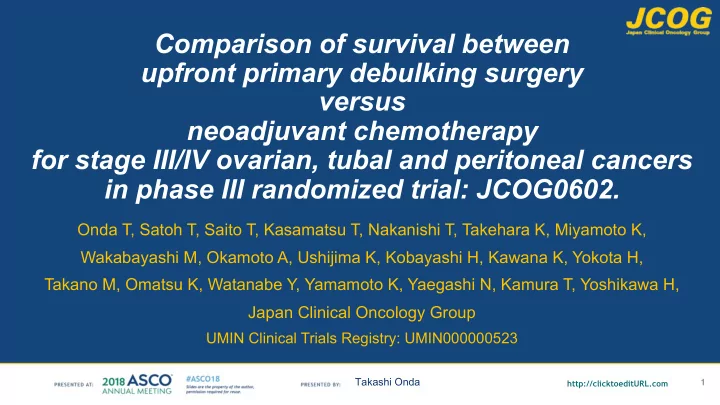
Comparison of survival between upfront primary debulking surgery versus neoadjuvant chemotherapy for stage III/IV ovarian, tubal and peritoneal cancers in phase III randomized trial: JCOG0602.

Onda T, Satoh T, Saito T, Kasamatsu T, Nakanishi T, Takehara K, Miyamoto K, Wakabayashi M, Okamoto A, Ushijima K, Kobayashi H, Kawana K, Yokota H, Takano M, Omatsu K, Watanabe Y, Yamamoto K, Yaegashi N, Kamura T, Yoshikawa H, Japan Clinical Oncology Group

UMIN Clinical Trials Registry: UMIN000000523

1

slide-2
SLIDE 2

Takashi Onda

http://clicktoeditURL.com

Background

  • Two preceding studies, EORTC55971 and CHORUS

comparing upfront primary debulking surgery (PDST) and neoadjuvant chemotherapy (NACT) for stage III/IV

  • varian, tubal and peritoneal cancers demonstrated

non-inferiority of NACT in overall survival (OS).

  • We have already reported reduced invasiveness of

NACT compared to PDST in several parameters.

2

slide-3
SLIDE 3

Takashi Onda

http://clicktoeditURL.com

Results of Previous studies

3

Characteristics EORTC (2010) CHORUS (2015) PDST (N=336) NACT (N=334) PDST (N=276) NACT (N=274) PFS(M) 12 12 11 12 OS(M) 29 30 23 24 HR for NACT in OS 0.98 0.87 Confidence interval (CI) 90% CI 0.84-1.13 95% CI 0.72-1.05 Non-inferiority margin 1.25 1.18 p value 0.01 NA

slide-4
SLIDE 4

Takashi Onda

http://clicktoeditURL.com

4

Parameters for treatment invasiveness PDST(n=149) NACT(n=152) P value Average number of surgery 1.32 0.86 <0.0001 Median operation time (min) 341 273 <0.0001 Median Blood/Ascites loss (ml) 3447 619.5 <0.0001 Resection of Abdominal organs 56(37.6%) 36(23.7%) 0.0121 Distant metastases 16(10.7%) 6(3.9%) 0.0272 Transfusion* RCC 97(66.0%) 79(52.7%) 0.0247 FFP 42(28.6%) 25(16.7%) 0.0180 Post-operative G3/4 adverse events** 23(15.6%) 6(4.6%) 0.0029 *among all treated patients, **among all operated patients

Comparison of Treatment Invasiveness

slide-5
SLIDE 5

Takashi Onda

http://clicktoeditURL.com

Main Objective of the JCOG0602

  • To prove non-inferiority of NACT compared with PDST

in terms of OS.

  • Primary Endpoint

Overall Survival (OS)

  • Secondary Endpoint

Progression-free Survival (PFS)

5

slide-6
SLIDE 6

Takashi Onda

http://clicktoeditURL.com

Trial Design

6

R a n d

  • m

i z a t i

  • n

TC regimen: PTX 175 mg/m2 iv, CBDCA AUC 6.0 iv

*; Optional for pts with suboptimal PDS. Mandatory for pts with any of Ut/Adn/OM Unremoved.

NAC (4x TC)

Experimental Arm (NACT)

IDS 4x TC

Standard Arm (PDST)

PDS 4x TC 4x TC IDS* 4x TC

Clinically diagnosed Stage III/IV ovarian, tubal, and peritoneal cancers

Multicenter (34 specialized institutions), Randomized Phase III Trial Balancing factors Institution, Stage III/IV PS 0-1/2-3, Age <60/≥60

PDS: primary debulking surgery IDS: interval debulking surgery

slide-7
SLIDE 7

Takashi Onda

http://clicktoeditURL.com

Key Eligibility Criteria

1. Untreated stage III or IV ovarian, tubal, or peritoneal cancers based on CT, MRI, and cytological tests. 2. Malignancies of other origin should be excluded by endoscopy, opaque enema, or ultrasonography when suspected. 3. CA125 >200 U/ml and CEA <20 ng/ml 4. No metastasis to brain, bone, or bone marrow 5. Age 20 to 75 years 6. PS of 0 to 3

  • 7. Adequate organ functions

7

slide-8
SLIDE 8

Takashi Onda

http://clicktoeditURL.com

Planned sample size was 300 (Expected number of events was 276)

  • One-sided alpha of 0.05
  • Power of 0.8
  • Expected 3-year OS

PDST = 25%, NACT = 30.3%

  • Non-inferiority margin = 5% in 3-year OS

Corresponding HR of 1.161

  • Accrual period: 3 years, Follow-up period: 5 years

8

Initial Statistical Considerations

slide-9
SLIDE 9

Takashi Onda

http://clicktoeditURL.com

Revised Statistical Considerations

  • Accrual period was extended to nearly 5 years
  • Follow-up period was extended to 6 years due to fewer

events

  • Final number of events was 227, power was 0.73
  • Interim analysis was performed twice

Predetermined analysis and additional analysis due to the extension of study period Multiplicity adjusted alpha = 0.04598

9

slide-10
SLIDE 10

Takashi Onda

http://clicktoeditURL.com

CONSORT Flow Diagram

10

Enrolled (N=301) PDST arm (N=149)

No PDS (N=2)

NACT arm (N=152)

No TC NAC (N=2) No Post-ope CTx (N=4) No Post-ope CTx (N=3) Discontinued NAC (N=20) Discontinued CTx (N=23) No CTx (N=9) Discontinued CTx (N=10) Discontinued CTx (N=26)

NAC (N=150) IDS (N=130) Post-ope CTx (N=126) PDS (N=147) IDS (N=49) Post-ope CTx (1-4th) (N=138) Post-ope CTx (5-8th) (N=125) Complete Tx (N=103) Complete Tx (N=99)

slide-11
SLIDE 11

Takashi Onda

http://clicktoeditURL.com

Patients’ Characteristics 1 (Balancing factors)

11

Characteristics PDST (N = 149) NACT (N = 152) Stage III IV 100 (67.1%) 49 (32.9%) 105 (69.1%) 47 (30.9%) Age Median (Range) < 60 ≥ 60 59 (30-75) 75 (50.3%) 74 (49.7%) 60.5 (36-75) 72 (47.4%) 80 (52.6%) PS 0-1 2-3 130 (87.2%) 19 (12.8%) 131 (86.2%) 21 (13.8%)

slide-12
SLIDE 12

Takashi Onda

http://clicktoeditURL.com

Patients’ Characteristics 2

12

Characteristics PDST (N = 149) NACT (N = 152) CA125 (U/ml) 200 <, ≤ 500 500 <, ≤ 1000 1000 <, ≤ 2000 2000 < 24 (16.1%) 25 (16.8%) 26 (17.4%) 74 (49.7%) 29 (19.1%) 34 (22.4%) 24 (15.8%) 65 (42.8%) Upper abdominal tumor ≤ 2cm 2 cm <, ≤ 5cm 5 cm <, ≤ 10cm 10cm < 32 (21.5%) 42 (28.2%) 40 (26.8%) 35 (23.5%) 42 (27.6%) 51 (33.6%) 35 (23.0%) 24 (15.8%)

slide-13
SLIDE 13

Takashi Onda

http://clicktoeditURL.com

Patients’ Characteristics 3

13

Characteristics PDST (N = 149) NACT (N = 152) Histology* (by surgical specimen) Serous Endometrioid Mucinous Clear Mixed Others Total 115 (78.2%) 6 (4.1%) 2 (1.4%) 12 (8.2%) 4 (2.7%) 8 (5.4%) 147 102 (78.5%) 4 (3.1%) 2 (1.5%) 4 (3.1%) 1 (0.8%) 17 (13.1%) 130 Chemotherapy Cycles Median (25%-75%) Average SD 8 (6-8) 6.7 2.5 8 (7-8) 6.8 2.2 Treatment Completion 99 (66.4%) 103 (67.8%)

*among all operated patients

slide-14
SLIDE 14

Takashi Onda

http://clicktoeditURL.com

Surgical Procedures

14

PDST PDS (N = 147) PDST PDS IDS (N = 147) NACT IDS (N = 130) Median Operation Time (min) 240 347 302 Complete Surgery (RT=0) Optimal Surgery (RT=0 or <1cm) 17 (11.6%) 55 (37.4%) 45 (30.6%) 92 (62.6%) 83 (63.8%) 107 (82.3%) Pelvic Lymphadenectomy Para-aortic Lymphadenectomy 40 (27.2%) 17 (11.6%) 59 (40.1%) 29 (19.7%) 94 (72.3%) 64 (49.2%) Abdominal Organ Resection Distant Metastases Resection 40 (27.2%) 8 (5.4%) 56 (38.1%) 16 (10.9%) 36 (27.7%) 6 (4.6%) RT: Residual Tumor

slide-15
SLIDE 15

Takashi Onda

http://clicktoeditURL.com

Pts at risk Arm A Arm B 149 152 140 140 112 115 91 88 76 71 57 58 50 46 34 35 22 22 15 11 4 3 Months after randomization Proportion 0.0 0.1 0.2 0.3 0.4 0.5 0.6 0.7 0.8 0.9 1.0 12 24 36 48 60 72 84 96 108 120 132

Overall Survival (N=301)

15

HR=1.05 [90.8% CI 0.83-1.33] (p=0.24)+

+ Cox proportional hazard model stratified by clinical stage, PS and age [for non-inferiority]

PDST (N=149) NACT (N=152) MST 49.0M 44.3M 95% CI 38.7-56.2M 35.8-52.5M

slide-16
SLIDE 16

Takashi Onda

http://clicktoeditURL.com

Pts at risk Arm A Arm B 149 152 99 112 44 48 32 32 28 23 26 20 24 19 15 14 11 11 9 6 1 1 Months after randomization Proportion 0.0 0.1 0.2 0.3 0.4 0.5 0.6 0.7 0.8 0.9 1.0 12 24 36 48 60 72 84 96 108 120 132

Progression-free Survival (N=301)

16

HR=0.96 [95% CI 0.75-1.23]+

+ Cox proportional hazard model adjusted by clinical stage, PS and age

PDST (N=149) NACT (N=152) MPFS 15.1M 16.4M 95% CI 13.4-18.1M 15.0-18.8M

slide-17
SLIDE 17

Takashi Onda

http://clicktoeditURL.com

OS according to Debulking Results

17

PDST (N=147) NACT (N=130)

Pts at risk RT = 0cm RT < 1cm 17 38 17 37 16 30 15 25 13 21 11 18 10 15 6 10 5 4 4 3 1 1 RT ≥ 1cm 92 86 66 51 42 28 25 18 13 8 2 Months after randomization Proportion 0.0 0.1 0.2 0.3 0.4 0.5 0.6 0.7 0.8 0.9 1.0 12 24 36 48 60 72 84 96 108 120 132 Pts at risk RT = 0cm RT < 1cm 83 24 81 22 71 17 59 11 46 9 43 4 37 3 28 3 17 3 8 2 3 RT ≥ 1cm 23 20 14 9 8 6 3 1 Months after randomization Proportion 0.0 0.1 0.2 0.3 0.4 0.5 0.6 0.7 0.8 0.9 1.0 12 24 36 48 60 72 84 96 108 120 132

RT MST 0 cm Not estimable < 1 cm 54.9M ≥ 1 cm 43.0M RT MST 0 cm 67.0M < 1 cm 34.0M ≥ 1 cm 32.0M

slide-18
SLIDE 18

Takashi Onda

http://clicktoeditURL.com

Treatment Effect on OS in Major Subgroups

18

  • HR[95% CI]

1.04[0.76-1.43] 1.15[0.73-1.81] 1.02[0.70-1.49] 1.13[0.79-1.63] 1.28[0.88-1.86] 0.98[0.64-1.53] 0.72[0.35-1.46] 0.68[0.33-1.42] 1.21[0.69-2.11] 1.15[0.68-1.94] 1.27[0.82-1.95] 1.17[0.63-2.20] 1.19[0.63-2.24] 1.40[0.76-2.58] 0.88[0.60-1.30] 1.07[0.62-1.85] 1.03[0.65-1.65] 1.06[0.63-1.81] 1.24[0.69-2.24] 1.95[0.71-5.34] 1.00[0.76-1.32] 1.12[0.66-1.90] 1.05[0.78-1.41] 1.36[0.92-2.01] 0.86[0.61-1.22] 1.08[0.83-1.40]

Factor Clinical stage Age Max size of upper abdominal tumor PS Alb CA125 Institution (Surgical activity) Histological type Institution (Study activity) Overall N (PDST/NACT)

100/105 49/47 75/72 74/80 71/87 59/44 19/21 23/14 34/31 35/41 56/65 24/29 25/34 26/24 74/65 32/42 42/51 40/35 35/24 14/8 133/135 40/36 109/116 73/67 76/85 149/152

Level

≤2cm 2cm<, ≤5cm 5cm<, ≤10cm 10cm< Optimal rate≥60% Optimal rate<60% III IV <60 ≥60 1 2 or 3 ≤2.5 2.5<, ≤3.0 3.0<, ≤3.5 3.5< 200<, ≤500 500<, ≤1000 1000<, ≤2000 2000< Clear/mucinous Others Enrolled≥20pts Enrolled<20pts

NACT better PDST better MST PDST / NACT 56.9M / 49.5M 46.8M / 42.4M

slide-19
SLIDE 19

Takashi Onda

http://clicktoeditURL.com

Subset Analysis (Institutional Study Activity)

19

PS 2–3 Study activity Category High(N=140) Low(N=161) Age 59 61 Stage IV 35% 29% Alb≤2.5 g/dl 9% 16% PS 2-3 12% 14% CA125 (U/ml) 1705.5 1603 PDS in PDST (N=72) (N=75) Optimal rate 51% 24% Operation time (min) 304 175 IDS in NACT (N=60) (N=70) Optimal rate 82% 83% Operation time (min) 320 284 HR for NACT 1.36(0.92-2.01) 0.86(0.61-1.22)

slide-20
SLIDE 20

Takashi Onda

http://clicktoeditURL.com

Comparison of Patient Characteristics

20

Characteristics EORTC (2010) CHORUS (2015) JCOG PDST (N=336) NACT (N=334) PDST (N=276) NACT (N=274) PDST (N=149) NACT (N=152) Age (Range) 62 (25-86) 63 (33-81) 66 (26-87) 65 (34-88) 59 (30-75) 60.5 (36-75) PS 2-3 40 (12%) 44 (13%) 54 (20%) 53 (19%) 19 (13%) 21 (14%) Stage IV 77 (23%) 81 (24%) 70 (25%) 68 (25%) 49 (33%) 47 (31%) CA125 (Median, U/ml) 1130 1180 NA NA 1950 1556.5 Clear/mucinous histology 14 (4%) 15 (4%) 6 (2%) 17 (8%) 14 (10%) * 6 (5%) * NA: not available *among all operated patients

slide-21
SLIDE 21

Takashi Onda

http://clicktoeditURL.com

21

Operative parameters EORTC(2010) CHORUS(2015) JCOG PDS in PDST (N=310) IDS in NACT (N=322) PDS in PDST (N=251) IDS in NACT (N=217) PDS PDS±IDS IDS in NACT (N=130) in PDST(N=147) Operation time(min) 165 180 120 120 240 347 302 Complete Surgery 61(19%) 151(51%) 39(17%) 79(39%) 17(12%) 45(31%) 83(64%) Optimal Surgery 131(42%) 238(81%) 96(41%) 147(73%) 55(37%) 92(63%) 107(82%) PLA 58(19%) 77(24%) 7(3%) 2(1%) 40(27%) 59(40%) 94(72%) PALA 26(8%) 49(15%) 3(1%) 1(<1%) 17(12%) 29(20%) 64(49%) Bowel Resection 48(16%) 28(9%) 27(10%) 18(7%) 38(26%) 51(35%) 33(25%) IDS in PDST 57(17%) NA 49(33%) PFS(M) * 12 12 11 12 15 16 OS(M) * 29 30 23 24 49 44 PLA: pelvic lymphadenectomy, PALA: para-aortic lymphadenectomy *among all registered patients

Comparison of Operative Parameters

slide-22
SLIDE 22

Takashi Onda

http://clicktoeditURL.com

Summary

  • 1. Non-inferiority of NACT compared with PDST was not confirmed in OS.
  • 2. Treatment effect on OS of NACT within major subgroups was

assessed. 1) PS 2/3, serum Alb ≤2.5, CA125>2000, and institution with low study activity were advantageous to NACT, and clear/mucinous (chemoresistant) histology was disadvantageous to NACT, though there were no significant differences. 2) Institution with high surgical activity was associated with better

  • utcome of both arms.

3) Advantage of NACT in institutions with low study activity may be not

  • nly due to lower optimal debulking rate in PDS but also due to

poorer pre-treatment condition (lower serum Alb level).

22

slide-23
SLIDE 23

Takashi Onda

http://clicktoeditURL.com

Conclusions

  • 1. NACT cannot be always a substitute for PDST in

first-line treatment of advanced ovarian, tubal, and peritoneal cancer.

  • 2. NACT can be possibly a substitute for PDST in

patients with poor general condition and in patients supposed with chemosensitive histology.

  • 3. Further studies may be necessary to demonstrate a

role of NACT.

23

slide-24
SLIDE 24

Takashi Onda

http://clicktoeditURL.com

Acknowledgements

24

JCOG Data Center and Operations Office Fukuda H (Data Center Director), Shibata T, Ogawa G (Statistical Section), Kubota K (Data Management Section), Eba J, Mizutani T (Operations Office) Gynecologic Cancer Study Group of the JCOG (Participating institutions) Hokkaido University Hospital, Sapporo Medical University, Iwate Medical University, Tohoku University Hospital, Faculty of Medicine, University of Tsukuba Hospital, National Defense Medical College, Saitama Cancer Center, Saitama Medical Center, Saitama Medical University, Jikei Kashiwa Hospital, National Cancer Center Hospital, Jikei University Hospital, Cancer Institute Hospital of Japanese Foundation for Cancer Research, The University of Tokyo Hospital, Juntendo University Hospital, Kitasato University School of Medicine, Niigata Cancer Center Hospital, Shinshu University School of Medicine, Aichi Cancer Center Hospital, Nagoya University School of Medicine, Kyoto University Hospital, Osaka City University Hospital, Kindai University Hospital, Osaka International Cancer Institute, Osaka City General Hospital, Kindai University Sakai Hospital, Tottori University, Kure Medical Center Chugoku Cancer Center, Shikoku Cancer Center, National Kyushu Cancer Center, Kurume University Hospiatal, Kyushu University Hospital, Faculty of Medicine, Saga University, Kagoshima City Hospital, University of the Ryukyus Hospital The study was supported by Health Sciences Research Grants for the Third-Term Comprehensive Control Research for Cancer (H16-035), Health Sciences Research Grants for Clinical Cancer Research (H19-028, H22-020), Grants-in Aid for Cancer Research (17S-1, 17S-5, 18-06, 20S-1, 20S-6) from the Ministry of Health, Labor and Welfare, Japan, and the National Cancer Center Research and Development Funds (23-A-16, 23-A-17, 26-A-4 and 29-A-3).