Options for Debulking of In-Stent No relevant disclosures - - PowerPoint PPT Presentation

options for debulking of in stent
SMART_READER_LITE
LIVE PREVIEW

Options for Debulking of In-Stent No relevant disclosures - - PowerPoint PPT Presentation

Options for Debulking of In-Stent No relevant disclosures Restenosis for Infra-inguinal Occlusive Disease: Atherectomy David Rigberg, M.D. Professor of Surgery Division of Vascular Surgery David Geffen School of Medicine at UCLA Los Angeles,


slide-1
SLIDE 1

1

Options for Debulking of In-Stent Restenosis for Infra-inguinal Occlusive Disease: Atherectomy

David Rigberg, M.D.

Professor of Surgery Division of Vascular Surgery David Geffen School of Medicine at UCLA Los Angeles, California

No relevant disclosures

Endovascular Treatment of Infra- Infrainguinal Disease

Stenting of the SFA and Popliteal Arteries

IFU indication/approval of Stents for SFA Increased number of CTO & Re-entry devices Widening breadth of techniques for complex disease Cordis S.M.A.R.T. Stent

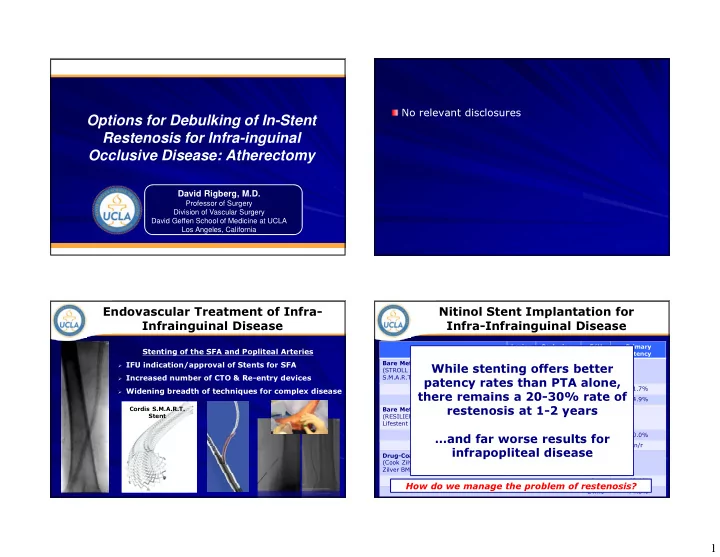
Nitinol Stent Implantation for Infra-Infrainguinal Disease

PHOTOS OF WATCHIN RETROGRADE PROCEDURE

Lesion Length Occlusions F/U Primary Patency Bare Metal Stent (STROLL Trial – Nonrandomized S.M.A.R.T . Stent FDA approval trial) 77mm 23.6% 12mo 81.7% 24mo 74.9% Bare Metal Stent (RESILIENT Trial – RCT of Cordis Lifestent v. PTA) 66mm 17.0% 12mo 80.0% 24mo n/r Drug-Coated Stent (Cook Zilver PTX – RCT of Zilver PTX v. Zilver BMS) 66mm 32.8% 12mo 83.1% 24mo 74.8%

While stenting offers better patency rates than PTA alone, there remains a 20-30% rate of restenosis at 1-2 years …and far worse results for infrapopliteal disease

How do we manage the problem of restenosis?

slide-2
SLIDE 2

2 In-Stent Restenosis in Infra- Inguinal Occlusive Disease

Strategies for Managing In-Stent Restenosis

Prevention Stent Oversizing / Chronic Outward Radial Force Pharamacotherapy Re-Intervention Balloon Angioplasty Cryoplasty

Atherectomy / Debulking

SFA In-Stent Restenosis Options for Debulking ISR

Silverhawk (ev3) Jetstream G2

(Pathway Med Tech)

Diamondback 360

(CSI) Turbo Elite Laser (Spectranetics)

SFA In-Stent Restenosis Options for Debulking ISR Limitations of Debulking Devices for ISR

Devices not designed for myointimal hyperplasia No device available with indication for ISR Some devices are contraindicated for ISR No effect on the biology of restenosis

SFA In-Stent Restenosis Turbohawk Excisional Atherectomy

FDA clearance in PAD in 2003 Directional excisional atherectomy catheter Single-use battery operated motor unit Carbide cutter blade (8000 rpm) Excised plaque directed into nose cone

slide-3
SLIDE 3

3 SFA In-Stent Restenosis Turbohawk Excisional Atherectomy

Porous nose cone allows dense packing Hinged elbow for vessel wall apposition Advantages

  • No interruption of blood flow during excision
  • No balloon for wall apposition

SFA In-Stent Restenosis Turbohawk Excisional Atherectomy

Monorail design 0.014-inch guidewire system 6Fr to 7Fr sheath compatibility Catheter working length 135cm Luminal gain 2mm to 5.5mm

PRE POST POST PRE Occlusions crossed

Heavily calcified and stented lesion with in-stent

  • cclusion
slide-4
SLIDE 4

4

J Am Coll Cardiol. 2006 Oct 17;48(8):1573-8.

Long-term results after directional atherectomy of femoro-popliteal lesions.

Zeller T , Rastan A, Sixt S, et al. Retrospective analysis of 131 lesions in 84 patients 43 lesions were in-stent restenosis of fempop stents Results (of the ISR lesions) : 83% technical success w/atherectomy alone Primary patency (50% by duplex) at 12months: 54% Secondary patency at 12months: 91% Only independent predictor of restenosis: Rx of Restenotic lesions

SFA In-Stent Restenosis Turbohawk Excisional Atherectomy

Cardiovasc Revasc Med. 2012 Jul-Aug;13(4):224-7.

Safety and 1-year revascularization outcome of SilverHawk atherectomy in treating in-stent restenosis of femoropopliteal arteries: a retrospective review from a single center.

Shammas NW , Shammas GA, Helou TJ, Voelliger CM, Mrad L, Jerin M. Retrospective analysis of SFA in-stent restenosis treated w/ atherectomy 41 patients, mean follow-up of 12months 100% technical success (w/ 98% adjunctive PTA at 11ATMs) Adjunctive stenting in 24%, Adverse events: 7.3% embolization, 4.9% stent thrombosis Results: Mean ABI at 1 month: Increased from 0.66 to 0.91 Mean ABI at 12 months: 0.61 (NS compared to preop)

SFA In-Stent Restenosis Turbohawk Excisional Atherectomy SFA In-Stent Restenosis Medrad Jetstream Navitus Atherectomy

7F sheath compatibility 0.014 wire platform Tip diameter 2.4/3.4 or 2.1/3.0 mm Expanding rotational blades for two different luminal diameters Self-contained disposable drive unit Combines atherectomy and active aspiration of generated debris

  • Vasa. 2013 Mar;42(2):127-33.

Rotational and aspiration atherectomy for infrainguinal in-stent restenosis.

Beschorner U, Krankenberg H, Scheinert D, Sievert H, Tübler T , Sixt S, Noory E, Rastan A, Macharzina R, Zeller T . Multicenter prospective registry, non-randomized 33 patients (40 lesions) with in-stent restenosis All infrainguinal disease; 5% infrapop Atherectomy alone in 40%, adjunctive angioplasty in 60% Results : No device related complications or embolizations Primary patency at 12- and 24-months: 33% and 25% Secondary patency at 12- and 24-months: 92% and 92%

SFA In-Stent Restenosis Jetstream Navitus Atherectomy
slide-5
SLIDE 5

5 SFA In-Stent Restenosis Spectranetics Laser Atherectomy

Catheter and laser generator Xenon laser : 308nm (ultraviolet) wavelength Tissue penetration 10µm, no adjacent temp increase Vaporizes thrombus, plaque, luminal debris 6Fr-7Fr Sheath compatibility Guide wire 0.014-inch or 0.018-inch Catheter diameters range 0.9-2.5mm

SFA In-Stent Restenosis Spectranetics Laser Atherectomy

Disadvantages : Small resultant luminal diameter

  • 7Fr Turbo-Booster : 0.9mm-1.7mm
  • 8Fr Turbo-Booster : 1.7mm-2.0mm

Advantages : Indications

  • In-stent restenosis Indication (CAD)
  • Thrombolytics (off-label)

PRE POST

slide-6
SLIDE 6

6

POST PRE

Photo-Ablation using the Turbo-booster and Excimer Laser for In-steNT Restenosis (PATENT) Study

Zeller T , Presented at Leipzig Interventional Course (LINC) 2013, Leipzig, Germany; January 23-26,2013 90 patients at five centers in Germany; Non-randomized registry Average lesion length 109mm Turbo Elite laser and turbo booster system Mean pre- and post-laser stenosis: 87% and 32.4% Andjunctive angioplasty in most cases Technical success of 98.8% Two episodes of stent thrombosis Freedom from TLR at 6- and 12-months: 82% and 52%

SFA In-Stent Restenosis Spectranetics Laser Atherectomy

THE EXCITE ISR TRIAL

EXCImer Laser Randomized Controlled Study for Treatment of FemoropopliTEal In-Stent Restenosis

U.S. FDA IDE trial Turbo Elite laser and turbo booster system 35 Centers with goal of 353 patients – stopped at 250

(early efficacy at prospectively-specified interim analysis)

2:1 Randomization between laser with PTA v. PTA alone Results: Procedural success 93.5% v 82.7% (p=0.01) Favorable at 6 months (freedom from TLR 73.5% v

51.8% (p<0.005)

SFA In-Stent Restenosis Spectranetics Laser Atherectomy

Excimer Laser and Heparin Bonded Viabahn for Treatment of Femoropopliteal In-Stent Restenosis (12m SALVAGE Study Results)

Single arm non-randomized study 27 pts with fempop in-stent restenosis Claudicants and CLI patients Results : 100% technical success No MAE (TLR, mortality, amputation) 12mo primary patency: 48% 12mo TLR: 17.4%

SFA In-Stent Restenosis Laser Atherectomy & Covered Stents

slide-7
SLIDE 7

7

Conclusions

Debulking of In-stent Restenosis:

  • Can be performed safely with multiple available

atherectomy devices.

  • All of these debulking strategies have been plagued by

high rates of restenosis, just as has been demonstrated in previous literature on balloon angioplasty, cryoplasty, and cutting balloon angioplasty.

  • Improvements in long term outcome may be improved by

understanding technical factors contributing to restenosis and by modulating the disease biology with drug-eluting technology & pharmacotherapy.

Division of Vascular Surgery University of California, Los Angeles UCLA Ronald Reagan Medical Center Los Angeles, California