Co mmunity Adviso ry Gro up Me e ting No . 1 Runnymede United - - PowerPoint PPT Presentation

co mmunity adviso ry gro up me e ting no 1
SMART_READER_LITE
LIVE PREVIEW

Co mmunity Adviso ry Gro up Me e ting No . 1 Runnymede United - - PowerPoint PPT Presentation

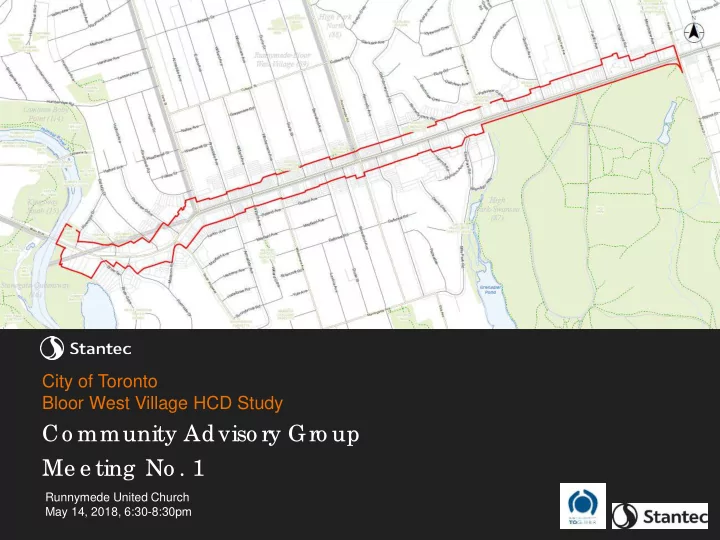
City of Toronto Bloor West Village HCD Study Co mmunity Adviso ry Gro up Me e ting No . 1 Runnymede United Church May 14, 2018, 6:30-8:30pm Me e ting Purpo se Introduce the Bloor West Village Heritage Conservation District (HCD) Study

slide-1
SLIDE 1

City of Toronto Bloor West Village HCD Study

Co mmunity Adviso ry Gro up Me e ting No . 1

Runnymede United Church May 14, 2018, 6:30-8:30pm

slide-2
SLIDE 2

Me e ting Purpo se

  • Introduce the Bloor West Village Heritage

Conservation District (HCD) Study and Process

  • Review the draft Terms of Reference of the

Community Advisory Group (CAG)

  • Provide an overview of work completed to date
  • Guided discussion on characteristics of the study

area and defining features

  • Discuss next steps
slide-3
SLIDE 3

Ag e nda Re vie w, Ope ning Re ma r ks a nd Intr

  • duc tions

Agenda Item One

slide-4
SLIDE 4

Ag e nda

6:30 Agenda Review, Opening Remarks, and Introductions 6:40 Review of Draft Terms of Reference 6:50 Bloor West Village HCD Presentations

  • HCD Study Overview and Process
  • HCD Preliminary Research

7:30 Guided Discussion 8:25 Wrap Up and Next Steps 8:30 Adjourn

slide-5
SLIDE 5

Re vie w of CAG Dr aft T e r ms of Re fe r e nc e

Agenda Item Two

slide-6
SLIDE 6
  • Nine (9) Members in the Bloor West

Village CAG

  • Local Residents (4)
  • Bloor West Village Residents

Association (1)

  • Bloor West Village BIA (1)
  • High Park Residents Association (1)
  • Swansea Ratepayers Association (1)
  • Municipal Planner (1)

CAG Members

Co mmunity Adviso ry Gro up (CAG) Co mpo sitio n

CAG Membership

Local Residents Bloor West Village Residents Association Bloor West Village BIA High Park Residents Association Swansea Ratepayers Association Municipal Planner

slide-7
SLIDE 7

CAG T e rms o f Re fe re nc e (T

  • R)

CAG ToR

  • The Bloor West Village HCD Study was prioritized by City Council in March 2015, and is being

undertaken in coordination with the Bloor West Village Avenue Study

  • The purpose is to examine the character and appearance of the Study Area to determine the

most appropriate approach to conserving its heritage resources

  • The HCD Study includes research, a built form survey, analysis and evaluation to determine if

the area, or portions of it, warrant designation as a Heritage Conservation District

  • The Study Area contains more than 240 properties fronting onto Bloor Street West between Keele

Street and the Humber River. The Study Area may be refined through the study process, and does not necessarily reflect any future HCD boundary

slide-8
SLIDE 8

CAG T

  • R – Ma nda te a nd Ob je c tive s
  • The mandate of the CAG is to provide local expertise

and advice to City staff and the consultant team to ensure the range of perspectives and priorities in the community are reflected in the HCD Study and its recommendations

  • The objectives of the CAG are to:
  • Assist in the identification of the Study Area’s

cultural heritage value;

  • Share perspectives on key issues affecting the

HCD Study;

  • Offer knowledge, views, and ideas for

consideration within the process; and

  • Provide City staff and the consultant team with a

vetting of information and ideas

slide-9
SLIDE 9

CAG T

  • R – Ro le s a nd Re spo nsib ilitie s

Blo o r We st Villa g e CAG Me mb e rs:

  • Attend and participate in CAG meetings;
  • Review all materials provided prior to each meeting, so that an informed discussion can take place;
  • Discuss the knowledge, information, views, opinions, perspectives, and insights on Bloor West Village as a whole

and not focus on one issue or location;

  • Engage in open, honest and respectful dialogue;
  • Ask questions of other members of the CAG or City staff/consultant team, where necessary, to clarify

understanding of an issue;

  • Remain positive and contribute to the discussion in a meaningful way;
  • Abide by the Terms of Reference and Code of Conduct established for the CAG; and
  • Communicate openly with stakeholders of the organizations represented (if applicable) and bring forward their

input, advice and suggestions.

City Sta ff a nd He rita g e Co nsulta nt:

  • Keep CAG members up-to-date on the HCD

Study progress using an accessible, easy-to- understand format and language;

  • Treat all questions posed with respect, and

provide clear and straightforward answers;

  • Provide a clear understanding of how input,

advice, and suggestions will be used; and

  • Balance input from different viewpoints to ensure

an inclusive environment.

F a c ilita to r (Sta nte c ):

  • Facilitate CAG meetings by:
  • keeping sessions on time and on track;
  • ensuring respectful and productive

meetings and group dialogue; and

  • balancing participation between all

members.

  • Record all inputs at meetings, provide

clarification, advice and suggestions to the CAG and prepare meeting summaries.

slide-10
SLIDE 10

CAG T

  • R – Co de o f Co nduc t
  • Participants should review the agenda and any reports before attending each meeting;
  • Participants will be courteous, listen to others and respect the opinions of others;
  • Participants should ask questions if a statement is unclear;
  • Participants should participate fully in discussion but not dominate the discussion or allow
  • thers to do so;
  • Participants will speak one at a time and not cut off other participants while they are

speaking;

  • Participants wishing to make comments will do so through the facilitator, and wait their turn

until they have the floor;

  • Private discussions should be held outside of the meeting room while the meeting is in

progress;

  • Participants will not swear and should not use obscene or foul language;
  • Participants will not make derogatory comments based on gender, race, ethnicity, religion,

sexual orientation or disability; and

  • Participants should not request that items outside of the mandate of the committee be

discussed at CAG meetings. The City of Toronto is committed to ensuring a safe and respectful environment for both clients and staff. Aggressive

  • r intimidating behaviour, harassment or coarse language will not be tolerated.

Members who do not follow this Code of Conduct will receive one initial warning after the first violation from the facilitator. Upon a second violation, the individual will be removed from the meeting. A third violation will result in dismissal from the CAG and will be taken into account in future City committee selection processes.

slide-11
SLIDE 11

CAG T

  • R (c o ntinue d)

De c isio n-Ma king

As an advisory body, the CAG is not responsible for making decisions regarding the HCD

  • Study. This is the responsibility of City staff and City Council. The Bloor West Village CAG is

encouraged to discuss and debate ideas towards the generation of consensus. If after a period of time no consensus can be reached, differences will be documented along with rationales.

Ag e nda s a nd Me e ting Summa rie s

City staff will provide electronically circulated agendas and meeting materials approximately

  • ne week prior to each CAG meeting. Meeting summaries will be distributed by e-mail

approximately two weeks following each meeting. Meeting summaries will be made available to the public and will form part of the Final HCD Study Report.

Co nflic t o f I nte re st

Every CAG member has a duty to promptly report any conflict of interest with the City of Toronto to the Study Team. The City of Toronto may deny a CAG membership to avoid, neutralize, or mitigate an actual, perceived, or potential conflict of interest. If a CAG member fails to promptly disclose the existence of any conflict of interest, the City of Toronto may in its sole discretion terminate the CAG member's membership.

slide-12
SLIDE 12

Bloor We st Village HCD Pr e se ntations

Agenda Item Three

slide-13
SLIDE 13

HCD Study Ove r vie w and Pr

  • c e ss

Agenda Item Three A (3A)

slide-14
SLIDE 14

B loor West Vi llage HCD Study - T i meli ne

1

slide-15
SLIDE 15

Study P ur pose

2

T he purpo se o f the HCD Study is to ide ntify a nd a sse ss the c ultura l he rita g e va lue a nd he rita g e a ttrib ute s o f the study a re a a nd to de ve lo p a stra te g ic a ppro a c h to the ir c o nse rva tio n. T his will invo lve de te rmining if the study a re a , o r a re a s within the study a re a , wa rra nt de sig na tio n a s a He rita g e Co nse rva tio n Distric t unde r Pa rt V o f the Ontario He ritag e Ac t.

slide-16
SLIDE 16

What is a Her itage Conser vation Distr ict?

An a re a with a c onc e ntr

ation

  • f he rita g e pro pe rtie s tha t

distinguish it fro m its

surro unding s Pro te c te d unde r Pa rt V o f the

Ontar io He r itage Ac t

Pla nning to o l tha t e nsure s

  • ngoing c hange c o nse rve s

a nd e nha nc e s a n a re a ’ s

he r itage c har ac te r

So uth Ro se da le HCD

3

slide-17
SLIDE 17

4

Her i tage Conser vati

  • n Di

str i cts i n T

  • r
  • nto
slide-18
SLIDE 18

Ci ty Pl anni ng Pr

  • c ess for

H CDs

we are here

slide-19
SLIDE 19

Communi ty Consultati

  • n & P

ubli c E ngagement

CAG #1: Today CAG #2: June 14, 2018 CCM#2: Date TBD 6 CCM#1:

February 15, 2018

slide-20
SLIDE 20

HCD Pr e liminar y Re se ar c h

Agenda Item Three B (3B)

slide-21
SLIDE 21

Blo o r We st Villa g e HCD Study Ove rvie w

  • Study Area is approximately 2.7 kilometres in length
  • Extends from Keele Street to the Humber River
  • Includes over 240 properties that front onto Bloor Street
  • Bounded by two significant natural features – High Park and the Humber River
  • Business Improvement Association (BIA) is the oldest in Canada and has over 400 members
  • 5 TTC Stations (Old Mill, Jane, Runnymede, High Park, Keele)

Overview

slide-22
SLIDE 22

Ove ra ll Pro g re ss

Consultation

Ongoing

History and Evolution Built Form and Landscape Survey Archaeology Character Analysis

Ongoing

Policy Context

Ongoing

Heritage Evaluation

Task Pending

Recommendations

Task Pending

Report

Ongoing

slide-23
SLIDE 23
  • Four community consultation meetings planned for the HCD Study:
  • Community Consultation Meeting (CCM) 1 (February 15, 2018)
  • Community Advisory Group Meeting 1 (CAG) (May 14, 2018)
  • CAG Meeting 2 (June 14, 2018)
  • CCM 2 (Date TBD)

CCM1

Co mmunity Co nsulta tio n

slide-24
SLIDE 24

CCM 1 Ove rvie w

  • Community Consultation Meeting 1

was held on February 15, 2018 at Runnymede United Church from 5:30- 8:30 pm

  • Open house format
  • Display boards
  • Mapping exercise
  • Archival photo station
  • Community Advisory Group

application table

  • Planning study station
slide-25
SLIDE 25

CCM 1 Atte nda nc e Summa ry

  • Attendance summary
  • 46 people signed the visitor register
  • Councilor Sarah Doucette attended
  • Organization Representatives from:
  • Bloor West Village Residents

Association

  • Swansea Area Ratepayers’

Association

  • Swansea Historical Society
  • High Park Residents’ Association
  • Representative from the Office of

Arif Virani, M.P., Parkdale-High Park

slide-26
SLIDE 26

Ma pping E xe rc ise

slide-27
SLIDE 27

CCM 1

  • Built Heritage Resources:

A functional neighbourhood with a commercial core supported by the surrounding residential community. Commercial core has many buildings with contextual value. Several notable buildings in the study area (landmarks and distinguished architecture).

  • Landscape and Views:

Heritage landscape components concentrated at east and west ends of Study

  • Area. Few heritage landscape elements were identified in the commercial core. Views

were identified by community members throughout the study area but were most concentrated in the vicinity of High Park and in the block between Armadale Avenue and Jane Street.

  • Urban Fabric and Public Realm:

The two-to-three storey building scale and fine grain property parcels within the commercial core identified as being character defining elements by the local

  • community. The community also noted that the north and south sides of Bloor Street

West have different characters, which is related to the density of properties and presence of TTC stations on the north side of the street.

slide-28
SLIDE 28

CCM 1 (c o ntinue d)

  • Boundaries and Sub-Character Areas:

Differing feedback was received from the local community regarding the boundaries of the potential Bloor Street West HCD. Suggested boundaries ranged from the full Study Area (extending between Keele Street and the Humber River) and limiting the potential HCD to the commercial core (between Clendenan Avenue and Jane Street).

  • Small Businesses and BIA:

The Bloor West Village Business Improvement Area (BIA) and small businesses were noted as being of significance to the character of Bloor West Village. It was noted by several community members that small businesses should be supported by a potential HCD in the area.

  • Community Values:

It was noted that the Bloor West Village Toronto Ukrainian Festival is an important event for the community.

  • Concerns: Development pressure in the area.

New developments have greater massing and coarse property grain when compared with the existing built form. Concerns were also expressed regarding the potential impact of an HCD on property values in the area.

slide-29
SLIDE 29

History and Evolution

Historical periods included in the HCD Study:

  • Indigenous Presence (Prior to 1791)
  • Survey and Settlement (1791-1800)
  • 19th Century (1800-1899)
  • Early to late 20th Century Development (1900-1980)
  • Late 20th Century Development to Present (1980-Present)

Histo ry a nd E vo lutio n o f the Study Are a

Key Dates (Pre-1900):

  • 15th-17th Century: Ancestral territory of the Huron-

Wendat

  • 17th Century: Settled by the Seneca, Village of

Teiaiagon established

  • Late 17th – 18th Centuries: Mississauga Nation

control the area

  • 1791: Township of York surveyed
  • 1805: Toronto purchase between the Crown and the

Credit River Mississauga Nation

  • 1834: Town of York incorporated as the City of

Toronto

  • 1835-1838: First lots sold to Euro-Canadian settlers
  • 1838: Colborne Lodge constructed
  • 1860s: Bloor Street opened between Dundas Street

and the Humber River

  • 1876: High Park opened to public
  • 1884: Southeast section of Study Area (including

High Park) annexed as part of the Village of Brockton

Salmon, James Victor. High Park Mineral Baths, Bloor Street West, North Side, East of Parkview Gardens. Baldwin Collection, S 1-1032C.

slide-30
SLIDE 30

Pro po se d T he ma tic Histo ric a l Pe rio ds

Two distinct periods of historical development in the Study Area: 1. Growth of the City of Toronto in the early 20th century (1910-1929) 2. Mid-Century City Expansion and Transportation Improvements (1960-1979)

Bloor Street West looking east from Glendonwynne Avenue May 29, 1914 (Source: Goss May 1914) Bloor Street West looking northwest to Jane Street 1954 (Source: City of Toronto Archives 1954)

slide-31
SLIDE 31

E a rly 20th Ce ntury Gro wth (1910-1929)

  • 1909: North section of Study Area annexed as part of the West Toronto Junction
  • 1914: Bloor Street remains a dirt road
  • 1920: Central Section of the Study Area annexed as part of the Village of Swansea
  • 1919-1929: Bloor Street West improvements and the construction of the streetcar line

City of Toronto Archives. 1914. Muddy Bloor Street West at High Park, looking west. Fonds 1244, William James Family Fonds, Item 18. City of Toronto Archives. Ca. 1920. Bloor Street West at High Park, looking east. Fonds 1244, William James family fonds, Item 7081. Toronto Public Library. 1920. Bloor Street West., North Side, West of Quebec Avenue. Baldwin Collection, 975-1-9.

slide-32
SLIDE 32

Mid-Ce ntury E xpa nsio n (1960-1979)

  • 1966: Keele TTC Station

constructed

  • 1967: Southwest section of

Study Area annexed

  • 1969: High Park,

Runnymede, Jane and Old Mill TTC stations constructed

  • 1970: BIA established
  • 1950-1980: Development

prompted by the conclusion of the Second World War and the establishment of the BIA

City of Toronto Archives. 1954. Bloor Street West and Jane Street, looking northwest toward

  • intersection. Fonds 492, Item

268. Curt Frey, 1963, Bloor West Streetcar east of Runnymede Road, On Transit Toronto. Electronic Document: https://transit.toronto.on.ca/streetcar /4115.shtml Last accessed on: February 1, 2018

slide-33
SLIDE 33
slide-34
SLIDE 34
  • Built Form and Landscape

survey field work completed in late November 2017

  • Property history, architectural

details, landscape elements, and contextual information captured

  • Information gathered using

ArcGIS

  • Total of 302 properties

surveyed, Consolidated to 288 forms Survey Work

Built F

  • rm a nd L

a ndsc a pe Surve y

2545 Bloor Street West 2357 Bloor Street West 2279 Bloor Street West 2283 Bloor Street West 5 High Park Avenue 1914 Bloor Street West

slide-35
SLIDE 35

Arc GI S Co lle c to r Da ta

slide-36
SLIDE 36

Archaeology

Arc ha e o lo g ic a l Po te ntia l

  • The Study Area does not contain any archaeological sites registered in the Ontario

Archaeological Sites Database

  • The Study Area does not contain any Archaeologically Sensitive Areas (ASAs)
  • Numerous properties within the Study Area have archaeological potential, and will

require an archaeological assessment prior to re-development.

slide-37
SLIDE 37
slide-38
SLIDE 38
  • There are currently two protected heritage

properties in the Bloor Street West HCD Study Area:

  • 2178 Bloor Street West (Listed)
  • 2223 Bloor Street West (Designated)

Character Analysis

Cha ra c te r Ana lysis

2178 Bloor Street West 2223 Bloor Street West

slide-39
SLIDE 39
slide-40
SLIDE 40

Da te s o f Co nstruc tio n

  • All buildings in the study area were

constructed in the 20th century

  • Analysis of property construction dates:
  • 29 (10%) date from 1900-1919
  • 185 (63%) date from 1920-1939
  • 7 (2%) date from 1940-1949
  • 7 (2%) date from 1925-1947
  • 20 (7%) date from 1950-1959
  • 19 (6%) date from 1960-1979
  • 25 (9%) date from 1980-present
  • 2 (1%) do not contain a structure

1914 Bloor Street West

slide-41
SLIDE 41
slide-42
SLIDE 42

Building He ig hts

  • The majority (96%) of buildings in the Bloor West Village HCD

Study Area are low-rise in form and are four storeys or less

  • Breakdown of building heights in the Study Area:
  • 20 (7%) are one storey
  • 6 (2%) are 1.5 storeys
  • 177 (60%) are 2 storeys
  • 14 (5%) are 2.5 storeys
  • 50 (17%) are 3 storeys
  • 8 (3%) are 3.5 storeys
  • 5 (2%) are 4 storeys
  • 6 (2%) are 5-10 storeys
  • 5 (2%) are 10+ storeys
  • 3 (1%) have no height

2311 Bloor Street West

slide-43
SLIDE 43
slide-44
SLIDE 44

L a nd Use

  • Bloor West Village HCD Study Area is defined by commercial

land use along Bloor Street West with residential land use located at the east and west ends and along side streets

  • Summary of land use in the Study Area:
  • 144 (52%) commercial (shops, restaurants,

businesses, offices, professional services)

  • 66 (23%) residential (detached and semi-detached

residences; low-rise, mid-rise, and tall apartment buildings)

  • 56 (20%) mixed use
  • 9 (3%) institutional (educational facilities, places of

worship, banks, health care)

  • 5 (2%) miscellaneous (utility and transportation, vacant lot)
slide-45
SLIDE 45
slide-46
SLIDE 46

Arc hite c tura l Style s

  • Arts and Crafts (1890-1940) 6 (9%)
  • Edwardian (1900-1930s)  62 (22%)
  • 20th Century Vernacular (1900s-1930s)  66 (23%)
  • Tudor Revival (1900-1940s)  9 (3%)
  • Italian Renaissance (1900-1940)  1 (less than 1%)
  • Colonial Revival (1890-1930)  2 (1%)
  • Mission/Spanish Revival (1910-1930s)  14 (5%)
  • Art Deco (1920-1940s)  2 (1%)
  • Art Moderne (1930-1950)  5 (2%)
  • Eclectic  4 (1%)
  • Mid-Century Modern (1950-1970)  14 (5%)
  • International (1920-1980s)  1 (less than 1%)
  • New Traditional (Post 1985)  5 (2%)
  • Contemporary (1980-Present)  65 (23%)
slide-47
SLIDE 47

Italian Renaissance Colonial Revival Eclectic Mid-Century Modern 20th Century Vernacular New Traditional Contemporary International Art Moderne Mission/Spanish Revival Edwardian Mission/Spanish Revival Edwardian Arts and Crafts Tudor Revival Art Deco

slide-48
SLIDE 48
slide-49
SLIDE 49

Pro pe rty Gra in

  • Fine Grain properties are considered to have a width

between 4 and 10 metres

  • Fine grain historic (1900-1949)  153 (54%)
  • Fine grain contemporary (1950-Present)  18 (6%)
  • Intermediate Grain properties are considered to have

a width between 11 and 35 metres

  • Intermediate grain historic (1900-1949)  58 (21%)
  • Intermediate grain contemporary (1950-Present)  26 (9%)
  • Coarse Grain properties have a width of more than 35

metres

  • Coarse grain historic (1900-1949)  7 (2%)
  • Coarse grain contemporary (1950-Present)  19 (7%)

Fine grain Intermediate grain Coarse grain

slide-50
SLIDE 50
slide-51
SLIDE 51

Building T ypo lo g ie s

  • Building Typologies fall into two categories:
  • Commercial Typologies
  • Typology 1: Two Storey Storefront
  • Typology 2: Three Storey Mixed Use
  • Typology 3: One Storey Commercial
  • Residential Typologies
  • Detached Residence
  • Semi-Detached Residence
  • Townhouse
  • Low-rise Apartment Building
  • Mid-rise Apartment Building
  • Tall Building
slide-52
SLIDE 52

Co mme rc ia l T ypo lo g ie s

  • Three commercial typologies were identified for the Bloor West

Village Study Area:

  • Typology 1: Two Storey Storefront  110 (81%)
  • Typology 1A: Two Storey Storefront Square  82 (60%)
  • Typology 1B: Two Storey Storefront Mission/Spanish  13 (10%)
  • Typology 1C: Two Storey Storefront  15 (11%)
  • Typology 2: Three Storey Mixed Use  20 (15%)
  • Typology 3: One Storey Commercial  6 (4%)
slide-53
SLIDE 53

Co mme rc ia l T ypo lo g y 1A

Summa ry o f T ypo lo g y 1A Cha ra c te ristic s:

  • Grain: Fine grain, width is between 4-10 metres
  • First Storey: Glazed commercial entrance; Often updated with

new doors, windows, and commercial signs.

  • Second Storey: Commercial or residential use; 1-3 bays
  • Roof Type: Flat with simply decorated frieze
  • Architectural Styles: 20th Century Vernacular, Edwardian, Art

Deco

slide-54
SLIDE 54

Co mme rc ia l T ypo lo g y 1B

Summa ry o f T ypo lo g y 1B Cha ra c te ristic s:

  • Grain: Fine grain, width is between 4-10 metres
  • First Storey: Glazed commercial entrance; Often updated with

new doors, windows, and commercial signs

  • Second Storey: Commercial or residential use; 1-2 bays
  • Roof Type: Flat with front gable with terracotta style shingles
  • Architectural Styles: Mission/Spanish Revival
slide-55
SLIDE 55

Co mme rc ia l T ypo lo g y 1C

Summa ry o f T ypo lo g y 1C Cha ra c te ristic s:

  • Grain: Fine grain, width is between 4-10 metres
  • First Storey: Glazed commercial entrance;
  • Often updated with new doors, windows, and commercial signs
  • Second Storey: Commercial or residential use; 1-2 bays
  • Roof Type: Flat with front facing hip roof. Some units have a

single gable in front facing hip.

  • Architectural Styles: Arts and Crafts, Tudor Revival
slide-56
SLIDE 56

Co mme rc ia l T ypo lo g y 2

Summa ry o f T ypo lo g y 2 Cha ra c te ristic s:

  • Grain: Fine grain, width is between 4-10 metres
  • First Storey: Glazed commercial entrance; Often updated with

new doors, windows, and commercial signs

  • Second and Third Storeys: Commercial or residential use; 1-2

bays

  • Roof Type: Flat with parapet or moulded cornice
  • Architectural Styles: Edwardian, 20th Century Vernacular,

Tudor Revival, Mid-Century Modern

slide-57
SLIDE 57

Co mme rc ia l T ypo lo g y 3

Summa ry o f T ypo lo g y 3 Cha ra c te ristic s:

  • Grain: Fine grain, width is between 4-10

metres

  • First Storey: Glazed commercial entrance;

Often updated with new doors, windows, and commercial signs

  • Second Storeys: Some examples have a

false second storey

  • Roof Type: Flat little-to-no ornamentation
  • Architectural Styles: 20th Century

Vernacular

slide-58
SLIDE 58
slide-59
SLIDE 59

Re side ntia l T ypo lo g ie s

  • Residential Typologies in the Bloor West Village HCD Study Area

include:

  • Detached Residence  29 (10%)
  • Semi-Detached Residence  4 (1%)
  • Townhouse  2 (1%)
  • Low-rise Apartment Building (1-5 storeys)  28 (10%)
  • Mid-rise Apartment Building (6-11 storeys)  5 (2%)
  • Tall building (12+ storeys)  3 (1%)
slide-60
SLIDE 60
slide-61
SLIDE 61

L a ndma rk Building s

2223 Bloor Street West 2178 Bloor Street West 1778 Bloor Street West 5 High Park Avenue 1942-1954 Bloor Street West 2001 Bloor Street West 2010 Bloor Street West 2197 Bloor Street West 2199 Bloor Street West 2219 Bloor Street West 2305 Bloor Street West 2326 Bloor Street West

slide-62
SLIDE 62

L a ndma rk Building s (c o ntinue d)

2223 Bloor Street West 2373 Bloor Street West 2407 Bloor Street West 2440 Bloor Street West 2442 Bloor Street West 2452 Bloor Street West 2487 Bloor Street West 2535 Bloor Street West 2545 Bloor Street West 2 Traymore Crescent

slide-63
SLIDE 63
slide-64
SLIDE 64

Circ ula tio n

  • There are four types of roads in the Study Area,

including:

  • 3 Major Arterial Roads (Bloor Street West, Keele

Street, Jane Street)

  • 2 Minor Arterial Roads (Runnymede Road north of

Bloor, South Kingsway)

  • 4 Collector Roads (High Park Avenue, Clendenan

Avenue, Runnymede Road south of Bloor, Windermere Road south of Bloor)

  • 19 Local Roads
  • The Study Area includes seven public laneways and

several informal pedestrian paths

  • Five TTC Stations located along the north edge of the

Study Area (Keele, High Park, Runnymede, Jane, Old Mill)

slide-65
SLIDE 65
slide-66
SLIDE 66

Stre e tsc a pe T ypo lo g ie s

There are four streetscape typologies in the Bloor West Village HCD Study Area:

  • Major Arterial Streets associated within the “older” commercial/retail context on

Bloor Street West

  • Major Arterial Streets with mixed use and mixed built form (commercial/residential

and mixed construction periods/massing)

  • Streetscapes associated with the residential context on Bloor Street West
  • Streetscapes associated with the residential context on the connecting side streets
  • Streetscape associated with the natural systems (Humber River and High Park)

Major arterial street within older commercial context Major arterial street with mixed use and built form Streetscape on connecting side streets Streetscape associated with natural systems

slide-67
SLIDE 67

Cha ra c te r Sub -Are a s

  • Five Character Sub-Areas were identified for the Bloor Street

West HCD Study Area:

  • High Park Frontage (Keele Street to Clendenan Avenue)
  • East Village (Clendenan Avenue to Glendonwynne Road)
  • Main Street Village (Glendonwynne Road to Jane Street)
  • West Village (Jane Street to South Kingsway)
  • West Gap (Riverview Gardens to Riverside Drive)
  • Humber Residential (Riverside Drive to Humber River)
slide-68
SLIDE 68
slide-69
SLIDE 69

Guide d Disc ussion

Agenda Item Four

slide-70
SLIDE 70

Discussion

Disc ussio n Que stio ns

1) Is there a sense of community in the Study Area?

  • What factors contribute to the community?

2) How do you define Bloor West Village?

  • Where does Bloor West Village begin and where does it end?

3) How has Bloor West Village evolved?

  • What changes do you perceive as positive or negative?

4) What do you think of the material presented?

slide-71
SLIDE 71

Wr ap Up and Ne xt Ste ps

Agenda Item Five

slide-72
SLIDE 72

Ne xt Ste ps

Next Steps

The next Community Advisory Group will be held on June 14th at Runnymede United Church. Do you have questions or feedback? Contact: Pourya Nazemi Heritage Planner, Heritage Preservation Services City Planning, Urban Design, City of Toronto Phone: 416-338-5702 Email: pourya.nazemi@toronto.ca

slide-73
SLIDE 73

HCD Re so urc e s

Bloor West Village Heritage Conservation District Website

  • https://www.toronto.ca/city-government/planning-development/planning-studies-

initiatives/bloor-street-west-heritage-conservation-district-study/ Heritage Conservation Districts in Toronto: Procedures, Policies and Terms of Reference (City of Toronto 2012)

  • https://www.toronto.ca/legdocs/mmis/2012/pg/bgrd/backgroundfile-44992.pdf

Heritage Conservation Districts: A Guide to District Designation Under the Ontario Heritage Act (MTCS 2006)

  • http://www.mtc.gov.on.ca/en/publications/Heritage_Tool_Kit_HCD_English.pdf

HCD Resources