Client Status Presentation Team Members: Tom Hamilton Treasurer - - PowerPoint PPT Presentation

client status presentation
SMART_READER_LITE
LIVE PREVIEW

Client Status Presentation Team Members: Tom Hamilton Treasurer - - PowerPoint PPT Presentation

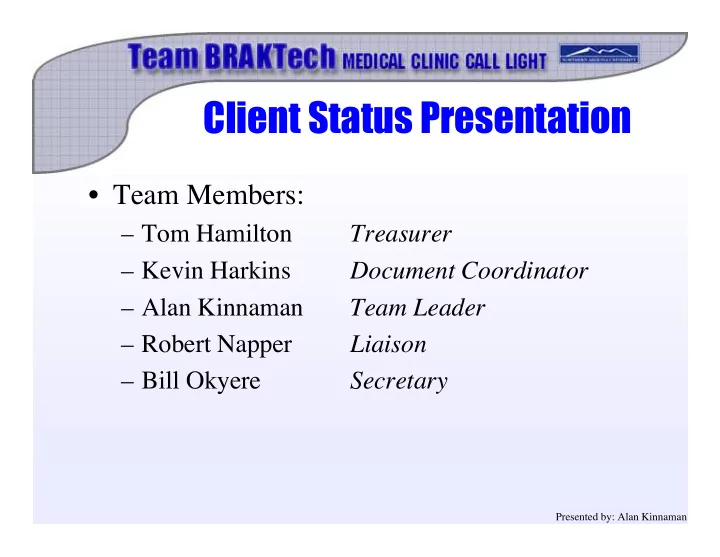
Client Status Presentation Team Members: Tom Hamilton Treasurer Kevin Harkins Document Coordinator Alan Kinnaman Team Leader Robert Napper Liaison Bill Okyere Secretary Presented by: Alan Kinnaman Presentation


slide-1
SLIDE 1

Client Status Presentation

  • Team Members:

– Tom Hamilton Treasurer – Kevin Harkins Document Coordinator – Alan Kinnaman Team Leader – Robert Napper Liaison – Bill Okyere Secretary

Presented by: Alan Kinnaman

slide-2
SLIDE 2

Presentation Overview

  • Problem Statement
  • Requirements & Specifications
  • Design Plan

– Philosophy – Approach – Deliverables

  • Schedule

Presented by: Alan Kinnaman

slide-3
SLIDE 3

Problem Statement

  • In a fast-paced clinic, administrators feel the need

to upgrade to a modern automated system.

  • Inexpensive systems exist, but lack capabilities.
  • Complex systems cost more, and require

significant design for each application.

  • Our goal is to design an affordable, modular

electronic system that will effectively improve a typical medical clinic’s workflow.

Presented by: Alan Kinnaman

slide-4
SLIDE 4

Problem Statement

  • Outdated.
  • Cumbersome.
  • Not automated.
  • Do not prioritize

workflow.

source: www.carstens.com

Presented by: Alan Kinnaman

Simple Mechanical Systems

slide-5
SLIDE 5

Problem Statement

  • Inexpensive systems

lack capabilities.

  • More comprehensive

systems are expensive.

  • Can be complicated.
  • Require design for

each application.

source: www.varitronics.com

Presented by: Alan Kinnaman

Available Electronic Systems

slide-6
SLIDE 6

Problem Statement

  • Affordable.
  • Modular.
  • Easy to use.
  • Improve a typical

medical clinic’s workflow.

Presented by: Alan Kinnaman

Our Goal

slide-7
SLIDE 7

Requirements

Environment

  • Temperature

– Must not build up excessive heat within the box. – Will be designed to meet microcontroller specifications.

  • Humidity

– Must tolerate excessive moisture within the wall. – Must use fuses or circuit breaker.

  • Vibration/Shock

– Must withstand wall vibrations.

Presented by: Tom Hamilton

slide-8
SLIDE 8

Requirements

  • Size

– Single gang electrical outlet box. – Made from a simple outlet box blank.

  • Weight

– Each station will be mounted in an electrical outlet box, which is where it will be permanently installed and will not pose a constraint.

  • Packaging

– Proper electrical grounding and isolation.

Mechanical

Presented by: Tom Hamilton

slide-9
SLIDE 9

Requirements

  • User’s Manual

– System configuration. – Day to day operation.

  • Maintenance Manual

– Maintenance and installation procedures. – Design documents.

Documentation

Presented by: Tom Hamilton

slide-10
SLIDE 10

Requirements

  • Microcontroller

– Electrical requirements pertain to the specifications.

  • Power

– One or more power supplies.

  • Interfacing

– Reliable communication link and protocol. – Each unit contain its own microprocessor.

  • Safety

– Must meet all electrical codes and regulations.

Electrical

Presented by: Tom Hamilton

slide-11
SLIDE 11

Specifications

The National Electric Code Electrical Guidelines RS-485 Communication Protocol 13-pair cable Communication Link Type 2.0 to 5.5 Volts Voltage Rating Microchip PIC16F877 Microprocessor Type Pushbuttons must be durable to withstand years of daily use. Controls Electrically isolated from ESD and if a metallic blank is used then it must be properly grounded. Protection Multiple twisted paired telephone cable or thermostat cable Interconnection No pertinent constraint Weight Typical electrical outlet blank Height = 4__ Width = 2__ Size of control panel Must not be greater than the following Height = 2__ Width = 2_ Depth = 2__ Size of electronics component +125°C Absolute Maximum Temperature

Specifications

Presented by: Tom Hamilton

slide-12
SLIDE 12

Design Plan

  • System Performance

– Must not rely on a single controller. – Units are modular and interconnected. – Failure of a unit shouldn’t affect others. – Superior to switch-based logic systems.

  • Ease of Operation

– Simple for new users to learn. – Improve the workflow.

Philosophy

Presented by: Kevin Harkins

slide-13
SLIDE 13

Design Plan

  • Installation

– Wiring should be simple. – Should not require extensive programming. – Automatic communication between units.

  • Quality

– Meets needs of a fast-paced and demanding workplace. – User-friendly alternative to existing office technologies.

Philosophy

Presented by: Kevin Harkins

slide-14
SLIDE 14

Design Plan

  • Schedule

– Four stages of design process:

  • Requirements
  • Proposal
  • Design
  • Implementation phase

– Capstone design conference: April 25th, 2004

Philosophy

Presented by: Kevin Harkins

slide-15
SLIDE 15

Design Plan

  • Cost Analysis

– Minimize costs associated with final product. – Report costs to client. – Overall costs must remain within our client’s means.

  • Design Safety

– Safety issues are incorporated in our design. – Will be safe to the user, patients, doctors.

  • Maintainability

– Doesn’t need substantial amount of maintenance.

Philosophy

Presented by: Kevin Harkins

slide-16
SLIDE 16

Approach

Design Plan

  • Goals

– Communication within medical clinic.

  • Patient-doctor
  • Doctor-medical assistant
  • Doctor-front desk
  • Cleaning attendant

– Provide a modular design for ease of upgrading. – Able to be marketable to other doctors offices.

Presented by: Bill Okyere

slide-17
SLIDE 17

Approach

Design Plan

  • Subsystems

– Basic functionality – Hardware

  • Interface chip with output lights.
  • Interface chip with power supply.
  • Interface communication chips with each other.

– Software – Networking

Presented by: Bill Okyere

slide-18
SLIDE 18

Design Plan

  • Team Organization

– Each problem should be distributed according to a group or team member based upon a team member’s strengths.

Approach

Presented by: Bill Okyere

slide-19
SLIDE 19

Deliverables

Design Plan

  • Client Status Report
  • Proposal Document
  • Status Report
  • Final Product, Installed
  • Capstone Design Conference
  • Final Report

Presented by: Rob Napper

slide-20
SLIDE 20

Schedule Schedule

Presented by: Rob Napper

slide-21
SLIDE 21

Questions?

Presented by: Rob Napper