
SLIDE 1
12/9/19 1
FROM SAIL TO STEAM TO BITS AND BYTES
John Cross School of Maritime Studies Marine Institute of Memorial University CISMaRT November 27 & 28
1
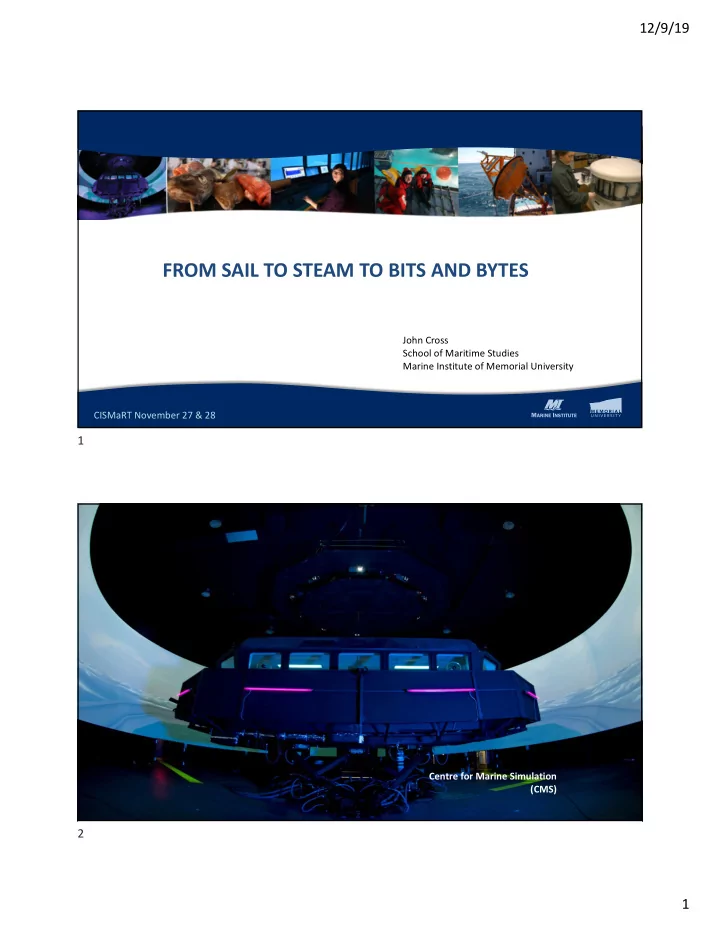
Centre for Marine Simulation (CMS)
FROM SAIL TO STEAM TO BITS AND BYTES John Cross School of Maritime - - PDF document
12/9/19 FROM SAIL TO STEAM TO BITS AND BYTES John Cross School of Maritime Studies Marine Institute of Memorial University CISMaRT November 27 & 28 1 Centre for Marine Simulation (CMS) 2 1 12/9/19 Shipping Crew and Shipping Knowledge
John Cross School of Maritime Studies Marine Institute of Memorial University CISMaRT November 27 & 28
Centre for Marine Simulation (CMS)
ENGINEERING - Roles and Requirements
1 2 3 4 5 6 REQUIREMENTS CAPABILITY REQUIREMENT OPERATIONAL REQUIREMENTS SHIP VOYAGE STATUS SITUATIONAL REQUIREMENTS SHORE TO SHIP ASSITANCE ENGINEERING DEPARTMENT STAFF A Propulsion and all supporting ship systems Personnel Qualifications COLD SHIP TO PORT STANDBY STANDARD OPERATION CONDITION BASED MONITORING Superintendent (Technical) B Maintenance Regulatory / Manning requirements PORT STANDBY to COMMENCEMENT OF MANOUVERING PLANNED MAINTENANCE REPAIR PLANNING CHIEF ENGINEER C FAILURE DIAGNOSIS Occupational responsilities defined by the company MANOUVERING to COMMENCEMENT OF PASSAGE AT SEA CONDITION BASED MAINTENANCE FAILURE DIAGNOSIS 2nd ENGINEER D PERFORMANCE AND EFFICIENCY MONITORING Survey Requirements COMMENCEMENT OF PASSAGE-AT SEA (FULL-AWAY) DRY DOCK EXPERT ASSITANCE ETO Electro Technical Officer E PROJECT MANAGEMENT EMERGENCY RESPONSE REPAIR PLANNING PROJECT MANAGEMENT 3rd Engineer/Motor Man F SAFE EVACUATIN OF PERSONNEL ALONGSIDE / ANCHORED COLLABORATIVE DISCUSSION 3rd ENGINEER/CADET G ADMIN DRY DOCK PERFORMANCE AND EFFICIENCY MONITORING MOTOR MAN
DECK - Roles and Requirements
1 2 3 4 5 6 REQUIREMENTS CAPABILITY REQUIREMENT OPERATIONAL REQUIREMENT S SHIP VOYAGE STATUS SITUATIONAL REQUIREMENTS SHORE TO SHIP ASSITANCE DECK DEPARTMENT STAFF A PASSAGE PLANNING (APEM) Personnel Qualifications BRIDGE DEPARTURE CHECKS STANDARD OPERATION CONDITION BASED MONITORING Superintendent (Marine) B COLLISION AVIODANCE Regulatory / Manning requirements BERTHING AND (PILOTAGE) MANOUVERING to COMMENCEMENT OF PASSAGE AT SEA PLANNED MAINTENANCE REPAIR PLANNING MASTER C MANOUVERING to COMMENCEMENT OF PASSAGE AT SEA including MANUAL BERTHING/SECURING ALONGSIDE AND ACHORING Occupational responsilities defined by the company MANOUVERING to COMMENCEMENT OF FULL -AWAY CONDITION BASED MAINTENANCE FAILURE DIAGNOSIS CHIEF OFFCIER D LIFE SAVING APPLIANCES Survey Requirements COMMENCEMENT OF PASSAGE-AT SEA (FULL-AWAY) DRY DOCK EXPERT ASSITANCE 2ND MATE E CARGO HANDLING EMERGENCY RESPONSE REPAIR PLANNING PROJECT MANAGEMENT 3RD MATE F SAFE EVACUATIN OF PERSONNEL ALONGSIDE / ANCHORED COLLABORATIVE DISCUSSION 4RD MATE G ADMIN DRY DOCK PERFORMANCE AND EFFICIENCY MONITORING AB/Bosun
Roles and Tasks - LIKELIHOOD OF HUMAN RELIANCE PRESENT DAY TO 2040
CAPABILITY REQUIREMENT PERSONNEL QUALIFICATIONS CARGO HANDING OCCUPATIONAL RESPONSIBILITIES DEFINED BY THE COMPANY - PERSONEEL SAFETY / CULTURE / ETHICS / CODE OF CONDUCT MANUAL SECURING OF VESSEL OR ANCHORING STANDARD OPERTATION EMERGENCY RESPONSE PASSAGE PLANNING
BERTHING ANCHORING COLLSION AVOIDANCE COLD SHIP TO PORT STANDBY MANOUVERING to COMMENCEMENT OF PASSAGE AT SEA COMMENCEMENT OF PASSAGE-AT SEA (FULL-AWAY COMMENCEMENT OF PASSAGE-AT SEA (FULL-AWAY SAFE EVACUATIO N OF PERSONNEL FAILURE DIAGNOSIS CONDITION BASED MAINTENANCE REPAIR PLANNING PROJECT MANAGEMENT COLLABORATIVE DISCUSSION SURVEY REQUIREMENTS PERFORMANCE AND EFFICIENCY MONITORING DRY DOCK EXPERT ASSITANCE
PRESENT DAY UNTIL 2020
PORT APPROACHES SHIP CONTROL/ MANAGEMENT SKILLS REQUIRED FROM PRESENT DAY FORCE
H H H H H H H H H H H H H H H H H H H H H H H H
YEAR 2020 - 2025
PORT APPROACHES SHIP CONTROL/ MANAGEMENT SKILLS REQUIRED FROM PRESNT DAY FORCE
H A H M/A M/A/A I H M-A M-A M-A M-AI H M M M H H H H H H M/L H H H
YEAR 2025 - 2030
INTERNATIONAL / COUNTRY BY COUNTRY SHIP CONTROL MANAGEMENT SKILLS REQUIRED OF FUTURE WORK FORCE
H A H A H M/L A AI L/AI L/AI L L L L A H M/L/A M/L H H L/A M/L M/L H
YEAR 2030 - 2040
INTERNATIONAL / COUNTRY BY COUNTRY SHIP CONTROL MANAGEMENT SKILLS REQUIRED OF FUTURE WORK FORCE
H A H A AI AI A AI AI AI A A A A A H/A/AI L/A/AI L/A H H L/A L/A L/A H
YEAR 2020 - 2025
MASTER, MARINE ENGINEER, SYSTEMS ENGINEER EXPERT ASSISTANCE MASTER, MARINE ENGINEER, SYSTEMS ENGINEER AB/BOSUN MASTER AND MARINE ENGINEER/SYS TEMS ENGINEER MASTER AND MARINE ENGINEER/SYSTEMS ENGINEER MASTER MASTER / PILOT MASTER / PILOT MASTER MARINE ENGINEER/SY STEMS ENGINEER MARINE ENGINEER/SYSTEMS ENGINEER MARINE ENGINEER/SYSTEMS ENGINEER MARINE ENGINEER/SYSTE MS ENGINEER
REOL
MASTER AND MARINE ENGINEER/SYSTEMS ENGINEER MASTER AND MARINE ENGINEER/SYSTEMS ENGINEER MARINE ENGINEER/SYSTEMS ENGINEER MARINE ENGINEER/SYSTEMS ENGINEER MASTER AND MARINE ENGINEER/SYSTEMS ENGINEER MASTER AND MARINE ENGINEER/SYSTEMS ENGINEER MASTER AND MARINE ENGINEER/SYSTEM S ENGINEER MARINE ENGINEER/SYS TEMS ENGINEER SHOREBASED
YEAR 2025 - 2030
MASTER, MARINE ENGINEER, SYSTEMS ENGINEER EXPERT ASSISTANCE MASTER, MARINE ENGINEER, SYSTEMS ENGINEER
REOL
MASTER AND MARINE ENGINEER/SYS TEMS ENGINEER MASTER AND MARINE ENGINEER/SYSTEMS ENGINEER MASTER/SYSTEMS ENGINEER MASTER / PILOT
REOL REOL
MARINE ENGINEER/SY STEMS ENGINEER MARINE ENGINEER/SYSTEMS ENGINEER MARINE ENGINEER/SYSTEMS ENGINEER MARINE ENGINEER/SYSTE MS ENGINEER
REOL
MARINE ENGINEER/SYSTEMS ENGINEER MARINE ENGINEER/SYSTEMS ENGINEER MARINE ENGINEER/SYSTEMS ENGINEER MARINE ENGINEER/SYSTEMS ENGINEER MARINE ENGINEER/SYSTEMS ENGINEER MARINE ENGINEER/SYSTEMS ENGINEER MARINE ENGINEER/SYSTEM S ENGINEER MARINE ENGINEER/SYS TEMS ENGINEER SHOREBASED
YEAR 2030 - 2040
SYSTEMS ENGINEER
REOL
SYSTEMS ENGINEER
REOL
SYSTEMS ENGINEER SYSTEMS ENGINEER
REOL REOL REOL REOL
SYSTEMS ENGINEER
REOL REOL REOL REOL
SYSTEMS ENGINEER SYSTEMS ENGINEER SYSTEMS ENGINEER SYSTEMS ENGINEER SYSTEMS ENGINEER SYSTEMS ENGINEER/ EXPERT ASSISTANCE SYSTEMS ENGINEER SYSTEMS ENGINEER SHOREBASED
Only for ships equipped with AI/Non Retrofit
HUMAN RELIANCE v TECHNOLGY ADVANCE RESOURCE
OIL SUPERINTENDENT CHIEF ENGINEER 2nd ENGINEER ELECTRO TECHNICAL OFFICER 3nd ENGINEER 4th ENGINEER MOTORMAN EXPERT ASSITANCE SURVEY
KEY
H
HIGH RELIANCE ON HUMAN SKILLS WATER SUPERINTENDENT MASTER CHIEF OFFICER 2nd MATE 3rd MATE 4th MATE/CADEY AB/BOSUN MARINE PILOT SURVEY
M
MEDIUM RELIANCE ON HUMAN SKILLS NEW ROLES
AI
SYSTEMS ENGINEER
A REO L
VIRTUAL ASSIANT CARGO HANDLING
L
LOW RELIANCE ON HUMAN SKILLS ARTIFICIAL INTELLIGENCE AUTOMATED REACHING/REACHED END OF LIFE DRY DOCK
A
AUTOMATED
AI
ARTIFICIAL INTELLIGENCE
Step 1 Step 2 Step 3 Step 4 Step 5 Step 6 Step 7 Step 8
AL0 – no autonomous functions. All operations are manual AL1 – on-ship decision support. Data will be available to crew AL2 – off-ship decision support. Shore monitoring
2020 – 2025 AL3 – Active human-in-the-loop. Semi-autonomous
2025 – 2030 AL4 – Human-on-the-loop. Ship operates
autonomously with human supervision
2030 – 2040 AL5 – Fully autonomous ship. There
is a means of human control AL6 – Fully autonomous ship that has no need for any human intervention
Future workforce training timeline verses Lloyds Register of Autonomy How will levels of autonomy affect future roles?
Past workforce Present workforce Present/Future workforce Present / Future workforce Present / Future workforce Future workforce
Technological rate of change
P R E S E N T A T I O N T I T L E - G O H E A D E R & F O O T E R T O E D I T T H I S T E X T 1 1
John Cross School of Maritime Studies Marine Institute of Memorial University