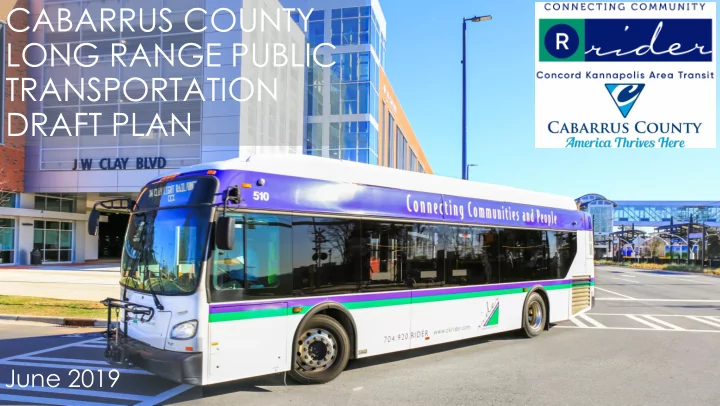
CABARRUS COUNTY LONG RANGE PUBLIC TRANSPORTATION DRAFT PLAN June - - PowerPoint PPT Presentation

cabarrus county
SMART_READER_LITE
LIVE PREVIEW

CABARRUS COUNTY LONG RANGE PUBLIC TRANSPORTATION DRAFT PLAN June - - PowerPoint PPT Presentation

CABARRUS COUNTY LONG RANGE PUBLIC TRANSPORTATION DRAFT PLAN June 2019 WHY THIS PLAN, AND WHY NOW? Cabarrus County is rapidly growing: need to develop a pathway to long term local and regional public transit options now How do we grow


slide-1
SLIDE 1

CABARRUS COUNTY LONG RANGE PUBLIC TRANSPORTATION DRAFT PLAN

June 2019

slide-2
SLIDE 2

WHY THIS PLAN, AND WHY NOW?

  • Cabarrus County is rapidly growing: need to

develop a pathway to long term local and regional public transit options now

  • How do we grow the system and plan

responsibly?

  • Learn from riders and non-riders what would

make transit an effective mobility option for them

  • Study consolidation of Rider Transit and

CCTS

  • Develop realistic cost information and

financing options

slide-3
SLIDE 3

WHY GROW PUBLIC TRANSIT?

Property values near rapid transit are 40% higher Adults who walk, bike or take transit have 1/3 the obesity rate of those who drive. Households using transit produce 70% lower emissions. Living near accessible transit saves up to $10,000/yr. Transit Oriented Development community and tax revenue growth, with less congestion. Supports affordable housing – 25%-50% more access to jobs. Retail in pedestrian & transit friendly areas have 80% higher sales

slide-4
SLIDE 4

WHERE PUBLIC TRANSIT GOES…COMMUNITY GROWS

Investing in public transit improves mobility, freedom and quality of life, providing better access to jobs, school and healthcare options. It can also affect the economy and the business community by providing:

  • less traffic congestion = more time, productivity
  • better air quality = less school and work time lost
  • access to larger labor pool with more diverse skills;

better worker reliability = stronger businesses

  • focused growth = stimulates business investment

87% of public

transit trips = direct economic impact on the local economy

$9,823

The average annual savings

  • f a household downsizing
  • ne car

60+%

  • f trips taken on

public transit are to/from work

slide-5
SLIDE 5

CURRENT CONDITIONS

  • 2015 LEHD Data shows that 53,000

people/day commute between Cabarrus and Mecklenburg Counties each work day

  • Current transit challenges
  • Need longer service hours
  • More frequent service
  • More fixed route service
  • Increased demand response service area
  • Cabarrus County expected to grow 50% or

more over next 20 years

  • Mobility will become more and more

challenging if we don’t take action

Concord Mills & Bruton Smith Blvds Poplar Tent Rd. & Concord Pkwy

slide-6
SLIDE 6

CURRENT DEMAND RESPONSE SERVICE

Both Rider and Cabarrus County operate demand response service Rider: within ¾ mile of fixed routes (ADA mandated) CCTS: trips are program specific

  • Medicaid
  • Work First Family Assistance Program
  • Adult and Aging Services Program
  • Rural General Public Program
slide-7
SLIDE 7

CURRENT FIXED ROUTE SERVICE

  • 7 local routes on 60/75

minute headways

  • 1 express route (CCX)
  • Operates 7 days a week
  • Weekdays:

5:30 am to 8:30 pm

  • Weekends:

8:30 am to 8:30 pm

slide-8
SLIDE 8

COMMUNITY ENGAGEMENT SUMMARY

  • Surveys (777)
  • Fixed Route On Board Survey
  • Demand Response/

ADA Passenger Survey

  • Community Survey
  • Stakeholder Meetings (100)
  • Transit Riders
  • Social Service Agencies
  • City, County and other

Governmental Agencies

  • Businesses and Employers
  • Community Events (350)
  • Kannapolis Fire Safety Festival
  • El Puente Latino Festival
  • Cabarrus Brewing Company
  • 26 Acres Brewing Company
slide-9
SLIDE 9
  • Later evening service and

Sunday service

  • Reduced wait time
  • More trip options
  • 35% ride one to five times a week
  • 30% ride for convenience
  • 25% don’t drive

COMMUNITY ENGAGEMENT SUMMARY

CCTS PASSENGER INPUT RESULTS

20% 20% 20% 13% 27%

Which of the following would most improve CCTS service for you?

Later Evening Service Less Wait Time Sunday Service Flex Service (any purpose) Other

slide-10
SLIDE 10

Top 5 Service Improvements

  • Later Service
  • More Bus Stop Amenities
  • More Frequent Service
  • Improved On-Time

Performance

  • More Routes & Service

Modes

COMMUNITY ENGAGEMENT SUMMARY

RIDER TRANSIT PASSENGER INPUT RESULTS

25% 25% 16% 14% 12% 8%

What Service Improvements Would You Like to See?

Later Service More Benches/Shelters More Frequent Service Improved On Time Performance More Route/Services Other

slide-11
SLIDE 11

COMMUNITY ENGAGEMENT SUMMARY

ON-LINE COMMUNITY INPUT RESULTS

0% 10% 20% 30% 40% 50% No parking hassle Convenience Cost savings Connect to other Transit Services Don't have a license/can't drive Don't have access to a vehicle Want to do something other than drive

What are the primary reasons you would use a bus in the future?

slide-12
SLIDE 12

COMMUNITY ENGAGEMENT SUMMARY

STAKEHOLDER INPUT RESULTS

20 40 60 80 100 120 Expanded Hours

  • f Service

More Local Buses/Go More Places Expanded Regional Connectivity Bus Stop Amenities Improve Connections to Charlotte More Frequency Rail Vanpooling

Highest Priorities for the Next 20 Years

slide-13
SLIDE 13

CURRENT SERVICE – WHERE WE ARE TODAY

Rider Transit - Fixed Route/ADA:

  • 8 routes
  • Fleet:

10 35-ft. buses

4 LTVs, 3 Vans

  • Personnel: 61: 6 City, 55 contracted
  • Budget: $4.6M
  • Current Ridership: 425,000

CCTS - Demand Response:

  • Fleet: 27 LTV
  • Personnel: 32
  • Budget: $1.1M
  • Current Ridership: 90,000
slide-14
SLIDE 14

Clayton County Transit Initiative Update

SYSTEM CONSOLIDATION

Benefits of merging CCTS and Rider Transit:

  • Improve efficiency and service delivery countywide
  • More flexible staffing; improved workflow (i.e. – grants)
  • Purchasing efficiencies
  • Avoid duplication of services
  • Improved trip coordination (local, regional)
  • Potential financial incentives (NCDOT)
  • “Seamless Service” – one fleet, call center, brand

Improve service quality and customer experience

slide-15
SLIDE 15

Year 1-3 Year 4-6 Year 7-8 Year 9-11 Year 12-14 Year 15-20

Extend Hours of Service for Fixed Route Buses Initiate Consolidation of CCTS and Rider Double frequency

  • f buses

(30-40 minute service) Implement Countywide Demand Response Service Increase Bus Routes (7) Establish true 30 minute service Double frequency of bus service (15 minutes) Increase Bus Routes (6) High Capacity Transit · Light Rail · Bus Rapid Transit (BRT) · Commuter Rail 1 New Bus Route

PUBLIC TRANSPORTATION IN CABARRUS COUNTY

A 20 20 Y YEAR R VIS ISIO ION

Major Service Enhancements

slide-16
SLIDE 16
  • 22 Bus Routes
  • 15 minute service
  • Countywide Demand Response Service

(vanpooling, microtransit, ridesharing)

  • 3 new hubs
  • Admin & Maintenance Facility
  • 550 employees
  • 104 buses, 45 van/LTV
  • Ridership: 6,400,000 – 6,600,000

THE 20 YEAR VISION

Regional High Capacity Transit

BRT/LRT Corridors Commuter Rail

slide-17
SLIDE 17

Total 20 Year Investment

Bus and Demand Response (non-rail) System Operating: $696,505,000 Capital: $139,584,000 Total Cost:

$836,000,000

High Capacity Transit Options

$1.5-$4 Billion

slide-18
SLIDE 18

FUNDING MECHANISMS

This is going to cost a lot… …how can we pay for it???

  • Potential funding mechanisms
  • Local funding
  • Sales Tax (non-rail)
  • Value Capture (rail)
  • Federal funding
  • Formula funding
  • Discretionary funding
  • CIG funding
  • State funding
  • Private partnerships
slide-19
SLIDE 19
slide-20
SLIDE 20

HIGH CAPACITY TRANSIT FUNDING MECHANISMS OPTIONS

Value Capture

  • Leverage increased property tax

values

  • Transit supportive land uses
  • Require appropriate local zoning land

use regulations and urban design standards

  • Provides financial equity

Public Private Partnerships

Pre Transit Development Post Transit Development

slide-21
SLIDE 21

OUR PLAN AND REGIONAL TRANSIT GROWTH

  • More capacity, options and connections =

greater regional mobility…partnerships are critical

  • Establishing High Capacity Transit regionally is key

to everyone’s success

  • Enhance user experience of transit corridors
  • Transit supportive land uses
  • Direct growth into high-capacity transit corridors

(reduce continued sprawl)

  • Maximize local benefits of transit investment

(social equity, economic development, increased mobility, stronger local economy and job growth, access to affordable housing, access to jobs and more)