Building a happy, social enterprise Tony Butler Director Museum - - PowerPoint PPT Presentation

building a happy social enterprise
SMART_READER_LITE
LIVE PREVIEW

Building a happy, social enterprise Tony Butler Director Museum - - PowerPoint PPT Presentation

Building a happy, social enterprise Tony Butler Director Museum of East Anglian Life 15 Historic Buildings Working demonstrations Breeding Large Black Pigs 75 Acres and 4 County Wildlife Sites Our young under fives cooks The celebrated


slide-1
SLIDE 1

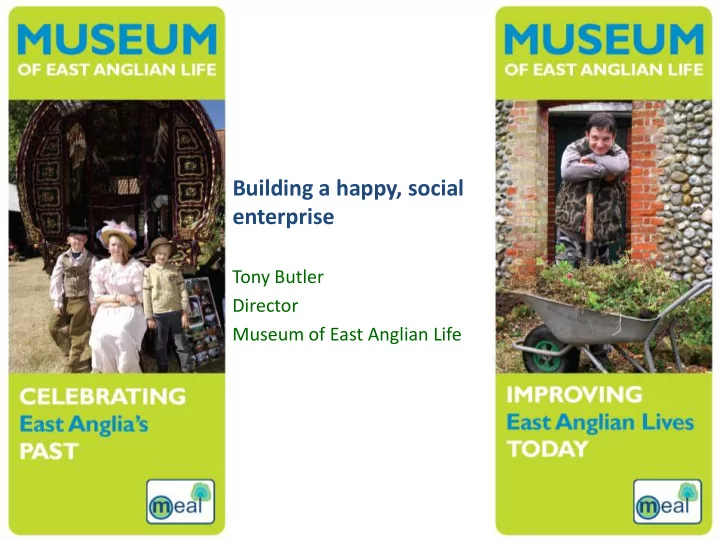
Building a happy, social enterprise

Tony Butler Director Museum of East Anglian Life
slide-2
SLIDE 2

15 Historic Buildings

slide-3
SLIDE 3

Working demonstrations

slide-4
SLIDE 4

Breeding Large Black Pigs

slide-5
SLIDE 5

75 Acres and 4 County Wildlife Sites

slide-6
SLIDE 6
slide-7
SLIDE 7
slide-8
SLIDE 8

Our young under fives cooks

slide-9
SLIDE 9

The celebrated MEAL beer festival 2007

slide-10
SLIDE 10

Progressive Morris 2009

slide-11
SLIDE 11

Musical Polish Roma play MEAL in 2007

slide-12
SLIDE 12

Kal, the biggest band in Serbia play MEAL in 2008

slide-13
SLIDE 13

Rekindling Memories, working with the Alzheimer’s Society to train carers to use museum objects as therapy for early stage dementia patients

slide-14
SLIDE 14

Defining social enterprise

Many commercial businesses would consider themselves to have social objectives, but social enterprises are distinctive because their social or environmental purpose is central to what they do. Rather than maximising shareholder value their main aim is to generate profit to further their social and environmental goals. Social Enterprise Coalition 2007

slide-15
SLIDE 15

What they say about social enterprise

You are proving that we link the principles of social action and enterprise, and I believe that this financial crisis is teaching us a very important lesson about the values that underpin the market place for the future. While we have free markets, and it is right to say we should have free markets, we shouldn't have value-free markets, markets should be underpinned by social purpose.

  • Gordon Brown. November 2008
slide-16
SLIDE 16
slide-17
SLIDE 17

Rochdale Pioneers

slide-18
SLIDE 18

Social Enterprise and sustainable development

  • Triple bottom line – helps make a good

society!

  • Take advantage of the tradition self-help and

collaboration

  • Economic localism – a predominately local

economy using local produce, employing local people to provide goods and services for local customers

slide-19
SLIDE 19

The Impetus for Social Enterprise

  • Others were being paid to do what we knew we

could do

  • Opportunities through public sector commissioning
  • Personalisation of adult care
  • More opportunities for people to participate in

heritage

  • It appealed to the entrepreneurial spirit of staff and

trustees

  • Because we believe in it !
slide-20
SLIDE 20

The Museum of East Anglian Life Social Enterprise

  • Set up cost £50,000 including

a project officer and volunteer co-ordinator

  • £10,000 capital for equipment

and building improvements

slide-21
SLIDE 21

MEAL Enterprises

  • 1. Training
  • A structured work-based

learning programme linked to work experience.

  • Training and qualifications

(NVQ and City and Guilds, LANTRA National Proficiency tests

  • Basic Skills literacy and

numeracy

  • Links with colleges and
  • ther training providers

who purchase our services

slide-22
SLIDE 22

MEAL Enterprises

  • 2. Therapeutic Placements
  • Activities for those in

receipt of individualised care budgets

  • Contracts with other

service providers Community Mental Health Trust

slide-23
SLIDE 23

MEAL Enterprises

  • 3. Retail
  • Production of

hanging baskets

  • Vegetable box

scheme

  • Adds an additional

attraction to the museum along with its café and deli

slide-24
SLIDE 24

MEAL Enterprises

  • 4. Volunteering
  • Increasing involvement by the

community in the heritage

  • Volunteering increases social

capital

  • More volunteers broadens the

range of activities on site

  • Volunteering as a pathway into

employment

slide-25
SLIDE 25

What were the benefits of social enterprise approach?

  • Real outcomes for

participants

  • Recognition for the

museum

  • Increase in social

capital

  • A new and lucrative

income stream for the museum

slide-26
SLIDE 26
slide-27
SLIDE 27
slide-28
SLIDE 28

When I first started volunteering at MEAL I had no other structure in my life, I was homeless and I wasn’t well. By getting involved with the museum I have gained a lot, I got put in touch with agencies that could help me and now I have a flat, I volunteer 4 days a week and I have got some

  • qualifications. It is still early days for me but I

am hoping that I will soon be able to look for employment, with MEAL acting as a referee. Luke Kerridge

slide-29
SLIDE 29

Co-production

The home base of the economy is the household, the neighbourhood, the community and civil

  • society. That is the

economy that co- production seems to rebuild and to reconstruct. Edgar S Cahn 2006

slide-30
SLIDE 30

What makes people happy ?

Fairness Helping Others Respect

Adaptability

Trust

Meaning

Status

slide-31
SLIDE 31

Martin Seligman and Positive Psychology

We would spend less time treating mental illness if we spend more time promoting mental wellness.

The Pleasant Life

Positive Emotion

The Good Life

Eudaemonic Flow

The Meaningful Life

In the cause of something greater than you

slide-32
SLIDE 32

The Happy Museum

  • Making friends
  • Being active
  • Learning something new
  • Taking notice of the world
  • Giving back
slide-33
SLIDE 33
slide-34
SLIDE 34
  • I do things for organisations which at one time I

would have thought had little value

  • Say ‘hello’ to a lot more people
  • Yes, it has given me a community respect and I

now help neighbours and last year my partner and I helped out in a soup kitchen on Christmas Day

  • Yes some people I work with have disabilities.

Once I got to know them I thought differently and they are actually quite amazing people.

  • I have made lots of new friends, I would say 149
  • Yes it keeps me fit and gives me something to

think about at 79 years of age

slide-35
SLIDE 35
slide-36
SLIDE 36

Happiness in 2010

  • Happy Days – using positive psychology

principle to encourage children to empathise

  • Trust – a small exhibition looking at the ties

which bound a rural community together

  • Happy MEAL – working with local young

people to curate a music, sport and art event celebrating the region

slide-37
SLIDE 37
slide-38
SLIDE 38

What would we need to do to become a true Social Enterprise?

slide-39
SLIDE 39

Asset Based Community Development

The Assets

People Social Networks Collections Historic Buildings Landscape Livestock

Stewardship Learning and Training Programming

slide-40
SLIDE 40

Social Accounting and Social Return On Investment

  • SROI is an approach to understanding and managing the

impacts of a project, organisation or policy. It is based on stakeholders and puts financial value on the important impacts identified by stakeholders that do not have market values.

  • SROI seeks to include the values of people that are often

excluded from markets in the same terms as used in markets, that is money, in order to give people a voice in resource allocation decisions. SROI is a framework to structure thinking and understanding. It’s a story not a number. The story should show how you understand the value created, manage it and can prove it

slide-41
SLIDE 41

Social Enterprise Mark

  • Do you have evidence of your company’s social and

environmental aims?

  • Does the company have its own constitution and governing

body?

  • Are at least 50% of the company profits spent on socially

beneficial purposes?

  • Does the company earn at least 50% of its income from

trading?

  • Can you provide externally verified evidence that you are

achieving your social or environmental aims?

  • On dissolution of the company, are all residual assets

distributed for the social/environmental purposes?

slide-42
SLIDE 42

Our Cause

The Museum of East Anglian Life is a social enterprise sharing the compelling story of East Anglian lives through historic buildings, collections and landscape. We aim to enrich people’s lives, encouraging enjoyment, learning and participation through our public programmes, training and volunteering schemes. The museum is a space for people to be active, learn new things, look at the world differently, make friends and give something back.

slide-43
SLIDE 43

Our principles

STEWARDSHIP We prize our distinctive and precious assets; our landscape, historic buildings and collections, people and livestock. We will care for and show them off to the standards they deserve. PARTICIPATION We’d rather not do it on our own. We welcome all members of the community to get involved, be active and exchange knowledge SOCIAL ENTERPRISE We want to be a resilient

  • rganisation. We’ll be opportunistic

and creative in using our unique assets and surroundings to help people fulfil their ambitions. MINDFULNESS We encourage curiosity and

  • consideration. Our work should

inspire and entertain, be playful and thoughtful and help people take more notice about the world around them.

slide-44
SLIDE 44

tony.butler@eastanglianlife.org.uk 01449 612229 www.eastanglianlife.org.uk Twitter tonybutler1 Blog http://tonybutler1.wordpress.com