Body Chart www.vompti.com C ERVICAL S PINE C ASE 2 C ERVICAL R - - PDF document

body chart
SMART_READER_LITE
LIVE PREVIEW

Body Chart www.vompti.com C ERVICAL S PINE C ASE 2 C ERVICAL R - - PDF document

VOMPTI 2017-18 Harstein/Lievre Body Chart www.vompti.com C ERVICAL S PINE C ASE 2 C ERVICAL R ADICULOPATHY A.J. Lievre, PT, DPT, OCS, CMPT Aaron Hartstein, PT, DPT, OCS, FAAOMPT Orthopaedic Manual Physical Therapy Series Charlottesville


slide-1
SLIDE 1

VOMPTI 2017-18 Harstein/Lievre For Individual Study by Enrolled Students Other Use Prohibited 1

www.vompti.com

Orthopaedic Manual Physical Therapy Series 2017-2018

Orthopaedic Manual Physical Therapy Series Charlottesville 2017-2018

CERVICAL SPINE CASE 2 CERVICAL RADICULOPATHY

A.J. Lievre, PT, DPT, OCS, CMPT Aaron Hartstein, PT, DPT, OCS, FAAOMPT

Orthopaedic Manual Physical Therapy Series 2017-2018 www.vompti.com

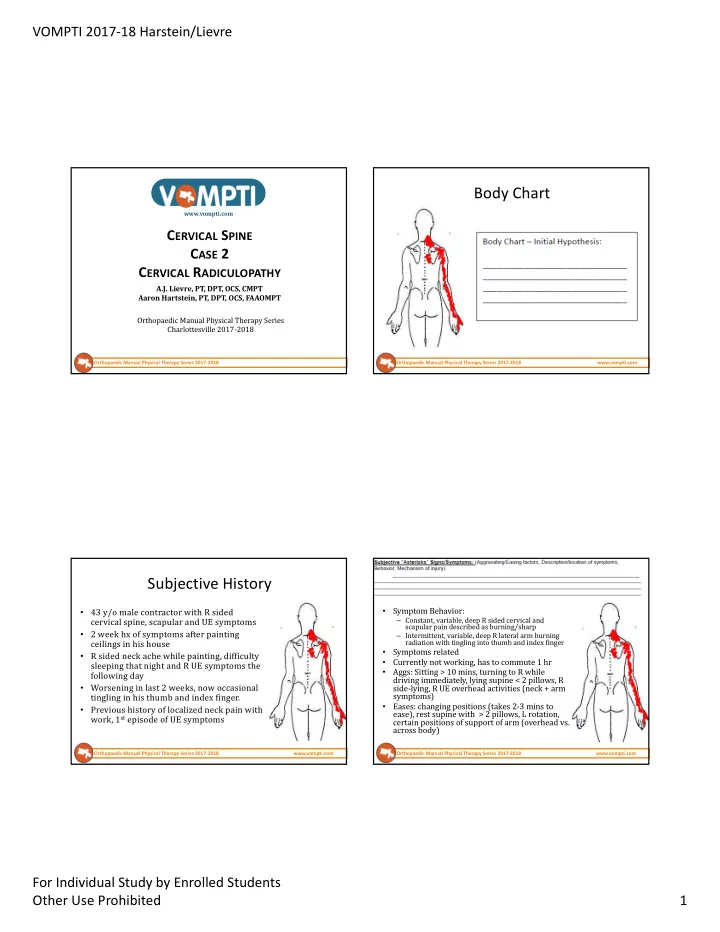
Body Chart

Orthopaedic Manual Physical Therapy Series 2017-2018 www.vompti.com

Subjective History

  • 43 y/o male contractor with R sided

cervical spine, scapular and UE symptoms

  • 2 week hx of symptoms after painting

ceilings in his house

  • R sided neck ache while painting, difficulty

sleeping that night and R UE symptoms the following day

  • Worsening in last 2 weeks, now occasional

tingling in his thumb and index finger.

  • Previous history of localized neck pain with

work, 1st episode of UE symptoms

Orthopaedic Manual Physical Therapy Series 2017-2018 www.vompti.com

  • Symptom Behavior:

– Constant, variable, deep R sided cervical and scapular pain described as burning/sharp – Intermittent, variable, deep R lateral arm burning radiation with tingling into thumb and index finger

  • Symptoms related
  • Currently not working, has to commute 1 hr
  • Aggs: Sitting > 10 mins, turning to R while

driving immediately, lying supine < 2 pillows, R side-lying, R UE overhead activities (neck + arm symptoms)

  • Eases: changing positions (takes 2-3 mins to

ease), rest supine with > 2 pillows, L rotation, certain positions of support of arm (overhead vs. across body)

slide-2
SLIDE 2

VOMPTI 2017-18 Harstein/Lievre For Individual Study by Enrolled Students Other Use Prohibited 2

Orthopaedic Manual Physical Therapy Series 2017-2018 www.vompti.com

C5-7, T4-7 Facet Scapulothoracic GH Elbow Wrist/Hand C5-7, T4-7 paraspinals and multifidus, Post RC, Triceps, Wrist Ext, 1st and 2nd forearm compartment muscles C5-7 Disc C5-7 Capsule GH Bursae Cervical Ligs Labrum Humerus (Fx) C5-7 nn Root Radial Nerve PIN Visceral Spondylo- arthropathy?

Orthopaedic Manual Physical Therapy Series 2017-2018 www.vompti.com

Somatic vs. Radicular Pain

  • Somatic (Referred/Non-Referred) vs. Radicular Pain
  • Somatic – nocioceptive input from structures not related to nervous

system (ligaments, facets, IVD, mm, dura, etc.)

  • Radicular – nocioceptive input from structures related to nervous

system (spinal nerve, nerve root, peripheral nerve)

  • Somatic pain quality: Deep, Ache, Diffuse, Dull and Poorly Localized
  • Radicular pain quality: Intense, Radiating, Severe, Sharp, Darting,

Lancinating, and Well Localized

Orthopaedic Manual Physical Therapy Series 2017-2018 www.vompti.com

Constant symptoms, Sharp/Burning description, Not working, Sleep and positional disruption, NDI = 44% Aggravated within 10 mins, takes 2-3 mins to ease, distal symptoms with daily activities (reaching overhead, etc)

Orthopaedic Manual Physical Therapy Series 2017-2018 www.vompti.com

  • Standing in waiting room, arm overhead
  • Cervical spine held in subtle L SB and Flexion
  • Cervical ROM: (+) R rotation 45 deg, Extension 10 deg,

(+) Quadrant/Spurling’s Test

  • (+) Compression/Distraction Testing
  • (+) Neuro Exam with Biceps Jerk 1+, C6 myotome = 4-

/5, decreased C6 sensation

  • (+) ULPT 1 (Median Nerve Bias)
  • (+) R Shoulder Quadrant (due to ND irritability)
  • (+) PPIVMs/PAIVMs R C5/6 and 6/7 into Extension
  • Neck Disability Index = 44% perceived disability
slide-3
SLIDE 3

VOMPTI 2017-18 Harstein/Lievre For Individual Study by Enrolled Students Other Use Prohibited 3

Orthopaedic Manual Physical Therapy Series 2017-2018 www.vompti.com

Beazell

C6 Cervical Radiculopathy

Orthopaedic Manual Physical Therapy Series 2017-2018 www.vompti.com

Cervical Radiculopathy

  • Disorder of the cervical nerve root
  • Commonly caused by osteophytic

changes or other space-occupying lesions

  • Less likely due to disc herniation
  • Results in nerve root inflammation,

impingement or both

  • Incidence 83.2/100,000 people
  • Increased prevalence in 5th to 6th

decade of life

  • C6 and C7 most commonly involved

Orthopaedic Manual Physical Therapy Series 2017-2018 www.vompti.com Orthopaedic Manual Physical Therapy Series 2017-2018 www.vompti.com

Relationship of Nerve Root to Foramen

  • Disc prolapse is rare in the cervical

region as the discs cannot escape posterior-laterally because of the uncinate processes of vertebral body

  • If prolapse occurs it is more central

than in the lumbar region and tends to be more severe with regards to cord compression

  • Root compression in the cervical region

is more commonly caused by OA of the U-Jt

  • Note close relationship of nerve root in

foramen to both the articular process and U-Jt

  • Osteophytes arise from both U-Jt > Z-Jt

and narrow foramen

slide-4
SLIDE 4

VOMPTI 2017-18 Harstein/Lievre For Individual Study by Enrolled Students Other Use Prohibited 4

Orthopaedic Manual Physical Therapy Series 2017-2018 www.vompti.com

1) Zygapophyseal joint, 2) Uncovertebral joint, 3) Nerve Root, 4) DRG, 5) Vertebral Artery

Orthopaedic Manual Physical Therapy Series 2017-2018 www.vompti.com

None, but need to R/O Cervical Myelopathy

Orthopaedic Manual Physical Therapy Series 2017-2018 www.vompti.com

Neurological Screen

  • When to perform:

– Symptoms distal to the AC joint or in the medial scapular border (due to possible discogenic

  • rigin)

– Subjective reports of paresthesia or numbness – Subjective reports of UMN type pathology

Orthopaedic Manual Physical Therapy Series 2017-2018 www.vompti.com

Neurological Screen – Reflex Testing

Reflex Root Level Biceps C5-6 Brachioradialis C5-6 Triceps C7-8 FDP C8-T1

Hypo-reflexia = LMN Lesion Hyper-reflexia = UMN Lesion

(+)

slide-5
SLIDE 5

VOMPTI 2017-18 Harstein/Lievre For Individual Study by Enrolled Students Other Use Prohibited 5

Orthopaedic Manual Physical Therapy Series 2017-2018 www.vompti.com

Neurological Screen - Myotomes

Action Nerve Root Peripheral Nerve Cervical Flexion C1-2 Roots Cervical Side Bending C3 Roots Shoulder Shrug C2-4 CN XI Spinal Accessory Shoulder Abduction and ER C5 Axillary and Suprascapular Elbow Flexion C5-6 Musculocutaneous Wrist Extension C6 Radial Elbow Extension C7 Radial Wrist Flexion C7 Median Thumb Opposition C8 Median Thumb Extension (EPL) C8 Radial - PIN Finger Abduction T1 Ulnar DIP Flexion (FDP) C8/T1 Median and Ulnar

(+)

Orthopaedic Manual Physical Therapy Series 2017-2018 www.vompti.com

Neurological Exam Findings

  • Myotomal Testing

– Maximal contraction tested and retested to determine fatigueability

  • Radiculopathy

– Segmental fatigueable weakness

  • Radiculitis

– No appreciable weakness

  • Neuropathy (Peripheral Lesion)

– Fatigueable weakness of muscles innervated by effected nerve

  • Myelopathy

– Multisegmental fatigueable weakness

Orthopaedic Manual Physical Therapy Series 2017-2018 www.vompti.com

Neurological Screen – Somatosensory Function

Orthopaedic Manual Physical Therapy Series 2017-2018 www.vompti.com

Neurological Screen – Somatosensory Function

  • Key Dermatomal Testing Areas

C8 C7

(+)

slide-6
SLIDE 6

VOMPTI 2017-18 Harstein/Lievre For Individual Study by Enrolled Students Other Use Prohibited 6

Orthopaedic Manual Physical Therapy Series 2017-2018 www.vompti.com

Cervical Myelopathy

  • Causes:

– Spinal cord compression in the spinal canal due to osteophyte, and/or disc degeneration

  • Symptoms:

– Hyperreflexia UE and LE – Sensory changes in nonsegmental pattern, common in 1 or both hands/feet – (+) Clonus – (+) Hoffman’s Reflex – (+) Babinski – (+) Inverted Supinator Reflex/Sign – General weakness below level of compression – Gait changes, tripping/falling for no reason

Orthopaedic Manual Physical Therapy Series 2017-2018 www.vompti.com

Upper Motor Neuron Testing

  • Hoffman’s Reflex

– Sung and Wang (Spine, 2001) – (+) result in 16 asymptomatic patients, MRI confirmed cord compression from HNP (15/16), remaining patient had T5/6 thoracic disc with compression

  • Very Specific Test!
  • Babinski
  • Clonus UE/LE
  • Inverted Supinator Sign/Test
  • C7 response to C6 reflex

Orthopaedic Manual Physical Therapy Series 2017-2018 www.vompti.com

Clinical Predictor Rule: Cervical Myelopathy

(-)

Orthopaedic Manual Physical Therapy Series 2017-2018 www.vompti.com

Cervical Myelopathy Cluster

slide-7
SLIDE 7

VOMPTI 2017-18 Harstein/Lievre For Individual Study by Enrolled Students Other Use Prohibited 7

Orthopaedic Manual Physical Therapy Series 2017-2018 www.vompti.com Orthopaedic Manual Physical Therapy Series 2017-2018 www.vompti.com Orthopaedic Manual Physical Therapy Series 2017-2018 www.vompti.com

CPR for Cervical Radiculopathy

  • 3/4 findings (+), pretest

probability increases 23% to 65%

  • 4/4 findings (+), +LR =

30.3 and probability 90%

  • ULTT = Sn = 97%, - LR =

0.12 (If Negative, most likely to rule out Radiculopathy)

– Importance of order of testing

(+)

slide-8
SLIDE 8

VOMPTI 2017-18 Harstein/Lievre For Individual Study by Enrolled Students Other Use Prohibited 8

Orthopaedic Manual Physical Therapy Series 2017-2018 www.vompti.com

  • Assessed Shoulder Abduction Test (SAT),

Spurling’s Test (ST), Upper Limb Tension Test (ULTT) on 97 patients and results compared to EMG findings

  • SAT and ST more specific tests (85%)
  • ULTT more sensitive (60% in acute and 35% in

chronic)

  • Concluded:

– ULTT is suitable for screening CR (SnNout) – SAT and ST can support diagnosis (SpPin)

Orthopaedic Manual Physical Therapy Series 2017-2018 www.vompti.com

Objective Examination Modification

  • Typical Cervical

Sequence

  • Active/Passive/Resisted

Testing

  • Provocation Testing
  • Neurological Testing
  • Neurodynamic Testing
  • Biomechanical Exam
  • Cervical Radiculopathy
  • APR

– Esp. Rotation, Extension – Quadrant – Spurling’s

  • Provocation

– Compression/Distraction

  • Neurological
  • Neurodynamic

– ULPT 1

  • Biomechanical?

Orthopaedic Manual Physical Therapy Series 2017-2018 www.vompti.com

Spurling’s Test

  • Foraminal compression

(Spurling’s)

– Sidebend (may add extension) – Compression through the head

  • Designed to test for

cervical radiculopathy

  • Specific test: 92%

– (+) LR = 4.87 – Not as sensitive (11-39%)

  • PT positioning?

Orthopaedic Manual Physical Therapy Series 2017-2018 www.vompti.com

Spurling’s Test

(+)

slide-9
SLIDE 9

VOMPTI 2017-18 Harstein/Lievre For Individual Study by Enrolled Students Other Use Prohibited 9

Orthopaedic Manual Physical Therapy Series 2017-2018 www.vompti.com

Compression

(+)

Orthopaedic Manual Physical Therapy Series 2017-2018 www.vompti.com

Distraction

(+)

Orthopaedic Manual Physical Therapy Series 2017-2018 www.vompti.com

Distraction in Flexion vs. Extension

Orthopaedic Manual Physical Therapy Series 2017-2018 www.vompti.com

Cervical Distraction Test - Supine

(+)

slide-10
SLIDE 10

VOMPTI 2017-18 Harstein/Lievre For Individual Study by Enrolled Students Other Use Prohibited 10

Orthopaedic Manual Physical Therapy Series 2017-2018 www.vompti.com

  • C4-T1 intervertebral foramen cross-sectional

area and shape with MRI

– Distraction 120% of control at all levels except C7/T1 – Spurling’s Test 70% of control – Most significant at C4/5 and C5/6 levels

  • Clinical significance of Spurling’s/Compression

Orthopaedic Manual Physical Therapy Series 2017-2018 www.vompti.com

Neurodynamic Testing

  • Upper Limb “Tension” Testing (Provocation)

– “SLR of the Upper Extremity” – Not disorder specific except for a (-) test to rule out cervical radiculopathy – Biased to the terminal branches of the brachial plexus based on their anatomy

  • Median nerve (ULTT 1 and 2a)
  • Radial nerve (ULTT 2b)
  • Ulnar nerve (ULTT 3)

– Sensitivity 72-97% – Specificity 22-33%

Orthopaedic Manual Physical Therapy Series 2017-2018 www.vompti.com

ULPT 1 – Median Nerve Bias (Base Test)

(+)

Orthopaedic Manual Physical Therapy Series 2017-2018 www.vompti.com

  • n = 51
  • ULNT (1-3 used combined) showed the highest sensitivity

0.97 and a specificity of 0.69

– ULNT corresponded with MRI in 88.2% of cases – Most credible way to identify subjects with cervical radiculopathy – ULNT 1 (Median) showed the highest validity – ULNT 3 (Ulnar) had highest specificity compared with MRI – ULNT 2b (Radial) had lowest validity

slide-11
SLIDE 11

VOMPTI 2017-18 Harstein/Lievre For Individual Study by Enrolled Students Other Use Prohibited 11

Orthopaedic Manual Physical Therapy Series 2017-2018 www.vompti.com

Reflection To Help Improve Pattern Recognition

Orthopaedic Manual Physical Therapy Series 2017-2018 www.vompti.com

Cervical Radiculopathy – Clinical Pearls

  • Profile: Common in middle age and older population, especially

in patients with established degenerative changes

  • Area:

– Dermatomal pattern, worse proximal > distal (chronic), worse distal > proximal (acute) – May have distal ache and/or N/T – If chronic may have Intermittent patchy symptoms – If acute may have constant chemical irritability

  • Aggs: Sustained Flexion activities, movements which narrow

foramen on involved side (Ext, SB, Rot), UE activities (if neurodynamic component)

  • Eases: Rest with neck and arm supported

– Arm overhead – C5 – Bakody Sign – Arm across body – C7

  • History:

– Current – Result of past acute radiculopathy that did not completely resolve – Past – May have had prior episodes of neck stiffness that resolved within days without treatment

Orthopaedic Manual Physical Therapy Series 2017-2018 www.vompti.com

What About Classification?

Orthopaedic Manual Physical Therapy Series 2017-2018 www.vompti.com

slide-12
SLIDE 12

VOMPTI 2017-18 Harstein/Lievre For Individual Study by Enrolled Students Other Use Prohibited 12

Orthopaedic Manual Physical Therapy Series 2017-2018 www.vompti.com

Centralization

  • Radicular/referred

symptoms in the upper quarter

  • Peripheralization and/or

centralization of symptoms with range of motion

  • Signs of nerve root

compression present

  • May have pathoanatomic

diagnosis of cervical radiculopathy

  • Mechanical/manual

cervical traction

  • Repeated movements to

centralize symptoms

Examination Findings Proposed Matched Interventions

Orthopaedic Manual Physical Therapy Series 2017-2018 www.vompti.com Orthopaedic Manual Physical Therapy Series 2017-2018 www.vompti.com

Centralization Results

Orthopaedic Manual Physical Therapy Series 2017-2018 www.vompti.com

How Does This Relate to Treatment?

slide-13
SLIDE 13

VOMPTI 2017-18 Harstein/Lievre For Individual Study by Enrolled Students Other Use Prohibited 13

Orthopaedic Manual Physical Therapy Series 2017-2018 www.vompti.com

Interventions: Neck pain with Radiating Pain

Orthopaedic Manual Physical Therapy Series 2017-2018 www.vompti.com

  • Only 4 studies met criteria (PEDro > 5)
  • Manual therapy often part of multimodal approach (ther ex, traction, etc.)
  • No clear cause and effect, however, results are “generally promising”
  • Conclusion: Although a definitive treatment progression for treating CR has not

been developed a general consensus exists within the literature that using manual therapy techniques in conjunction with therapeutic exercise is effective in regard to increasing function, as well as AROM, while decreasing levels of pain and disability. High quality RCTs featuring control groups are necessary to establish clear and effective protocols in the treatment of CR.

Orthopaedic Manual Physical Therapy Series 2017-2018 www.vompti.com Orthopaedic Manual Physical Therapy Series 2017-2018 www.vompti.com

slide-14
SLIDE 14

VOMPTI 2017-18 Harstein/Lievre For Individual Study by Enrolled Students Other Use Prohibited 14

Orthopaedic Manual Physical Therapy Series 2017-2018 www.vompti.com

Vs.

Orthopaedic Manual Physical Therapy Series 2017-2018 www.vompti.com

Positioning and foraminal effects, discussion of expectations, medications, rest, comparison to surgery

T/S Manipulation, Cerv Lateral Glides/STM, Man/Mech Traction, Cervical Mobilization (PPIVM/PAIVMs)

Deep Cervical Flexors, Mid/Lower Traps, Serratus Anterior Cervical Q, ULPT, C5/6 myotomes, Shoulder Q, PAIVM testing

Orthopaedic Manual Physical Therapy Series 2017-2018 www.vompti.com

  • Significant difference at 10

weeks for craniovertebral angle, pain, C6 and C7 dermatomal EMG output

  • Postural corrective

exercise, US and Infrared radiation

Orthopaedic Manual Physical Therapy Series 2017-2018 www.vompti.com

  • Measured foraminal height on radiograph of

C5/6, C6/7 in various positions (22-29 y/o asymptomatic men)

  • Flexion + Lat Flex R + Rotation L increases

the height of the cervical IVF (on L)

  • Implications for treatment position and

patient education

  • Approaching manipulative position
slide-15
SLIDE 15

VOMPTI 2017-18 Harstein/Lievre For Individual Study by Enrolled Students Other Use Prohibited 15

Orthopaedic Manual Physical Therapy Series 2017-2018 www.vompti.com Orthopaedic Manual Physical Therapy Series 2017-2018 www.vompti.com Orthopaedic Manual Physical Therapy Series 2017-2018 www.vompti.com

JOSPT Perspectives for Patients

Orthopaedic Manual Physical Therapy Series 2017-2018 www.vompti.com

  • Cervical Lateral Glides vs. Ultrasound

– Subacute symptoms

  • Measured ULPT elbow ROM, symptom

distribution and pain intensity

  • Significant differences in cervical lateral

glide group

  • Bob Elvey, PT (LV Technique)
  • Referred or Radicular UE symptoms
  • Assess Lat Glide in Neutral
  • Assess Lat Glide with ULPT
  • 2/3rd Rule
  • Away vs. Towards
slide-16
SLIDE 16

VOMPTI 2017-18 Harstein/Lievre For Individual Study by Enrolled Students Other Use Prohibited 16

Orthopaedic Manual Physical Therapy Series 2017-2018 www.vompti.com

  • Measured median nerve movement in

forearm with cervical lateral glide vs lateral flexion

  • Lateral Flexion = 2.3 mm of movement
  • Lateral Glide = 3.3 mm of movement
  • Relationship to treatment progression and

stage

Orthopaedic Manual Physical Therapy Series 2017-2018 www.vompti.com

ULND Positioning Techniques

Orthopaedic Manual Physical Therapy Series 2017-2018 www.vompti.com

  • Predictors of improvement with NTM

– Absence of neuropathic pain qualities – Older age – Smaller deficits in median nerve neurodynamic test ROM

  • NTM = brief education, manual therapy, and

nerve gliding exercises for 2 weeks (versus advice to remain active)

Orthopaedic Manual Physical Therapy Series 2017-2018 www.vompti.com

CERVICAL EXAM BIOMECHANICAL ALGORITHM

History Cervical Scan

Medical Diagnosis Refer or Treat with Caution

Biomechanical Exam PPIVM’s PAIVM’s Stability Tests Mobilize/Manipulate Stabilization (-) (+)

(+) Hypomobile (-) Normal or Hypermobile (+) Articular Hypomobility (+) Unstable (-) Extra-articular Hypomobility PPIVM Stretch Muscle Energy Hypermobile or Non Mechanical (-)

slide-17
SLIDE 17

VOMPTI 2017-18 Harstein/Lievre For Individual Study by Enrolled Students Other Use Prohibited 17

Orthopaedic Manual Physical Therapy Series 2017-2018 www.vompti.com

PAIN

Combined Movement Treatment

Orthopaedic Manual Physical Therapy Series 2017-2018 www.vompti.com

Cervical Treatment – SB PPIVM/PAIVM

Neutral Flexion Extension

Rx Progression Gr I-IV:

  • 1. L-R C5/6 Flexion
  • 2. R-L C5/6 Flexion
  • 3. L-R C5/6 Ext
  • 4. R-L C5/6 Ext

Orthopaedic Manual Physical Therapy Series 2017-2018 www.vompti.com

Thoracic Manipulation Evidence

  • Immediate changes in neck pain and AROM following T/S manipulation

(Fernandez De-Las-Penas, 2007)

  • Short term improvements in pain and disability with thoracic thrust vs

non-thrust mobilization/manipulation (Cleland, et al., 2007)

  • RCT, Immediate effects of thoracic manipulation - increased cervical

rotation and decreased pain at end range rotation (vs. control group of rest)(Krauss, et al., 2008)

  • T/S manipulation demonstrated superior benefits (versus TENs/Heat) for

acute neck pain at 2 weeks and 4 week follow-up (Gonzalez-Igelsias, et al., 2009)

  • Short-term improvement in lower trapezius strength following T/S

manipulation (Cleland, et al., 2002)

  • Short-term effects of T/S manipulation on patients with shoulder

impingement syndrome (Boyles)

  • CPR for patients with shoulder pain who respond to cervical and thoracic

manipulation: Shoulder Elevation < 127, Shoulder IR < 53, (-) Neer’s, No medication, symptoms < 90 days (Mintken, et al.)

Orthopaedic Manual Physical Therapy Series 2017-2018 www.vompti.com

slide-18
SLIDE 18

VOMPTI 2017-18 Harstein/Lievre For Individual Study by Enrolled Students Other Use Prohibited 18

Orthopaedic Manual Physical Therapy Series 2017-2018 www.vompti.com

Upper and Mid Thoracic AP Variations

  • T3/4 and Above – “Loose Fist”
  • Mid Thoracic – Flat Hand/“Dog” or Pistol

– Pistol De-Rotation

Orthopaedic Manual Physical Therapy Series 2017-2018 www.vompti.com

Figure 1. Seated thoracic spine distraction thrust manipulation used in this study. The therapist uses his or her sternum as a fulcrum on the subject’s middle thoracic spine and applies a high- velocity distraction thrust in an upward direction.

Orthopaedic Manual Physical Therapy Series 2017-2018 www.vompti.com

Cervical Treatment – Manual Traction

C5/6 in Flexion

Orthopaedic Manual Physical Therapy Series 2017-2018 www.vompti.com

  • Predictors for success

– Age ≥ 55yo – Positive shoulder abduction test – Positive ULTT A – Symptom peripheralization with central posterior– anterior motion testing at lower cervical (C4–7) spine – Positive neck distraction test

  • Prediction of success

– ≥3 predictors

  • 79.2%
  • +L:R 4.81

– ≥ 4 predictors

  • 94.8%
  • +LR 23.1
slide-19
SLIDE 19

VOMPTI 2017-18 Harstein/Lievre For Individual Study by Enrolled Students Other Use Prohibited 19

Orthopaedic Manual Physical Therapy Series 2017-2018 www.vompti.com

  • N = 86 x 4 wks
  • Assessed NDI and pain
  • 4 weeks, 6 and 12 mo
  • Exercise + Mech Tx

– Lower NDI and pain – 6 and 12 mo follow-up

  • Conclusion:

– Adding mechanical traction to exercise for patients with CR resulted in lower disability and pain

Orthopaedic Manual Physical Therapy Series 2017-2018 www.vompti.com

  • A 4-variable model identified subjects who were

most likely to achieve success with PT interventions

– Age < 54 yrs – Dominant arm not affected – Looking down does not worsen symptoms – Multimodal treatment including manual therapy, cervical traction and DNF muscle strengthening for at least 50% of visits

  • 3/4 variables present: (+) LR 5.2 (Prob 85%)
  • 4/4 variables present: (+) LR 8.3 (Prob 90%)

Orthopaedic Manual Physical Therapy Series 2017-2018 www.vompti.com