Areas and lengths in polar coordinates By parametric equation - - PowerPoint PPT Presentation

areas and lengths in polar coordinates
SMART_READER_LITE
LIVE PREVIEW

Areas and lengths in polar coordinates By parametric equation - - PowerPoint PPT Presentation

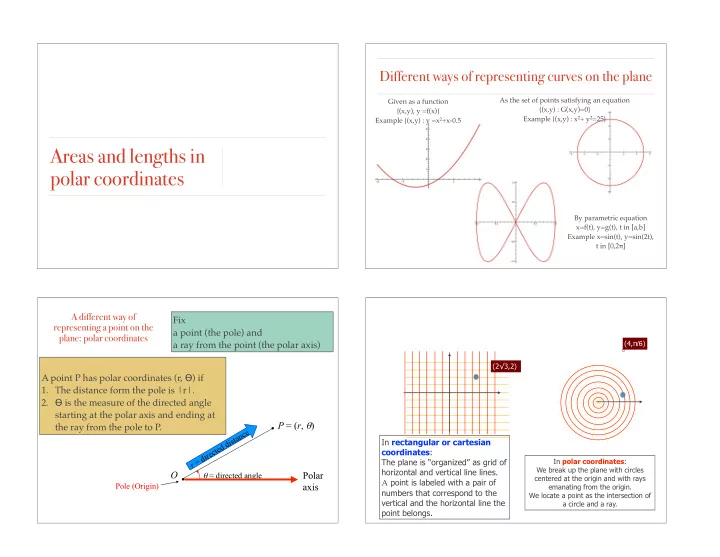
Different ways of representing curves on the plane As the set of points satisfying an equation Given as a function {(x,y) : G(x,y)=0} {(x,y), y =f(x)} Example {(x,y) : x 2 + y 2 =25} Example {(x,y) : y =x 2 +x-0.5 Areas and lengths


slide-1
SLIDE 1

Areas and lengths in polar coordinates

Different ways of representing curves on the plane

As the set of points satisfying an equation {(x,y) : G(x,y)=0} Example {(x,y) : x2+ y2=25} Given as a function {(x,y), y =f(x)} Example {(x,y) : y =x2+x-0.5 By parametric equation x=f(t), y=g(t), t in [a,b] Example x=sin(t), y=sin(2t), t in [0,2π]

θ = directed angle

Polar axis

r = directed distance

O

Pole (Origin)

P = (r, θ) Fix a point (the pole) and a ray from the point (the polar axis)

  • A point P has polar coordinates (r, ϴ) if
  • 1. The distance form the pole is |r|.
  • 2. ϴ is the measure of the directed angle

starting at the polar axis and ending at the ray from the pole to P.

A different way of representing a point on the plane: polar coordinates

In rectangular or cartesian coordinates: The plane is “organized” as grid of horizontal and vertical line lines. A point is labeled with a pair of numbers that correspond to the vertical and the horizontal line the point belongs.

In polar coordinates: We break up the plane with circles centered at the origin and with rays emanating from the origin. We locate a point as the intersection of a circle and a ray. Coordinate systems are used to locate the position of a point. (2√3,2) (4,π/6)

slide-2
SLIDE 2

How to plot a point P with polar coordinates (r,ϴ) How to plot a point P with polar coordinates (r,ϴ)

❖ If r=0, P is the pole. ❖ If r>0, rotate the polar axis an

angle ϴ (counterclockwise if ϴ>0, clockwise otherwise) and place P on this ray at distance r from the pole.

❖ If r<0, proceed as if r>0, but

place P the point in the

  • pposite ray, at distance -r

from the pole.

Plot the points with polar coordinates given below.

❖ (0, 27) ❖ (4, π/6) ❖ (-3, π/2)

Points can be represented in more than one way in polar coordinates. Find more ways to represent the points above.

If (x,y) in rectangular coordinates is given r= (x2+y2)1/2 ϴ = arctan(y/x) If (r,ϴ) in polar coordinates is given x=r.cosϴ y=r.sinϴ The rectangular coordinates of the point are (x,y) The polar coordinates

  • f the point are (r, ϴ)

θ r (x,y) y x

Example

1.Find polar coordinates for a the point with rectangular coordinates (2√3,2) 2.Find the rectangular coordinates for the point with polar coordinates (-4, 5π/6) 3.Sketch a graph of the polar curve r = sinϴ - cosϴ 4.Sketch a graph of the polar curve r = cos(5ϴ)

slide-3
SLIDE 3

Polar curves

A polar curve is a curve described by an a equation in polar coordinates. Plot the following examples

❖ r = 3 cos(2ϴ) ❖ r = (1-cosϴ ) ❖ r=ϴ ❖ r = sin ϴ

Match the curve with the equation

❖ r = 3 cos(2ϴ) ❖ r = (1-cosϴ ) ❖ r=ϴ ❖ r = sin ϴ 2

2 A r θ = π π

2

2 r A θ ⇒ =

Area of a sector of a circle of radius r Area A of a region bounded by a polar curve

  • f equation r=f(ϴ), ϴ in [a,b]

A = 1

2

R b

a f(θ)2 dθ

∆θr2/2 = ∆θ.f(θ)2/2

Consider the polar curve of equation r = a (1-cosϴ ) (a is constant) ϴ in [0,2π]

  • (This curve is called cardiod. The

animation is from Wolfram http://mathworld.wolfram.com/ Cardioid.html)

This curve has parametric equations x=a cos(t)(1-cos(t)) y=sin(t)(1-cos(t))

  • and its rectangular coordinates its points

satisfy the equation (x2+y2+ax)2=a2(x2+y2)

Example: Compute the area bounded by the cardiod r = (1-cosϴ ) ϴ in [0,2π]

slide-4
SLIDE 4

❖ Find the area inside one petal of

the curve r=3cos(2 ϴ)

❖ Find the area enclosed by the

curve r=sin(ϴ)

❖ Find the area enclosed by the curve

r=ϴ , ϴ in [0,2π] and the positive x-axis

Arc length review

Δy Δx s (a,b) (c,d) a b

k

s Δ

k

x Δ

k

y Δ

slide-5
SLIDE 5

Length of a curve in polar coordinates

Given the polar curve Differentiate with respect to ϴ Square and add Using the formula for parametric curves

cos & ( ) sin x r r f y r θ θ θ = " = # = $ Example: Express (but not evaluate) as an integral the arc length of the cardiod lying above the x-axis. r = 1-cosϴ ϴ in [0,2π] Example: Express (but not evaluate) as an integral the length of a petal of 3 cos(2ϴ) Example: Compute the arc length

  • f the circle r = sinϴ

ϴ in [0,2π] Example: Compute the length arc

  • f the spiral r = eϴ

in [0,2π]

Example: Compute the arc length of the circle r = sinϴ ϴ in [0,2π] Example: Compute the length arc of the spiral r = eϴ in [0,2π] Example: Compute the length two arcs of the cycloid x= ϴ - sinϴ, y=1- cos ϴ. (Hint (1-cos(t))=2 sin2(t/2)) Example: Compute the arc length the graph of the curve y=x3/2, x in [0,5]

POLAR POLAR PARAMETRIC FUNCTION