
SLIDE 1
- Dr. Jon Aars,
Norwegian Polar Institute
Tracking the Polar Bear
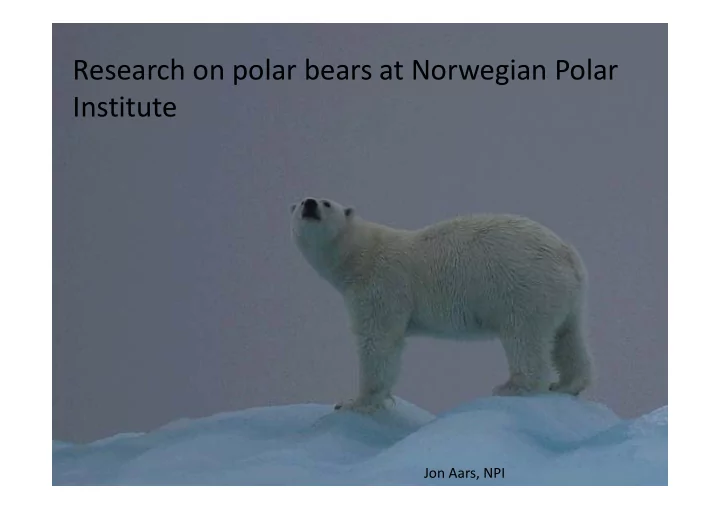
Research on polar bears at Norwegian Polar Institute
Jon Aars, NPI
Research on polar bears at Norwegian Polar Tracking the Polar Bear - - PowerPoint PPT Presentation
Research on polar bears at Norwegian Polar Tracking the Polar Bear Institute Dr. Jon Aars, Norwegian Polar Institute Jon Aars, NPI What are Norwegian Polar Institutes (NPI) mandates? We are asked by our government to do science based monitoring on
Norwegian Polar Institute
Jon Aars, NPI
governments having polar bears have signed a treaty (in 1973) stating that all nations should manage their populations based on best available scientific data, and encourage sampling and exchange of data and knowledge based on such programmes
Norwegian directorate and ministry.
and analyze scientific data (and believe that is important), but we do not judge if the management bodies should or should not use alternative sources for their management decisions.
tourist ships and others. It helps us understanding the biology of the ebars (there are several scientific notes from Svalbard based on such data). BUT capture‐recapture provides other types of data, much of this cannot be aquired just by observations (pollution, deseases, age structure, survival, movement, …..)
what is important is that what we believe is the correct conclusions of our work gets out, and that we not in any way are restricted, that has usually not been a problem
Is it correct we only guess how many bears there are in Arctic? Our best guess (Polar Bear Specialist Group) is based on: ‐Good knowledge about numbers from many areas ‐less good knowledge from other areas ‐very little data from several areas So the total, 20 000 – 25 000, are based on numbers we feel confident about plus numbers we are much less confident about (based on guesses / typical densities from other areas) It could thus easily be that the real number is lower or higher than this
http://pbsg.npolar.no/ Info about population sizes (and removals, mainly hunting)
factors
Group, and PBSG is frequently asked about input when local quotas are set
sustainable, and that quotas should be set according to population sizes and trends based on scientific programmes.
to TEK (traditional ecological knowledge) provided by locals. The choice is up to the management authorities in each area
treaty in 1973. PBSG consider climate change/habitat loss to be the main threat today
platform: RV Lance
N23732, female, 4 year
Taking samples and getting data
20 40 60 80 100 120 1 3 5 7 9 11 13 15 17 19 21 23 25 27 29 31 33
age Number captured
females males
Survival low above 15 years, few bears more than 22 years old
0.2 0.4 0.6 0.8 1 1.2 1.4 1.6 1.8
0‐year 1year 2year 20 40 60 80 100 120 140 160 0‐year 1year 2year
Based on this: survival ca 44% first year for cubs after leaving the den Litter size Number of litters april september
http://mosj.npolar.no/en/fauna/marine /indicators/polar‐bear.html Many young females with cubs of the year, but few young females manage to raise them (to yearlings)
Other questions: decrease in body weight in Svalbard? ‐ no, not with time, but it does vary between years depending on climate (suggesting we will see a decrese after several years with worse conditions) shift in ringed seal pupping area? ‐Need sea ice, so lost breeding habitat many places, more consentrated on sea ice in smaller areas, often lack of snow for protection, often low survival of pups in these areas due to bears, foxes and gulls..
Karen Lone, master degree, 2011
Observed movement Potential movement 1) Almost no movement between NW and SE Svalbard 2) Observed movement << distance between random capture positions
F=female M=male
Distance between individuals, random pairs Distance between close relatives
Zeyl m.fl. 2009
Derocher et al. 2010
Old males (11‐20 year) fight most Age structure captured males Age structure males with known
Zeyl et al. 2009
So young males may be smarter…
Derocher m.fl. 2011
Question: do we predict many females denning on Kongsøya 2014‐2015, given ice came early in autumn 2014, YES, WE DO
Different tracks
Mette Mauritsen, PhD 1) Two strategies: local or wide‐roaming bears (very different in summer/autumn) 2) Bears have to walk against the ice drift to keep in prefered area (energy demanding) 3) Seasonal area use (e.g. using same area in Svalbard every spring, but at e.g. Franz Josef Land in summer/autumn)
Females with small cubs use glacier fronts in spring (Freitas m. fl. 2012)
Karen Lone, 2011 Areas used in differnt seasons, based on collar data
Time in water, adult females with (y) and without (n) cubs of the year, % time in sea Critical distances of open water for cubs?
N23703 Swimming, four females
Light loggers to reveal denning / reproduction Data from tags glued onto collars ”Time Depth Recorders”, light and
5 10 15 20 25 30 35 40 30/09/2013 00:00 10/10/2013 00:00 20/10/2013 00:00 30/10/2013 00:00 09/11/2013 00:00 19/11/2013 00:00 29/11/2013 00:00 09/12/2013 00:00 19/12/2013 00:00 29/12/2013 00:00
N23980cc temp max and min
Tmin('C) Tmax('C) 6
Data from ear tag: temp tells she went into den before mid October Lower panel: data from collar, activity, temperature and speed (movement) indicate time
Spring: opened den early March, left den about 27th March