First Results of POLAR: A dedicated Gamma-Ray Burst Polarimeter - - PowerPoint PPT Presentation

first results of polar a dedicated gamma ray burst
SMART_READER_LITE
LIVE PREVIEW

First Results of POLAR: A dedicated Gamma-Ray Burst Polarimeter - - PowerPoint PPT Presentation

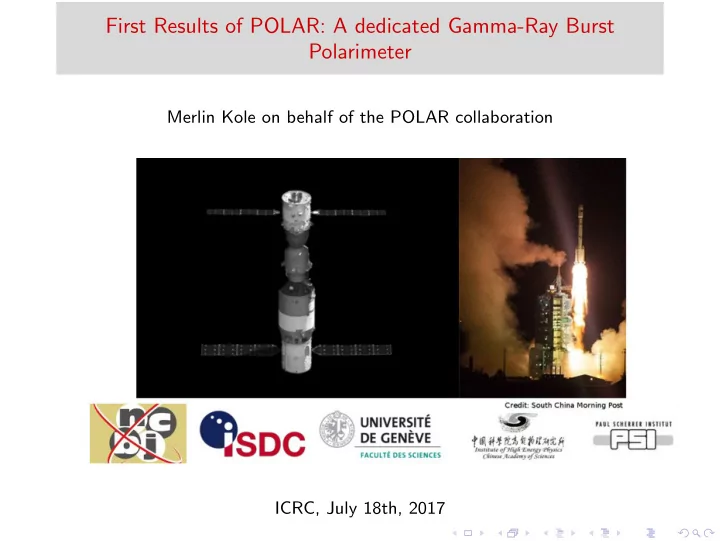
First Results of POLAR: A dedicated Gamma-Ray Burst Polarimeter Merlin Kole on behalf of the POLAR collaboration ICRC, July 18th, 2017 POLAR on the TG-2 2011: TG-1 Space Lab launched TG-2 Chinese Space Lab launch in September 2016 POLAR


slide-1
SLIDE 1

First Results of POLAR: A dedicated Gamma-Ray Burst Polarimeter

Merlin Kole on behalf of the POLAR collaboration ICRC, July 18th, 2017

slide-2
SLIDE 2

POLAR on the TG-2

2011: TG-1 Space Lab launched TG-2 Chinese Space Lab launch in September 2016 POLAR launched with the TG-2 POLAR is the only foreign payload

  • n TG-2

Operational time of 2 years Original Aim: Measuring the polarisation of upto 100 Gamma-Ray Bursts

2 / 14

slide-3
SLIDE 3

Gamma-Ray Burst Polarimetry

First detection of a GRB almost 50 years ago today Most energetic events in the universe since the big bang Timing, Direction and Energy spectrum measured in great detail Two parameters remain: polarisation degree and polarisation angle

3 / 14

slide-4
SLIDE 4

Gamma-Ray Burst Polarimetry

Many models exist with many different predictions on the polarization parameters See for example: Kenji Toma arXiv:1308.5733 Polarisation holds information on emission process, e.g. synchrotron emission or photospheric emission or... Also on emission region, strong magnetic fields? Highly ordered?

4 / 14

slide-5
SLIDE 5

Gamma-Ray Burst Polarimetry

Previous measurements were performed GRB Instr./Sat.

  • Pol. (%)

Remark 151006A AstroSat polarised systematics dominated? 110721A GAP/IKAROS 84+16

−28

Constant Pol. Angle 110301A GAP/IKAROS 70 ± 22 Constant Pol. Angle 100826A GAP/IKAROS 27 ± 11

  • Pol. Angle changes by ≈ 90◦

021206 RHESSI 80 ± 20 systematics 021206 RHESSI 41+57

−44

systematics 140206A IBIS/INTEGRAL ≥ 48

  • 061112

IBIS/INTEGRAL ≥ 60 041219A IBIS/INTEGRAL ≤ 4/43 ± 25 Changing Angle and Degree 041219A SPI/INTEGRAL 98 ± 33 Inconsistent with IBIS 960924 BATSE/CGRO ≥ 50

  • 930131

BATSE/CGRO ≥ 35

  • Most measurements performed by non-dedicated instruments

Non of the measurements is really constraining Required: A large catalogue of GRB constraining measurements

5 / 14

slide-6
SLIDE 6

Compton Polarimetry

Azimuthal scattering angle dependence on polarisation Figure of merit = µ100: Modulation measured for a 100% polarized incoming beam Second figure of merit = MDP: Minimum level of polarization distinguishable from an unpolarized flux with (typical) 3σ certainty dσ dΩ = r2

  • 2

E′2 E2 E′ E + E E′ − 2 sin2 θ cos2 φ

  • .

(1)

6 / 14

slide-7
SLIDE 7

POLAR design

POLAR uses a segmented scintillator array to measure the Compton scattering angle In total 1600 plastic scintillators, 6 × 6 × 176 mm, EJ-248M Plastic scintillators optimise the cross section for Compton scattering in the 50-500 keV energy range Plastic scintillators allow for a relatively large effective area, with low mass

  • f 30kg

Small granularity of the scintillator array results in high angular resolution, high sensitivity for polarisation measurements

7 / 14

slide-8
SLIDE 8

The Final Product

Relatively large effective area Small pixels allows for high precision scattering angle measurements Uniform effective area gives us a large Field of View We see half of the sky and perform polarimetry for sources within 1/3rd of the sky

8 / 14

slide-9
SLIDE 9

POLAR on the TG-2

TG-2 Chinese Space Lab launched on September 15th 2016 Operational time of 2 years

9 / 14

slide-10
SLIDE 10

Do we see photons?

Crab illustrates our timing capabilities Crab serves as energy calibration source and potential polarization measurement target See poster or conference proceedings by H.C. Li ’POLAR measurements of the Crab pulsar’

10 / 14

slide-11
SLIDE 11

Do we see GRBs?

Total of 49 GRBs reported to community Light curves on: http://www.isdc.unige. ch/polar/lc/ See also poster or conf.

  • proc. by S.L. Xiong et al.

’Overview of the GRB

  • bservation by POLAR’
  • Aprox. 10 of these GRBs

have an MDP below 30%, 3 below 15% Detailed analysis is

  • ngoing

11 / 14

slide-12
SLIDE 12

Instrument Calibration

Careful on-ground calibration was performed Detailed simulations are built to reproduce the measured results in great detail Tests for different energies and different angles Paper in final stages of review In-orbit performance also being studied: see poster and conf. proc. by Y.H. Wang et al. ’In-orbit Calibration of POLAR: Non-uniformity correction of detection efficiency in 1600 pixels’

12 / 14

slide-13
SLIDE 13

Summary and Outlook

POLAR is a Compton based polarimeter designed to study GRB emission in the 50-500 keV energy range Instrument successfully launched We can see the Crab and are sensitive enough to look for exotic signals (GW, FRBs etc.) We have 10 GRBs from which good polarisation measurements are expected (MDP below 30%) Expect first polarisation results end of this year, more will follow soon after

13 / 14

slide-14
SLIDE 14

Thank you for your attention!

See also: 886 Shaolin Xiong: Overview of GRBs detected by POLAR 887 Shaolin Xiong: GRB search, identification and alert system for POLAR 888 Shaolin Xiong: POLAR in the multi-wavelength and multi-messanger era 994 Bobing Wu: POLAR measurements of the Crab pulsar 995 Yuanhao Wang: In-orbit Calibration of POLAR

14 / 14