Les Pulsars gamma The GeV Gamma Gamma- -ray ray The GeV avec - - PowerPoint PPT Presentation

les pulsars gamma
SMART_READER_LITE
LIVE PREVIEW

Les Pulsars gamma The GeV Gamma Gamma- -ray ray The GeV avec - - PowerPoint PPT Presentation

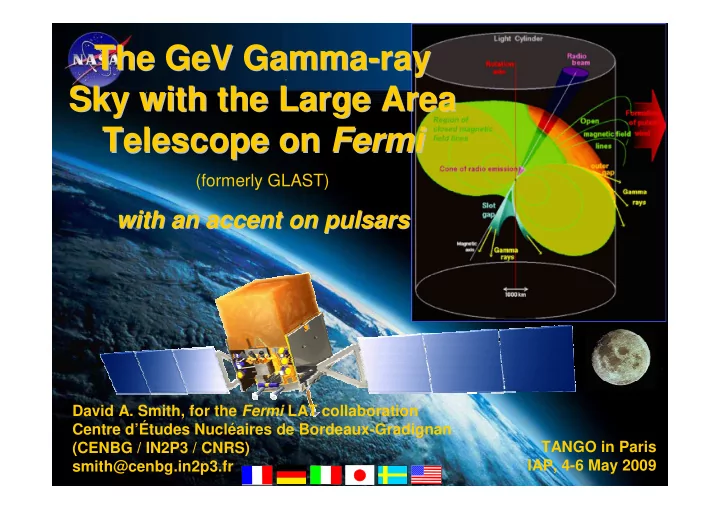
Les Pulsars gamma The GeV Gamma Gamma- -ray ray The GeV avec GLAST Sky with the Large Large Area Area Sky with the Fermi on Fermi Telescope on Telescope (formerly GLAST) with an accent on pulsars an accent on pulsars with David


slide-1
SLIDE 1

Les Pulsars gamma avec GLAST

David Smith Centre d’Etudes Nucléaires de Bordeaux-Gradignan ( CENBG - in2p3 - CNRS )

TANGO in Paris IAP, 4-6 May 2009

The GeV The GeV Gamma Gamma-

  • ray

ray Sky with the Sky with the Large Large Area Area Telescope Telescope on

  • n Fermi

Fermi

(formerly GLAST)

with with an accent on pulsars an accent on pulsars

David A. Smith, for the Fermi LAT collaboration Centre d’Études Nucléaires de Bordeaux-Gradignan (CENBG / IN2P3 / CNRS) smith@cenbg.in2p3.fr

slide-2
SLIDE 2

The whole sky, 8 times per day:

  • Record the expected, as well as

the unexpected.

  • Including variable objects.

GBM

2nd instrument Gamma-ray burst monitor

slide-3
SLIDE 3

> 2000 > 2000 AGNs AGNs

blazars and radiogal = f(θ,z) evolution z < 5 Sag A*

10 10-

  • 50

50 γ γ γ γ γ γ γ γ-

  • ray bursts/year

ray bursts/year

GeV afterglow spectra to high energy

Cosmic rays and clouds Cosmic rays and clouds

acceleration in Supernova remnants OB associations propagation (Milky Way, M31, LMC, SMC) Interstellar mass tracers in galaxies

Possibilities Possibilities

starburst galaxies galaxy clusters measure EBL* Un-IDs

Dark Matter Dark Matter

neutralino lines sub-halo clumps

γ γ γ γ γ γ γ γ-

  • ray binaries

ray binaries

Pulsar winds µ-quasar jets

Pulsars Pulsars

gammas from radio and X-ray pulsars blind searches for new Gemingas* pulsar wind nebulae

* Name of the only radio-quiet gamma-ray pulsar known before launch *Extragalactic Background Light. Probed via γγ->e+e-.

slide-4
SLIDE 4

3 months of sky-survey

slide-5
SLIDE 5

3 months: 205 LAT Bright Sources

(>10σ >0.3 GeV)

Fermi Large Area Telescope Bright Gamma-ray Source List Abdo, A. A. et al. 2009, Ap J Suppl submitted, arXiv: 0902.1340

Bright AGN Source List from the First Three Months of the Fermi Large Area Telescope Sky Survey Abdo, A. A. et al. 2009, Ap J submitted, arXiv: 0902.1559

slide-6
SLIDE 6

Fermi LAT Publications: http://www-glast.stanford.edu/cgi-bin/pubpub

Discovery of Pulsed Gamma Rays from the Young Radio Pulsar PSR J1028-5819 with the Fermi Large Area Telescope Abdo et al. 2009, ApJL, 695, L72 arXiv: 0903.1602 Fermi observations of high-energy gamma-ray emission from GRB 080916C Abdo, A. A. et al. 2009, Science, 323, 1688 The Fermi Large Area Telescope discovers the pulsar in the young galactic supernova remnant CTA 1 Abdo, A. A. et al. 2008, Science, 322, 1218 arXiv: 0810.3562 Fermi/LAT discovery of gamma-ray emission from a relativistic jet in the Narrow-Line Quasar PMN J0948+0022 Abdo, A. A. et al. 2009, ApJ Measurement of the cosmic ray e+ + e- spectrum from 20 GeV to 1 TeV with the Fermi Large Area Telescope Abdo, A. A. 2009, Phys. Rev. Lett. Fermi LAT Observations of the Vela Pulsar Abdo, A. A. et al. 2009, ApJ, arXiv: 0812.2960 Fermi/LAT discovery of gamma-ray emission from the flat-spectrum radio quasar PKS 1454-354 Abdo, A. A. et al. 2009, ApJ, arXiv: 0903.1713 Fermi Discovery of gamma-ray emission from NGC1275 Abdo, A. A. et al. 2009, ApJ, 699, arXiv: 0904.1904 Pulsed Gamma-rays from the millisecond pulsar J0030+0451 with Fermi Abdo, A. A. et al. 2009, ApJ, arXiv: 0904.4377 Early Fermi Gamma-ray Space Telescope Observations of the Quasar 3C 454.3 Abdo, A. A. et al. 2009, ApJ,arXiv: 0904.4280 Simultaneous observations of PKS 2155-304 with H.E.S.S., Fermi, RXTE and ATOM… Abdo, A. A. et al. 2009, ApJL, arXiv: 0903.2924

~10 more papers submitted, or very close.
slide-7
SLIDE 7

This talk:

  • Focus on pulsars

We have already seen many Why more may be coming

  • Very few words about other Galactic sources
  • No words about other source types (GRBs, blazars… sorry – time constraint)
slide-8
SLIDE 8

EGRET pulsars EGRET pulsars young pulsars discovered using radio ephemeris young pulsars discovered using radio ephemeris pulsars discovered in blind search pulsars discovered in blind search

Fermi pulsars Fermi pulsars

29 gamma-ray and radio pulsars (includes 8 millisecond pulsars) 16 gamma-ray only pulsars

millisecond pulsars discovered using radio millisecond pulsars discovered using radio ephemerides ephemerides

slide-9
SLIDE 9

Spin-down power Edot = 4π²Pdot/P3.

“Recycled”, or millisecond pulsars newborn pulsars

(The EGRET pulsars are here) In middle age, they become invisible, but can accrete a binary companion’s spin, to live again. >1800 known radio pulsars

(perhaps millions in Galaxy)

~ 50 in X-rays, 6 in optical, and, before Fermi, 6 in γ-rays.

slide-10
SLIDE 10

Most photon power in gammas (for known γ psr's) . A fraction to tens of % of Edot. Even bigger fraction of Edot in the electron wind.

Thompson et al (1999)

Vela pulsar

Power

slide-11
SLIDE 11

Pulsar categories:

  • EGRET-like. Young radio pulsars with large Edot, but "timing noise"

Substantial pre- to post-launch radio and X-ray timing campaign 224 target pulsars with Edot > 1E34 erg/s

  • Geminga-like. If the gamma-ray beam is wider than the radio beam, or oriented

differently, both may not sweep the Earth. ("outer magnetosphere models") High-performance "blind rotation period search" algorithms. Clever choices of candidate locations (e.g. X-ray neutron star candidates)

  • Millisecond pulsars. Lower B-field, higher spin, similar gamma-ray emission.
  • None-of-the-above. Sky-survey ensures that all bright emitters are recorded. Our

analysis infrastructure accepts broadening search categories. Rotation ephemerides for ~800 pulsars of all types, from Nançay and Jodrell Bank.

  • Radio follow-up of gamma-ray point sources.

Radio sky surveys are far from complete. For low gamma-ray counts, or for binary systems, radio searches better.

slide-12
SLIDE 12

Parkes (Australia) Nançay (France) Jodrell Bank (England) RXTE

slide-13
SLIDE 13

Campaign to time 224 high Edot "Egret-like" pulsars Excellent working relation with the radio and X-ray pulsar experts. A&A 492, 293 (2008)

slide-14
SLIDE 14

radio emission cone γ-ray emission fan beam

Radio-quiet, Geminga-like "Gamma-ray selected" pulsars

  • Geminga : no radio pulsations even with very deep searches.
  • Deep radio searches of LAT discovered pulsars ongoing.
  • Cone-like radio beam from polar cap?
  • Fan-like gamma beam from "outer" or "slot" gap?
  • Relative radio/gamma pulse profiles

Powerful model discriminant

  • Below left: ζ vs phase ϕ for a "slot gap" model.
  • Below right: Cut across some line-of-sight ζ.
slide-15
SLIDE 15
  • !

""#$%&'()*+

  • #
  • ,-*
  • .%

//0 /.1-/2.1-*

  • ,0

3

5/3/2009 Matthew Kerr -- Rencontres de Moriond 15

  • Radio

X-rays γ γ γ γ-ray bands

slide-16
SLIDE 16

Submitted to "Science", 28 April 2009 (CTA 1)

slide-17
SLIDE 17

4

Millisecond ("recycled") pulsars Millisecond ("recycled") pulsars

Pre-launch opinions about γ γ γ γ detectability were divided.

  • L. Guillemot, Rencontres de Moriond 2009, 7 February 2009

(MSPs in GCs excluded)

The far, high Edot, and the close, intermediate Edot MSPs are detected. => high spin-down flux MSPs (Edot / d2) Many intermediate distance MSPs should be detected with time. Gamma-ray emission from MSPs: a general rule ? Is there a threshold ?

  • 5""6"7"#8

"$""#9:8 6$#9;7"66 6"" 5"97#6 "$""66 $##;7"68 :4" 5"#64#48 "$""8484 $<;7"6# 8: 5":6""" "$""6": $6;7"6# #9" 5"#"4< "$""8: 8$6;7"66 86" 54##6# "$""#"48 8$;7"66 #9" 5#6689 "$""#<6 :$49;766 8" Soon to be submitted to "Science".

slide-18
SLIDE 18
  • ! ""# $"%&'
  • (
  • )*) !

+) ,'- +..

Publication in preparation (J. Knodsleder, CESR Toulouse).

slide-19
SLIDE 19

<

Other Globular Clusters ? Other Globular Clusters ?

  • L. Guillemot, Rencontres de Moriond 2009, 7 February 2009

There are ~ 100 MSPs in 26 GCs. Promising sources of collective emission. Some individuals might be detectable. Search for pulsations ongoing. Terzan 5: D = 10.3 kpc 47 Tuc: D = 4.9 kpc M28: D = 5.6 kpc M15: D = 10.3 kpc NGC6624: D = 7.9 kpc

slide-20
SLIDE 20

Many galactic EGRET unidentified sources are pulsars

  • Example 1:

3EG J2033+4118 coincides with the TeV source near Cyg OB2. Shocks between the winds of massive stars? T. Montmerle, ApJ 231, 95-110 (1979)

  • M. Cassé & J. Paul, ApJ 237, 236-243 (1980)
  • R. Mukherjee et al, ApJ 589, 487-494 (2003)

No! LAT PSR J2032+4127

  • Example 2:

3EG J2021+3716 coincides with the open cluster Berkeley 87. A hadron accelerator driven by shocks from winds from WR star(s) ?

  • W. Bednarek MNRAS 382, 367 (2007) and references therein

No! radio PSR J2021+3651 in the "Dragonfly" PWN.

  • Example 3:

3EG J2020+4017 associated with SNR γ Cygni. Shock acceleration?

No! LAT PSR J2021+4044

Yet another example: 3EG J1028-5819 is indeed the recently discovered radio pulsar PSR J1028-5819, see Abdo et al. 2009, ApJL, 695, L72 arXiv: 0903.1602

All within 10°in Cygnus… The point is: of the large variety of proposed

accelerators, the correct answer is "pulsar" in a majority of cases so far.

slide-21
SLIDE 21
  • About the LAT pulsars
  • Generally (but not always), two peaks separated by ½ rotations.
  • Generally (but not always), gamma peak offset from radio.
  • Exponential cut-offs at ~1 to ~3 GeV.
  • Favors outer magnetospheric emission.
  • MSPs resemble young pulsars.

LAT spectra for PSR J2021+3651

Ap J submitted, January 2009. Here: M. Kerr, proc. Moriond

slide-22
SLIDE 22

Plenty of nearby, energetic pulsars

Geminga & Monogem – over-emphasis in cosmic ray e± discussion?

ATNF pulsar database ( http://www.atnf.csiro.au/research/pulsar/psrcat ) :

  • 115 have DIST1<1000pc and are older than 50,000 years

(so the nebula has dissipated and the electron wind can escape).

  • 547 have DIST1<3000 pc and are older than 50,000 years.
  • Of these, 174 have Edot > 1E33 and 45 have Edot > 1E34.
  • exclude MSPs (P0>0.03): 34 pulsars with d<3 kpc, Edot>1E34.
slide-23
SLIDE 23

Radio pulsar searches NOT complete

  • Trend to higher radio frequencies (>10 GHz) to search for distant pulsars

in highly dispersed directions (e.g. galactic plane). Biased against nearby pulsars! Have to see dispersion to distinguish from earthly interference.

  • Surveys favor the plane: more pulsars per square degree.

Biased against nearby pulsars! They're off the plane… Fermi catalogs seeding new radio pulsar searches.

Example of radio frequency dependence of pulse arrival time, due to interstellar electron plasma.

Courtesy I. Cognard, Nançay radiotelescope

slide-24
SLIDE 24

Figure: ApJ 604:775-790 (2004) "Role of Beam Geometry in Population Statistics and Pulse Profiles of Radio and Gamma-Ray Pulsars", Gonthier, Van Guilder, & Harding

Population synthesis

  • LAT all-sky survey yielding

better neutron star tallies better emission models (e.g. beam sizes, Lγ vs Edot)

  • Better population syntheses contribution to diffuse gamma and electron fluxes.
slide-25
SLIDE 25

This talk:

  • Focus on pulsars

We have already seen many Why more may be coming

  • Very few words about other Galactic sources
  • No words about other source types (GRBs, blazars… sorry – time constraint)
slide-26
SLIDE 26

Pulsar Wind Nebulae (PWNs) & Supernova Remnants (SNRs)

  • Clear detection of the Crab nebula

Source detection in pulsar "off-pulse" phase Spectrum joins neatly with that of TeV (Cherenkov)

M-H Grondin & M. Lemoine-Goumard in proc. Moriond

All pulsar phases Off-pulse only 15°x 15°

Galactic plane

slide-27
SLIDE 27

4

PSR J1420-6048 Radio observation of the Kookaburra region (Roberts et al, ApJ 515:712, 1999) Pulsar candidate

The Kookaburra complex

+

  • =6=&$ >?

66:7"6

  • .&&$ >?667"

'"9

.&&

=& &

& +

@.5#":"#9$:9

  • ; 264
  • 28:
  • 26"""

;?.;A !;@@

slide-28
SLIDE 28

9

Fermi LAT work-in-progress

Detection of pulsed emission in the Rabbit Nebula (2 cycles are shown)

** P~110 ms pulsar discovered in the Rabbit nebula ("blind period search"). ** Radio quiet? ** Seems to be off-pulse emission (extended?) ** Very good case for multi-wavelength studies (especially GeV-TeV)

On- (left) and off-pulse (right) emission

preliminary H.E.S.S.

slide-29
SLIDE 29

Pulsars as a bright foreground

  • The PWN story illustrates that to study faint, subtle signals

must subtract nearby pulsars Off-pulse is a good handle

(but are you sure the neutron star doesn't emit at all rotation phases?)

must wait a little longer for statistics, and for better diffuse modeling & instrument knowledge, etc I.e….. more care about systematics (duh).

  • Unless a Dark Matter signal is surprisingly strong, great care for classical

astrophysics has to come first.

slide-30
SLIDE 30

High-mass X-ray binaries (often called µQuasars)

slide-31
SLIDE 31

Fermi LAT detection of LS I +61°303

  • A. Hill & G. Dubus, Grenoble. R. Dubois, SLAC

Here: proc. Moriond Ap J submitted

slide-32
SLIDE 32

X-ray binaries (a.k.a. "µQuasars")

The following question is intriguing: Not the case for LS +61° 303. But those pesky pulsars can be in the darndest places.

slide-33
SLIDE 33

Conclusions

  • Fermi LAT is working marvelously.

Excellent localization even in the confused Galactic plane.

  • Fermi pulsar searches are working marvelously.

µS GPS clock accuracy – rare that a satellite gets it so right! Radio ephemerides γ γ γ γ-ray phase folding: a smooth pipeline Efficient blind rotation-period search

  • Pulsars appear to be the main source of (non-diffuse) Galactic gamma-rays.
  • Gamma-triggered radio pulsar searches underway
  • Improved pulsar modeling driven by observations
  • Even if you don't much care about rotating neutron stars, they are

ubiquitous and must be treated carefully.

slide-34
SLIDE 34

Back-up slides

slide-35
SLIDE 35

Spectra shown for mid-latitude range

  • EGRET GeV excess in this region of the sky is not confirmed

Sources are a minor component LAT errors are systematics dominated and estimated ~10%. Ongoing: diffuse emission over the entire sky and broader energy range.

If TANGO want details a) I have Troy Porter's slides b) Andy Strong is here.

ApJ submission this month.

Diffuse γ γ γ γ-ray emission: no GeV excess at mid-latitude