Polar Coordinates Example 2: Find ( r , ) = (2 , 3 ) in Cartesian - - PowerPoint PPT Presentation

polar coordinates
SMART_READER_LITE
LIVE PREVIEW

Polar Coordinates Example 2: Find ( r , ) = (2 , 3 ) in Cartesian - - PowerPoint PPT Presentation

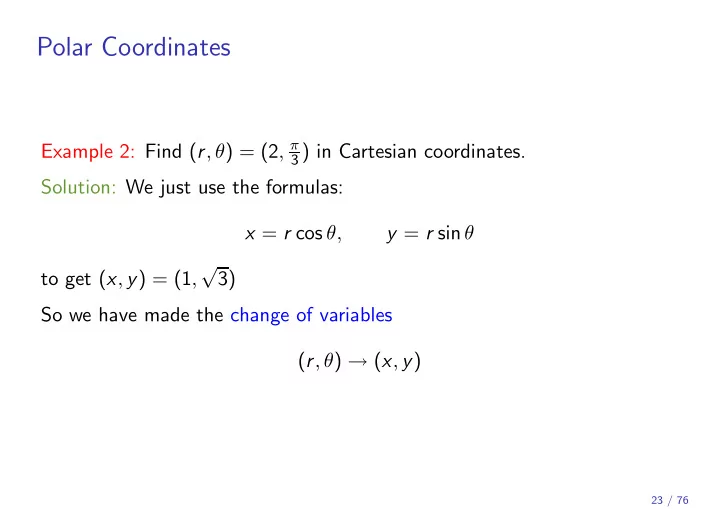
Polar Coordinates Example 2: Find ( r , ) = (2 , 3 ) in Cartesian coordinates. Solution: We just use the formulas: x = r cos , y = r sin to get ( x , y ) = (1 , 3) So we have made the change of variables ( r , ) ( x , y )


slide-1
SLIDE 1

Polar Coordinates

Example 2: Find (r, θ) = (2, π

3 ) in Cartesian coordinates.

Solution: We just use the formulas: x = r cos θ, y = r sin θ to get (x, y) = (1, √ 3) So we have made the change of variables (r, θ) → (x, y)

23 / 76
slide-2
SLIDE 2

Polar Coordinates

Example 1: The circle of centre (0, 0) and radius 1 can be written using polar coordinates as r = 1 BIG IDEA: Polar coordinates are suitable when the problems have circular symmetry.

24 / 76

slide-3
SLIDE 3

Polar Coordinates

Example 2: Valentine’s day is approaching ... In this spirit, consider the function r = 1 − cos θ

–1 –0.5 0.5 1 –2 –1.5 –1 –0.5

Figure: Cardioid

25 / 76

slide-4
SLIDE 4

Polar Coordinates

In general, let x = r cos θ, y = r sin θ with 0 ≤ θ < 2π. Then a function g(r, θ) is a composition of f (x, y), with x(r, θ) = r cos θ and y(r, θ) = r sin θ, i.e., g(r, θ) = f (x(r, θ), y(r, θ)) Useful formulas: r =

  • x2 + y 2,

θ = arctan y x

  • 26 / 76
slide-5
SLIDE 5

Polar Coordinates

Example 2: Let f (x, y) = x2 + y 2.

2 4 6 8 10 12 14 16 18 –3 –2 –1 1 2 3 y –3 –2 –1 1 2 3 x

What is g(r, θ) = f (r cos θ, r sin θ)?

27 / 76

slide-6
SLIDE 6

Cylindrical Coordinates

We can extend the idea of polar coordinates in 3 dimensions. Consider the chance of coordinates: (x, y, z) → (r, θ, z) with x = r cos θ, y = r sin θ, z = z with 0 ≤ θ < 2π Then a cylinder with axis of symmetry the z-axis and radius 1 can be represented as r = 1 BIG IDEA: Suitable coordinates for problems with cylindrical symmetry!

28 / 76

slide-7
SLIDE 7

Cylindrical Coordinates

A function f (x, y, z) can be written as a function g(r, θ, z) = f (r cos θ, r sin θ, z) in cylindrical coordinates. Example: Let f (x, y, z) = e √

x2+y2 −

zx

  • x2 + y 2

In cylindrical coordinates this would become g(r, θ, z) = f (r cos θ, r sin θ, z) = er − z cos θ Much simpler to manipulate!

29 / 76

slide-8
SLIDE 8

Spherical Coordinates

We can extend the idea of polar coordinates in 3 dimensions, in yet another way than cylindrical coordinates. Consider the chance of coordinates: (x, y, z) → (r, θ, φ) with x = r cos θ sin φ, y = r sin θ sin φ, z = r cos φ with 0 ≤ θ < 2π AND 0 ≤ φ ≤ π Example: Write (x, y, z) = (1, 1, 0) in spherical coordinates. Answer: (r, θ, φ) = ( √ 2, π

4 , π 2 )

30 / 76

slide-9
SLIDE 9

Spherical Coordinates

A sphere with centre (0, 0) and radius 1 can be represented as r = 1 BIG IDEA: Suitable coordinates for problems with spherical symmetry!

31 / 76

slide-10
SLIDE 10

Spherical Coordinates

A function f (x, y, z) can be written as a function g(r, θ, φ) = f (r cos θ sin φ, r sin θ sin φ, r cos φ) in spherical coordinates. Example: Let f (x, y, z) = x2 + y 2 + z2 − z In spherical coordinates this would become g(r, θ, φ) = f (r cos θ sin φ, r sin θ sin φ, r cos φ) = r2 − r cos φ Much simpler to manipulate!

32 / 76