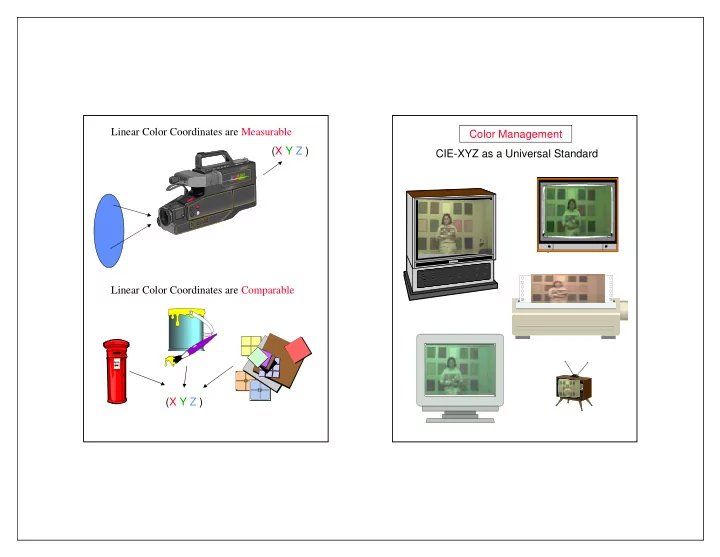
SLIDE 1
(X Y Z ) Linear Color Coordinates are Measurable Linear Color Coordinates are Comparable (X Y Z ) CIE-XYZ as a Universal Standard Color Management
SLIDE 2 0.2 0.4 0.6 0.8 0.2 0.4 0.6 0.8
reference white
Chromaticity defined in Polar Coordinates
Given a reference white. Dominant Wavelength - wavelength of the spectral color which added to the reference white, produces the given color. Complementary Wavelength - wavelength of the spectral color which added to the given color, produces the reference white. Excitation Purity - the ratio of the lengths between the given color and reference white and between the dominant wavelength light and reference white. Ranges between 0 .. 1.
purity Dominant/complimentary Wavelength
Relationship between HSV and XYZ
Y vs V : Luminance (intensity) vs Brightness (Lightness) Luminance
∆I1 ∆I2 I2 I1
I1 < I2, ∆I1 = ∆I2 Equal intensity steps: Equal brightness steps:
SLIDE 3
Weber’s Law
In general, ∆I needed for just noticable difference (JND) over background I was found to satisfy: ∆I I = constant (I is intensity, ∆I is change in intensity) Weber’s Law: Perceived Brightness = log (I)
Intensity Perceived Brightness
Munsell lines of constant Hue and Chroma. MacAdam Ellipses of JND (Just Noticable difference)
x y
0.1 0.2 0.3 0.4 0.5 0.6 0.1 0.2 0.3 0.4 0.5
Value =1/
0.2 0.4 0.6 0.8
y
0.2 0.4 0.6
x (Ellipses scaled by 10)
SLIDE 4 The transformation from XYZ space to perceptual space is Non Linear: Linear approximation defined by CIE: CIE Uniform Chromaticity Scale (UCS) : U = X 2 3 V = Y W = -X + 3Y + Z 2 0.66 0 0 0 1 0
X Y Z U V W =
CIE- UVW Coordinates
u = 4x
v = 6y
CIE-uv Chromaticity Coordinates: Munsell lines of constant hue and chroma plotted in CIE-uv coordinates:
u v
0.1 0.2 0.3 0.4 0.5 0.6 0.1 0.2 0.3 0.4
Value =1/
SLIDE 5 b* = 200 [ (X/X0) 1/3 - (Z/Z0)1/3]
CIE- L*a*b* Coordinates
a* = 500 [ (X/X0) 1/3 - (Y/Y0)1/3] X0 Y0 Z0 = coordinates of reference white L* = 116(Y/Y0)1/3 - 16 for Y/Y0 > 0.01 903(Y/Y0) otherwise
The transformation from XYZ space to perceptual space is Non Linear:
Perceptual Color Spaces CIE- L*u*v* Coordinates
u* = 13 L*(u’-u0’) v* = 13 L*(1.5v’-v0’) L* = 116(Y/Y0)1/3 - 16 for Y/Y0 > 0.01 903(Y/Y0) otherwise u0 v0 Y0 = coordinates of reference white u‘ = u v‘ = 1.5 v
Munsell lines of constant hue and chroma plotted in CIE- L*u*v* Coordinates:
u*
50 100 150
Value =5/
200 100 50
v*
MacAdam Ellipses of JND plotted in CIE- L*u*v* Coordinates:
u*
50 100 150 200
100 50
v*
SLIDE 6
Measuring Color Differences ∆e 2 = ∆L*2 + ∆a* 2 + ∆b* 2 ∆e2 = ∆L*2 + ∆u* 2 + ∆v* 2 ∆e = 3 visually indistiguishable ∆e = 5 acceptable error (most printers) ∆e = 10 bad ∆e = 15 unacceptable
error for ∆I1 : ∆e = 37.36 error for ∆I2 : ∆e = 4.64
Luminance ∆I1 ∆I2 I2 I1
Image Retrieval - Image Database
Distances should be measured in Perceptual Color space.
SLIDE 7 Opponent Colors
Ewald Hering (1905) - Pure colors R G B Y. No such colors greenish-red, yellowish-blue Boynton & Gordon (1965) - With R G B Y can categorize all visible hues. Jameson & Hurvich (1955, 1957) - Hue Cancellation Experiments
+
test light Hue Cancellation Experiment
Why Opponent process ?
A: Efficient Encoding.
L and M cone sensitivities are highly correlated.
Wavelength (nm) Relative sensitivity
Cone Spectral Sensitivity
400 500 600 700 0.25 0.5 0.75 1 L M S
Cone responses to several Natural SPDs :
0.25 0.5 0.75 1 0.25 0.5 0.75 1
L-cone absorption M-cone absorption
0.25 0.5 0.75 1 0.25 0.5 0.75 1
M-cone absorption S-cone absorption
SLIDE 8 Decorrelation: 0.30 0.59 0.11 0.60 -0.47 -0.22 0.21 0.52 -0.31 R G B = O1 O2 O3 Spectral sensitivity of three decorrelating signals:
Blue-Yellow Red-Green Black-White
400 500 600 700
1.5 1 + +
SLIDE 9
+
Opponent Color Space
black-white red-green blue-yellow
+ +
SLIDE 10
YIQ - Color Space
NTSC = National Television Systems Committee Y = luminance I = red-green Q = blue-yellow R G B = Y I Q
0.177 0.813 0.011 0.540 -0.263 -0.174 0.246 -0.675 0.404 R G B are the CIE-RGB
SLIDE 11
Original Y - Blur I - Blur Q - Blur
Subtractive Color System - CMYK
Cyan Magenta Yellow blacK = removes red = removes green = removes blue = removes all Printer Dyes: cyan magenta yellow B G R B G R B G R
transmit
Ideal block dyes:
SLIDE 12
Opponent Color Wheel Additive primaries Subtractive Primaries
yellow B G R
Multiplicative (Subtractive) Color System
red = magenta + yellow magenta B G R red R B G R
*
= B G R = magenta + yellow = cyan + yellow = magenta + cyan red green blue
SLIDE 13
SLIDE 14
Cyan - controls amount of red in print: cyan B G R low C = high R (also high G and B) high C = low R (high G and B) R G B R G B R G B High density cyan Medium density cyan Low density cyan
SLIDE 15 CMY + Black
C + M + Y = K (black)
- Using three inks for black is expensive
- C+M+Y = dark brown not black
- Black instead of C+M+Y is crisper with more
contrast. 100 50 70 Undercolor removal - (gray component replacement)
=
50 20 50
+
C M Y C M Y K
SLIDE 16
SLIDE 17
SLIDE 18
Color Spaces - Summary
RGB space - Additive space used for CRT, Color Image representation CIE-XYZ Tristimulus Coordinates - Device Independent, Universal standard CIE-Lab - Perceptual Space, used for image quality, Image Metric (distance measure). YIQ - Opponent Space, used for color television broadcast. HSV - Perceptual Digitized Space, used for Human Interactive Painting. CMYK - Subtractive Space used for ink and dyes (printing). All these color spaces are 3D. There are conversions from one space to the other.