ANALYSIS OF THE MECHANICAL BEHAVIOUR OF MAGNETO SHAPE MEMORY - - PDF document

analysis of the mechanical behaviour of magneto shape
SMART_READER_LITE
LIVE PREVIEW

ANALYSIS OF THE MECHANICAL BEHAVIOUR OF MAGNETO SHAPE MEMORY - - PDF document

18 TH INTERNATIONAL CONFERENCE ON COMPOSITE MATERIALS ANALYSIS OF THE MECHANICAL BEHAVIOUR OF MAGNETO SHAPE MEMORY POLYMERS UNDER MAGNETIC FIELD H. Park 1 , W.-R. Yu 1 *, C.-H. Ahn 1 , P. Harrison 2 , Z. Guo 3 1 Department of Materials Science and


slide-1
SLIDE 1

18TH INTERNATIONAL CONFERENCE ON COMPOSITE MATERIALS

1 Introduction Shape memory polyurethane (SMPU) is a smart material that can change its macroscopic shape from a temporarily fixed shape to a memorized and permanent one upon heating. Current SMPUs have several unresolved issues, delaying their applications to smart devices and composites. These include low mechanical stiffness and prolonged strain recovery. Many efforts have been made to enhance such low properties by reinforcing SMPUs with particulate fillers or stiff fibers, such as clay and carbon nanotubes [1, 2]. This study was aimed to model the mechanical behavior of a new SMPU composite (magneto SMPU, ma-SMPU), which were prepared by introducing aligned carbonyl iron particles (CIP) under magnetic field, and further to investigate the novelty of the composites through the virtual characterization of their mechanical properties. In this study, a homogenization concept was used, i.e., the distribution of CIPs was the same over the

  • material. The mechanical behavior of ma-SMPU and

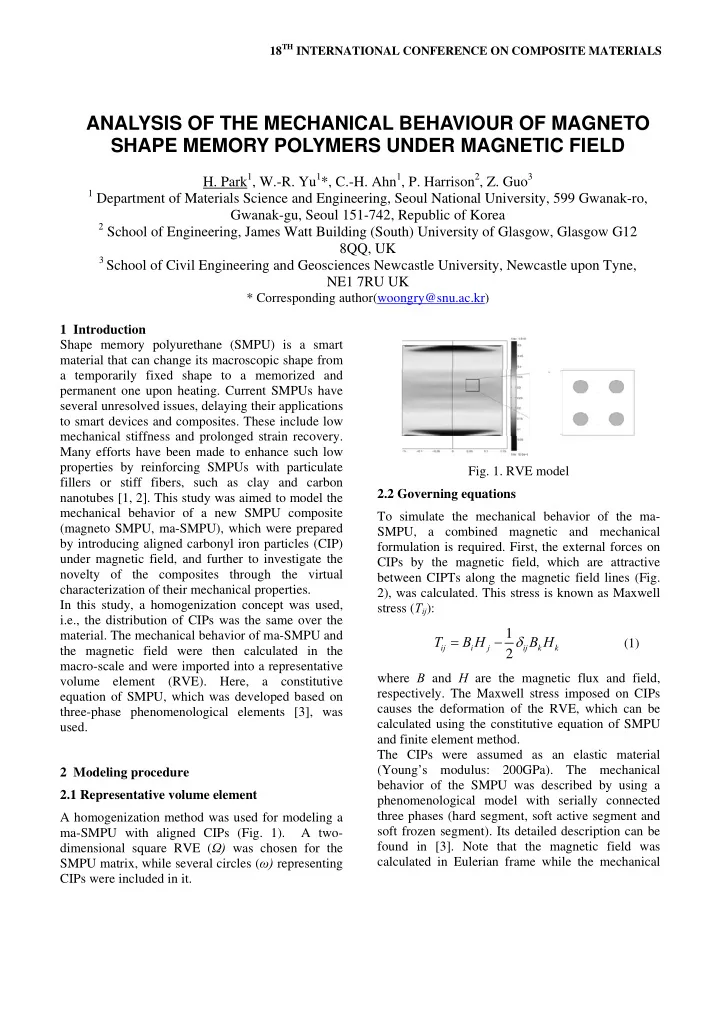
the magnetic field were then calculated in the macro-scale and were imported into a representative volume element (RVE). Here, a constitutive equation of SMPU, which was developed based on three-phase phenomenological elements [3], was used. 2 Modeling procedure 2.1 Representative volume element A homogenization method was used for modeling a ma-SMPU with aligned CIPs (Fig. 1). A two- dimensional square RVE (Ω) was chosen for the SMPU matrix, while several circles (ω) representing CIPs were included in it.

  • Fig. 1. RVE model

2.2 Governing equations To simulate the mechanical behavior of the ma- SMPU, a combined magnetic and mechanical formulation is required. First, the external forces on CIPs by the magnetic field, which are attractive between CIPTs along the magnetic field lines (Fig. 2), was calculated. This stress is known as Maxwell stress (Tij):

1 2

ij i j ij k k

T B H B H   

(1) where B and H are the magnetic flux and field,

  • respectively. The Maxwell stress imposed on CIPs

causes the deformation of the RVE, which can be calculated using the constitutive equation of SMPU and finite element method. The CIPs were assumed as an elastic material (Young’s modulus: 200GPa). The mechanical behavior of the SMPU was described by using a phenomenological model with serially connected three phases (hard segment, soft active segment and soft frozen segment). Its detailed description can be found in [3]. Note that the magnetic field was calculated in Eulerian frame while the mechanical

ANALYSIS OF THE MECHANICAL BEHAVIOUR OF MAGNETO SHAPE MEMORY POLYMERS UNDER MAGNETIC FIELD

  • H. Park1, W.-R. Yu1*, C.-H. Ahn1, P. Harrison2, Z. Guo3

1 Department of Materials Science and Engineering, Seoul National University, 599 Gwanak-ro,

Gwanak-gu, Seoul 151-742, Republic of Korea

2 School of Engineering, James Watt Building (South) University of Glasgow, Glasgow G12

8QQ, UK

3 School of Civil Engineering and Geosciences Newcastle University, Newcastle upon Tyne,

NE1 7RU UK

* Corresponding author(woongry@snu.ac.kr)

slide-2
SLIDE 2

behavior of the ma-SMPU was formulated in Lagrangian (material) frame.

  • Fig. 2. External forces on RVE by magnetic field

2.3 Geometry and boundary conditions A two dimensional RVE (30 30 m

 

) was used, in which four circles were regularly introduced for modeling CIPs. The radius

  • f

each circle was

m  79 . 3

, rendering a volume fraction of 20% CIPs with respect to the whole RVE. To apply the magnetic field in a direction, the magnetic vector potential was input in the top and bottom (or right and left) boundaries as follows.

k A j i A

z

     ˆ ˆ      ) ( ) (

, ,

left bottom A right top A A

z z z

(3) where

, z

A

is z-direction element of

z

A 

. 3 Simulation procedures The mechanical behavior of the ma-SMPU was simulated by following a test procedure set up for characterizing the one way shape memory effect of SMPU [3]. Note that a magnetic field was applied during this test cycle. The cyclic deformation behavior of ma-SMPU by cyclic magnetic fields was also simulated. 3.1 One way shape memory under magnetic Field A thermo-mechanical cyclic test was simulated under various magnetic field: 0T, parallel 4.0T, and normal 2.0T. The test consisted of four steps: (a) Extension: a tensile stress was applied to the ma- SMPU up to

MPa 5 . 3

. The magnetic field was then applied when the stress was reached to

MPa 5 . 1

. (b) Relaxation: the ma-SMPU was fixed by cooling it down from 50 to 0°C. (c) Unloading: the stress was

  • released. (d) Heating : the ma-SMPU was heated up

to 50°C, allowing it to recover its initial shape. 3.2 Reversible deformation behavior of magneto- SMPU by a periodic magnetic field Under periodically increasing and decreasing magnetic field, a creep test of the ma-SMPU was simulated to investigate its periodic deformation behavior by the magnetic field. During the whole test, a constant stress (

MPa 5 . 2

) was applied. Several tests were simulated for various magnetic fields directed in parallel to the tension (with its magnitude of 0T, 1.0T, 3.0T, and 4.0T) and in normal to the tension (with its magnitude of 0T, 1.0T, 1.5T, 2.0T) (see Fig. 3).

  • Fig. 3 Magnetic fields normal (top) and parallel

(bottom) to tension 4 Results and discussions COMSOL software was used to analyze the thermo- mechanical behavior

  • f

the ma-SMPU. To implement the constitutive equation of pure SMPU, the weak form of both force equilibrium and constitutive equation were inputted into COMSOL.

slide-3
SLIDE 3

3 ANALYSIS OF THE MECHANICAL BEHAVIOUR OF MAGNETO SHAPE MEMORY POLYMERS UNDER MAGNETIC FIELD

The themo-mechanical behavior of the ma-SMPU was calculated as shown in Fig. 4. At a stress of 3.5 MPa, pure SMPU and ma-SMPU showed 51.4 and 44.8% extension without magnetic field, respectively, while the ma-SMPU extended to 35.1, and 50.0% when 4.0T in parallel and 2.0T in normal direction to the tensile axis were applied,

  • respectively. These results demonstrate that both

CIPs and magnetic field have significant influence

  • n the mechanical behavior of the SMPU. Note that

the normal magnetic field facilitated the extension of the ma-SMPU due to the longitudinal forces while the parallel field obstructed the extension due to the transversal force. The fixity of the ma-SMPU was slightly increased due to the CIPs and the normal magnetic field increased it (Table 1). Note that the parallel field decreased the fixity due to the transverse force added by the magnetic field. On the

  • ther hand, the recovery strain showed the reverse

trend, which was readily understandable because the forces in opposite direction to the recovery axis

  • bstruct the strain recovery. To explain this,

Maxwell stress was investigated as follows.

  • Fig. 4. Stress-strain curve of thermo-mechanical test
  • f SMPU under various conditions

Table 1. The effect of magnetic field on the thermomechanical behavioar of ma-SMPUs. Material Field

s

E

(MPa)

f

R

(%)

r

R

(%) ma-SMPU Parallel 4.0T 10.0 90.92 91.45 SMPU No 6.8 92.15 72.13 ma-SMPU No 7.8 92.77 71.47 ma-SMPU Normal 2.0T 7.0 93.26 71.41 When the parallel magnetic field was applied on CIPs, the Maxwell stress was developed in the same direction to the tensile axis as shown in Fig. 5., resulting in lower strain than only the mechanical stress applied. This Maxwell stress acted during unloading, having brought about higher stiffness and recovery strain. Contrast to the parallel field, Maxwell stress acted in the normal direction to the tensile axis when the normal field applied (Fig. ). This stress facilitated the extension during the loading step, while it disturbed the recovery strain during the recovery step.

  • Fig. 5. Maxwell stress on CIP developed due to the

parallel magnetic field. The simulated creep behavior of ma-SMPU under the periodic parallel magnetic fields is shown in Fig.

  • 6. The SMPU without the magnetic field showed the

simple creep behavior similar to general viscoelastic

  • materials. Applying the magnetic field caused ma-

SMPU to contract, while releasing magnetic field returned it to the original creep curve for without magnetic field case. The bigger the magnitude of magnetic field was applied, the larger strain, e.g., a maximum of 10%, the ma-SMPU showed. The total strain decreased with increased magnetic field, i.e., the magnetic field imposed the compressive stress

  • n ma-SMPU, delaying the tensile strain.
slide-4
SLIDE 4
  • Fig. 6. Maxwell stress on CIP developed due to the

normal magnetic field. The creep behavior of ma-SMPU under the normal magnetic field was also calculated as shown in Fig.

  • 7. Contrasted to the parallel field applied before, the

ma-SMPU showed increased strain due to the magnetic field applied. 5 Summary A research framework was provided in this study to simulate the thermo-mechanical behavior of ma-

  • SMPUs. A two-dimensional RVE was introduced

with CIPs and pure SMPU. Using a constitutive equation developed for pure SMPU, the mechanical behavior of the RVE was simulated under magnetic

  • field. It was demonstrated that the stiffness of ma-

SMPU was controlled by the aligned magnetic field, e.g., the parallel filed strengthens ma-SMPU while normal one weakens it. Experimental research is undergoing to validate the simulations results, which will be presented at the conference. References

[1] F. Cao and S. C. Jana, “Nanoclay-tethered shape memory polyurethane nanocomposites”, Polymer,

  • Vol. 48, pp 3790-3800, 2007.

[2] A. Lendlein and S. Kelch, “Shape-memory polymers as stimuli-sensitive implant materials.”, Clin.

  • Hemorheol. Micro., Vol. 32, pp 105-116, 2005.

[3] J. H. Kim, T. J. Kang, W.-R. Yu, “Thermo- mechanical constitutive modeling of shape memory polyurethanes using a phenomenological approach”, International Journal of Plasticity, Vol. 26, pp. 204– 218, 2010.

  • Fig. 6. Creep behavior of the ma-SMPU under the

cyclic magnetic field applied parallel to the tension at a temperature (50°C).

  • Fig. 7. Creep behavior of the ma-SMPU under the

cyclic magnetic field normal to the tension at a temperature (50°C).