
SLIDE 1
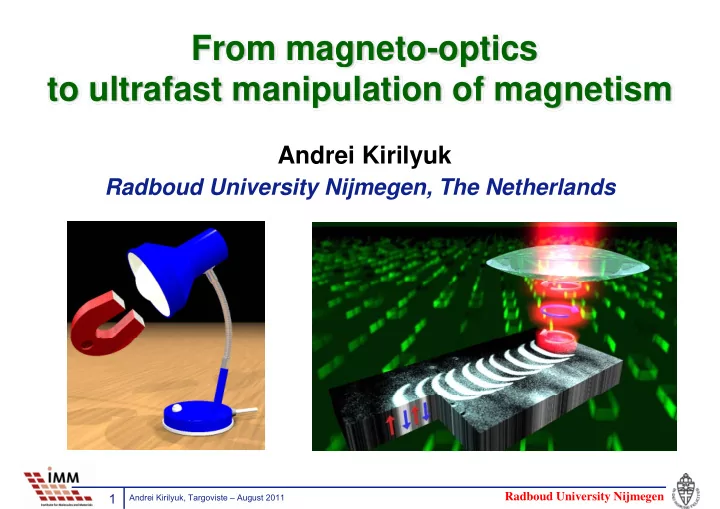
From magneto-optics From magneto optics to ultrafast manipulation of magnetism
Andrei Kirilyuk
Radboud University Nijmegen, The Netherlands
Andrei Kirilyuk, Targoviste – August 2011
Radboud University Nijmegen
1
From magneto-optics From magneto optics to ultrafast manipulation - - PowerPoint PPT Presentation
From magneto-optics From magneto optics to ultrafast manipulation of magnetism Andrei Kirilyuk Radboud University Nijmegen, The Netherlands 1 Radboud University Nijmegen Andrei Kirilyuk, Targoviste August 2011 Outline of the lecture
Andrei Kirilyuk
Radboud University Nijmegen, The Netherlands
Andrei Kirilyuk, Targoviste – August 2011
Radboud University Nijmegen
1
Outline of the lecture
Light as a probe linear magneto optics linear magneto-optics nonlinear (magneto-)optics Example: all-optical FMR Light as an excitation classification of effects classification of effects basics of opto-magnetism coherent control local control of spins p can this become too-ultrafast?
Andrei Kirilyuk, Targoviste – August 2011
Radboud University Nijmegen
2
Outline of the lecture
Light as a probe linear magneto optics linear magneto-optics nonlinear (magneto-)optics Example: all-optical FMR Light as an excitation classification of effects classification of effects basics of opto-magnetism coherent control local control of spins p can this become too-ultrafast?
Andrei Kirilyuk, Targoviste – August 2011
Radboud University Nijmegen
3
Optics
1.5–3.2 eV
Andrei Kirilyuk, Targoviste – August 2011
Radboud University Nijmegen
4
Why are certain wavelengths “visible”?
1 km
Transmission through water
UV X ray wave IR
1 km
X-ray Radio Microw
1 m 1 mm 1 µm 1 km 1 m 1 mm 1 µm 1 nm
visible spectrum
wavelength
Andrei Kirilyuk, Targoviste – August 2011
Radboud University Nijmegen
5
spectrum
Optics
1.5–3.2 eV
) ( t r k i
e E E
ω −
=
r r
r r
χ ε ˆ 1 ˆ + =
2
Andrei Kirilyuk, Targoviste – August 2011
Radboud University Nijmegen
6
2
Anisotropic media
⎟ ⎞ ⎜ ⎛
xz xy xx
ε ε ε ⎟ ⎟ ⎟ ⎠ ⎜ ⎜ ⎜ ⎝ =
yz yy yx
ε ε ε ε ˆ
E r
⎟ ⎠ ⎜ ⎝
zz zy zx
ε ε ε
E r
y
E
⎞ ⎛
if H = 0
x
E
⎟ ⎟ ⎞ ⎜ ⎜ ⎛ =
xx
ε ε ε ˆ ⎟ ⎟ ⎠ ⎜ ⎜ ⎝
zz yy
ε ε ε
i.e. one could chose such a coordinate system
Andrei Kirilyuk, Targoviste – August 2011
Radboud University Nijmegen
7
Driven oscillator model t E ω sin
ω
F x dt x d m = ⎟ ⎟ ⎠ ⎞ ⎜ ⎜ ⎝ ⎛ +
2 2 2
ω dt ⎠ ⎝
t eE F ω sin =
t E e x x d ω ω sin
2 2
= + t E m x dt ω ω sin
2
= +
Andrei Kirilyuk, Targoviste – August 2011
Radboud University Nijmegen
8
Driven oscillator model
solution in the form:
( )
e
x t r ( ) E t r
( )
t m eE t x x ω ω ω ω sin sin
2 2
− = =
( )
lit d
amplitude depends on ω
amplitude
ω
x
ω ω ω ω
°
phase
damped oscillator
°
−180 p
Andrei Kirilyuk, Targoviste – August 2011
Radboud University Nijmegen
9
Sum of the two waves:
Δz
incoming + outgoing
amplitude
( )
E E i
phase
( )
t E z E ω sin = =
phase
Andrei Kirilyuk, Targoviste – August 2011
Radboud University Nijmegen
10
Phase of the light after transmission
Δz
( )
⎟ ⎞ ⎜ ⎛ z t E E i
( )
⎟ ⎠ ⎜ ⎝ − = c t E z E ω sin
z Δ
extra time because of n:
c z n Δ − ) 1 ( ⎞ ⎛ Δ Δ
( )
⎟ ⎠ ⎞ ⎜ ⎝ ⎛ Δ − − − = c z n c z t E z E ) 1 ( sin ω
phase delay:
c z n Δ − ) 1 ( ω
z
z = 0
( )
t E E i
thus if a phase delay occurs
( )
t E z E ω sin = =
thus if a phase delay occurs, this is equivalent to the refractive index
Andrei Kirilyuk, Targoviste – August 2011
Radboud University Nijmegen
11
Absorption en refractive index
multiple resonances:
amplitude = absorption phase = refractive index
2 2
/ 2 1 Ne Ne ω ω γ −
2 2 2 2 0 0
1 2 ( ) ( / 2) 4 ( ) ( / 2)
e e
n c m m γ α ε ω ω γ ε ω ω ω γ = − = − + − +
t f d i
Andrei Kirilyuk, Targoviste – August 2011
Radboud University Nijmegen
12
γ accounts for damping
Kramers-Kronig relations
ε ε ε i + =
∞
2 1
ε ε ε i + =
ik n n + = ~
u u
∞
− − =
2 2 1 2
1 2 ω ε π ω ω ε
ik n n + =
u u u
∞ 2
2 ε ω π
2 2 1
k n − = ε k 2
u u u
− =
2 2 2 1
ω ε π ω ε
nk 2
2 =
ε
real and imaginary parts are not independent!
Andrei Kirilyuk, Targoviste – August 2011
Radboud University Nijmegen
13
Dispersion of glass
Andrei Kirilyuk, Targoviste – August 2011
Radboud University Nijmegen
14
Optical constants of metals
Ni Au Ni Au
Andrei Kirilyuk, Targoviste – August 2011
Radboud University Nijmegen
15
How does magnetic field (magnetization) modify dielectric tensor? dielectric tensor?
r r
xx
⎥ ⎤ ⎢ ⎡ε
y
E D r r εε =
2
n
yy xx
= ⎥ ⎥ ⎥ ⎦ ⎢ ⎢ ⎢ ⎣ = ε ε ε
x
H=0
if isotropic
zz ⎥
⎦ ⎢ ⎣ ε
z
if isotropic
⎥ ⎥ ⎤ ⎢ ⎢ ⎡ = ? ? ? ? ? ? ε
M or H
H≠0
E r
⎥ ⎥ ⎦ ⎢ ⎢ ⎣ = ? ? ? ? ? ? ε
H≠0
E
Andrei Kirilyuk, Targoviste – August 2011
Radboud University Nijmegen
16
How does magnetic field modify conductivity? g y y
H 0 y
⎥ ⎤ ⎢ ⎡
xx
σ
E j H=0 x
⎥ ⎥ ⎥ ⎦ ⎢ ⎢ ⎢ ⎣ =
zz yy xx
σ σ σ
E j r r σ =
E j H y x
FL=e[V×H]
Lorentz force
⎦ ⎣
zz
x
FL e[V H]
Lorentz force H E j
Ey → jx Ex → jy
j H
⎥ ⎤ ⎢ ⎡
xy xx
σ σ
E
⎥ ⎥ ⎥ ⎦ ⎢ ⎢ ⎢ ⎣ =
zz yy yx
σ σ σ σ
Andrei Kirilyuk, Targoviste – August 2011
Radboud University Nijmegen
17
Onsager principle: symmetry of kinetic coefficients symmetry of kinetic coefficients
⎥ ⎤ ⎢ ⎡
xy xx
ε ε
⎥ ⎤ ⎢ ⎡
xx
ε
⎥ ⎥ ⎥ ⎦ ⎢ ⎢ ⎢ ⎣ =
zz yy yx
ε ε ε ε
⎥ ⎥ ⎥ ⎦ ⎢ ⎢ ⎢ ⎣ =
zz yy
ε ε ε H=0 H≠0
X f W ∂ ∂
f S X
ji ij
S S =
t f t ∂ = ∂
j ij i
f S X =
X - response If S is a function of magnetic field
S (H) S (H) S ( H)
f - stimulus W - energy
Sij(H)=-Sji(H)=Sji(-H)
t D E t W ∂ ∂ = ∂ ∂
Onsager principle is applicable to ε
εij(H)=-εji(H)=εji(-H)
j ij i
E D ε =
in non-absorbing media
εij=εji*
L d & Lif hi Th i l Ph i 5 d 8
Andrei Kirilyuk, Targoviste – August 2011
Radboud University Nijmegen
18
Landau & Lifshitz, Theoretical Physics, vv. 5 and 8.
Faraday effect – 1
⎞ ⎛
Isotropic medium in a magnetic field:
⎟ ⎟ ⎟ ⎞ ⎜ ⎜ ⎜ ⎛ − =
xy xy
i i ε ε ε ε ε ˆ
z xy
M ∝ ε
⎟ ⎟ ⎠ ⎜ ⎜ ⎝ +
zz xy
ε ε 0
2 z zz
M ∝ ε
H H r r =
E r
y x in
E j E i E r r r + =
z
H H =
in
E r
E
x
??? =
E r
y z
Andrei Kirilyuk, Targoviste – August 2011
Radboud University Nijmegen
19
Faraday effect – 2
E i ⎞ ⎛ ⎞ ⎛
To find the eigenvalues of the problem:
E n E E i i E D
y x xy xy
r r r
2
ˆ = ⎟ ⎟ ⎟ ⎞ ⎜ ⎜ ⎜ ⎛ ⎟ ⎟ ⎟ ⎞ ⎜ ⎜ ⎜ ⎛ − = = ε ε ε ε ε
⎟ ⎟ ⎠ ⎞ ⎜ ⎜ ⎝ ⎛ = ⎟ ⎟ ⎠ ⎞ ⎜ ⎜ ⎝ ⎛ ⎟ ⎟ ⎠ ⎞ ⎜ ⎜ ⎝ ⎛ −
y x y x xy xy
E E n E E i i
2
ε ε ε ε
⎟ ⎠ ⎜ ⎝ ⎟ ⎠ ⎜ ⎝ ε
⎠ ⎝ ⎠ ⎝ ⎠ ⎝
y y xy
2 2
= − − − n i i n
xy
ε ε ε ε
2
1 ε ε ε
xy
n ± =
n i
xy
ε ε
2 1 ε ε ε
xy
n ± ≅
4 3
10 10 ~
− − − xy
ε
y x
iE E ± =
⎟ ⎟ ⎞ ⎜ ⎜ ⎛1 ⎟ ⎟ ⎞ ⎜ ⎜ ⎛ 1
eigenmodes and ,
y x
iE E ±
⎟ ⎟ ⎠ ⎜ ⎜ ⎝i ⎟ ⎟ ⎠ ⎜ ⎜ ⎝−i
g and , or
Andrei Kirilyuk, Targoviste – August 2011
Radboud University Nijmegen
20
Faraday effect – 3
1 ε xy
y x
iE E ± =
Two circularly polarized waves ith diff t f ti i di
2 1 ε ε
xy
n ± ≅
±
with different refractive indices:
r
−
E
+
E
E r
in
E r
−
E
+
E
l
F
α
+ +
F
2 ε πl
Faraday rotation:
2 ε ε λ π α
xy F
l =
lines of force, Phil. Trans. R. Soc. Lond. 136, 104 (1846).
Andrei Kirilyuk, Targoviste – August 2011
Radboud University Nijmegen
21
f f ( )
Kerr effect: various geometries
θ θ θ θ θ
M r M r M r H r
θ
θ
θ polar longitudinal transverse
Andrei Kirilyuk, Targoviste – August 2011
Radboud University Nijmegen
22
Magnetic linear birefringence
r r
light propagates along x axis, so that
z y in
E k E j E r r r + =
z
H
x y ⎟ ⎟ ⎞ ⎜ ⎜ ⎛ − =
xy
i i ε ε ε ε ε ˆ y ⎟ ⎟ ⎠ ⎜ ⎜ ⎝ + =
zz xy
i ε ε ε ε ε
2
zz
ε ε + , ε
Eigenvalues
2
M
zz ∝
ε
Eigenmodes
z y E
E r r ,
Andrei Kirilyuk, Targoviste – August 2011
Radboud University Nijmegen
23
light wave spins
light wave spins
exchange + spin-orbit
Andrei Kirilyuk, Targoviste – August 2011
Radboud University Nijmegen
24
What could be measured?
0.3
(deg)
'up' 0.0
tization" (
B i l PRL 76 4250 (1996)
3
'down'
"Magnet
Beaurepaire et al, PRL 76, 4250 (1996).
3 3
Field (kOe)
dynamics hysteresis
Andrei Kirilyuk, Targoviste – August 2011
Radboud University Nijmegen
25
dynamics hysteresis
Outline of the lecture
Light as a probe linear magneto optics linear magneto-optics nonlinear (magneto-)optics Example: all-optical FMR Light as an excitation classification of effects classification of effects basics of opto-magnetism coherent control local control of spins p can this become too-ultrafast?
Andrei Kirilyuk, Targoviste – August 2011
Radboud University Nijmegen
26
Electromagnetic wave equation and source term
E r r r ∂
2 2 2 2P
∂ r r
2 2
ˆ Q M P ∂ ∂ ∂ r r r S E c t E = ∇ ⋅ − ∂ ∂
2 2 2 2
t P S ∂ ∂ = r
2 2
t Q t M t P S ∂ ∂ ∇ − ∂ ∂ × ∇ + ∂ ∂ =
ω ωE
E
d ) 1 (
1 Φ
( )
) , 1 ( ) , 1 ( ) , 1 ( ω ω ω ω ω ω
χ χ χ E E H E E E
d m d
∇ + + − = Φ
ω ω
χ E E
d ) , 1 (
2 − = Φ
( )
, ... 1
ω ω ω
γ β α E H E + ∇ + + + ×
ω ω
χ E P
d ) , 1 (
= Φ ∂ − =
E r
) , 1 ( ) , 1 ( ) , 1 ( ... ω ω ω ω
χ χ χ E H E P
q m d
+ ∇ + + = χ E ∂ ...
) , 2 ( ) , 2 ( ) , 2 ( ω ω ω ω ω ω
χ χ χ E E H E E E
q m d
∇ + + +
electric dipole approximation magnetic dipole electric quadrupole
Andrei Kirilyuk, Targoviste – August 2011
Radboud University Nijmegen
27
magnetic dipole electric quadrupole
Harmonic oscillator
U(x)
(L)
Linear response U(x) P(L) x E
2 1
) ( x k x U = k x dU F ) (
1
) ( x k x U kx dx Fel = = ) (
2
E F x e dt d m
el =
+
2 2
) ( ) ( ) (
) (
ω ω χ ω
j ij L i
E P =
Andrei Kirilyuk, Targoviste – August 2011
Radboud University Nijmegen
28
Linear vs nonlinear optics?
Linearity in optics:
Andrei Kirilyuk, Targoviste – August 2011
Radboud University Nijmegen
29
Nonlinear oscillator
Anharmonism
) ( ) ( NL L
P P P + = P(NL) U(x)
2ω + DC
E x
ω
3 2 2 1
) ( x k x k x U + =
ω
) ( ) ( ) 2 ( ) 2 (
) (
ω ω ω χ ω
NL
E E P =
2 2 1
3 2 ) ( x k x k dx x dU Fel + = =
) ( ) ( ) ( ) (
) (
ω ω χ
k j ijk NL i
E E P =
) ( ) ( ) 2 ( ) 2 ( ω ω ω χ ω
k j ijk i
E E P =
Andrei Kirilyuk, Targoviste – August 2011
Radboud University Nijmegen
30
Nonlinear polarization and symmetry
( )
...
) 2 ( ) 1 (
+ ⋅ + ⋅ ∝
ω ω ω
χ χ ω E E E P
(electric dipole approximation)
t i
e ω
t i t i t i
e e e
ω ω ω 2
= ⋅
second-harmonic generation
t i t i t i
e e e
⋅ −
= ⋅
ω ω
inversion symmetry:
( ) ( )
ω ω
χ ω E E P ⋅ ∝
) 2 (
2
−1 −1 −1 1 1 1
( )
2 ≡ ω P(
)
except at surface/interface
Andrei Kirilyuk, Targoviste – August 2011
Radboud University Nijmegen
31
Magnetization-sensitive SHG
( )
) ( ) ( 2 ω ω ω
χ
k j ijk i
E E P =
) ( ) ( ) ( ) ( ω ω
χ χ
k j m ijk cr ijk
E E ± =
crystallographic ± magnetic
space inversion:
g
P E r r , H M r r ,
p
polar vector axial vector
time reversal:
vector vector
time reversal:
i d R.R. Birss, Symmetry and Magnetism (North-Holland, Amsterdam, 1966).
Andrei Kirilyuk, Targoviste – August 2011
Radboud University Nijmegen
32
Example: surface/interface sensitivity
ultrathin Co/Cu(001) films
t
Fe(110) surface
C (001) Co (x ML)
ast (%) total mag
Cu(001)
tic contra gnetizatio G magnet
SHG units)
at 4 ML, both interfaces are formed
Reif et al, Phys. Rev. Lett. 67, 2878 (1991)
Andrei Kirilyuk, Targoviste – August 2011
Radboud University Nijmegen
33
General phenomenology
... : :
) 3 ( ) 2 ( ) 1 (
+ + + ⋅ ∝ E E E E E E P r r r r r r r χ χ χ χ χ χ
( )
[ ]
3 ) ( mmm mem mee nl
r r r r r r r r r
( )
[ ]
3 ) (
, : : : H E
H H E E E P
emm eem eee nl
r r r r r r r r r + + + ∝ χ χ χ
( )
[ ]
3 ) (
, : : : H E
H H E E E M
mmm mem mee nl
+ + + ∝ χ χ χ
( )
[ ]
3 ) (
, : : : ˆ H E
H H E E E Q
qmm qem qee nl
r r r r r r r r + + + ∝ χ χ χ
( )
[ ]
, Q χ χ χ
Source term:
sum- and difference frequency generation, including SHG and including SHG and
Andrei Kirilyuk, Targoviste – August 2011
Radboud University Nijmegen
34
Outline of the lecture
linear magneto optics
nonlinear (magneto-)optics Example: all-optical FMR Light as an excitation classification of effects classification of effects basics of opto-magnetism coherent control local control of spins p can this become too-ultrafast?
Andrei Kirilyuk, Targoviste – August 2011
Radboud University Nijmegen
35
Outline of the lecture
Light as a probe linear magneto optics linear magneto-optics nonlinear (magneto-)optics Example: all-optical FMR Light as an excitation classification of effects classification of effects basics of opto-magnetism coherent control local control of spins p can this become too-ultrafast?
Andrei Kirilyuk, Targoviste – August 2011
Radboud University Nijmegen
36
Andrei Kirilyuk, Targoviste – August 2011
Radboud University Nijmegen
37
What you need: a femtosecond laser
Model Model Model TISSA20 TISSA50 TISSA100 Pump Power1) 3-5 W 3-7 W 5-10 W Output Power at 800 nm 150 - 250 mW 150-500 mW >10% efficiency Pulse Duration2) <20 fs 3) < 50 fs <100 fs Pulse Duration2) <20 fs 3) < 50 fs <100 fs Tuning Range 800 ± 20 nm 740 - 950 nm4) 720 - 980 nm4)
Interferometric autocorrelation function
Repetition Rate 70 - 140 MHz
te e o et c autoco e at o u ct o
group velocity dispersion compensation
you have some choice!
Andrei Kirilyuk, Targoviste – August 2011
Radboud University Nijmegen
38
you have some choice!
pump & probe technique: stroboscopic, needs repeatable process! needs repeatable process!
time base pump adjustable delay delay probe
Andrei Kirilyuk, Targoviste – August 2011
Radboud University Nijmegen
39
Stroboscopic magneto-optical pump-probe measurements
Ti:Sapphire 1 KHz 100 fs 805 nm 100 fs, 805 nm
delay τ delay τ
Delay line 0 1 μm = 0 7 fs
delay τ
Polarization change
( )
r
0.1 μm = 0.7 fs
is detected
( )
τ M ∝
Andrei Kirilyuk, Targoviste – August 2011
Radboud University Nijmegen
40
Optical pump-probe measurements of FMR
before pump pulse arrives after pump has arrived external field
s ani ext eff
H H H H r r r r + + =
Pump pulse affected by the laser
Andrei Kirilyuk, Targoviste – August 2011
Radboud University Nijmegen
41
All-optical magnetic resonance in antiferromagnets
175 K, 433 GHz (x6)
1.0
u n i t s )
0.7
1un.)
Z
δM
155 K, 406 GHz (x6) 135 K, 372 GHz (x3)
0.5
A m p l i t u d e ( a r b . u
0 5 0.6
0.01 0.1plitudes (arb. u
Z Y X
δM
115 K, 327 GHz (x3) 95 K, 271 GHz (x3)
25 50 75 0.0
A Pulse fluence (mJ/cm
2)0.4 0.5
(deg)
450
20 50 80 110 140 170Amp Temperature (K)
Y X
k
σ
+
quasi-FM mode
z)
75 K, 211 GHz 60 K, 175 GHz
0.3
y rotation
300
Z
ncy (GHz
, 50 K, 159 GHz 40K 153 GH z
0.2
Faraday
δM S2
Y Z
k S1
quasi-AFM mode
Frequen
40 K, 153 GH z 30 K, 151 GHz 18K 151 GH
0.1
150 25 50 75 100 125 150 175
Y
k
σ
+
X
18 K, 151 GH z
50 100 150 200 250 300 0.0
25 50 75 100 125 150 175
Temperature (K)
Andrei Kirilyuk, Targoviste – August 2011
Radboud University Nijmegen
42
Time delay (ps)
Outline of the lecture
Light as a probe linear magneto optics linear magneto-optics nonlinear (magneto-)optics Example: all-optical FMR Light as an excitation classification of effects classification of effects basics of opto-magnetism coherent control local control of spins p can this become too-ultrafast?
Andrei Kirilyuk, Targoviste – August 2011
Radboud University Nijmegen
43
Effects of the laser pulse: classification
change of M is a result of change of T change of M is a result of change of T
Andrei Kirilyuk, Targoviste – August 2011
Radboud University Nijmegen
44
Thermal laser-induced effects
ultrafast phase transitions
excitation and study
laser-induced collapse of magnetization
Tex
ex 1T S ×
S1 Tex Tex S2
A 1H S ×
A 2H S ×
Ju et al., PRL 82, 3705 (1999) van Kampen et al, PRL 88, 227201 (2002) Beaurepaire et al, PRL 76, 4250 (1996) Kimel et al., Nature 429, 850 (2004) Ju et al, PRL 93, 197403 (2004) Thiele et al, APL 85, 2857 (2004)
Andrei Kirilyuk, Targoviste – August 2011
Radboud University Nijmegen
45
, , ( )
Effects of the laser pulse: classification
I. Thermal effects: change of M is a result of change of T change of M is a result of change of T
based on photon absorption
Andrei Kirilyuk, Targoviste – August 2011
Radboud University Nijmegen
46
Photo-magnetic effects: modification of anisotropy
polarization-dependent polarization-dependent effect => nonthermal!
Hansteen et al., PRL 95, 047402 (2005);
Andrei Kirilyuk, Targoviste – August 2011
Radboud University Nijmegen
47
Circular polarization, photon spin, and absorption
1 S
1 + =
z
S
2 1 =
z
S
1 − =
z
S
1 2 1 − =
z
S
1 h t / it 20000 K ΔT very fast and easy? ~0.01 phot/site max 1 photon / site = 20000 K ΔT ff 10 4 p ≤0.01 efficiency effect ≤ 10-4
Andrei Kirilyuk, Targoviste – August 2011
Radboud University Nijmegen
48
Effects of the laser pulse: classification
I. Thermal effects: change of M is a result of change of T change of M is a result of change of T
based on photon absorption III N th l t ti ff t
do not require absorption
Andrei Kirilyuk, Targoviste – August 2011
Radboud University Nijmegen
49
Extended introduction in laser-induced dynamics
everything you ever wanted to know about everything you ever wanted to know about laser-induced magnetization dynamics...
Andrei Kirilyuk, Targoviste – August 2011
Radboud University Nijmegen
50
Thermodynamics of magneto-optics
( ) ( )
ω ω εε
*
E E = Φ
( ) ( ) ( ) ( )
E E H ∂ − = Φ ∂ − = ε ω ω ε
*
1
σ
+
( ) ( ) ( ) ( ) M
E E M H ∂ ∂ ω ω μ μ
σ
−
σ
⎞ ⎛
δH
+
δH
−
( )⎟
⎟ ⎟ ⎞ ⎜ ⎜ ⎜ ⎛ + − = ˆ M i M i
yy xx
ε α α ε ε
Inverse Faraday effect
δH δH
( )⎟
⎠ ⎜ ⎝ +
2
M O
zz
ε
( ) ( ) ( )
ω ω α ε
*
E E H r r r × =
( ) ( ) ( )
μ0
Pitaevskii, Sov. Phys. JETP 12, 1008 (1961). van der Ziel Phys. Rev. Lett. 15, 190 (1965).
Andrei Kirilyuk, Targoviste – August 2011
Radboud University Nijmegen
51
Faraday effect Inverse
F d t ti
2 α π θ M l =
Faraday rotation:
ε λ θF =
no absorption required!
( ) ( ) ( )
ω ω α ε
*
E E H r r r × =
no angular momentum transfer!
( ) ( ) ( )
μ0
−
E
+
E
in
E r
−
E
+
E
l
E r + +
F
α
H r
Andrei Kirilyuk, Targoviste – August 2011
Radboud University Nijmegen
52
H
Effect for opposite pulse helicities
it works!!!
i l t t 100 f equivalent to a 100 fs magnetic field pulse of some 0.5–1 Tesla!
[ ]
ε
( ) ( ) ( )
[ ]
ω ω α μ ε
*
E E H r r r × =
100 1 . ~ −
IFE
H
Tesla
Hansteen et al., PRL 95, 047402 (2005);
Andrei Kirilyuk, Targoviste – August 2011
Radboud University Nijmegen
53
y , ( )
Works everywhere! (almost)
+ 1.0
+
(deg.)
σ
−
σ
+
0.2
tation (
δM
+
0.1
δM
−
0.5
plitude (ar
day rot
25 50 75 0.0
Amp
DyFeO T = 95 K
3
−
Farad
0.0
25 50 75
Pulse fluence (mJ/cm
2)
T = 95 K
15 30 45 60
Time delay (ps)
( ) ( ) ( )
[ ]
ω ω α ε
*
E E H r r r × =
Time delay (ps)
( ) ( ) ( )
[ ]
ω ω α μ0 E E H
Kimel et al., Nature 435, 655 (2005)
Andrei Kirilyuk, Targoviste – August 2011
Radboud University Nijmegen
54
Microscopic mechanism of the inverse Faraday effect
Stimulated Raman scattering on magnons (2 h t )
[Shen et al, Phys. Rev. (1966)]
(2-photon process)
L=1 Number of photons is conserved hω2 hω2 hω1 h(ω1−Ω) Process can be fast
τ ~ 1 / ω ~ 1 fs
L=0
hΩ light helicity (= angular momentum) is also conserved!
Andrei Kirilyuk, Targoviste – August 2011
Radboud University Nijmegen
55
Manipulating pulse frequencies
picture courtesy Th.Baumert
Amplitudes and phases
Andrei Kirilyuk, Targoviste – August 2011
Radboud University Nijmegen
56
Opto-magnetic effect with “shaped” pulse
ΩAFMR ΩAFMR
AFMR
Andrei Kirilyuk, Targoviste – August 2011
Radboud University Nijmegen
57
Outline of the lecture
Light as a probe linear magneto optics linear magneto-optics nonlinear (magneto-)optics Example: all-optical FMR Light as an excitation classification of effects classification of effects basics of opto-magnetism coherent control local control of spins p can this become too-ultrafast?
Andrei Kirilyuk, Targoviste – August 2011
Radboud University Nijmegen
58
Higher frequency component?
Hi h f High frequency: 650 GHz Phase change with pump helicity. p p y
Kaplan–Kittel exchange resonance
Andrei Kirilyuk, Targoviste – August 2011
Radboud University Nijmegen
59
p , y ( )
Garnet structure [Lu1.69Y0.65Bi0.66](Fe3.85Ga1.15)O12
“d”–sites ferrimagnetic ferrimagnetic
“a”–sites different local environment!
Andrei Kirilyuk, Targoviste – August 2011
Radboud University Nijmegen
60
Exchange Resonance
Shouldn’t be able to see it. Neither OM nor MO necessarily correlate with M.
Andrei Kirilyuk, Targoviste – August 2011
Radboud University Nijmegen
61
Correlation with the IFE
The same spectral dependence
locally driven spin dynamics!
Andrei Kirilyuk, Targoviste – August 2011
Radboud University Nijmegen
62
locally driven spin dynamics!
Outline of the lecture
linear magneto optics
nonlinear (magneto-)optics
classification of effects
basics of opto-magnetism
local control of spins
can this become too-ultrafast?
Radboud University Nijmegen
63
Transient magneto-optical response
Transient complex (Kerr or Faraday) rotation
( ) ( ) ( ) ( )
t M t F t G t + = θ ~
( ) ( ) ( ) ( )
t M F t F M t G t
T
Δ + Δ + Δ = Δ ~ θ
Pump-induced change
( ) ( )
t M F G t ~ + = θ
( ) ( )
G G F t F ≡
If, by some chance , then
( ) ( ) ( )
G t G ≡
( ) ( ) ( )
, y , then
( ) ( ) ( )
M t M t t Δ = Δ = Δ ε ε θ θ
and
Andrei Kirilyuk, Targoviste – August 2011
Radboud University Nijmegen
64
( ) ( ) ( )
t M t t Δ Δ Δ ε θ( )
( ) ( )
M t M t t Δ = Δ = Δ ε ε θ θ
system out of equilibrium system out of equilibrium
Andrei Kirilyuk, Targoviste – August 2011
Radboud University Nijmegen
65
Optical effects?
nonmagnetic magnetic magnetic
Andrei Kirilyuk, Targoviste – August 2011
Radboud University Nijmegen
66
Messages to take home
not everything you measure is magnetization t ti ff t l d t l h
it is a challenge to show whether there is an
any other nonthermal mechanism to do this!
Andrei Kirilyuk, Targoviste – August 2011
Radboud University Nijmegen
67