Ultrafast Imaging of Laser-Driven Plasma-Accelerators Malte C. - - PowerPoint PPT Presentation

ultrafast imaging of laser driven plasma accelerators
SMART_READER_LITE
LIVE PREVIEW

Ultrafast Imaging of Laser-Driven Plasma-Accelerators Malte C. - - PowerPoint PPT Presentation

Plasma Diagnostics Ultrafast Imaging of Laser-Driven Plasma-Accelerators Malte C. Kaluza Institute of Optics and Quantum Electronics, Friedrich-Schiller-Universitt Jena, Germany Helmholtz-Institute Jena 1 Outline Plasma Diagnostics


slide-1
SLIDE 1

Plasma Diagnostics

1

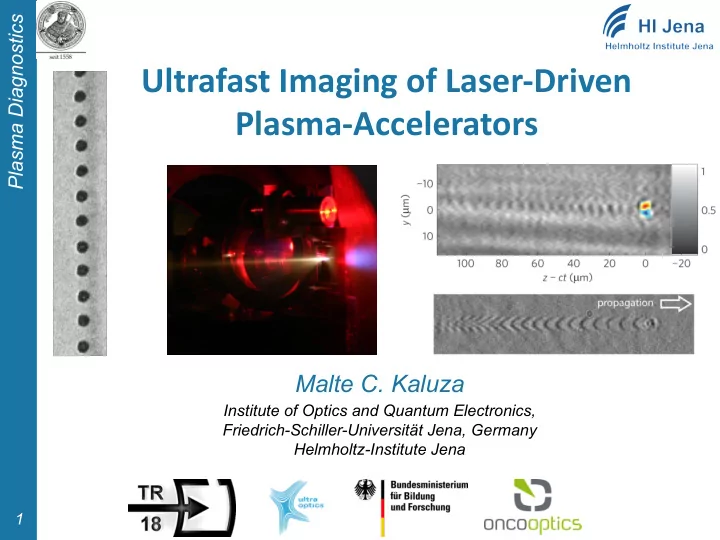
Ultrafast Imaging of Laser-Driven Plasma-Accelerators

Malte C. Kaluza

Institute of Optics and Quantum Electronics, Friedrich-Schiller-Universität Jena, Germany Helmholtz-Institute Jena
slide-2
SLIDE 2

Plasma Diagnostics

2

Outline

  • Motivation: Why plasma diagnostics necessary
  • Pump-probe scenarios:

Which different types of probe pulses can be applied?

  • Electro-magnetic probe pulses:
  • Shadowgraphy
  • Interferometry
  • E- and B-field sensitive techniques
  • Transverse vs. longitudinal probing
  • Particle probe pulses:
  • Proton probing
  • Electron probing
  • Detection of magnetic and electric field distributions
slide-3
SLIDE 3

Plasma Diagnostics

3

Motivation

  • Laser-produced plasmas:
  • formation and modulation occuring on time scales of driving

laser

  • density distribution?
  • temperature?
  • internal fields?
  • High relevance for particle accelerators
  • plasma-wakefield accelerators: detect details of plasma wave
  • plasma ion accelerators: e.g. sheath field of accelerating

fields from solid targets

  • Pump-probe geometry well suited: probe interaction driven

(„pumped“) by main pulse

slide-4
SLIDE 4

Plasma Diagnostics

4

Electromagnetic Probe Pulses

  • Generation of synchronized optical probe pulses:
  • split off part of

the main pulse

  • guide it towards

interaction along different path

  • adjust temporal

delay Þperfect synchronization Þprobe pulse duration similar to main pulse Þrecord movie from subsequent shots at different delays (requires good shot-to-shot stability!) Probe-pulse generation

slide-5
SLIDE 5

Plasma Diagnostics

5

Electromagnetic Probe Pulses

  • Delay scan for interaction of 10-TW CPA-laser pulse with plasma

preformed by Nd:glass laser from different shots:

  • How can we deduce the plasma density from these images?

Use interferometry! Probe-pulse generation

slide-6
SLIDE 6

Plasma Diagnostics

6

Electromagnetic Probe Pulses

  • Refractive index of a plasma:
  • Integrated optical path length
  • r integrated phase j depends
  • n plasma density distribution

seen by light rays.

  • Visualize phase difference

between probe ray and ray going through vacuum: interferometer

  • Challenge for short pulses: rays‘ path lengths need to be

identical within pulse length (few µm)! Easier: Wollaston prism

www.wikipedia.de

Interferometry

slide-7
SLIDE 7

Plasma Diagnostics

7

Electromagnetic Probe Pulses

  • Wollaston prism = polarizing beam splitter, combination of two

birefringent prisms

  • Probe pulse:

polarization under 45°w.r.t. both optical axes

  • Two replica separated

by α, polarized perpendicularly to each other

  • Imaging system: generation of two images shifted laterally
  • Polarizer under 45°: interference between to replica possible,

„mixing“ of beam parts going through interaction region and through vacuum

  • Separation distance i of fringes on CCD:
  • Fringe shift between data and reference Þ phase difference Dj

Interferometry

slide-8
SLIDE 8

Plasma Diagnostics

8

Electromagnetic Probe Pulses

  • Deduce plasma density distribution by assuming cylindrical

symmetry:

  • Phase shift difference Dj

between ray going through the plasma and through vacuum:

  • Deduce plasma density via Abel inversion:

Interferometry

slide-9
SLIDE 9

Plasma Diagnostics

9

Electromagnetic Probe Pulses

  • Deduce plasma density distribution by assuming cylindrical

symmetry:

H.-P. Schlenvoigt, PhD thesis, Uni Jena (2009)

Interferometry

slide-10
SLIDE 10

Plasma Diagnostics

10

Electromagnetic Probe Pulses

  • 2-color probe pulses:

visualize different time steps of evolution during a single shot by taking 2 images at different times

  • 2 pulses (1w and 2w)

go through window at different speed (GVD) => separation by few ps

  • Separate pulses after

interaction: get 2 images of the same interaction at 2 different times Probe-pulse generation

slide-11
SLIDE 11

Plasma Diagnostics

11

Electromagnetic Probe Pulses

  • 2-color probe pulses:

visualize different time steps of evolution during a single shot by taking 2 images at different times

  • 2 pulses (1w and 2w)

go through window at different speed (GVD) => separation by few ps

  • Separate pulses after

interaction: get 2 images of the same interaction at 2 different times

earlier later

Probe-pulse generation

slide-12
SLIDE 12

Plasma Diagnostics

12

Electromagnetic Probe Pulses

Image courtesy of A.G.R. Thomas

  • Plasma wave generation (e.g. by laser pulse’s ponderomotive potential)

º modulation of ne against ion background (vph,plasma = vgr,laser) Þ longitudinal E-fields (~ 0.1 TV/m)

  • Injection of electrons into the wave

Þ relativsitic electron current Û azimuthal B-fields

Probing of plasma wakefield acceleration process

slide-13
SLIDE 13

Plasma Diagnostics

13

Electromagnetic Probe Pulses

Probing of plasma wakefield acceleration process

  • longitudinal
  • transversal

pump

Challenge: Imaging a tiny, fast moving object.

  • characteristic length scale: 𝜇" =

$%& '(

  • phase velocity of plasma wave: ~c

pump

  • time integrated
  • for slowly evolving plasma features
  • snap shots: 𝜐"+,-. ≪ 𝜇"/𝑑
  • for fast evolving plasma features

Interferometry, Shadowgraphy, Polarimetry, … Fourier Domain Holography, … sufficient resolution vph ~ c

slide-14
SLIDE 14

Plasma Diagnostics

14

Electromagnetic Probe Pulses

Probing of plasma wakefield acceleration process

  • N. Matlis et al., Nature Physics 2, 749 (2006)

Split off part of the compressed main pulse, chirp it and let it co-propagate

„Frequency Domain Holography“

slide-15
SLIDE 15

Plasma Diagnostics

15

Electromagnetic Probe Pulses

Probing of plasma wakefield acceleration process

  • Z. Li et al., Phys. Rev. Lett. 113 085001 (2014)

Temporal resolution depends on probe pulse bandwidth : 𝜐"+,-. ⋅ 𝑑 > 𝜇" 2

„Frequency Domain Streak Camera“

slide-16
SLIDE 16

Plasma Diagnostics

16

Electromagnetic Probe Pulses

Probing of plasma wakefield acceleration process Transverse probing

super sonic gas jet imaging lens pump pulse electrons xrays,… probe pulse

slide-17
SLIDE 17

Plasma Diagnostics

17

Electromagnetic Probe Pulses

d ) ( ) ( 2

probe probe cr e e rot

s k k r B n r n c m e ! ! ! ! × =

ò

f Þ rotation of probe polarization: Þ measure frot to get signature of B-fields, measure ne to get amplitude!

  • Transverse probing of B-fields in underdense plasma with linearly-polarized

probe pulse:

B k ! !

probe

if Þ B-field induced difference of h for circularly- polarized probe components

  • J. A. Stamper et al. PRL (1975)

Probing of plasma wakefield acceleration process