
SLIDE 1
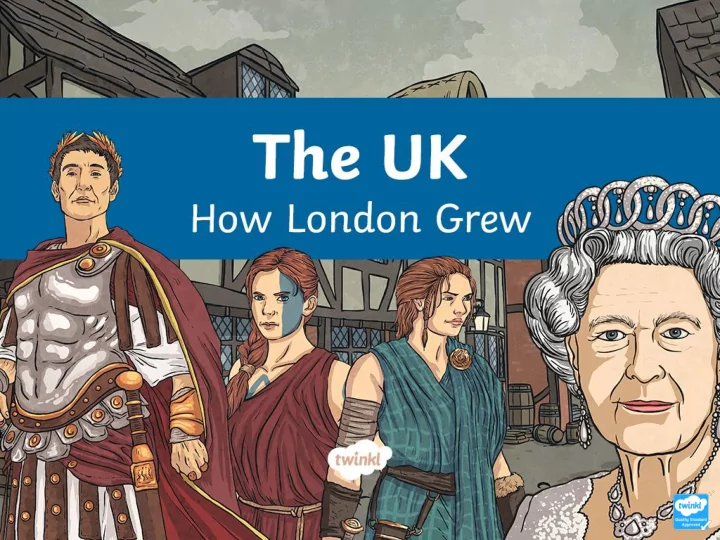
Aim Aim I can identify ways that London changed over time. I can - - PowerPoint PPT Presentation
Aim Aim I can identify ways that London changed over time. I can explain the importance of the Prime Meridian to Londons history. Success Criteria Success Criteria I can tell you who first settled in London. Statement 1 Lorem
history.
Meridian.
M25 Greater London City of London River Thames
How old do you think London is? ? Has it always looked like this? ? Who were the first people to live in London? ?
The Romans invaded Britain in AD 43 and built a settlement called Londinium on the banks of the River Thames. This model from the Museum of London shows what the north side of the river might have looked like in around AD60. By AD100, Londinium was the new capital city of Britain and had a population of around 60 000 people!
After the Romans left in AD 410, an Anglo-Saxon settlement called Lundenwic was built west of the Roman settlement, outside the Roman city walls.
In AD 800, Lundenwic was attacked by Vikings and renamed Lundenburgh. The population was around 15 000.
After the Norman Invasion of AD 1066, many forts were built, including the Tower of London.
In AD 1209, London Bridge was built to replace many smaller wooden bridges. It was the only bridge crossing the River Thames until AD 1739! The population was around 80 000.
London was still quite small, but the River Thames provided an important trading link with Russia and the newly-discovered America.
Between AD 1485 and AD 1603, the Tudors ruled England. Many trading companies developed. Immigrants from other parts of the UK and around the world increased the population to 225 000. Some of Queen Elizabeth I’s courtiers built country villas in the surrounding countryside of Essex and Surrey.
New houses were built to the west, close to The Royal Family’s new residence at St James’s Palace.
The year before the Great Fire,
people died because of the Great Plague.
AD 1708 saw the completion of St Paul’s Cathedral. In AD1762, King George III bought Buckingham House to be his new Royal Residence. The population of London was now 1 million. By the Victorian period, London was the capital of the British Empire. Trading and finance were becoming important industries.
Immigrants moved to London and the population rose to 6.7 million. Railways linked London to other parts of the UK. Landmarks such as Trafalgar Square, Big Ben, the Royal Albert Hall and Tower Bridge were built. London grew bigger as new areas of housing were built.
In the early 20th Century, London continued to grow. Landmarks such as Trafalgar Square, Big Ben, the Royal Albert Hall and Tower Bridge were built. People wanted bigger, more spacious homes. Semi-detached houses were built in new suburban areas outside London, leading the population to be nearly 9 million.
During the Second World War, areas of London were bombed and many houses and other buildings were destroyed. After the war ended, high-rise flats were built to replace the destroyed houses.
In the 1970s and 1980s, the docks that had once been a vital part of London’s trading links with other countries finally closed. Many of the Docklands buildings were converted into housing. The Thames Barrier was built to protect London from tidal surges travelling up the River Thames. The new millennium saw many building projects, including the Millennium Dome (now known as the O2 Arena), the Millennium Wheel (The London Eye) and the Queen Elizabeth Olympic Park for the London 2012 Olympic Games.
Read the different facts you have been given. Can you match each fact to the year it relates to? ?
AD 60 AD 800 AD 1200 AD 1666 AD 1900 AD 1945 AD 2012
The settlement is called Londinium. The city of Lundenwic is attacked by Vikings. The Tower of London is built. Over 60 000 people died because of the Great Plague. The population is
The population is almost 9 million. London hosts the Summer Olympic Games. The city has replaced Colchester as the capital of Britain. The city is to the west of the old walled city. London Bridge is built. The city is renamed Lundenwic. London is the capital of the British Empire. Children have been evacuated to the countryside. The Thames Barrier protects London from flooding. The population is around 60 000. The population is around 15 000. The population is around 80 000. 60% of the city has been destroyed by fire. Trafalgar Square, Big Ben and Tower Bridge are built. Many houses have been destroyed by the bombing in the Blitz. The London Eye and 02 Arena are popular tourist attractions. A wall has been built around the city. The city is renamed Lundenburgh. Stone is used for more buildings, including bridges. The city of Lundenwic is attacked by Vikings. Railways bring more people to the city. Semi-detached houses are popular in the suburbs. The Docks are no longer used for shipping, and are used for housing instead.
Early settlers in Londinium and Lundenwic chose this site to build their homes as it was close to supplies of water, wood and
From AD1485 until early in the 1900s, London was an important shipping and trading port, with large trading companies forming in the Docklands area. From AD1800, London became an important city for finance and investment, linked to its trading and Empire.
In 1884, the International Meridian Conference chose to make the line at 0° longitude run through the Royal Observatory in Greenwich, England. The conference chose Greenwich because most of the world’s ships used this meridian already. The Prime Meridian is an imaginary line which divides the Earth into two hemispheres: the eastern hemisphere and the western hemisphere.
The FTSE Stock Exchange plays an important part in financial investments around the world.
Photo courtesy of .Martin. (@flickr.com) - granted under commons licence
Airport is used for passengers as well as freight. Many global businesses are based in London. Do you think London is still important today? ? What is it famous for? ?
history.
Meridian.