
SLIDE 1
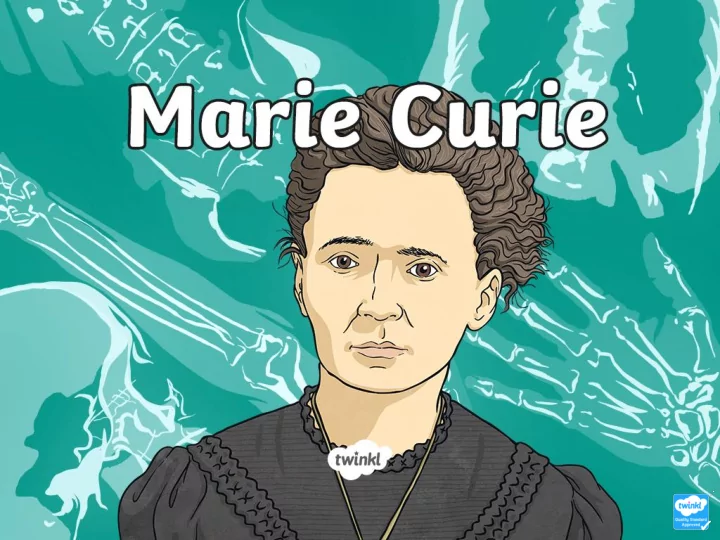
Aim Aim To explain how Marie Curies work on x -rays helped us - - PowerPoint PPT Presentation
Aim Aim To explain how Marie Curies work on x -rays helped us identify bones. Success Criteria Success Criteria Statement 1 Lorem ipsum dolor sit amet, consectetur adipiscing elit. I can describe Marie Curies life and work.
medicine.
functions.
She is best known for discovering two new elements (radium and polonium) and for developing the use of x-rays and radiation in medicine. Use the Marie Curie Fact Sheet to create your Marie Curie Flip Book Biography all about Marie's life and career and the discoveries she made.
X-rays are waves of electromagnetic radiation that can pass through many opaque materials.
the body.
through the body. The images produced are recorded on a computer or on film.
body, such as bones, so these will appear white on the x-ray image. X-rays can pass through softer parts of the body more easily, so muscles and organs will appear grey on the image.
They are most often used to look at bones, teeth and joints, but are also sometimes used to investigate soft tissue, such as internal organs. Doctors look at x- ray images to identify fractures and other problems.
Before Marie Curie developed the use of x-rays in medicine, doctors had to diagnose broken bones and other problems simply by physical examination, which meant feeling for any injuries. Sometimes, this meant that injuries and problems were not spotted or not treated correctly. It could be dangerous for patients if their problems were not treated properly. Once x-ray machines were developed and available, doctors could identify problems much more quickly and
Can you recall any of these functions? Bones have three main functions in our bodies. Can you think of any other examples? Bones are used for support, protection and movement. Support
Our bones support
us upright.
Protection
Bones protect some of our most important organs. For example, the skull protects the brain.
Movement
Joints between bones allow our bodies to
allows the leg to move.
best to stick the bones on in the correct layout. Complete the X-Ray Explanation Activity Sheet and stick it beneath your model x-ray image. Your task is to create your own model of an x-ray image of a bone
skeleton. two facts about x- rays; two facts about Marie Curie;
In this lesson, you will have found out about Marie Curie, x-rays and the skeleton. Tell your partner five things you have learnt in this lesson, including: