6/18/2015 Biosciences eastern and central Africa International - - PDF document

6 18 2015
SMART_READER_LITE
LIVE PREVIEW

6/18/2015 Biosciences eastern and central Africa International - - PDF document

6/18/2015 Biosciences eastern and central Africa International Livestock Research Institute (BecA ILRI) Hub Mobilizing biosciences for Africas development LABORA LABORATORY MANA MANAGEM GEMENT NT AND AND EQ EQUIPMENT O OPERA


slide-1
SLIDE 1

6/18/2015 1

Biosciences eastern and central Africa – International Livestock Research Institute (BecA‐ILRI) Hub

Mobilizing biosciences for Africa’s development

BecA‐ILRI Hub Nairobi, Kenya 15‐19 June, 2015

LABORA LABORATORY MANA MANAGEM GEMENT NT AND AND EQ EQUIPMENT O OPERA ERATIONS TRAINI TRAINING W NG WORKS RKSHOP

15th-19th June 2015

Venue: Rwanda Agriculture Board (RAB) – Rubona Station

Presentation 3 esentation 3

Laboratory Design, Construction and Maintenance

EN ENGINEERIN GINEERING C G CONSIDERA NSIDERATION IONS

Presentation by: Wanjawa W. B. – ILRI Engineering Department, Nairobi, Kenya

Desig Design: Ov Over ervie view

  • Engineering principles of design and construction have not changed
  • Continuous improvement in modern methods of architectural, structural

and civil works design

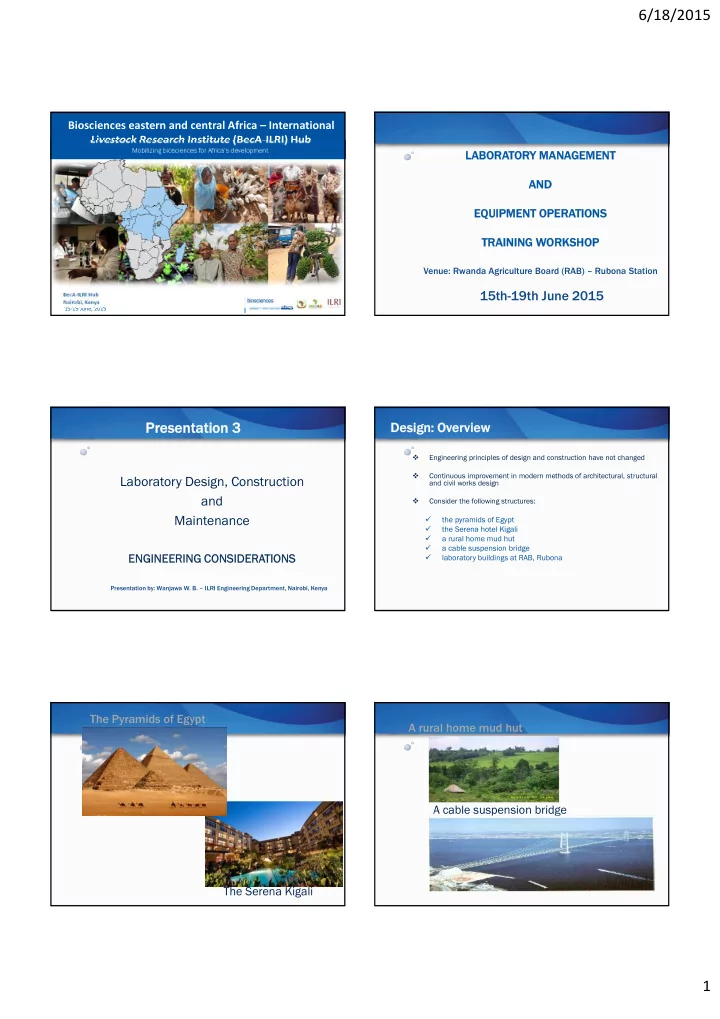
  • Consider the following structures:
  • the pyramids of Egypt
  • the Serena hotel Kigali
  • a rural home mud hut
  • a cable suspension bridge
  • laboratory buildings at RAB, Rubona

The Pyramids of Egypt The Serena Kigali A rural home mud hut A cable suspension bridge

slide-2
SLIDE 2

6/18/2015 2

Labor Laboratory Build Buildings at ILRI Nair ings at ILRI Nairobi

What are the differences between the structures? What are the similarities?

Fact ctor

  • rs t

s that nece at necessita ssitate & & cont ntrol de rol design sign

Client requirements Functional requirements Government regulations

Environmental e.g. NEMA, REMA Planning departments e.g. city councils

Aesthetic values… Dead loads: self weight Live loads: occupancy Fact ctor

  • rs t

s that nece at necessita ssitate & & cont ntrol de rol design sign con cont’d…

Imposed loads: additions & alterations Lateral vibrations e.g. earthquakes Wind loads Impact: Lateral/vertical Hydrostatic pressures: soil-water interaction Fire protection

Desig Design Phas Phase

Topographical & geotechnical survey Architectural Structural

De Desi sign Pr Proce

  • cess

Pre-analysis

Getting the problem statement, defining the project scope, setting of goals and

  • bjectives, gathering of data

Desig Design pr proce

  • cess co

s cont. nt.

Analysis

Looking at design considerations, design constraints and possible design options for the problem Aim to have optimum design where all constraints and difficulties are dealt with satisfactorily Structure should perform its required function and present an acceptable appearance at least cost

Desig Design pr proce

  • cess co

s cont. nt.

Design: Architectural & Structural

Is a technical phase where the designer’s technical abilities and competence is called upon Designer guided by academic training and professional codes of design Architect produces architectural drawings Engineer goes through a mathematical process to produce integral structural members, then structural drawings

slide-3
SLIDE 3

6/18/2015 3

Key st y struct ructural m ural member embers s of

  • f a building

building st structure include ructure include:

Foundation bases Columns Beams Slabs Roof trusses

Desig Design pr process

  • cess cont

cont. The Principle of Load T The Principle of Load Trans ansfer er

Roof loads Beams Columns Floor slab Foundation Bases Load forces Soil bearing pressure (CBR) F(load) F(resistance) F(load) F(resistance) 1/3

Cons Constr truction Phase Phase

Key players: Client/Employer/Owner: project finance Consultant: project design, supervision, quality assurance Quantity Surveyor: project costing, measurements, final account Contractor: implementation Approving Authorities: compliance

Common Construction Common Construction Mat Materials rials

Cement (binder: hydrated calcium silicate) Fine aggregate (sand, quarry dust) Course aggregate (ballast) Masonry blocks Kilned bricks Structural steel: takes tensile force Water: provides workability, hydration

Other Con r Construction M truction Materials rials

Tiles: ceramic, pvc: floors and walls Terrazzo: corridors, washrooms, kitchens Granito/marble: worktops, wet areas Wood: applicable where? Paints: finishes: oil, water based? Why? Chip board, acoustic panels: ceiling Iron sheets, clay tiles, decra: roofing

Commo Common Const n Construc uction Equi Equipme ment nt

Concrete mixers Poker vibrators Batching boxes (batching plant) Wheelbarrows Water tanks Wheel loaders Dumpy levels – Total stations Tape measures, etc

slide-4
SLIDE 4

6/18/2015 4

At At t the C Construction S Site te

Drawings: architectural, structural, civils Bills of Quantities Bending Schedules Site Instruction Book Visitors Book Daily Report & Occurrence Book PPE Equipment: Helmets, Boots, Hand Gloves, Goggles, Dust masks, Overalls, First Aid Kit, Safety Officer

Maint intenance Phase nance Phase

Lifespan of a modern laboratory building: about 100 years Survey & Design Phase: 4 months Construction Phase: 8 months Usage: 99 years So why maintenance???

Types of Buildin pes of Building Maint g Maintena nance nce

Corr rrecti tive (R (Reacti ctive) e) Ma Main intenance: e: This is where the client/user/owner initiates the request for repairs after a part of the structure breaks down Pre Preven entive (Pr (Pro-acti ctive) e) Ma Main intenance: e: This is where the service provider plans in advance and requests the client/user/owner to avail the building for renovation when it falls due What are the advantages/Disadvantages of each approach??

Typica pical Laborat l Laboratory La Layout ut Typica pical Laborat l Laboratory La Layout cont. ut cont.

What can you see in these pictures?

Typical cal Laborat

  • rator
  • ry L

y Layout ut cont. nt.

Discuss observations?

slide-5
SLIDE 5

6/18/2015 5

End o d of Presenta entation 3

  • n 3

Thank you

Barack Wamkaya Wanjawa Engineering Maintenance Coordinator ILRI Nairobi Kenya Engineering Department b.wanjawa@cgiar.org Mobilizing biosciences for Africa’s development http://hub.africabiosciences.org