22/10/2015& BUILDING RESILIENT LEADERSHIP 2012 - 2015 - - PDF document

22 10 2015
SMART_READER_LITE
LIVE PREVIEW

22/10/2015& BUILDING RESILIENT LEADERSHIP 2012 - 2015 - - PDF document

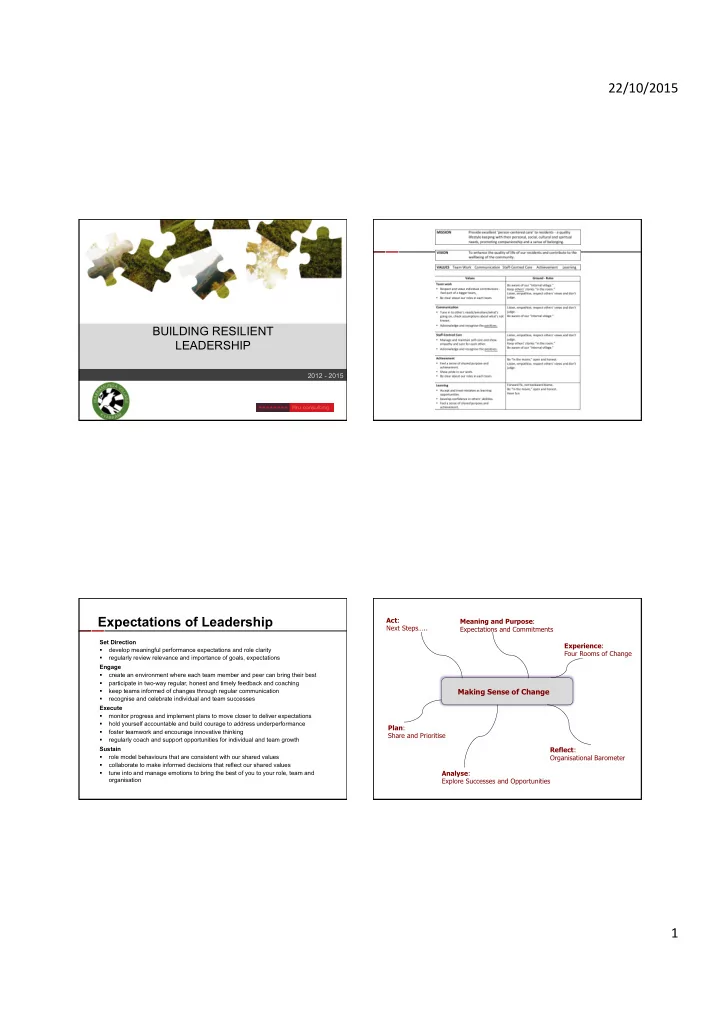
22/10/2015& BUILDING RESILIENT LEADERSHIP 2012 - 2015 Expectations of Leadership Act : Meaning and Purpose : Next Steps.. Expectations and Commitments Set Direction Experience : ! develop meaningful performance expectations and role


slide-1
SLIDE 1

22/10/2015& 1&

2012 - 2015

BUILDING RESILIENT LEADERSHIP

Expectations of Leadership

Set Direction ! develop meaningful performance expectations and role clarity ! regularly review relevance and importance of goals, expectations Engage ! create an environment where each team member and peer can bring their best ! participate in two-way regular, honest and timely feedback and coaching ! keep teams informed of changes through regular communication ! recognise and celebrate individual and team successes Execute ! monitor progress and implement plans to move closer to deliver expectations ! hold yourself accountable and build courage to address underperformance ! foster teamwork and encourage innovative thinking ! regularly coach and support opportunities for individual and team growth Sustain ! role model behaviours that are consistent with our shared values ! collaborate to make informed decisions that reflect our shared values ! tune into and manage emotions to bring the best of you to your role, team and

  • rganisation

Making Sense of Change

Meaning and Purpose: Expectations and Commitments Experience: Four Rooms of Change Plan: Share and Prioritise Reflect: Organisational Barometer Analyse: Explore Successes and Opportunities Act: Next Steps…..

slide-2
SLIDE 2

22/10/2015& 2&

Plant Harvest Courage Realistic conscious choice Need for awareness Feedback Trap door Slippery slope Zero point Unconscious Conscious

Denial / Self- Censorship Contentment Renewal / Inspiration Confusion / Conflict

DEPRESSION FLOW

The Four Rooms

  • f Change

Make Sense of Leadership Action Plans Mindsets, Skillsets Emotional Agility Strengths-Based Leadership How are we travelling? Team Strengths

Reflective Practice

EXPERIENCE: What happened? REFLECT: What was it like? ANALYSE: What does it mean? PLAN & ACT: What next?

trust value tension coach feedback advocate accessible compassion Critical Friend

slide-3
SLIDE 3

22/10/2015& 3&

Journals

! Planning ! Budgeting ! Organising ! Controlling ! Coordinating ! Resource use ! Time management ! Decision Making ! Problem Solving ! Identifying Risk ! Supervising ! Creating Vision ! Motivating ! Inspiring ! Building Relationships ! Facilitating Team work ! Listening ! Persuading ! Counselling ! Coaching ! Teaching ! Mentoring

Operational Strategic

Leadership: A Balance….

Internal( External( Individual( Leadership*Mindset*

!

  • A#tude!
  • Beliefs!
  • Engagement!
  • Mo4va4on!
  • Fears!

Leadership*Skillset*

!

  • Skills!
  • Competencies!
  • Behaviours!
  • Capability!
  • Knowledge!

!

Collec2ve( Culture*

!

  • Norms!
  • Group!Values!
  • Poli4cs!
  • Shared!Beliefs!
  • Accepted!Standards!

!

Leadership*Toolset*

!

  • Systems!&!Processes!
  • Technology!
  • Structure!
  • Resources!
  • Strategy!!

*

Integral Model

Laissez-Faire “hands-off” Collaborative “coaching” Autocratic “my way or highway” Little or no feedback Don’t believe in ‘micro-managing’ Don’t hold people to account No influence Manager partners staff Willing to listen and open to being influenced Shares investment in process and outcomes Encourages ownership, accountability, responsibility Highly directive Uses hierarchy or expertise as power Gives no control to staff Promotes blame, excuses, denial

Leadership Styles

slide-4
SLIDE 4

22/10/2015& 4&

All members of the organisation, unrestricted by role or reporting relationships, courageously engage in candid and respectful conversations with

  • ne another to enable feedback to be heard about

how they can improve their working relationships and collective work performance.

Coaching Culture

SILENCE VIOLENCE

SHARED POOL OF MEANING

ME OTHER Source: Crucial Conversations by Kerry Patterson et al

Conversational Space

Vision Mission Values Strategy Performance Planning

1 2 4

GROW Coaching

3

Assessing Performance Recognition And Reward Coaching Feedback Making Sense of Leadership Mindful Leadership

Resilient Leadership

Performance Planning

Objective

To align individual and team performance plans with organisation’s vision, mission, values and strategy and agree each individuals expected performance results and behaviours.

team member responsibilities

  • Actively prepare for and participate in planning

and review discussions.

  • Discuss and clarify expectations (what success

looks like) and alignment with your manager.

  • Discuss, reality-check, modify and agree

performance plans.

  • Take responsibility for your performance, seek

clarification and support, raise any concerns and share successes with your manager.

manager responsibilities

  • Identify and clarify performance expectations and

alignment to the organisations drivers of success.

  • Ensure results and behaviours detailed in the

performance plan are SMARTER.

  • Prepare to gain the team members agreement to

performance plans.

  • Discuss, reality-check, modify and agree

performance plans.

  • Instill accountability for performance.

Vision Values Mission Strategy 1 2 4 GROW Coaching 3 Assessing Performance Recognition And Reward Feedback & Coaching Feedback & Coaching Feedback & Coaching Feedback & Coaching Planning Performance

slide-5
SLIDE 5

22/10/2015& 5&

Situation or Task Action Alternative Action Result Desired Result

Source : Development Dimensions International (DDI)

Feedback : STAR / AR

GOAL

! State purpose and importance of discussion ! Agree on the specific objective to achieve by the end of the discussion ! Clarify what’s at stake

REALITY

! Check assumptions ! Seek views, concerns, issues ! Invite self-assessment ! Ask for specific examples ! Share feedback (STAR/AR)

OPTIONS

! Generate possible solutions ! Explore all options ! Invite suggestions from individual ! Offer suggestions carefully ! Ensure choices are made

WRAP-UP

! Commit to action ! Identify possible obstacles ! Make steps specific, define timing ! Agree on support needed

GROW: How to Coach

Source: Susan David and Caruso/Salovey’s Emotionally Intelligent Manager

Recognise

Emotions What is going on for you right now?” How does that feel?”

Use Emotions

What does that mean for you? ” How does the way you feel impact your thoughts on this issue?

Understand

Emotions What has caused you to feel like this? What’s the result? What else are you feeling/why? How do you want to feel?

Manage

Emotions What can you do to move towards feeling that way? What will enable you to do that? What values do you hold that will enable you to do that?

RUUM questions…..

Status

  • how we perceive our position in relation to others we have a

relationship with e.g. boss, peers, direct reports, friends, family

  • can include job titles, public and private forms of recognition or

criticism, salary and any other aspects associated with status.

Certainty

  • how sure we feel about events/people/situations that affect us
  • Higher level of uncertainty, more likely a threat state created

Autonomy

  • level of control over the decisions that affect us - more

autonomous, the more engaged and confident tend to be

  • the more empowered people feel, the more likely they are to feel

like their effort is making a difference

Relatedness

  • quality of our relationships with others
  • our brains categorise people into either a friend or foe – a different

circuit gets activated when we perceive someone as a friend vs foe

Fairness

  • sense of justice and right and wrong and how this affects us
  • if dealt with fairly, feel motivated and engaged (rewarded) but if lack

sense of fairness, can move towards a threat state so more likely to respond in a defensive way

Putting on the SCARF…..

slide-6
SLIDE 6

22/10/2015& 6&

Resilience

The ability to adapt to stress and adversity, to face difficult experiences and rise above them with ease.

Slow down, notice, recognise

  • bserve reactivity, reflection, cultivate attitude of curious scientist,

mindfulness meditation, journaling, coaching, feedback

Take note of stories, name patterns, label dialogue

build emotional vocabulary, identify as transient data vs facts/ truth.. ‘notice thought/feeling/sensation/urge….’, ‘is this helpful?’

Open up make room, accept inner dialogue

make space, de-literalise, create room, mindfulness, kindness, common humanity eg thank the mind

Pursue and Act on your values

workability, purpose, strengths, valued choice

Build Resilience: Emotional Agility

Leadership

Culture Performance

Strengths

! feeling of ownership and authenticity ! act in accordance with natural tendencies ! intrinsic motivation to use inner capacities

Role of Strengths

Mindfulness Kindness Common Humanity

Self Compassion

slide-7
SLIDE 7

22/10/2015& 7&

  • Trust each other – know their thoughts and intentions, so when action

is taken, they know they will be on-board.

  • Engage in intellectually rigorous dialogue on issues and decisions

that are critical to the organisation's success, prepared to disagree with each other, in the spirit of finding the best answers and making useful decisions.

  • Ensure all opinions and ideas are considered to achieve genuine

buy-in to important decisions, even when members of the team initially disagree.

  • Hold peers accountable for adhering to decisions and performance

standards – don’t rely on one leader as primary source of accountability.

  • Set aside individual needs and focus on team success - resist

temptation to put departments, careers, or status ahead of team results.

Adapted from Lencioni (2005) The Five Dysfunctions of a Team

Great Leadership Teams….

Reduced levels of:

  • absenteeism, turnover intentions
  • anxiety, stress, mental illness, OH&S risks

Improved:

  • job satisfaction, communication, efficiencies, health
  • learning of job skills, confidence to solve problems,
  • workplace innovation, decision-making, performance

Sources: Karekla, Forsyth, Kelly 2004, Bond & Bunce 2003, Donaldson & Bond 2004, Goldberg 1990, Bond & Flaxman 2006, Bond & Hayes 2002,

Create enriching workplaces…

slide-8
SLIDE 8