2/5/2017 Hancock County Flood Risk Reduction Project Update: Maumee - - PDF document

2 5 2017
SMART_READER_LITE
LIVE PREVIEW

2/5/2017 Hancock County Flood Risk Reduction Project Update: Maumee - - PDF document

2/5/2017 Hancock County Flood Risk Reduction Project Update: Maumee Watershed Conservancy District Draft Draft January 17, 2017 Project Overview Agenda Stantec Scope Ga p Ana lysis Da ta Co lle c tio n De sig n Re fine me


slide-1
SLIDE 1

2/5/2017 1

Draft Draft

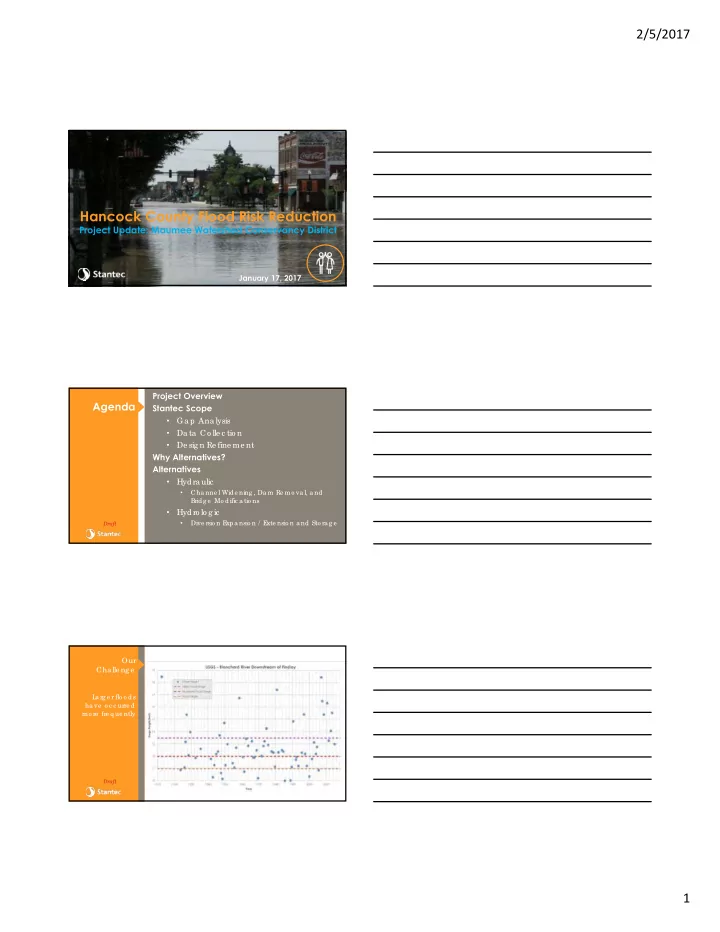
Hancock County Flood Risk Reduction

Project Update: Maumee Watershed Conservancy District

January 17, 2017

Draft Draft

Agenda

Project Overview Stantec Scope

  • Ga p Ana lysis
  • Da ta Co lle c tio n
  • De sig n Re fine me nt

Why Alternatives? Alternatives

  • Hydra ulic
  • Cha nne l Wide ning , Da m Re mo va l, a nd

Bridg e Mo dific a tio ns

  • Hydro lo g ic
  • Dive rsio n E

xpa nsio n / E xte nsio n a nd Sto ra g e

Draft Draft

Our Cha lle ng e

L a rg e r flo o ds ha ve o c c urre d mo re fre q ue ntly

slide-2
SLIDE 2

2/5/2017 2

Draft Draft Draft Draft

25-Year Channel Sizing Estimates 01 Lands & Damages $ 6,580,000 02 Relocations $ 14,590,000 06 Fish & Wildlife $ 1,758,000 08 Roads, Railroads Bridges $ 2,657,000 09 Channels and Canals $ 34,587,000 15 Floodway Control & Diversion Structure $ 8,708,000 18 Cultural Resource Preservation $ 692,000 30 Planning, Engineering & Design $ 8,182,000 31 Construction Management $ 3,149,000 First Costs $ 80,903,000 Interest during construction $ 5,671,000 Total Cost $ 86,574,000

Cha nne l Size Co sts E stima te

We ste rn Dive rsio n o f E a g le Cre e k

25-ye a r 3,000 c fs 50-ye a r 3,500 c fs 100-ye a r 4,050 c fs 500-ye a r 5,400 c fs

**Ab o ut $15 millio n a llo c a te d fo r b ridg e s a nd ro a ds

Draft Draft

Stantec Scope

  • Ana lyze the USACE

F e a sib ility Re po rt to unde rsta nd the ir finding s a nd re c o mme nd a ny c ha ng e s to the Co rps c o nc lusio ns

  • Pe rfo rm fie ld surve ys a nd g e o te c hnic a l

inve stig a tio ns

  • De te rmine pre fe rre d c ha nne l a lig nme nt
  • Prepare property acquisition plan and legal

descriptions

  • Prepare final design and construction plans
  • Prepare necessary documents to secure

regulatory permits E nte r Sta nte c

slide-3
SLIDE 3

2/5/2017 3

Draft Draft

Pha se 1 – Ga p Ana lysis Pha se 2 – Wo rk Pla n & Pro o f o f Co nc e pt

  • Pa rt A

– Additio na l Da ta Co lle c tio n And Ana lysis

  • Pa rt B

– Re fine me nt o f Co nc e ptua l De sig n

  • Pa rt C

– 30% De sig n Pla ns

Sta nte c Sc o pe

Co nc e ptua l De sig n Adva nc e me nt

Draft Draft

De sig n a nd E ng ine e ring

  • 1. Unc le a r pro je c t o bje c tive

Co st/ E c o no mic s

  • 2. BCR le ss tha n 1.0

Hydro lo g y & Hydra ulic s (H&H)

  • 3. Risk ba se d e va lua tio n ne e de d
  • 4. Co nflic ting re sults be twe e n USACE

mo de l a nd re po rt

4 Key Gaps

Missing Da ta / Ana lysis

Draft Draft

Pa rt B

  • Asse ss wa ys to impro ve the initia l de sig n

c o nc e pt (Alte rna tive 13)

  • Be ne fit/ Co st Ana lysis

– E va lua te a dditio na l be ne fits to a c hie ve a BCR g re a te r tha n 1

  • H&H

– Asse ss va ria tio ns to the re c o mme nde d pla n via c ha nne l a lig nme nt, da m a lig nme nt, c ha nne l sizing

Pa th F

  • rwa rd

Re fine me nt o f Co nc e ptua l De sig n

slide-4
SLIDE 4

2/5/2017 4

Draft Draft

Co nc e pt De sig n Ana lysis

Diversion Channel Refinement

Draft Draft

Co nc e pt De sig n Ana lysis Dive rsio n Cha nne l Alig nme nt

Draft Draft

Co nc e pt De sig n Ana lysis E a g le Cre e k Dive rsio n Cha nne l Pro file

slide-5
SLIDE 5

2/5/2017 5

Draft Draft

Co nc e pt De sig n Re fine me nt E a g le Cre e k Dive rsio n Cha nne l

Preliminary Recommendations

  • Re lo c a te e ntra nc e
  • Re duc e dive rsio n c ha nne l le ng th
  • At-g ra de inte rse c tio n with Aura nd Run
  • Re fine pro file

– Re duc e o ve ra ll e xc a va tio n & wa ste – Re duc e ro c k e xc a va tio n

  • Upda te width fo r de sig n disc ha rg e

– 25yr -vs- 100yr c a pa c ity

  • Cro ssing g e o me trie s
  • Gra ding Re vie w

Draft Draft

Problems to Solve

  • Co nflic ting Mo de l/ Re po rting Re sults
  • Re sidua l Risk o f Pro je c t
  • Do ub le -Pe a ke d Hydro g ra ph

Why Alternatives?

Draft Draft

April 2015 August 2015

slide-6
SLIDE 6

2/5/2017 6

Draft Draft Draft Draft

Upda te d Pro je c t Ob je c tive

Achieve approximately 4.5’ level of reduction in Findlay to reduce flooding at Main Street and other key points Be tte r c ha nc e a t “flo o d fig hting ” Spe c ific & me asurable pro je c t g o al

“The 4.6’ drop in WSE in downtown Findlay is based on a model run where the flow

  • ptimization feature did

not properly converge on an internally consistent result.”

Draft Draft

T he Bla nc ha rd Rive r Wa te rshe d

slide-7
SLIDE 7

2/5/2017 7

Draft Draft

Hydro g ra ph Co mpa riso ns E xisting Co nditio ns

Bla nc ha rd Rive r in F indla y

14,370 cfs 15,560 cfs 7,880 cfs 4,600 cfs 1,890 cfs 11,120 cfs 10,470 cfs Hr 43

Draft Draft

Hydro lo g y a nd Hydra ulic s (H&H) Part A

Additio na l Da ta Co lle c tio n And Ana lysis

“There would be a minimal performance of Alternative 13 when storm events are primarily over either the Blanchard River or Lye Creek watersheds upstream of Findlay, with minimal storm events over the Eagle Creek watershed.” USACE F e a sibility Study

Will E a g le Cre e k dive rsio n wo rk?

  • Pro b a b ility o f a disc ha rg e o f X o n E

a g le Cre e k whe n the Bla nc ha rd Rive r in F indla y e xpe rie nc e s a disc ha rg e o f Y

  • Appro pria te ly size E

a g le Cre e k dive rsio n fo r de sire d flo o d risk re duc tio n Draft Draft

Pe rc e nt o f Wa te rshe d Influe nc e d Re sidua l Risk

slide-8
SLIDE 8

2/5/2017 8

Draft Draft

Hydro g ra ph Co mpa riso ns

E a g le Cre e k Dive rsio n Bla nc ha rd Rive r in F indla y

11,120 cfs 10,890 cfs Hr 65 10,680 cfs

Draft Draft

Bla nc ha rd Rive r Ra ting Curve a t Ma in Stre e t

Draft Draft

Why Alternatives?

Alternative 13 (Recommended Plan)

  • 25-year event diversion channel with Eagle Creek at 100 cfs
  • Curre nt pro je c t do e s no t fully a c hie ve de sire d re duc tio n (2’ dro p in WSE

@ Ma in St.)

  • Re c o mme nde d Pla n re c e ive s flo w fro m o nly 15% o f the dra ina g e a re a
  • BCE

< 1.0

  • Pro je c t a dditio ns a nd/ o r e nha nc e me nts ne e de d to ma na g e “do ub le pe a k”
slide-9
SLIDE 9

2/5/2017 9

Draft Draft

Alte rna tive s

Draft Draft

Co nc e pt De sig ns Re vie we d

Hydraulic Improvements

“Clean out the Blanchard!”

Re mo ve Inline Riffle s/ Da ms Cha nne l Wide ning Bridg e Mo dific a tio ns

Draft Draft

F lo o dpla in Be nc h Wide ning

Hydra ulic Impro ve me nts

slide-10
SLIDE 10

2/5/2017 10

Draft Draft

L

  • w He a d Da ms & Riffle Struc ture s

Hydra ulic Impro ve me nts

Draft Draft

RR Bridg e

F a c ing upstre a m

Draft Draft

Co nc e pt De sig n Ana lysis Bla nc ha rd Rive r Mo dific a tio ns RR Bridg e Mo dific a tio n Opportunities

  • Re duc e WSE
  • n the Bla nc ha rd Rive r
  • Po te ntia l c o st sha ring with RR fo r re pla c e me nt

Challenges

  • Minima l rise a va ila b le - tie in to side stre e ts

Costs Reduction in WSE?

  • ~0.05’ fo r 1’ rise
  • ~0.10’ fo r 2’ rise
  • ~0.20’ fo r 3’ rise

Scenario RR Rise Track & Roadway Total 1' Rise $125,000 $130,000 $255,000 2' Rise $300,000 $500,000 $800,000 3' Rise $900,000 $2,000,000 $2,900,000 50' Span Addition $1,000,000 RR Bridge Modification Costs

slide-11
SLIDE 11

2/5/2017 11

Draft Draft

Bla nc ha rd Rive r Ra ting Curve a t Ma in Stre e t

Draft Draft

Pe rc e nt o f Wa te rshe d Influe nc e d

Draft Draft

Dive rsio n E xte nsio n

slide-12
SLIDE 12

2/5/2017 12

Draft Draft

Eagle to Lye to Blanchard

Dive rsio n E xte nsio n

Draft Draft

Pe rc e nt o f Wa te rshe d Influe nc e d

Draft Draft

Pe rc e nt o f Wa te rshe d Influe nc e d

slide-13
SLIDE 13

2/5/2017 13

Draft Draft

Sto ra g e

Draft Draft

E a g le Cre e k Dry Sto ra g e

Draft Draft

Hydro g ra ph Co mpa riso ns

E a g le Cre e k Sto ra g e Bla nc ha rd Rive r in F indla y

11,120 cfs 10,890 cfs Hr 65 10,680 cfs

slide-14
SLIDE 14

2/5/2017 14

Draft Draft

Sto ra g e

Draft Draft

Sto ra g e

Bla nc ha rd Rive r & Po ta to Run a t Mt. Bla nc ha rd

Draft Draft

Hydro g ra ph Co mpa riso ns

  • Mt. Bla nc ha rd

Sto ra g e + E a g le Cre e k Sto ra g e Bla nc ha rd Rive r in F indla y

slide-15
SLIDE 15

2/5/2017 15

Draft Draft

Pe rc e nt o f Wa te rshe d Influe nc e d

Draft Draft Draft

Co nc e pt De sig ns Re vie we d Bla nc ha rd/ L ye Cuto ff L e ve e E xisting Co nd. 500-Ye a r Ma ximum De pth

Draft Draft

Co nc e pt De sig ns Re vie we d Bla nc ha rd/ L ye Cuto ff L e ve e With L e ve e 500-Ye a r Ma ximum De pth

slide-16
SLIDE 16

2/5/2017 16

Draft Draft

Co nc e pt De sig n Ana lysis Cut-o ff L e ve e Opportunities

  • Re duc e flo o ding a lo ng L

ye Cre e k Challenges

  • I

nduc e d flo o ding a lo ng Bla nc ha rd Rive r

  • Pro pe rty b uyo uts?

Costs

  • ~$8,000,000 fo r c uto ff le ve e (fro m USACE

/ URS a na lysis) Increase in WSE

  • 0-2’

Draft Draft

2007 F lo o d Hydro g ra ph Co mpa riso ns

  • Mt. Bla nc ha rd

Sto ra g e + E a g le Cre e k Sto ra g e Bla nc ha rd Rive r in F indla y

Draft Draft

2007 F lo o d Hydro g ra ph Co mpa riso ns

E a g le Cre e k Dive rsio n Bla nc ha rd Rive r in F indla y

slide-17
SLIDE 17

2/5/2017 17

Draft Draft

  • Pa th F
  • rwa rd
  • Sc he dule
  • Que stio ns

Clo sing

Draft

slide-18
SLIDE 18

1/17/2017 MWCD Presentation – Slide Notes

  • Slide 1: Cover Page
  • Introduction from Steve Wilson – Stantec has taken over the Upper Blanchard River Watershed Study

from the USACE. Stantec began project review in July 2016 and are now updating MWCD on the progress of the Proof of Concept work.

  • Slide 2: Agenda
  • Stantec completed its preliminary work in three stages: Gap Analysis, Data Collection, and Design

Refinement

  • Stantec has already filled MWCD in on the preliminary work including geotechnical,

environmental and surveying during past board meetings.

  • This presentation will focus on why Stantec is analyzing alternatives and provide discussion on

some of the alternatives Stantec is considering.

  • Slide 3: Our Challenge
  • There have been several large and frequent flooding events observed at the USGS gage downstream of

Findlay since 1999.

  • 1913 and 2007 flood of record events reached stages of 18.5 feet.
  • Major flood stage according to the National Weather Service is 13.5 feet.
  • The general goal is to get flooding events at or below this Major Flood stage.
  • Slide 4: USACE Recommended Plan
  • USACE proposed a 9.2-mile diversion channel conveying the 4% annual chance exceedance (ACE) (25-

year) flood event, approximately 3,000 cfs, from Eagle Creek to the Blanchard River (downstream of Findlay) when a 20% ACE event was predicted on the Blanchard River.

  • 100 cfs of flow would still be conveyed down Eagle Creek
  • Flows greater than the 4% ACE, would continue past the diversion structure on Eagle Creek and

downstream into the Blanchard River through Findlay.

  • Slide 5: USACE Costs
  • The latest cost estimate for the diversion channel from USACE was approximately $80.9 million. A large

percentage of those costs ($15 million) were for roadways and bridges.

  • The bridges do not help hydrology or flood control, but are a necessary consequence of

constructing the diversion channel.

  • Slide 6: Stantec Scope
  • Stantec’s scope was initially set to review the USACE report, perform preliminary field work, and

determine a preferred alignment.

  • After Stantec found gaps in the USACE study during the review process, Stantec was asked to hold off on

the property acquisition plan, final design and drawings, and permitting documentation until a more thorough review was completed on the USASCE Plan’s effectiveness.

  • Slide 7: Stantec Scope, Phase 2
  • A Work Plan was developed, following the Gap Analysis, for proof of concept of the USACE study.
  • Phase 2 included collecting additional data to fill in the gaps found during Phase 1 and

performing design refinement with the knowledge that the project has transitioned from one predicated on Federal Regulations and Guidelines to one that is regionally focused and community driven.

  • Slide 8: Major Gaps Found
  • Four critical gaps were found by Stantec during the data review process of Phase 1.
  • The project did not have a clearly defined and measurable goal.
  • The project has a benefit-to-cost- ratio (BCR) less than 1.0.
  • The USACE stated in its feasibility study that the USACE Plan would have minimal benefit when a

storm event occurred primarily over Lye Creek and the Blanchard River and not Eagle Creek.

slide-19
SLIDE 19
  • Stantec determined this risk needed to be quantified.
  • There was a reporting discrepancy in the Water Surface Elevation (WSE) benefit achieved by the

USACE Plan. Some sources showed 4.6 feet of stage reduction in downtown Findlay, while other data showed 2 feet.

  • Slide 9: Path Forward
  • Because of the gaps mentioned on Slide 8, Stantec needed to find ways to improve the USACE design

concept.

  • Several benefits were identified that could help elevate the project’s BCR greater than 1.0 for both

National Economic Development and Regional Economic Development methodologies.

  • Slide 10: Diversion Channel Refinement
  • Variations to the USACE Plan were considered during initial design refinement including review of the

diversion channel’s alignment, profile, size and inlet location.

  • Slide 11: Diversion Channel Alignment
  • Alignment improvements are projected to reduce diversion channel length by approximately 1 to 1.5

miles.

  • Slide 12: Diversion Channel Profile
  • Stantec generally increased the elevation of the diversion channel’s bed profile to make an at-grade

crossing with Aurand Run and to avoid unnecessary excavation through bedrock.

  • Slide 13: Preliminary Diversion Channel Recommendations
  • Stantec suggests relocating the diversion channel inlet downstream on Eagle Creek to reduce channel

length and allow for potential expansion of diversion channel to Lye Creek and the Blanchard River

  • Recommendations also include Increasing the diversion channel capacity to the 100-year flows and not

just the 25-year flows.

  • Slide 14: Why Alternatives?
  • Stantec reviewed alternatives as part of the design refinement process to address three issues found

during the data review and data collection processes.

  • Slides 15, 16, 17: Issue 1: Conflicting Model/Reporting Results & Updated Project Objective
  • In April 2015, the USACE reported a 2 feet reduction in the WSE during the 1% ACE. In August 2015, the

USACE reported a 4.6 feet reduction in WSE.

  • The reported 4.6 feet reduction was due to a modeling output error. The project’s benefit was

actually closer to the 2 feet reduction originally reported.

  • The client requested the project objective such that the flood flows from a 1% ACE event (similar

to the 2007 flood) would be reduced so emergency vehicles could pass over Main Street during the flood event.

  • This reduction equates to roughly a 4.5 feet decrease in WSE.
  • Slides 18, 19, 20 and 21: Issue 2: Residual Risk of the Project
  • The watershed contributing runoff to the downtown Findlay area is approximately 350 square miles,

mainly from Eagle Creek, Lye Creek, and the Blanchard River.

  • Hydrographs extracted from the Hydrologic HEC-HMS model show that the first main peak on the flow

hydrograph (approximately 15,000 cfs) is comprised mainly of the peaks from Eagle Creek and Lye Creek, and the rising limb from the Blanchard River.

  • The rising limb on the Blanchard River is mostly from runoff generated from area close to

downtown Findlay and east of the City near the Water Reservoir.

  • A second peak (approximately 11,000 cfs) is generated from flow on the Blanchard River almost

exclusively from area of the upper Blanchard watershed near Mt. Blanchard.

  • Eagle Creek’s watershed upstream of the diversion channel is about 15% of the contributing watershed.
  • Stantec recommended performing a hydrologic analysis to determine the residual risk to the

community if the diversion channel is constructed because the USACE did not report multiple events or scenarios.

slide-20
SLIDE 20
  • Slides 22 and 23: Issue 3: Double Peaked Hydrograph
  • Even with the complete removal of Eagle Creek and Lye Creek, the second peak from the Blanchard

River (Over 10,000 cfs) would remain and flooding would remain significant.

  • The hydrograph shows that even after removing 3,000 cfs from Eagle Creek, the first peak would still be

approximately 12,000 – 13,000 cfs during the 1% ACE.

  • The rating curve shows that in order to get the 4.5 feet of WSE reduction requested by the client, flows

would need to be reduced from about 15,000 cfs to about 7,000 cfs (a reduction of 8,000 cfs).

  • There is not 8,000 cfs of flow in Eagle Creek during the 1% ACE to divert down the proposed

diversion channel. Therefore, to achieve the project goal, something else needs to be done in place of or in addition to the USACE Plan.

  • Slide 24: Why Alternatives?
  • Additional projects were considered to achieve client’s goal due to:
  • An undersized diversion channel in the USACE Plan
  • Minimal coverage of watershed from the USACE Plan (15%)
  • Flooding in and around Findlay due to more than just flows from Eagle Creek
  • Current BCR less than 1.0
  • Slide 25: Alternatives
  • The following slides introduce preliminary conceptual alternatives considered by Stantec
  • Slide 26: Hydraulic Improvements
  • Hydraulic improvement projects were considered along the Blanchard River and tributaries that could

be cost effective and technically feasible to reduce the WSE.

  • These projects were considered beneficial from the risk perspective because they would have a

positive benefit on WSE reduction during different rainfall distributions because the proposed hydraulic improvements would be downstream of about 95% of the watershed.

  • Slide 27: Floodplain Bench Widening
  • Several areas were considered for widening that were identified as restrictions to flow and contained

parcels mostly owned by the City of Findlay or Hancock County. The most effective location identified for widening was between Broad Avenue and the Norfolk Southern Railroad Bridge. A floodplain bench would be constructed above the bankfull elevation.

  • Slide 28: Low Head Dams and Riffle Structure Removals
  • Four inline structures were identified through Findlay that could produce a moderate WSE reduction.
  • The inline structure at Riverside Park is not included as one of the four structures Stantec is

recommending for removal.

  • Slide 29 and 30: Railroad Bridge
  • The Norfolk Southern Railroad Bridge was identified as a flow constriction that increases the WSE

upstream of the bridge during high flow conditions.

  • Stantec recommends modifying the bridge structure to increase flow capacity through the bridge by

increasing the span of the existing railroad bridge and potentially raising the deck by about 1 foot.

  • Slide 31 and 32: Rating Curve Update
  • Instead of needing to reduce flow to 7,000 cfs in the Blanchard River to achieve the stated project
  • bjective, flow would need to be reduced to approximately 9,000 cfs (a reduction of about 6,000 cfs) to

achieve the same WSE with the hydraulic improvements along the Blanchard River.

  • Slide 33, 34, 35, 36: Diversion Channel Extension
  • Since additional flow is needed to be diverted in addition to the flow from Eagle Creek (to meet the

client’s project objective), extensions to Lye Creek and the Blanchard River were reviewed for technical feasibility, cost effectiveness, and expected impacts.

  • Options were reviewed at a conceptual level for both extension to Lye Creek alone and also a

longer extension to the Blanchard River

slide-21
SLIDE 21
  • Draft concepts show that the land between Eagle Creek and the Blanchard River has a minimal change in
  • elevation. The slope of the diversion channel extension would be small, but would likely be technically

feasible.

  • While technically feasible, a large number of impacts to land, roads and bridges would exists since the

required diversion channel widths would be up to 1,200 feet to convey the necessary flow.

  • This alternative is likely cost prohibitive
  • The risk of flooding would be reduced by creating projects that would control both the Lye Creek

and Upper Blanchard River watersheds

  • Slide 37: Storage
  • 8-9 regional dry storage basins were reviewed at several locations based on topography (storage

capacity) and expected impacts and benefits. The three storage basins shown were identified as providing enough storage capacity to warrant further analysis

  • The basins would remain dry with the exception of times during large, infrequent storm events.
  • The basins would likely drain within a couple of days
  • The basins would function similar to dams observed within the Miami Conservancy District
  • utside of Dayton, Ohio
  • These basins have row crops upstream of the structures
  • Slide 38 and 39: Storage on Eagle Creek
  • Storage on Eagle Creek would occur in a similar location as the USACE Plan diversion channel.
  • The storage option would be in lieu of the diversion channel option.
  • An approximately 4-mile storage berm would impound water over 1,000 acres during the 1% ACE.
  • The concept was reviewed to send 500 cfs down Aurand Run and 500 cfs down Eagle Creek.
  • The concept is expected to produce comparable results to a diversion channel on Eagle Creek

sized for the 1% ACE, and likely have a lower cost.

  • Slides 40, 41, 42, and 43: Storage on Blanchard River and Potato Run
  • Two dry storage basins were reviewed south of Mt. Blanchard.
  • Impacts on Potato Run would be limited to land. A couple of impacts to structures would occur with

Storage on the Blanchard River

  • Flow in Findlay is expected to be reduced to a peak of approximately 10,000 cfs for a limited duration

with a combination of storage at Eagle Creek and on the Blanchard River.

  • The projects would provide benefit and retain water from more than half of the Findlay watershed’s

drainage area.

  • Slides 44, 45 and 46: Cutoff Levee
  • With the storage options on the Blanchard River, the cutoff levee could be back on the table as an
  • ption without the adverse impacts of induced flooding when simulated as a stand-alone project.
  • Preliminary Costs as proposed by the USACE were approximately $8 million.
  • Slides 47 and 48: 2007 Flood results
  • Results out of preliminary HEC-HMS models simulating the 2007 flood event with the USACE Plan and

with the combination of three storage basins on Eagle Creek, Blanchard River and Potato Run are shown in the flow hydrographs.

  • Slide 49: Closing
  • Report will be issued to the MWCD as a draft document at the end of January.
  • MWCD will review and provide comment followed by a rollout to the public in preparation for

the April MWCD meeting.