2/1/2015 The Emerging Europe and the Byzantine Empire Church of - - PDF document

2 1 2015
SMART_READER_LITE
LIVE PREVIEW

2/1/2015 The Emerging Europe and the Byzantine Empire Church of - - PDF document

2/1/2015 The Emerging Europe and the Byzantine Empire Church of All Saints - Brixworth Built prior to 675 A.D. Oldest Saxon Church in England 1 1 The Fall of Rome in the West Advent of the Dark Ages (Approx. 500 A.D.) Early


slide-1
SLIDE 1

2/1/2015 1

1

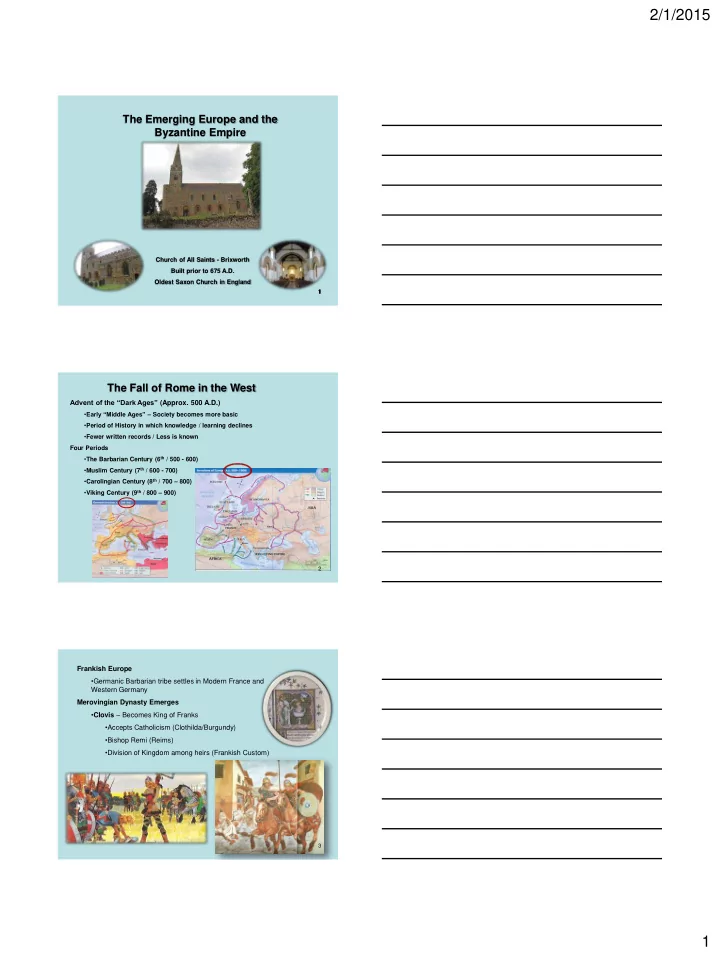
The Emerging Europe and the Byzantine Empire

Church of All Saints - Brixworth Built prior to 675 A.D. Oldest Saxon Church in England

1 2

The Fall of Rome in the West

Advent of the “Dark Ages” (Approx. 500 A.D.)

  • Early “Middle Ages” – Society becomes more basic
  • Period of History in which knowledge / learning declines
  • Fewer written records / Less is known

Four Periods

  • The Barbarian Century (6th / 500 - 600)
  • Muslim Century (7th / 600 - 700)
  • Carolingian Century (8th / 700 – 800)
  • Viking Century (9th / 800 – 900)

2 3

Frankish Europe

  • Germanic Barbarian tribe settles in Modern France and

Western Germany Merovingian Dynasty Emerges

  • Clovis – Becomes King of Franks
  • Accepts Catholicism (Clothilda/Burgundy)
  • Bishop Remi (Reims)
  • Division of Kingdom among heirs (Frankish Custom)

3

slide-2
SLIDE 2

2/1/2015 2

4

Family Tree of the Merovingian's = Merovech (Clovis’ Grandfather)

Three kingdoms gradually emerge:  Neustria  Austrasia  Burgundy

5

Division of Clovis’ Frankish Kingdom on his Death

Custom creates constant strife among the heirs to consolidate power (511 – 673 A.D.) Rise of the Mayors of the Palace (673 – 718 A.D.)

  • Paris (“Lutetium”) of the Roman Era

(4,000 pop.)

  • Became one of the Frankish Capitals

6

The Rise of the Medieval Catholic Church

Religion is central to the life of the people: “Cradle to Grave” Sacraments important to all the people Parish priests were from the local area, education varied “in saeculo” (“In the World”) – Secular Western monasticism began with St. Benedict in 529 Abbey of Monte Cassino, Italy (Benedictine home) “regula” (“Followed Rules”) = Regular Women’s religious orders follow with St. Scholastica Sister of St. Benedict

Our own Brother Rick Wilson T.O.R. Franciscan Third Order “Regular”

slide-3
SLIDE 3

2/1/2015 3

7

Monastic life important to Western Europe Schools / Hospitals / Agriculture

Balance between work and prayer Benedictines pray seven times a day Vows of Poverty, Chastity and Obedience

8

Monasteries Served to Care for Travelers

Early Medical Practices Early Pharmacies

Cistercian Monastery of Vauclair, France Founded 1134 Destroyed in 1789 / 1918

9

Monasteries Provided Sanctuary for People Accused of a Crime

Durham Cathedral and Monastery, England

slide-4
SLIDE 4

2/1/2015 4

10 10 10 10

Center of Western Monasticism

11 11 11 11

Interior of Monte Cassino Abbey

Tombs of St. Benedict and St. Scholastica

12 12 12 12

Pope St. Gregory I (the Great)

(Refer to Handout)

597 A.D. use of Benedictine Rule Sends Missionaries spread Catholicism

  • England – St. Augustine of

Canterbury

  • First Bishop of England
  • Christianization of Anglo-Saxon

England

slide-5
SLIDE 5

2/1/2015 5

13

Cathedral of Canterbury – Archbishop – Primate of England (Anglican!)

14

Irish Missionaries important

  • Spread Catholicism to Europe

(Re-evangelize)

  • Glendalough Community =

2,000 Monks!! Synod of Whitby – 664

  • Follow Roman (Latin)

Traditions

15 15 15 15

Illuminated Manuscripts

slide-6
SLIDE 6

2/1/2015 6

16 16 16 16

Manuscript Collection Cathedral of Siena, Italy

Scriptorium in the Monastery

17

Staff / Stave Western Musical Notation

  • Inventor of Modern Musical

Notation (1025 / 1026)

  • To help Choir Monks learn Chant

and to sight read music.

Guido da Pomposa

992 - 1050 Monk at the Benedictine Abbey of Pomposa, Italy

18 18 18

Watch where you walk!

Charles Martel (“The Hammer”)

  • Begins to consolidate and control Frankish

conquests and lands

  • Continues to govern in the name of the

Merovingian monarchs

Mayors of the Palace (Prime Minister)

Battle of Tours 732

slide-7
SLIDE 7

2/1/2015 7

19 19 19

Pepin the Short

Deposes the Last Merovingian King / 751 Lombards / Pope / 754 / Byzantines Donation of Pepin / Papal States

  • St. Boniface crowns Pepin in

Mainz - 751 Pope Stephen crowns him in Paris 754

20 20 20 20 20 20

Donation of Pepin 754 A.D. Start of the Papal States (Ends 1870) (Vatican Today)

  • 1. Roman Empire Falls
  • 2. Byzantine Reconquest
  • 3. Pope gains degree of

autonomy

  • 4. Lombard Invasions
  • 5. Pepin becomes “King” of

Franks 751

  • 6. Franks conquer N. Italy 754
  • 7. Charlemagne adds more

territory 757 - 789

20 21 21 21 21 21 21 21

Carolus Magnus (Charles the Great) = Charlemagne

Physical Stature = 6’4” (Einhard – Biographer) Aachen (Aix-la-Chapelle)

  • Capital city – today is between modern France

and Germany

slide-8
SLIDE 8

2/1/2015 8

22

The Carolingian Dynasty lasts for

  • ver 150 Years

Emergence of France / Germany

Revival of Learning

23 23 23 23 23 23

Frankish Kingdom Expansion (Division!)

Development of the Holy Roman Empire 800 A.D.

  • Modern France will emerge
  • Modern Germany will emerge

24 24 24 24 24 24

Carolingian Renaissance – Revival of Learning

Palace school, Alcuin of York (Benedictine Monk)

  • Educate clergy, nobility, commoners (grammar, rhetoric, logic)
  • Latin the “official” language of the government & law
  • Carolingian Script – Addition of punctuation to Latin
  • Abbey/monastery schools develop - scriptorium

Becomes Holy Roman Emperor; 800 A.D. – Rome Dies in 814 Louis the Pious (surviving son) becomes the emperor

slide-9
SLIDE 9

2/1/2015 9

25 25 25 25 25 25 25

Carolingian Renaissance Script

Roman Latin Carolingian Latin

26 26 26 26 26 26 26

  • 1. Charles the Bald = France
  • 2. Lothaire = Luxembourg, Switzerland,

portions of France & Northern Italy

  • 3. Louis the German = Germany

Treaty of Verdun 843 A.D. Louis the Pious becomes the emperor in 814

  • Multiple Marriages

Louis dies in 840 Lothaire gets the title as Holy Roman Emperor (He is the oldest!)

27 27 27 27 27 27 27

The Invasion of Europe – Development of Feudalism

Vikings – Hit and Run Raids

  • Charlemagne is able to temporarily halt

the Viking raids on the Holy Roman Empire (Frankish Kingdom)

  • Vikings attack and plunder in the spring

and summer – return to Scandinavia in the fall

  • Becomes harder to halt raids
  • People begin to lose faith in ability of

rulers to protect them – turn to local nobles for protection

 Rise of Feudalism

Typical Viking Longships?

slide-10
SLIDE 10

2/1/2015 10

28 28 28 28 28

Magyars Attack Europe from the East (From modern Hungary) Islamic Arabs Attack Europe from the South

Additionally !!

29 29 29 29 29

 Louis the Pious is able only to partially halt the raids as they increase  Viking raids continue to increase during the rule of Charles the Bald  Viking impact on France is more destructive than on Germany  Charles III (King of the West Franks) invites Vikings to settle in France Viking leader Rollo (Robert) – Normandy – 911

30 30 30 30 30 30

Viking raids first come to England at the Monastery at Lindesfarne 793 A.D. Begin to Settle in England – York – 866 Danelaw Established / Conflict with the Saxons – Alfred the Great Lindesfarne 793 A.D. York – 866 Alfred the Great

slide-11
SLIDE 11

2/1/2015 11

31 31 31 31 31 31

Lindesfarne Monastery, England First Viking Raid 793 A.D.

32 32 32 32 32

Rise of Feudalism

Has its roots in Roman times 3rd Century Monarchs unable to protect people who turn to the local nobles for protection Highly decentralized form of government Mutual relationships Began in Northern France – Why? Spread to rest of Western Europe Vassal could pledge loyalty to more than one lord

33

The Rise of Anglo – Saxon England

(4th – 5th Century) Romans Depart by Early 4th Century

slide-12
SLIDE 12

2/1/2015 12

34 34 34 34 34

Settlements of Early Celtic and Romans in England

Some areas taken over by Angles and Saxons in 5th Century and later invasions

35 35 35 35

Larger Anglo-Saxon Settlements in England

Replacement for Roman presence Brought new culture to England Portchester

  • Roman
  • Saxon
  • Norman

Portchester Today

Wessex Town approximately 800 A.D. 36 36 36 36

Alfred the Great unifies the Saxon kingdoms

  • Defeated the Danes

in 886 A.D.

  • Becomes known as

England

  • Revival of Learning
  • “Anglo-Saxon

Chronicles” records the early history of England – written by Monks

slide-13
SLIDE 13

2/1/2015 13

37 37 37 37

William the Conqueror

Duke of Normandy (aka “The Bastard”)

  • Brings French culture to England

Battle of Hastings – 14 October 1066

  • Last Successful Invasion of England
  • Defeats Harold Godwinson – Last Saxon

King of England

38 38 38 38

Battle of Hastings - 14 October 1066

39 39 39 39

William the Conqueror -- 1070

  • After the Battle – Abbey Built
  • To commemorate the Conquest
  • To Honor the Deceased Warriors

Battle Abbey Today

slide-14
SLIDE 14

2/1/2015 14

40 40 40 40

London will eventually become the political capital of England

  • Fortress of London – “Tower of

London”

  • Roman Walls & Norman Castle

41 41 41 41

Domesday Book

(HIGHLY TESTABLE!)

  • 1st Census of Western

Europe since the Romans

  • Taxable Wealth
  • 1080? – 1086
  • Accurate Record of

England in 11th Century

42

Succession of William the Conqueror

(Divides wealth among sons)

  

slide-15
SLIDE 15

2/1/2015 15

43 43 43 43

Henry II: King of England, Duke of Normandy, 1154 - 1189

(Please NOTE!) The Most Powerful Monarch of the Medieval European Period

  • Henry II – Duke of Normandy
  • Marries Eleanor of Aquitaine
  • Controls more of France than

the French King

  • Becomes King of England
  • English Legal System develops
  • Common Law
  • Roman Laws
  • Local Customs

 Grand Jury  Petit Jury

  • Conflict with Church
  • Church Courts vs. Royal Courts
  • St. Thomas a’ Becket

– Archbishop of Canterbury

Eleanor & Henry’s Tomb Effigies; Fontevaurd Abbey, France 44 44 44 44

Murder of St. Thomas a’ Becket – 1170 Canterbury, England

Struggle between Church & State

Small fragments of his relics – St. Thomas Catholic Church, Canterbury, England 45 45 45 45 45

The Magna Carta (The Great Charter)

15 June 1215

  • Protects the Rights of the Nobles
  • Later includes all English People
  • Main Focus -- The King is NOT above the Law
  • Nobles will give advice and counsel to the

King Under John, England loses the Duchy of Normandy to France in 1204 King John vs. Barons

slide-16
SLIDE 16

2/1/2015 16

46 46 46 46 46

The Magna Carta (The Great Charter) 1215 Four copies Still Exist – Salisbury Cathedral

47 47 47 47

New Social Class Emerges in England – the Middle Class – Burgesses

  • Income from business – Trade
  • Towns become more influential – Burgesses involved in Local Government

Edward I Creates the Model Parliament

  • Includes representatives from Clergy, Nobility & Burgesses
  • Function is to Give Advice to King

By 1400 Parliament Divides in Two Bodies

  • House of Lords – Nobility
  • House of Commons – Middle

Classes

England has Representative Government

48 48 48 48

Emergence of Medieval France

Monarchs begin to break away from Feudalism Frankish Lands Dissolve – Local Rulers Emerge 987 A.D. – Hugh Capet (Capetians)

  • Seize French Throne
  • Capital on the Isle de Cite (Paris)
  • Control the Lands Surrounding Paris

Limestone quarries dating back to Roman times.

slide-17
SLIDE 17

2/1/2015 17

49

Successors of Hugh Capet begin to Expand Borders of France

  • Adopt Primo-geniture (First Born Male

Heir)

  • Later provide positions to townspeople

(Bourgeoisie) and authority to local towns  They remain loyal to King – Weakens the power of Feudal Lords Basilica of St. Denis, Paris Burial place of French kings Clovis I – Louis XVI

50 50 50 50

Rise of Philip II (Augustus)

  • Captures / Conquers land from Normandy / England

(Conflicts with Richard / John)

  • Doubles the Borders of France
  • England retains the Aquitaine

Louis IX (Saint Louis)

  • Holy Individual / 7th & 8th Crusades
  • Royal Courts rise / Feudal Courts

diminish Philip IV (the Fair)

  • Gains more English Lands in France
  • Controls Flanders – Trade – Wool and other products
  • Instrumental in the Dissolution
  • f the Knights Templar Military

Order -- 1307 – 1313

  • Pope Clement V
  • Jacques DeMolay

51 51 51 51

Holy Roman Empire – Germany Different Results -- Never Unifies

  • Many German Kings and Holy Roman Emperors spent more time in Italy than in

Germany

  • German Rulers begin to be involved in Papal (s)election -- resulting centuries of
  • conflicts. They claim right to appoint popes / Pope claims right to anoint monarchs
  • Henry IV vs. Pope (St.) Gregory VII
  • Lay Investiture -- who will appoint bishops?

Henry IV at Canossa, Italy -- 1077 Concordat of Worms – 1122

  • Emperor can still name

bishops

  • Pope can reject unworthy

candidates

  • These problems will never go

away As late as 19th century the Austro-Hungarian monarchs claimed right to approve of papal selections.

slide-18
SLIDE 18

2/1/2015 18

Development of the Slavic East and Russia

Dnieper River (North – South Commerce Route) Steppes – Vast Plains (Short Agriculture Season)

  • Heavily Wooded Forests in Parts
  • Little Urbanization
  • Poor Transportation Network

Three Slavic Groups West Slavs (Poland, Czech Republic, Slovakia) Latin/Western South Slavs (Balkans = Serbs, Croats, Slovenes) Latin/West & Orthodox/East East Slavs – Largest (Russians, Ukraine, Byelorussians) Orthodox/East Harsh Life / Brutal Winters / great use of Wood / Live off the Land

52

“Primary Chronicle” – Documents the early history of Russia

Begins in the north – Novgorod – Seeks order and protection

  • Invites (for a second time) the Varangians (Scandinavians)
  • Viking leader Rurik = Slavs called them the “Rus”
  • Novgorod important for northern trade
  • Novgorod controlled by assemblies of the people

Primary Chronicle Written 1100 A.D.

53

Know who he is!!

Early Novgorod

54

slide-19
SLIDE 19

2/1/2015 19

  • Oleg of Novgorod conquers Kiev to the south – Dnieper River
  • Location important for trade
  • Kiev = “Mother of Eastern Slavic Cities”
  • The Kievian Rus are ruled by “Grand Princes”

55

The First Russian State = Kiev Christianity arrives in Russia

Olga – First to Accept Christianity (Eastern) Grandson Vladimir – Grand Prince of Kiev Kievan ruler who accepts Christianity for the Slavic people Impact: Russians adopt Orthodox faith and Byzantine Practices Kiev / Russia becomes more isolated from the West

56

Vladimir Expands the Borders of Kievan Rus

57

slide-20
SLIDE 20

2/1/2015 20

Golden Age of Kiev

After Vladimir’s reign, his son Yaroslav comes to power Kiev enters what is called the “Golden Age of Kiev” Culture develops that follows example of Byzantines

  • Library
  • Legal system
  • Political marriages – daughters
  • Trade flourishes

After Yaroslav’s death

  • No clear line of succession
  • Internal fighting
  • Begins to decline

Trade declines – problems in Constantinople (Latin’s)

58

Mongols Arrive at Europe’s Doorstep

59

Mongols Sack and Destroy Kiev 1240

60

Kiev looses importance for many decades

slide-21
SLIDE 21

2/1/2015 21

Mongol Rule of Russia

  • Lasts for approximately 200 years
  • Mongol culture does not contribute to Russia
  • All advances of the Kievan society were

erased Use many Russians to work for them – collect taxes

  • Some Russian city-states begin to rise in

power/status

  • Moscow of note

Novgorod becomes independent

  • Builds trade network
  • Comes into conflict
  • with West

Walls of Novgorod

61

Mongols never conquer Novgorod in North

Alexander, Prince of Novgorod

Prince of Novgorod in early 13th century

  • Defeats Swedes at Neva River in 1240
  • Becomes known as Alexander “Nevsky” (of the Neva”)
  • Defeats German Teutonic Knights in 1242
  • Ensures prosperity for Novgorod

Alexander Nevsky becomes client ruler for Mongols

  • Son Daniel moves to Moscow, becomes ruler
  • Daniel is client ruler for Mongols

62

The City of Moscow / The Third Rome

After the fall of Constantinople (1453) – center of the Eastern Orthodox Church

  • Ivan III marries a Byzantine princess – successor of the Roman’s
  • Symbol of Russia = Double Headed Eagle
  • Rulers adopt the title Czar (Caesar)

Greek and Latin (Byzantine) influences are found in Moscow However, a unique Russian culture emerges that is reflected in the Slavic language, buildings, religion, arts (icons) Russian Orthodox religion stresses

  • bedience to the Czar as God’s

representative on earth.

City Plan of Moscow

63

slide-22
SLIDE 22

2/1/2015 22

Rise of the Byzantine Empire

Begins with Division of Roman Empire -- Diocletian -- 284AD* Germanic Invasions – Frontiers Not Secure *Note: Majority of invasions are in the Western part of the Roman Empire

64

Constantine Comes to Power – 306AD (Mother is St. Helena)

 Defeats Maxentius at Battle of Milvian Bridge -312 AD “Hoc signo vince” (By this sign win your victory)  Edict of Milan – 313 AD = Christianity is a LEGAL religion Becomes sole emperor by 324 AD  Decides to build new capital in the east (escape invasions) Byzantium – Greek trading colony New capital is opened 330 AD = Constantinople (“Constantinpolis”)

65

Constantinople develops

*East / West Crossroads by land *North / South Crossroads by sea

Trade!

66

slide-23
SLIDE 23

2/1/2015 23

Western Roman Empire “Collapses” in 476

Christian Church (Pope/”papa”) remains in Rome

  • Accepts leadership role in west
  • Retains Latin
  • Roman Catholicism develops

Eastern Roman Empire continues

Still Known as “Roman Empire” (Consider themselves to be Roman) Since 16th Century known as “Byzantine Empire” Cultural Blend of Greek, Roman (Latin) and Persian Cultures Greek eventually becomes the dominant language Distinctive form of Christianity develops – Eastern Orthodox

  • St. Peter’s Basilica – From Constantine

67

Justinian

Humble origins (Balkans) – Uncle Emperor Justin I Marries Theodora (19 years younger)

  • actress / beautiful / smart

Ultimate dynamic power couple of Byzantine age

  • shared power

Each supports the other – both have their own courts – regal lifestyle

Ravenna Where have you seen this picture?

Justinian Theodora

Basilica of St. Vitale +548 A.D. 68

Basilica of St. Vitale = 548 A.D.

Byzantine Architecture (Greek & Roman)

69

Kudo’s Question? What is the largest Byzantine Church in Metro Washington, D.C.?

slide-24
SLIDE 24

2/1/2015 24

70

Constantinople is considered to be one of the most beautiful cities in the world Considered to be the center of knowledge inherited from the Greeks and the Romans

Justinian Dies in 565 Gains in the West begin to be lost

71

Justinian’s Code of Laws

Roman law codes accumulated for 1,000 years Never organized into a useful system Under Tribonian updated legal system Corpus of Civil Law – “Justinian Code” Become the basis for the majority of European legal codes

KUDO’s QUESTION!!

What one State in the United States uses a form of the Justinian Code as a basis for their laws?

72

slide-25
SLIDE 25

2/1/2015 25

Justinian and the Church

Construction of the Church of

Hagia Sophia (“Holy Wisdom”)

532 – 537 (5 years to build!) Largest Christian / Catholic church for 1,000 years! Western Europe – Abbey of Cluny was the largest Catholic church.

  • St. Peter’s Basilica became the

largest church in the 17th century. Became a mosque! Today it is a museum!

73

Byzantine Emperors and the Church

Heavily involved in church affairs. Appoint the Patriarch (Bishop) of Constantinople Majority of the people are involved in religion Dispute over Icons (Images) Images = God, Jesus, Saints Bible = Do not worship Images vs. Icons = Symbols of God & Saints Iconoclast (“Image Breaker”) Controversy (726 A.D.) Emperor Leo III – Removal of Icons from churches Pope Gregory II – Supported the use of Icons in churches Conflict between east and west Council of Nicaea 787 A.D. – icons were allowed – no statues.

74 75

Great Schism (Split) – 1054

  • Eastern Catholic

(Orthodox / Greek) Church splits from Western (Roman / Latin) Church

  • No longer recognizes

authority of the Pope

slide-26
SLIDE 26

2/1/2015 26

Byzantine Economy

 Trade / Crossroads / Central location  River networks / Seaways  Northern goods – furs / wood products  Eastern goods – spices / silks / precious goods  Silk Industry develops in Constantinople

76

Spread of Christianity

Missionaries

  • St. Cyril & St. Methodius
  • Apostles to the Slavs
  • Cyrillic Alphabet

Development of monasticism

  • Mono = One/Alone

77 78

Major Events Hasten the Decline of the Byzantine Empire

  • Islamic Arab attacks beginning 630’s A.D.
  • Norman Seizure of Southern Italy – 1071
  • Battle of Manzikert – 1071

Byzantines vs. Seljuk Turks Byzantine Army decisively defeated

  • Capture of Constantinople – 1204 – 4th Crusade

78

slide-27
SLIDE 27

2/1/2015 27

79

Ottoman Turks -- 1453

80 81

The Crusades -- an Overview

Latin = “Crux” (Cross) Crusading Period = 1095 – 1291

  • 1095 - Council of Clermont, France (Pope Urban II)
  • 1291 – Fall of Crusader Fortress at Acre

Holy Land – Jerusalem

  • Byzantine Empire Control
  • Falls to Islamic Forces – Arabs in 637/8
  • Jerusalem Third most Sacred City - Islam
  • Muhammad Ascended to Heaven from the

“Dome of the Rock” Byzantines fight for control of Holy Land off – on for 400 years.

81

slide-28
SLIDE 28

2/1/2015 28

Our Focus: Eight Numbered Crusades

Others with different names: Peasants (People’s) Crusade (April – October 1096) Children's Crusade (1212 / Tragic End!) Focused on Recapturing the Holy Land (Jerusalem) Begins with:

  • Seljuk Turks Capture Baghdad 1055
  • Seljuk Turks – Manzikert – 1071 Defeat Byzantine Army
  • Seljuk's Capture Jerusalem in 1073
  • No Further Pilgrim Visits – Very Dangerous
  • Byzantine Emperor Alexius Comnenus
  • Realizes the Threat of the Seljuk’s to His Empire
  • Seeks Help from the West (Remember the Great Schism!)

82

  • 20,000 Pilgrims / Unarmed
  • Peter the Hermit
  • Majority Killed by Turks

82

Council of Clermont, France 1095 – Pope Urban II

19 – 28 November 1095

  • Approx. 300

Bishops, Abbots, Religious

“Deus Vult” = “God Wills It!” Papal Promises

  • Indulgences
  • Protection of

the Church

83 83

First Crusade: 1096 – 1099

 French Nobility (No Kings)  Goal to Capture Jerusalem  Meet in Constantinople (Move Eastward)  Capture Islamic / Arab Fortified Coastal Cities along Eastern Mediterranean.  Conquer Jerusalem 15 July 1099  Begin 88 Years of Christian Occupation

84 84

slide-29
SLIDE 29

2/1/2015 29

85

The Holy Land after the First Crusade – Peace Reigns 1099 – 1187

85 85

Second Crusade: 1147 – 1149

Preached by St. Bernard of Clairvaux

  • Speyer, Germany

King Louis VII of France Holy Roman Emperor Conrad III Conrad’s Army arrives early, marches across the interior of Turkey

  • Is destroyed at Dorylaeum 25 October 1147

Later Louis VII and remnants of Conrad’s Army attack Damascus and are defeated. Louis returns to France Saladin Emerges from Egypt – Conquers The Middle East

86 86

Third Crusade: 1189 – 1192

“Crusade of the Kings”

 Richard the Lionhearted (England)  Philip II (France)  Frederick I (Holy Roman Emperor)

  • Drowns enroute to Constantinople
  • Richard insults Duke Leopold of Austria

Richard and Philip Argue

  • Philip returns to France
  • Usurp Richard’s Lands?

Richard campaigns against Saladin

  • Series of battles that are split between

both armies

  • Richard’s greatest victory at Arsuf

7 September 1191

87 87

slide-30
SLIDE 30

2/1/2015 30

88

Results of the Crusades

Improvements in Art of Warfare

  • Innovations
  • Learned things from the Arabs
  • Better ships / maps / compass

Serves to initiate the breakdown / decline

  • f Feudalism

People travel to different parts of the world – new view of world Development and improvement in trade with the east

  • Luxury goods
  • Prosperity for Venice & Genoa
  • Foster the start of the Italian

Renaissance Unified the Muslims against a common enemy

88