1 4-Sept-2006 4-Sept-2006 Background APCELL Research Outcomes - - PDF document

1
SMART_READER_LITE
LIVE PREVIEW

1 4-Sept-2006 4-Sept-2006 Background APCELL Research Outcomes - - PDF document

4-Sept-2006 Background APCELL Research Outcomes ACELL Summary Australasian Chemistry Enhanced Laboratory Learning Project The ACELL Project (The Australian Chemistry Enhanced Laboratory Learning) Directors: Simon Barrie (ITL, Sydney)


slide-1
SLIDE 1

1

“Developing Better Ways of Teaching in the Laboratory”

The ACELL Project

(The Australian Chemistry Enhanced Laboratory Learning)

Scott Kable

School of Chemistry

  • Univ. of Sydney

4-Sept-2006

Background APCELL Outcomes Research Summary ACELL

Australasian Chemistry Enhanced Laboratory Learning Project

Directors: Simon Barrie (ITL, Sydney) Bob Bucat (Chem, UWA) Mark Buntine (Chem, Adelaide) Geoff Crisp (ITL, Adelaide) Adrian George (Chem, Sydney) Ian Jamie (Chem, Macquarie) Scott Kable (Chem, Sydney)

  • Assoc. Dir.

Justin Read (almost PhD in Chem. Ed., U.Syd.)

>30 partner universities in Australia / NZ

4-Sept-2006

Background APCELL Outcomes Research Summary ACELL

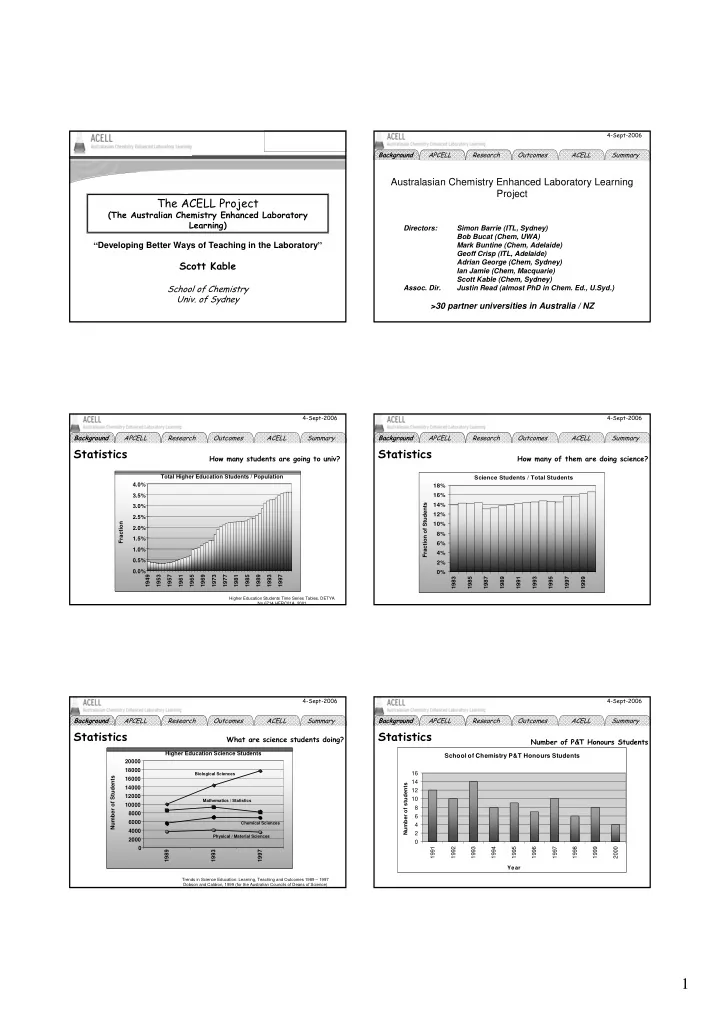
How many students are going to univ?

Higher Education Students Time Series Tables, DETYA No 6714 HERC01A, 2001

Total Higher Education Students / Population 0.0% 0.5% 1.0% 1.5% 2.0% 2.5% 3.0% 3.5% 4.0% 1949 1953 1957 1961 1965 1969 1973 1977 1981 1985 1989 1993 1997 Fraction

Statistics

4-Sept-2006

Background APCELL Outcomes Research Summary ACELL

Science Students / Total Students 0% 2% 4% 6% 8% 10% 12% 14% 16% 18% 1983 1985 1987 1989 1991 1993 1995 1997 1999 Fraction of Students

How many of them are doing science?

Statistics

4-Sept-2006

Background APCELL Outcomes Research Summary ACELL

Higher Education Science Students 2000 4000 6000 8000 10000 12000 14000 16000 18000 20000 1989 1993 1997 Number of Students

Biological Sciences Chemical Sciences Mathematics / Statistics Physical / Material Sciences

What are science students doing?

Trends in Science Education: Learning, Teaching and Outcomes 1989 – 1997 Dobson and Caldron, 1999 (for the Australian Councils of Deans of Science)

Statistics

4-Sept-2006

Background APCELL Outcomes Research Summary ACELL

Number of P&T Honours Students

School of Chemistry P&T Honours Students 2 4 6 8 10 12 14 16 1991 1992 1993 1994 1995 1996 1997 1998 1999 2000

Year Number of students

Statistics

slide-2
SLIDE 2

2

4-Sept-2006

Background APCELL Outcomes Research Summary ACELL

35 Australian universities teach chemistry - at least to First Year. ~20,000 students per year take these courses. Laboratory training is an ESSENTIAL component in chemical

education.

RACI accreditation = 350 hours / year

Description of problem

Some “facts”:

4-Sept-2006

Background APCELL Outcomes Research Summary ACELL

Physical Chemistry is particularly vulnerable to student discontent in the laboratory

Arcane concepts Antiquated experiments Perceived lack of relevance Reliance on expensive instrumentation that not all

departments can afford

Boring

Laboratories

4-Sept-2006

Background APCELL Outcomes Research Summary ACELL

What Can We do to Reverse the Trend? Maybe teachers can teach better Maybe students can learn better

Laboratories

4-Sept-2006

Background APCELL Outcomes Research Summary ACELL

  • recall one laboratory exercise you remember as

being a good learning experience.

  • Why?

Think back to your own undergraduate experience…

  • recall one laboratory exercise you remember as

being a poor learning experience.

  • Why?

Laboratories

4-Sept-2006

Background APCELL Research Outcomes ACELL Summary

Australian Physical Chemistry Enhanced Laboratory Learning

APCELL

4-Sept-2006

Background APCELL Research Outcomes ACELL Summary

  • 1. The Idea

~8 years ago discussed at several occasions that we were together (e.g.

conferences)

several other people also knew about the idea and had already had

some input.

History of APCELL

slide-3
SLIDE 3

3

4-Sept-2006

Background APCELL Research Outcomes ACELL Summary

History of the project

  • 2. When we started...

In September 1998, Mark Buntine and I decided we

would have a go at getting funding for the idea.

We wrote to all 35 Australian Universities that teach

chemistry.

N.B. An existing network (the R.A.C.I.) was invaluable

and important to demonstrate network already exists.

4-Sept-2006

Background APCELL Research Outcomes ACELL Summary

History of the project

  • 3. The Proposal

CTL reviewed several drafts of our application, and it is

here that we realise we don’t speak the same language!!

Barrie (ITL) joins team. Funded by CUTSD ($167,000)

pays for Assoc. Director (Dr Ian Jamie) pays for first APCELL workshop

4-Sept-2006

Background APCELL Research Outcomes ACELL Summary

Chemical Education Research

Research Led Teaching Enquiry-Development Cycle Action Research Broader Education Research

4-Sept-2006

Background APCELL Research Outcomes ACELL Summary

Research Led Teaching (RLT)

The use of disciplinary research in teaching - for example, the use by a teacher of one of their current journal publications reporting a key piece of cutting edge research; Teaching and curriculum that uses evidence derived from research and inquiry - for example, designing an assessment task on the basis of published education research or one’s own inquiries into how students approach particular assessment tasks; Research into teaching and learning - for example, a research investigation into how students approach different assessment tasks.

4-Sept-2006

Background APCELL Research Outcomes ACELL Summary

Formulation of APCELL development project funding application

  • Research literature on student learning
  • Research literature on laboratory T&L
  • Research literature on academic

development

  • Inquiry into the nature of the barriers
  • Why hadn’t somebody done something about

this before?

  • T&L conceptions
  • Resources
  • Inquiry into student learning from the

student experience perspective

  • Gather data on students’ perceptions of

their teaching & learning experiences

The Inquiry-Development Spiral

4-Sept-2006

Background APCELL Research Outcomes ACELL Summary

The Inquiry-Development Spiral

(Canberra Workshop) Participatory development of template Engage with academics’ views of T&L Shared student learning perspective Development of laboratory classes and resources using template Peer (staff and student) review of laboratory classes and resources – and subsequent revision (Sydney Workshop) Collaborative review / inquiry into T&L effectiveness of APCELL laboratories Engage with academics’ views of T&L Dissemination of teaching development products Resources that support further inquiry into T&L APCELL database, Template, Review Tools, Resources, People Ian Jamie joins team

slide-4
SLIDE 4

4

4-Sept-2006

Background APCELL Research Outcomes ACELL Summary

55 participants, including 20 students 30 experiments, all set up and performed over 3 days extensive review Experiment workshop, Sydney, Jan, 2001

4-Sept-2006

Background APCELL Research Outcomes ACELL Summary

The Inquiry-Development Spiral

time

  • Testing template
  • Submission of

expts Canberra Workshop, 2000 Development of template Sydney Workshop, 2001

  • Dissemination of

teaching development products

  • Modification of template

IUPAC conference, 2001 Link with AJEC

  • Refereeing
  • Publications

Other Workshops, 2002 Recognition of APCELL

  • Extension to

ACELL

  • Involvement
  • f RACI

ACELL

ARC / HEIP, 2003 Grant applications

4-Sept-2006

Background APCELL Research Outcomes ACELL Summary

Research Led Teaching (RLT)

The use of disciplinary research in teaching - for example, the use by a teacher of

  • ne of their current journal publications reporting a key piece of cutting edge

research; Teaching and curriculum that uses evidence derived from research and inquiry - for example, designing an assessment task on the basis of published education research or one’s own inquiries into how students approach particular assessment tasks;

Research into teaching and learning - for example, a research investigation into how students approach different assessment tasks.

4-Sept-2006

Background APCELL Research ACELL Outcomes Summary

Outcomes of APCELL

Database of Experiments The Educational Template Workshops at Aust. Phys. Chem. and Chem. Ed.

conferences

Collaboration with the Australian Journal of Education

in Chemistry

Uptake of experiments and methods by Chemistry

departments

Network of academics and students Communication

4-Sept-2006

Background APCELL Research Outcomes ACELL Summary

Section 1: Summary of the Experiment Section 2: Educational Analysis What are the intended learning outcomes How the outcomes are achieved How the outcomes are monitored Section 3: The Student Learning Experience Section 4: Documentation student notes, demonstrator notes, technical notes, etc Section 5: Peer Assessment Criteria

The Educational Template

4-Sept-2006

Background APCELL Research Outcomes ACELL Summary

APCELL database A database of experiments that have been educationally validated.

including student, demonstrator and technical notes 14 fully refereed experiments (available to all) ~20 further submitted experiments (available upon registration)

APCELL Database

slide-5
SLIDE 5

5

4-Sept-2006

Background APCELL Research Outcomes ACELL Summary

Educational template and documentation assessed by academics and

students

Experiment set up and run by academics and students in an

independent laboratory

Fulfils “scholarly activities” criteria, and Quality Improvement/Quality

Assurance criteria

Experiment entered into APCELL database - publicly available Publication in Australian Journal of Education in Chemistry - refereed

journal

Refereeing and Publications

4-Sept-2006

Background APCELL Research Outcomes ACELL Summary

Refereeing and Publications

4-Sept-2006

Background APCELL Research Outcomes ACELL Summary School of Chemistry P&T Honours Students

2 4 6 8 10 12 14 16 1991 1992 1993 1994 1995 1996 1997 1998 1999 2000 2001 2002 2003 Year Number of students

Number of P/T honours students

4-Sept-2006

Background APCELL Research ACELL Outcomes Summary

Sep-1998 Approach to Australian Universities for support Late - 1999 CUTSD approves project funding Feb-2000 Launch of project (11th National Convention, RACI) Jan-2001 Experiment Workshop, University of Sydney Jul-2001 Presentation at World Chemistry Congress, Brisbane Jan-2002 Presentation and Workshop at RACI meeting, Christchurch, NZ Feb-2002 Official end of APCELL project (phase 1?) and electronic publication of database Nov-2002 Workshop at Chem. Ed. Conference, Melbourne May-2003 Team expanded Feb-2004 Joint Workshop of Phys.Chem. / Chem. Ed. Conferences, Hobart April-2004 ACELL HEIP application submitted and funded (~$144,000) Late-2004 ACELL STARTS!

Where to from here… ? (ACELL?)

4-Sept-2006

Background APCELL Research Outcomes ACELL Summary

All of Chemistry – ACELL Three principal aims

Database of educationally and chemically sound

experiments, that have been tested by both academic staff and students

Provide for professional development of chemistry

academic staff

Facilitate the development of a chemistry education

community of practice

4-Sept-2006

Background APCELL Research Outcomes ACELL Summary

Section 1 – Summary of the Experiment Section 2 – Educational Analysis

Learning outcomes in areas Theoretical and Conceptual Knowledge Scientific and Practical Skills Thinking Skills and Generic Attributes

Section 3 – Student Learning Experience Section 4 – Documentation

Methods – Educational Template

slide-6
SLIDE 6

6

4-Sept-2006

Background APCELL Research Outcomes ACELL Summary

Educational Analysis For each learning outcome:

What should students learn? How will students learn it? How will staff and students know that students have

achieved the learning outcome?

4-Sept-2006

Background APCELL Research Outcomes ACELL Summary

33 academic staff 31 undergraduate students 27 universities from across Australia and New Zealand 33 experiments

⇒ 3 very full days

February 2006 ACELL Workshop

4-Sept-2006

Background APCELL Research Outcomes ACELL Summary

Workshop Program

4-Sept-2006

Background APCELL Research Outcomes ACELL Summary

Laboratory Testing

4-Sept-2006

Background APCELL Research Outcomes ACELL Summary

Collaborative Work

4-Sept-2006

Background APCELL Research Outcomes ACELL Summary

Group Discussion

slide-7
SLIDE 7

7

4-Sept-2006

Background APCELL Research Outcomes ACELL Summary

Evening Debrief Sessions

4-Sept-2006

Background APCELL Research Outcomes ACELL Summary

Improving Student Learning

0% 10% 20% 30% 40% 50% 60% 70% 80% Strongly Agree Agree Neutral Disagree Strongly Disagree Staff (n = 26) Student (n = 25)

The ACELL workshop offers a useful means to improve students' learning in laboratory exercises 4-Sept-2006 Background APCELL Research Outcomes ACELL Summary

Valuable Process

0% 10% 20% 30% 40% 50% 60% 70% Strongly Agree Agree Neutral Disagree Strongly Disagree Staff (n = 26) Student (n = 25) Participation in the ACELL workshop has been a valuable experience for me

4-Sept-2006

Background APCELL Research Outcomes ACELL Summary 0% 5% 10% 15% 20% 25% 30% 35% 40% 45% 50% 55% Strongly Agree Agree Neutral Disagree Strongly Disagree

Student (n = 25) Laboratory exercises are intended to teach more than I had previously realised

Content of Lab Exercises

4-Sept-2006

Background APCELL Research Outcomes ACELL Summary

Changing Perceptions

0% 5% 10% 15% 20% 25% 30% 35% 40% 45% 50% Strongly Agree Agree Neutral Disagree Strongly Disagree Student (n = 25) Academic staff are more interested in laboratory learning than I had previously realised 4-Sept-2006 Background APCELL Research Outcomes ACELL Summary

Delegate Feedback

Staff: “It made me sit down and think carefully about what I wanted my students to get out of my experiment, and how I could judge if they had been successful” Staff: “The interaction of participants was excellent – so much better than a conference – ‘learning in a fun environment’”

slide-8
SLIDE 8

8

4-Sept-2006

Background APCELL Research Outcomes ACELL Summary

Perceptions

Student: “I learnt that also there are teachers / lecturers that actually do care about their students and want to improve their learning experience” Staff: “That there were so many academics interested in education and student interests” Staff: “The enthusiasm with which students engaged in the activities and the thoughtful comments given”

4-Sept-2006

Background APCELL Research Outcomes ACELL Summary

Improving the Experiments

Student: “The debrief sessions seem to be the most valuable, since we were all able to critique the experiments and really get our opinion heard, and especially to get changes made to better the experiments” Student: “The templates showed me exactly what

  • bjectives lecturers were actually trying to get across

in practicals”

4-Sept-2006

Background APCELL Research Outcomes ACELL Summary

Potential of ACELL

Staff: “Workshop was excellent and meetings of this type need to be a basis of communication between practitioners at Australian institutions” Student: “The workshop was fantastic. I have a deeper appreciation and outlook on practicals and my application to

  • them. If every student could see what happened over these

three days, I think all attitudes would change”

4-Sept-2006

Background APCELL Research Outcomes ACELL Summary

The ACELL Website

Experiments and their documentation Publications, including published papers

13 published experiments from APCELL

Information on ACELL events Education resources for ongoing professional

development

Process information – content analysis Theory information – constructivism

4-Sept-2006

Background APCELL Research Outcomes ACELL Summary

The ACELL website

hyperlink to website

4-Sept-2006

Background APCELL Research Outcomes ACELL Summary

Summary and Acknowledgements

slide-9
SLIDE 9

9

4-Sept-2006

Background APCELL Research Outcomes ACELL Summary

Database of student-tested, educationally sound

undergraduate experiments

30 under review, aim is to have >50 reviewed by mid-2007

Professional development of delegates Provision of educational resources Building a community of practice A model for other countries and domains

being trialled in microbiology at U. Adelaide

Summary

4-Sept-2006

Background APCELL Research Outcomes ACELL Summary

Acknowledgements

Staff and student delegates HREC at the University of Sydney

Funding and support

  • Aust. gov’t grants

(CUDST, HEIP) Royal Aust.

  • Chem. Institute

4-Sept-2006

Background APCELL Research Outcomes ACELL Summary

Acknowledgements

“The Team”

Sydney:

  • Justin Read
  • Simon Barrie
  • Adrian George

Adelaide:

  • Mark Buntine
  • Geoff Crisp

Macquarie:

  • Ian Jamie

Western Australia

  • Bob Bucat

4-Sept-2006

Background APCELL Research Outcomes ACELL Summary

ACELL Website

http://acell.chem.usyd.edu.au