1 About me Choosing an exercise group At ETH for five years - - PDF document

1
SMART_READER_LITE
LIVE PREVIEW

1 About me Choosing an exercise group At ETH for five years - - PDF document

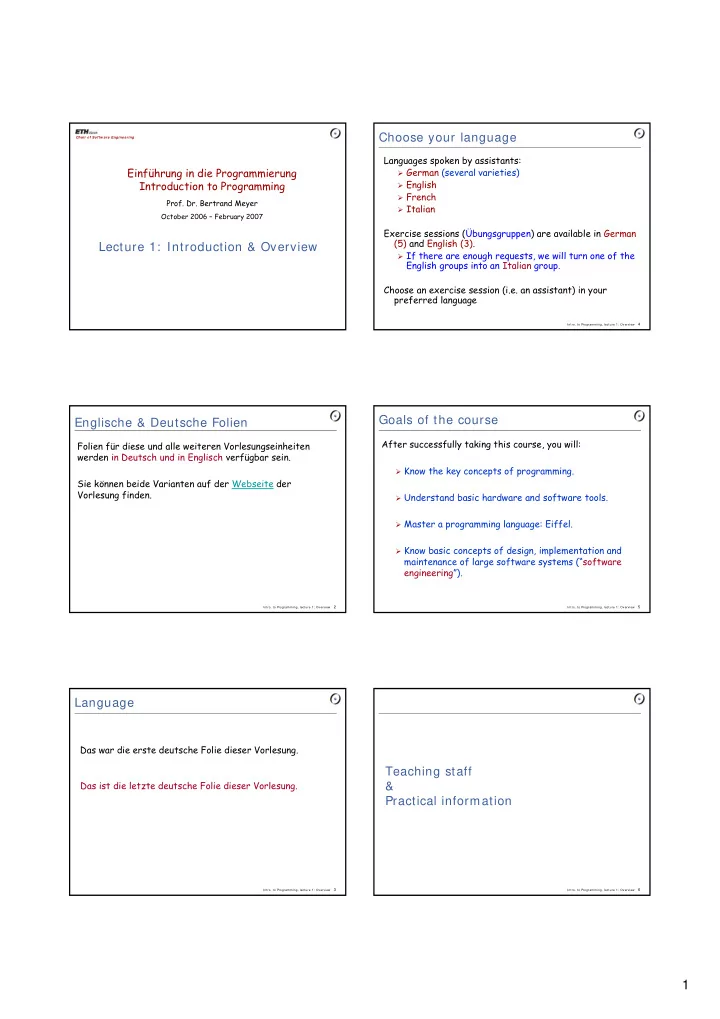
Choose your language Chair of Softw are Engineering Languages spoken by assistants: Einfhrung in die Programmierung German (several varieties) Introduction to Programming English French Prof. Dr. Bertrand Meyer Italian


slide-1
SLIDE 1

1

Einführung in die Programmierung Introduction to Programming

  • Prof. Dr. Bertrand Meyer

October 2006 – February 2007

Chair of Softw are Engineering

Lecture 1: Introduction & Overview

I ntro. to Programming, lecture 1: Overview 2

Englische & Deutsche Folien

Folien für diese und alle weiteren Vorlesungseinheiten werden in Deutsch und in Englisch verfügbar sein. Sie können beide Varianten auf der Webseite der Vorlesung finden.

I ntro. to Programming, lecture 1: Overview 3

Language

Das war die erste deutsche Folie dieser Vorlesung. Das ist die letzte deutsche Folie dieser Vorlesung.

I ntro. to Programming, lecture 1: Overview 4

Choose your language

Languages spoken by assistants:

German (several varieties) English French Italian

Exercise sessions (Übungsgruppen) are available in German (5) and English (3).

If there are enough requests, we will turn one of the

English groups into an Italian group. Choose an exercise session (i.e. an assistant) in your preferred language

I ntro. to Programming, lecture 1: Overview 5

Goals of the course

After successfully taking this course, you will:

Know the key concepts of programming. Understand basic hardware and software tools. Master a programming language: Eiffel. Know basic concepts of design, implementation and

maintenance of large software systems (“software engineering”).

I ntro. to Programming, lecture 1: Overview 6

Teaching staff & Practical information

slide-2
SLIDE 2

2

I ntro. to Programming, lecture 1: Overview 7

About me

At ETH for five years In industry most of my career Founded Eiffel Software in Santa Barbara,

California, in 1985. Now “Chief Architect”

Published a number of books, in particular Object-

Oriented Software Construction (2nd edition: 1997)

Plan: help the industry build the best software

possible

I ntro. to Programming, lecture 1: Overview 8

Contact details

E-mail: Bertrand.Meyer@inf.ethz.ch Office: RZ J22 Secretary: Claudia Günthart, 044 632 83 46 Claudia.Guenthart@inf.ethz.ch Office: RZ J7 Office hours: normally Thursdays during the semester, contact Ms. Günthart

I ntro. to Programming, lecture 1: Overview 9

Schedule

Lectures:

  • Monday, 13:15 – 15:00, HG E7
  • Tuesday, 8:15 – 10:00, HG F1

Exercise sessions:

  • 7 groups
  • Monday, 15:15 – 16:00, various rooms
  • Tuesday, 13:15 – 15:00, various rooms
  • 1 group
  • Tuesday, 13:15 – 14:00, IFW B42
  • Thursday, 15:15 – 17:00, HG G26.3

I ntro. to Programming, lecture 1: Overview 10

Choosing an exercise group

Registration lists are available during the break. Choose your group according to

Preferred language Your schedule constraints Availability

We may have to reassign students to a different group to keep the numbers balanced The first exercise session takes place this afternoon!

I ntro. to Programming, lecture 1: Overview 11

The assistants

Ilinca Ciupa Philipp Kraehenbuehl Andreas Leitner Michela Pedroni Beat Herlig Hermann Lehner Piotr Nienaltowski Marco Piccioni Bernd Schoeller

I ntro. to Programming, lecture 1: Overview 12

Hermann Lehner

E-mail: hermann.lehner@inf.ethz.ch Language: German Office: RZ F6 Phone: 044 632 85 39 Rooms:

Monday: ML J37.1 Tuesday: ETZ E9

Mailing list: lovelace@se.inf.ethz.ch

slide-3
SLIDE 3

3

I ntro. to Programming, lecture 1: Overview 13

Philipp Krähenbühl

E-mail: pk@student.ethz.ch Language: German Rooms:

Monday: ML F39 Tuesday: LEC C18

Mailing list: goldberg@se.inf.ethz.ch

I ntro. to Programming, lecture 1: Overview 14

Ilinca Ciupa

E-mail: Ilinca.Ciupa@inf.ethz.ch Office: RZ J4 Phone: 044 632 44 49 Language: English Room:

Monday: IFW A32.1 Tuesday: ETZ K91

Mailing list: nygaard@se.inf.ethz.ch

I ntro. to Programming, lecture 1: Overview 15

Marco Piccioni

E-mail: Marco.Piccioni@inf.ethz.ch Language: English Office: RZ J5 Phone: 044 632 65 32 Rooms:

Tuesday: IFW B42 Thursday: HG G26.3

Mailing list: knuth@se.inf.ethz.ch

I ntro. to Programming, lecture 1: Overview 16

Beat Herlig

E-mail: beatherlig@student.ethz.ch Language: German Rooms:

Monday: ML H37.1 Tuesday: LFW C5

Mailing list: torvalds@se.inf.ethz.ch

I ntro. to Programming, lecture 1: Overview 17

Piotr Nienaltowski

E-mail: Piotr.Nienaltowski@inf.ethz.ch Language: English Office: RZ J3 Phone: 044 632 44 68 Rooms:

Monday: ML H34.3 Tuesday: HG F3

Mailing list: dijkstra@se.inf.ethz.ch

I ntro. to Programming, lecture 1: Overview 18

Michela Pedroni

E-mail: Michela.Pedroni@inf.ethz.ch Office: RZ J8 Phone: 044 632 76 84 Language: German Rooms:

Monday: ML J34.1 Tuesday: HG F5

Mailing list: liskov@se.inf.ethz.ch

slide-4
SLIDE 4

4

I ntro. to Programming, lecture 1: Overview 19

Andreas Leitner

E-mail: Andreas.Leitner@inf.ethz.ch Office: RZ J4 Phone: 044 632 30 21 Language: German Rooms:

Monday: IFW A 36 Tuesday: LEC C14

Mailing list: wirth@se.inf.ethz.ch

I ntro. to Programming, lecture 1: Overview 20

Course page:

se.inf.ethz.ch/teaching/ws2006/0001/index.html

Check it at least twice a week English version available, but German more up to date Lecture material:

Lecture slides Textbook: Touch of Class (draft)

Available electronically from course page Exercise material:

Exercise sheets Master solutions

Also: Video recording of lectures!

Your most important URL for the next 4 months

I ntro. to Programming, lecture 1: Overview 21

The textbook in progress

I ntro. to Programming, lecture 1: Overview 22

Electronic forums

Discussion forums: Help forum for the whole course: http://forum.vis.ethz.ch/ Mailing list for each group Advice and rules:

Use the forums and mailing lists! Learning to program is hard: take

advantage of every help you can get.

Don’t be shy. There are no stupid questions. Criticism welcome, but always be polite to every participant and

  • bserve the etiquette.

To email the whole teaching team (professor and assistants): eprog-assi@se.inf.ethz.ch

I ntro. to Programming, lecture 1: Overview 23

If you need a laptop…

ETH has good prices through the NEPTUN program Thinkpad (Lenovo, ex-IBM) or Apple You choose your OS: Windows, Linux, MacOS Limited time window: see www.neptun.ethz.ch

I ntro. to Programming, lecture 1: Overview 24

Exercises, “Testat” regulations

“Testat”: Needed for admittance to fall exam. Tasks:

7 weekly assignments 2 classroom exercises 1 project

To get the “Testat” you must have done at least:

5 weekly assignments Both classroom exercises The project

What you must do for each task:

Show serious effort to address the questions Fill out questionnaire

Military services or illness contact your assistant.

slide-5
SLIDE 5

5

I ntro. to Programming, lecture 1: Overview 25

The software

The exercises rely on the Traffic “library” Application domain: Transportation system in a city (in the book: Paris in this course: Zurich) You will need to download:

EiffelStudio:

eiffelsoftware.origo.ethz.ch/downloads/builds/

Traffic: traffic.origo.ethz.ch/download.html

(this can wait until next week).

I ntro. to Programming, lecture 1: Overview 26

Discovering Traffic

I ntro. to Programming, lecture 1: Overview 27

Behind the software

Patrick Schoenbach (initial version) Michela Pedroni (current Traffic project leader) Till Bay (EiffelMedia library)

Numerous ETH students including: Marcel Kessler, Rolf Bruderer, Ursina Caluori, Roger Küng, Alan Fehr, Sarah Hauser, Michele Croci, Matthias Bühlmann, Florian Geldmacher, Susanne Kasper, Lars Krapf, Valentin Wüstholz, Stefan Daniel, …

I ntro. to Programming, lecture 1: Overview 28

Warning

Not everything is perfect from our side. The Traffic software probably has mistakes (“bugs”), and the textbook does, too. BUT:

We will correct our mistakes, as quickly as we can. If you try something, don’t blame the software

  • first. It may be doing just what you told it to.

I ntro. to Programming, lecture 1: Overview 29

Why this approach?

Many software issues become really tough for big systems With other approaches, in an intro course, you only see small programs We give you lots of software; use it as model & inspiration You learn to use software through abstract interfaces (also known as contracts) You go from consumer to producer: outside-in Traffic is graphical and fun! You should at the end be able to understand all of it. Then you can add to it yourself

I ntro. to Programming, lecture 1: Overview 30

Tootor (Marie-Helene Ng Cheong Vee)

(Univ. of London) Tool: helps you solve exercises, gives feedback Data collection: help us improve the teaching.

slide-6
SLIDE 6

6

I ntro. to Programming, lecture 1: Overview 31

Topics

What is software? Objects & programs Interfaces and the

notion of class

Logic and contracts The run-time model:

  • bject creation,

references

Describing syntax Control structures Inheritance Genericity Recursion Data structures Event-driven

programming & agents

Topological sort Intro to software

engineering

I ntro. to Programming, lecture 1: Overview 32

Basic advice

Attend all lectures Read material — textbook, slides — before lecture

(Note: slides often updated after lecture)

Attend all exercise sessions Do all exercises & the project

(you’ll need them for the “Testat”)

If you don’t understand, ask

(again: there are no stupid questions)

If you have already programmed, take advantage of it,

but take a fresh look at the material; explore Traffic

If you are new to programming, don’t panic, it can be

tough at the beginning

I ntro. to Programming, lecture 1: Overview 33

Some personal advice

Succeeding at university (and specifically ETH):

You are in charge Take advantage of ETH possibilities

Talks by visiting scientists Conferences Library Labs Projects

Talk to professors, assistants Read the department’s Web page, browse around Look for courses with projects, other opportunities to

do personal work

I ntro. to Programming, lecture 1: Overview 34

More advice

Attend lectures Attend exercise sessions Read and print slides ahead of courses Take notes Don’t neglect non-CS courses, esp. first two years Don’t prepare for the exam at the last minute

I ntro. to Programming, lecture 1: Overview 35

The industry of pure ideas

I ntro. to Programming, lecture 1: Overview 36

Software engineers build machines

You can’t touch, kick or drop our machines: they’re immaterial But they are machines anyway We call them programs or systems To operate (or run or execute) a program you need a physical machine: a computer Computers and related devices: hardware Programs and associated intellectual value: software

slide-7
SLIDE 7

7

I ntro. to Programming, lecture 1: Overview 37

Software everywhere

Banking: manage millions of accounts Trading: decide to sell or buy Transportation: control trains, track planes...

Some cars have millions of lines of program code

Travel: air, train, hotel reservations Communication: phones, Internet, … Government: manage taxes, track laws... Health care: keep health record, control devices Education Entertainment Information etc.

I ntro. to Programming, lecture 1: Overview 38

Computers

Computers are universal machines. They execute the program that you feed them The only limit is your imagination The good news:

Your computer will do exactly what your program

says

I ntro. to Programming, lecture 1: Overview 39

Working with a computer

Programmer: writes programs User: runs programs

Program Program

A programmer writes a a user which runs on a computer

I ntro. to Programming, lecture 1: Overview 40

Working with a computer

Program Program

A programmer writes a a user which runs on a computer using a computer

I ntro. to Programming, lecture 1: Overview 41

Working with a computer

Program Program

A programmer writes a users which their computers using a computer run on

I ntro. to Programming, lecture 1: Overview 42

Working with a computer

Program Program

Programmers write a users which their computers using a computer run on

slide-8
SLIDE 8

8

I ntro. to Programming, lecture 1: Overview 43

Computers

Computers are universal machines. They execute the program that you feed them. The only limit is your imagination. The good news:

Your computer will do exactly what your program says. It will do it very fast.

I ntro. to Programming, lecture 1: Overview 44

Moore’s “Law”

Approximate doubling of computer power, for comparable price, every eighteen months

2000 1 MHz 10 MHz 1 GHz 100 MHz 1990 1980 1970 8008: < 1 MHz 80386: 33 MHz 80486: 50 MHz Pentium: 133 MHz Pentium IV: 1.3 GHz to 1 GHz: 26 years from 1 to 2 GHz: 8 months Speed of Intel processors (1 Hertz = 1 clock cycle per second) 3.8 GHz

I ntro. to Programming, lecture 1: Overview 45

Common myths and excuses

“Computers are intelligent”

Fact: Computers are neither intelligent nor stupid. They execute programs devised by humans. These programs reflect the intelligence of their authors. The basic computer operations are extremely elementary (store this value, add these two numbers…).

“The computer has crashed” “The computer doesn’t allow this” “The computer lost your record” “The computer messed up your record”

I ntro. to Programming, lecture 1: Overview 46

Computers don’t make mistakes * ....

Programs don’t make mistakes either Programmers do make mistakes

*Actually, hardware can malfunction, but this is much more rare than

program errors

I ntro. to Programming, lecture 1: Overview 47

Computers

Computers are universal machines. They execute the program that you feed them The only limit is your imagination and your carefulness The good news:

Your computer will do exactly what your program says It will do it very fast

The bad news:

Your computer will do exactly what your program says It will do it very fast

“To err is human, but to really mess things up takes a computer”

I ntro. to Programming, lecture 1: Overview 48

Writing software is tough

Programs “crash” Programs that don’t crash don’t necessarily work Badly functioning programs have killed people, e.g. in medical devices Ariane 5 rocket, 1996: $10 billion lost because of a simple program error Programmers are responsible for the good functioning

  • f their programs

The purpose of this course is to teach you not just programming but good programming

slide-9
SLIDE 9

9

I ntro. to Programming, lecture 1: Overview 49

The “Blue Screen Of Death”

I ntro. to Programming, lecture 1: Overview 50

Learning to program well

I ntro. to Programming, lecture 1: Overview 51

What computers do

  • Storage and retrieval
  • Operations
  • Communication

Storage and retrieval memories Operations processors Communication communication devices Memories, processors and communication devices are the hardware.

Rest of the world Rest of the world Processors Memories Communication devices

I ntro. to Programming, lecture 1: Overview 52

General organization

Rest of the world Rest of the world Processors Memories Communication devices “Core” memory, disks... “Persistent” or not Keyboard, mouse, video display, network connector... Also “CPU”

I ntro. to Programming, lecture 1: Overview 53

Information and data

Information is what you want, e.g. a text or music Data is how it is encoded for the computer, e.g. MP3 audio format

  • Data: collections of

symbols held in a computer

  • Information:

interpretation of data for human purposes

I ntro. to Programming, lecture 1: Overview 54

Information and data processing

Data is stored in memory Input devices produce data from information Output devices produce information from data

Information Information Data Data Data Data Data I nput Output Process

Computer

slide-10
SLIDE 10

10

I ntro. to Programming, lecture 1: Overview 55

Computers come in all sizes, colors, flavors

I ntro. to Programming, lecture 1: Overview 56

Computers everywhere

Banks Airplanes, cars… Washing machines Cell phones (70% of value) Printers Tomorrow: your shirt…

I ntro. to Programming, lecture 1: Overview 57

Computers

Computers are universal machines. They execute the program that you feed them.

Program (Universal machine) + = Specialized machine

I ntro. to Programming, lecture 1: Overview 58

Where’s the program?

Stored-program computer: the program is in memory. “Executable data”. The computer, with the help of some basic programs (operating system) knows how to find your program in memory to execute it. A program can appear in memory in different forms:

Source: human-readable form (programming language). Target form, machine code, object form: form executable by

the computer. Compilers transform source text to machine code.

I ntro. to Programming, lecture 1: Overview 59

Software Engineering

Writing software that’s

Correct

Does what it’s supposed to!

Extendible

Easy to change!

Readable

by humans!

Reusable

Don’t reinvent the wheel!

Robust

React appropriately to errors

I ntro. to Programming, lecture 1: Overview 60

Operating systems: source size

Unix V7: 10K 1990 1992 1995 1998 2000 Red Hat 7.1: 30 Linux: 10 K 10 20 40 30 Lines of code (millions)

Windows 3.1: 3 M

Windows NT: 4 M Windows 95: 15 Windows 98: 18 Windows 2000: 40 Red Hat 6.2: 17 Solaris 7: 12 Windows XP: 45 2006 50 Vista: 50 Debian 2.2: 55 Debian 3.1: 213! 2001

slide-11
SLIDE 11

11

I ntro. to Programming, lecture 1: Overview 61

In other application areas

(source: Siemens)

I ntro. to Programming, lecture 1: Overview 62

Writing software is tough

Programs crash, etc.

I ntro. to Programming, lecture 1: Overview 63

Writing software is fun

Design and build your own machines Exert your creativity and imagination Programs save lives and help make the world better Experience the feeling of a program that you wrote, and that works

I ntro. to Programming, lecture 1: Overview 64

For next week

Read chapter 1 of Touch of Class Recommended: start reading chapter 2 and slides for next lecture

I ntro. to Programming, lecture 1: Overview 65

End of lecture 1