Table of Contents Motivations Berner Fachhochschule-Technik und - - PowerPoint PPT Presentation

table of contents
SMART_READER_LITE
LIVE PREVIEW

Table of Contents Motivations Berner Fachhochschule-Technik und - - PowerPoint PPT Presentation

Table of Contents Motivations Berner Fachhochschule-Technik und Informatik Basic JSF Lifecycle Why? / At what time? Working Example: User Registration Advanced Web Technologies JSF Conversion Default Converters 6) JSF Validators


slide-1
SLIDE 1

Berner Fachhochschule-Technik und Informatik

Advanced Web Technologies 6) JSF Validators and Converters

  • Dr. E. Benoist

Fall Semester 09-10

Advanced Web Technologies 6) JSF Validators and Converters 1

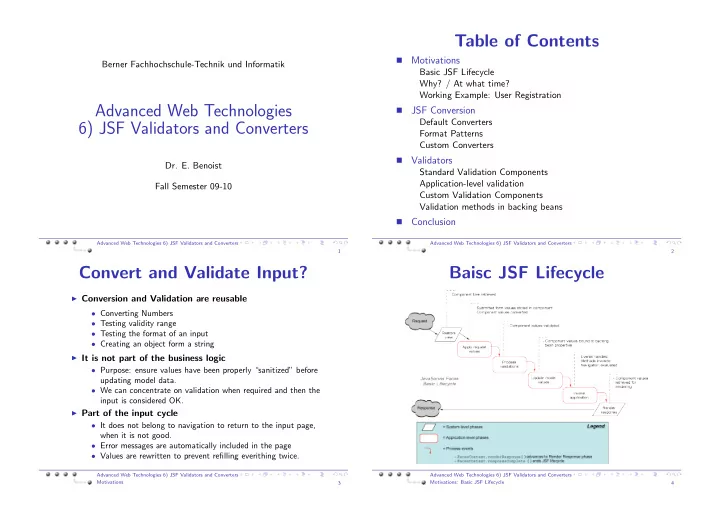
Table of Contents

  • Motivations

Basic JSF Lifecycle Why? / At what time? Working Example: User Registration

  • JSF Conversion

Default Converters Format Patterns Custom Converters

  • Validators

Standard Validation Components Application-level validation Custom Validation Components Validation methods in backing beans

  • Conclusion

Advanced Web Technologies 6) JSF Validators and Converters 2

Convert and Validate Input?

◮ Conversion and Validation are reusable

  • Converting Numbers
  • Testing validity range
  • Testing the format of an input
  • Creating an object form a string

◮ It is not part of the business logic

  • Purpose: ensure values have been properly “sanitized” before

updating model data.

  • We can concentrate on validation when required and then the

input is considered OK.

◮ Part of the input cycle

  • It does not belong to navigation to return to the input page,

when it is not good.

  • Error messages are automatically included in the page
  • Values are rewritten to prevent refilling everithing twice.

Advanced Web Technologies 6) JSF Validators and Converters Motivations 3

Baisc JSF Lifecycle

Advanced Web Technologies 6) JSF Validators and Converters Motivations: Basic JSF Lifecycle 4

slide-2
SLIDE 2

Conversion? Validations?

◮ Conversion is the process of ensuring data is the right

  • bject or type.

◮ Two typical conversions

  • string value is convertible to a java.util.Date
  • string value is convertible to a Float

◮ Validation ensures that data contains the expected

content

◮ Typical conversions

  • java.util.Date is MM/yyyy format
  • Float is between 1.0 and 100.0

Advanced Web Technologies 6) JSF Validators and Converters Motivations: Why? / At what time? 5

Details of the Lifecycle

Advanced Web Technologies 6) JSF Validators and Converters Motivations: Why? / At what time? 6

When the immediate attribute is true

Advanced Web Technologies 6) JSF Validators and Converters Motivations: Why? / At what time? 7

A working example: User Registration

◮ This application will demonstrate

  • Usage of standard JSF converters for converting form field data
  • Usage of standard JSF validation components for validating

form field data

  • How to write custom converters and validator
  • How to register custom converters and validators in the

faces-config.xml file

  • How to customize default error messages

◮ Application utilizes three JSP pages

  • index.jsp redirects the user to UserRegistration.jsp
  • UserRegistration.jsp contains the application’s form fields
  • results.jsp notifies the application that the user was

registered

Advanced Web Technologies 6) JSF Validators and Converters Motivations: Working Example: User Registration 8

slide-3
SLIDE 3

JSF Conversion

◮ JSF supplies many standard data converters. ◮ You can also plug in your own custom converter by implementing the

Converter interface

◮ List of given Converters

javax.faces.BigDecimal javax.faces.convert.BigDecimalConverter javax.faces.BigInteger javax.faces.convert.BigIntegerConverter javax.faces.Boolean javax.faces.convert.BooleanConverter javax.faces.Byte javax.faces.convert.ByteConverter javax.faces.Character javax.faces.convert.CharacterConverter javax.faces.DateTime javax.faces.convert.DateTimeConverter javax.faces.Double javax.faces.convert.DoubleConverter javax.faces.Float javax.faces.convert.FloatConverter

Advanced Web Technologies 6) JSF Validators and Converters JSF Conversion: Default Converters 9

Demonstration of the Default Converters

◮ JSF tag

<!−− UserRegistration.jsp −−> <h:inputText id=”age” value=”#{UserRegistration.user.age}”/>

◮ UserRegistration.user.age represents a value-binding

property of type int.

  • JSF uses standard converter
  • It is also used for BigInteger and BigDecimal

◮ You can also increase granularity using a given converter

<!−− UserRegistration.jsp −−> <h:inputText id=”age” value=”#{UserRegistration.user.age}”> <f:converter id=”javax.faces.Short”/> </h:inputText>

Advanced Web Technologies 6) JSF Validators and Converters JSF Conversion: Default Converters 10

Error authomatically generated

Advanced Web Technologies 6) JSF Validators and Converters JSF Conversion: Default Converters 11

Error, value is too large

Advanced Web Technologies 6) JSF Validators and Converters JSF Conversion: Default Converters 12

slide-4
SLIDE 4

Choosing a Date Format Pattern

◮ For dates, you must specify the conversion tag

<f:convertDateTime/>

◮ Example:

<!−− UserRegistration.jsp −−> <h:inputText id=”birthDate” value=”#{UserRegistration.user.birthDate}”> <f:convertDateTime pattern=”MM/yyyy”/> </h:inputText>

Advanced Web Technologies 6) JSF Validators and Converters JSF Conversion: Format Patterns 13

Additional Patterns

◮ JSF provides a special converter for dealing with

numbers such as percentages or currency

  • It deals with grouping (such as commas), number of decimal

digits, currency symbols, and such.

◮ Example

<!−− UserRegistration.jsp −−> <h:inputText id=”salary” value=”#{UserRegistration.user.salary}”> <f:convertNumber maxFractionDigits=”2” groupingUsed=”true” currencySymbol=”$” maxIntegerDigits=”7” type=”currency”/> </h:inputText>

Advanced Web Technologies 6) JSF Validators and Converters JSF Conversion: Format Patterns 14

Incorrectly formated currency data

Advanced Web Technologies 6) JSF Validators and Converters JSF Conversion: Format Patterns 15

Custom Converters

◮ Necessary to convert field data into an

application-specific value object

  • String to PhoneNumber object (PhoneNumber.areaCode,

PhoneNumber.prefix)

  • String to Name object (Name.first, Name.last)

◮ You must follow the following steps

  • 1. Implement the Converter interface (a.k.a.

javax.faxes.convert.Converter).

  • 2. Implement the getAsObject method, which converts a field

(string) into an object (for example, PhoneNumber).

  • 3. Implement the getAsString method, which converts an
  • bject (for example, PhoneNumber) into a string.
  • 4. Register your custom converter in the Faces context.
  • 5. Insert the converter into your JSPs with the <f:converter/>

tag.

Advanced Web Technologies 6) JSF Validators and Converters JSF Conversion: Custom Converters 16

slide-5
SLIDE 5

Custom Methods in JSF Lifecycle

Advanced Web Technologies 6) JSF Validators and Converters JSF Conversion: Custom Converters 17

Creating a custom converter

◮ Step 1: Implement the Converter interface

import javax.faces.convert.Converter; import org.apache.commons.lang.StringUtils; ... public class PhoneConverter implements Converter { ... }

Advanced Web Technologies 6) JSF Validators and Converters JSF Conversion: Custom Converters 18

Step 2: getAsObject method

public class PhoneConverter implements Converter { ... public Object getAsObject(FacesContext context, UIComponent component, String value) { if (StringUtils.isEmpty(value)){ return null;} PhoneNumber phone = new PhoneNumber(); String [] phoneComps = StringUtils.split(value,” ,()−”); String countryCode = phoneComps[0]; phone.setCountryCode(countryCode); if (”1”.equals(countryCode)){ String areaCode = phoneComps[1]; String prefix = phoneComps[2]; String number = phoneComps[3]; phone.setAreaCode(areaCode); phone.setPrefix(prefix); phone.setNumber(number); }else{ phone.setNumber(value);} return phone; }}

Advanced Web Technologies 6) JSF Validators and Converters JSF Conversion: Custom Converters 19

Custom Converter (Cont.)

◮ Step 3: Implement the getAsString method

public class PhoneConverter implements Converter { ... public String getAsString(FacesContext context, UIComponent component, Object value) { return value.toString(); } } public class PhoneNumber implements Serializable { ... public String toString(){ if (countryCode.equals(”1”)){ return countryCode + ” ” + areaCode + ” ” + prefix + ” ” + number; }else{ return number; } } }

Advanced Web Technologies 6) JSF Validators and Converters JSF Conversion: Custom Converters 20

slide-6
SLIDE 6

Custom Converter (Cont.)

◮ Step 4: Register custom converter with faces context

Step 4 can be executed in one of two ways.

◮ Register the PhoneConverter class with an id

<converter> <converter−id>arcmind.PhoneConverter</converter−id> <converter−class>com.arcmind.converters.PhoneConverter</converter−class> </converter>

◮ register the PhoneConverter class to handle all PhoneNumber objects

automatically, <converter> <converter−for−class>com.arcmind.value.PhoneNumber</converter−for−class> <converter−class>com.arcmind.converters.PhoneConverter</converter−class> </converter>

Advanced Web Technologies 6) JSF Validators and Converters JSF Conversion: Custom Converters 21

Custom Converter (Cont.)

◮ Step 5: Use the converter tag in your JSPs? ◮ If converter registered with id arcmind.PhoneConverter

<h:inputText id=”phone” value=”#{UserRegistration.user.phone}”> <f:converter converterId=”arcmind.PhoneConverter” /> </h:inputText>

◮ If you chose to register the PhoneConverter class to handle all

PhoneNumber objects automatically then you won’t need to use the <f:converter/> tag in your JSPs. <h:inputText id=”phone” value=”#{UserRegistration.user.phone}”> [Look, no converter!] </h:inputText>

Advanced Web Technologies 6) JSF Validators and Converters JSF Conversion: Custom Converters 22

Conversions

Advanced Web Technologies 6) JSF Validators and Converters JSF Conversion: Custom Converters 23

JSF Validation

◮ Esures that input fullfil some requirements

  • java.util.Date is MM/yyyy format
  • Float is between 1.0 and 100.0

◮ There are four forms of validation within JSF:

  • Built-in validation components
  • Application-level validation
  • Custom validation components (which implement the

Validator interface)

  • Validation methods in backing beans (inline)

Advanced Web Technologies 6) JSF Validators and Converters Validators 24

slide-7
SLIDE 7

The JSF validation lifecycle and components

Advanced Web Technologies 6) JSF Validators and Converters Validators 25

Standard Validation Components

◮ DoubleRangeValidator: Component’s local value must

be numeric type; must be in range specified by minimum and/or maximum values.

◮ LongRangeValidator: Component’s local value must be

numeric type and convertible to long; must be in range specified by minimum and/or maximum values.

◮ LengthValidator: Type must be string; length must be

in range specified by minimum and/or maximum values.

Advanced Web Technologies 6) JSF Validators and Converters Validators: Standard Validation Components 26

Standard validation

◮ Age has to be between 0 and 150

<h:inputText id=”age” value=”#{UserRegistration.user.age}”> <f:validateLongRange maximum=”150” minimum=”0”/> </h:inputText>

◮ Length restrictions on the first-name field.

<h:inputText id=”firstName” value=”#{UserRegistration.user.firstName}”> <f:validateLength minimum=”2” maximum=”25” /> </h:inputText>

Advanced Web Technologies 6) JSF Validators and Converters Validators: Standard Validation Components 27

Standard Validation Error Messages

Advanced Web Technologies 6) JSF Validators and Converters Validators: Standard Validation Components 28

slide-8
SLIDE 8

Application-level Validation

◮ In concept, application-level validation is really business

logic validation.

  • JSF separates form- and/or field-level validation from

business-logic validation.

  • application-level validation entails adding additional code to

the backing bean methods that use the model to qualify the data already bound to your model.

  • In the case of a shopping cart, form-level validation may

validate whether a quantity entered is valid, but you would need business-logic validation to check whether the user had exceeded his or her credit limit.

Advanced Web Technologies 6) JSF Validators and Converters Validators: Application-level validation 29

Application-level Validation (Cont.)

◮ Example

  • The user clicks Register button which executes the

register() method.

  • We could add validation code to the register() method to

determine whether the first-name field is blank or null.

  • In cases where the field was null, we could also add a message

to the FacesContext directing the associated component to return navigation to the current page.

  • (This example is not a good example of business logic

validation)

Advanced Web Technologies 6) JSF Validators and Converters Validators: Application-level validation 30

Application-level validation

Advanced Web Technologies 6) JSF Validators and Converters Validators: Application-level validation 31

Validation Message

Advanced Web Technologies 6) JSF Validators and Converters Validators: Application-level validation 32

slide-9
SLIDE 9

Pros and cons of application-level validation

◮ The advantages of application-level validation are as

follows:

  • Easy to implement
  • No need for a separate class (custom validator)
  • No need for page author to specify validator

◮ The disadvantages of application-level validation are as

follows:

  • Occurs after other forms of validation (standard, custom)
  • Validation logic limited to backing bean method, resulting in

limited re-use

  • Can be difficult to manage in large applications and/or team

environment

◮ Ultimately, application-level validation should be used

  • nly for circumstances requiring business-logic validation.

Advanced Web Technologies 6) JSF Validators and Converters Validators: Application-level validation 33

Custom Validation Components

◮ The steps to create a custom validator are as follows;

we’ll go over them one by one:

  • Create a class that implements the Validator interface

(javax.faces.validator.Validator).

  • Implement the validate method.
  • Register your custom validator in the faces-config.xml file.
  • Use the <f:validator/> tag in your JSPs.

Advanced Web Technologies 6) JSF Validators and Converters Validators: Custom Validation Components 34

Custom Validation (Cont.)

◮ Step 1: Implement the Validator interface

import javax.faces.validator.Validator; import javax.faces.validator.ValidatorException; ... public class ZipCodeValidator implements Validator{ private boolean plus4Required; private boolean plus4Optional; /∗∗ Accepts zip codes like 85710 ∗/ private static final String ZIP REGEX = ”[0−9]{5}”; /∗∗ Accepts zip code plus 4 extensions like ”−1119” or ” 1119” ∗/ private static final String PLUS4 REQ REGEX = ”[ |−]{1}[0−9]{4}”; /∗∗ Optionally accepts a plus 4 ∗/ private static final String PLUS4 OPT REGEX = ”([ |−]{1}[0−9]{4})?”; ... }

Advanced Web Technologies 6) JSF Validators and Converters Validators: Custom Validation Components 35

Custom Validation (Cont.)

◮ Step 2: Implement the validate method

public void validate(FacesContext context, UIComponent component, Object value) throws ValidatorException { Pattern mask = null; initProps(component); if (plus4Required){ mask = Pattern.compile(ZIP REGEX + PLUS4 REQ REGEX); } else if (plus4Optional){ mask = Pattern.compile(ZIP REGEX + PLUS4 OPT REGEX); } else if (plus4Required && plus4Optional){ throw new IllegalStateException(”Plus 4 Error ...”); } else { mask = Pattern.compile(ZIP REGEX); }

Advanced Web Technologies 6) JSF Validators and Converters Validators: Custom Validation Components 36

slide-10
SLIDE 10

Custom Validation (Cont.)

String zipField = (String)value; Matcher matcher = mask.matcher(zipField); if (!matcher.matches()){ FacesMessage message = new FacesMessage(); message.setDetail(”Zip code not valid”); message.setSummary(”Zip code not valid”); message.setSeverity(FacesMessage.SEVERITY ERROR); throw new ValidatorException(message); } }

Advanced Web Technologies 6) JSF Validators and Converters Validators: Custom Validation Components 37

Custom Validation (Cont.)

◮ Step 3: Register your custom validator with the

FacesContext <validator> <validator−id>arcmind.zipCodeValidator</validator−id> <validator−class> com.arcmind.jsfquickstart.validation.ZipCodeValidator </validator−class> </validator>

Advanced Web Technologies 6) JSF Validators and Converters Validators: Custom Validation Components 38

Custom Validation (Cont.)

◮ Step 4: Use the <f:validator/> tag in your JSPs

<h:inputText id=”zipCode” value=”#{UserRegistration.user.zipCode}”> <f:validator validatorId=”armind.zipCodeValidator”/> <f:attribute name=”plus4Optional” value=”true”/> </h:inputText> To read the plus4Optional attribute for the zipCode inputText component, do the following: private void initProps(UIComponent component) { Boolean optional = Boolean.valueOf((String) component.getAttributes(). get(”plus4Optional”)); Boolean required = Boolean.valueOf((String) component.getAttributes(). get(”plus4Required”)); plus4Optional = optional==null ? plus4Optional :

  • ptional.booleanValue();

plus4Required = required==null ? plus4Optional : required.booleanValue(); }

Advanced Web Technologies 6) JSF Validators and Converters Validators: Custom Validation Components 39

Validation methods in backing beans

◮ you can simply implement custom validation in a backing bean

method, [SomeBackingBean.java] public void validateEmail(FacesContext context, UIComponent toValidate, Object value) { String email = (String) value; if (email.indexOf(’@’) == −1) { ((UIInput)toValidate).setValid(false); FacesMessage message = new FacesMessage(”Invalid Email”); context.addMessage(toValidate.getClientId(context), message); } }

Advanced Web Technologies 6) JSF Validators and Converters Validators: Validation methods in backing beans 40

slide-11
SLIDE 11

Validation methods (Cont.)

◮ The method would then be used in the JSF tag via the

validator attribute as shown here: <h:inputText id=”email” value=”#{UserRegistration.user.email}” validator=”#{UserRegistration.validateEmail}” required=”true”> </h:inputText>

Advanced Web Technologies 6) JSF Validators and Converters Validators: Validation methods in backing beans 41

Default validation

◮ Notice the required attribute of the email tag of the

previous slide

  • Utilizing the required attribute is a form of default validation.
  • If the attribute is true then the corresponding component must

have a value.

Advanced Web Technologies 6) JSF Validators and Converters Validators: Validation methods in backing beans 42

Custom messages

◮ it’s possible to change the default messages supplied by

JSF by creating your own message resource bundle.

◮ Contained in the jsf-impl.jar (or similar) is a

message.properties file that contains the default messages shown

Advanced Web Technologies 6) JSF Validators and Converters Validators: Validation methods in backing beans 43

Switching out the message resource bundles

Advanced Web Technologies 6) JSF Validators and Converters Validators: Validation methods in backing beans 44

slide-12
SLIDE 12

Conclusion

◮ conversion and validation don’t necessarily work well

together.

  • Conversion converts strings into objects, whereas most of the

standard validators work on strings.

  • Therefore, you must execute caution when using custom

convertors and validators together.

  • For instance, our PhoneNumber object would not work with a

length validator.

  • In this case, you would either have to write a custom validator,

as well,

  • or simply include any special validation logic in the custom

converter.

  • We prefere the later option because it allows us to simply

associate a custom converter (with built-in validation logic) with a specific object type and have JSF handle that object type.

Advanced Web Technologies 6) JSF Validators and Converters Conclusion 45

References

◮ http://www-128.ibm.com/developerworks/java/

library/j-jsf3/

Advanced Web Technologies 6) JSF Validators and Converters Conclusion 46