Table A2 Field Descriptions for the Laboratory Instrument Table - - PDF document

table a2 field descriptions for the laboratory instrument
SMART_READER_LITE
LIVE PREVIEW

Table A2 Field Descriptions for the Laboratory Instrument Table - - PDF document

Table A2 Field Descriptions for the Laboratory Instrument Table (Table A2) Contains related to laboratory instrument calibration on an analyte level and GC/MS Tune information. This table is optional depending on project requirements. Do not


slide-1
SLIDE 1

Page 6 of 21

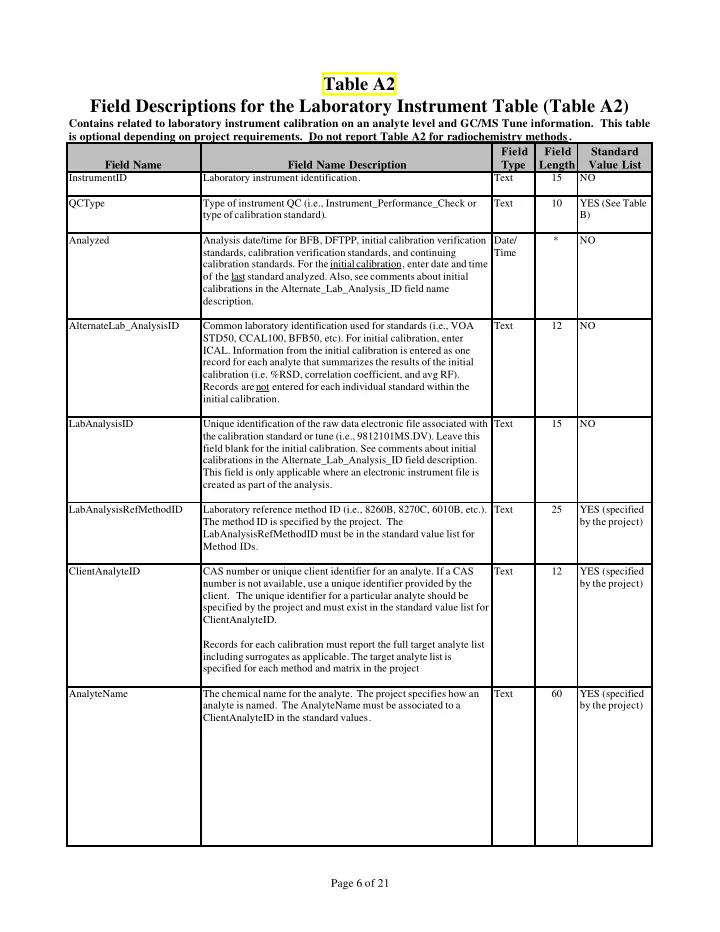
Table A2 Field Descriptions for the Laboratory Instrument Table (Table A2)

Contains related to laboratory instrument calibration on an analyte level and GC/MS Tune information. This table is optional depending on project requirements. Do not report Table A2 for radiochemistry methods . Field Name Field Name Description Field Type Field Length Standard Value List

InstrumentID Laboratory instrument identification. Text 15 NO QCType Type of instrument QC (i.e., Instrument_Performance_Check or type of calibration standard). Text 10 YES (See Table B) Analyzed Analysis date/time for BFB, DFTPP, initial calibration verification standards, calibration verification standards, and continuing calibration standards. For the initial calibration, enter date and time

  • f the last standard analyzed. Also, see comments about initial

calibrations in the Alternate_Lab_Analysis_ID field name description. Date/ Time * NO AlternateLab_AnalysisID Common laboratory identification used for standards (i.e., VOA STD50, CCAL100, BFB50, etc). For initial calibration, enter

  • ICAL. Information from the initial calibration is entered as one

record for each analyte that summarizes the results of the initial calibration (i.e. %RSD, correlation coefficient, and avg RF). Records are not entered for each individual standard within the initial calibration. Text 12 NO LabAnalysisID Unique identification of the raw data electronic file associated with the calibration standard or tune (i.e., 9812101MS.DV). Leave this field blank for the initial calibration. See comments about initial calibrations in the Alternate_Lab_Analysis_ID field description. This field is only applicable where an electronic instrument file is created as part of the analysis. Text 15 NO LabAnalysisRefMethodID Laboratory reference method ID (i.e., 8260B, 8270C, 6010B, etc.). The method ID is specified by the project. The LabAnalysisRefMethodID must be in the standard value list for Method IDs. Text 25 YES (specified by the project) ClientAnalyteID CAS number or unique client identifier for an analyte. If a CAS number is not available, use a unique identifier provided by the

  • client. The unique identifier for a particular analyte should be

specified by the project and must exist in the standard value list for ClientAnalyteID. Records for each calibration must report the full target analyte list including surrogates as applicable. The target analyte list is specified for each method and matrix in the project Text 12 YES (specified by the project) AnalyteName The chemical name for the analyte. The project specifies how an analyte is named. The AnalyteName must be associated to a ClientAnalyteID in the standard values. Text 60 YES (specified by the project)

slide-2
SLIDE 2

Page 7 of 21

Table A2 Field Descriptions for the Laboratory Instrument Table (Table A2)

Contains related to laboratory instrument calibration on an analyte level and GC/MS Tune information. This table is optional depending on project requirements. Do not report Table A2 for radiochemistry methods . Field Name Field Name Description Field Type Field Length Standard Value List

RunBatch Unique identifier for a batch of analyses performed on one instrument under the control of one initial calibration and initial calibration verification. The Run Batch ID links both the initial calibration and initial calibration verification to subsequently analyzed and associated continuing calibrations, field samples, and QC analyses. For GC/MS methods, the Run_Batch ID also links a BFB or DFTPP tune and the initial calibration and initial calibration verification standards to associated samples and method QC analyses. A new and unique Run Batch ID must be used with every new initial calibration. Text 12 NO AnalysisBatch Unique laboratory identifier for a batch of analyses performed on

  • ne instrument and under the control of a continuing calibration or

continuing calibration verification. The Analysis Batch ID links the continuing calibration or calibration verification to subsequently analyzed and associated field sample and QC

  • analyses. For GC/MS methods, the Analysis Batch ID also links

the BFB or DFTPP tune. A new and unique Analysis Batch ID must be used with every new continuing calibration or continuing calibration verification. For GC methods, only report opening standards, do not include closing standards (unless the closing standard functions as the

  • pening standard for a subsequent set of analyses, in which case a

new and unique Analysis Batch ID is assigned). When dual or confirmation columns/detectors are used, enter results from the primary column/detector only (this is similar to CLP Pesticide reporting). Text 12 NO LabReportingBatch Unique laboratory identifier for a batch of samples including associated calibrations and method QC, reported as a group by the lab (i.e., lab work order #, log-in #, or SDG). Links all instrument calibrations, samples, and method QC reported as a group or SDG. Text 12 NO PercentRelativeStandard Deviation The standard deviation as a percentage of the mean used to evaluate initial calibration linearity. Organic methods may use either %RSD or Correlation Coefficient. If applicable, enter the %RSD. Leave this field blank if the Correlation Coefficient is used. Numeric 5 NO CorrelationCoefficient The correlation coefficient resulting from linear regression of the initial calibration. For metals by ICAP, enter '1.0' if a two-point initial calibration was analyzed. Organic methods may use either %RSD or Correlation Coefficient. If applicable, enter the Correlation Coefficient. Leave this field blank if the %RSD is used Numeric 5 NO RelativeResponseFactor This field applies to GC/MS only. For continuing calibration enter the relative response factor. For initial calibration enter the average relative response factor. Refer to comments about initial calibration records in the field description for Alternate_Lab_Analysis_ID. Numeric 5 NO

slide-3
SLIDE 3

Page 8 of 21

Table A2 Field Descriptions for the Laboratory Instrument Table (Table A2)

Contains related to laboratory instrument calibration on an analyte level and GC/MS Tune information. This table is optional depending on project requirements. Do not report Table A2 for radiochemistry methods . Field Name Field Name Description Field Type Field Length Standard Value List

Percent_Difference (or Percent Recovery) For organic methods, this field is the difference between 2 measured values expressed as a percentage. If %RSD is reported, enter the % difference between the average response factor of the initial calibration (IC) and the response factor

  • f the initial calibration verification (ICV) or continuing calibration

(CCV). If correlation coefficient is used, enter the % difference between the true value and the measured value. The Percent_Difference is expressed as a negative or positive

  • value. Do not express Percent_Difference as an absolute value.

Use a negative value if the CCV or ICV response factor is less than the IC average response factor or, in the case of correlation coefficient, the CCV or ICV measured value is less than the true

  • value. Use a positive value if the CCV or ICV response factor is

greater than the IC average response factor, or in the case of correlation coefficient, the CCV or ICV measured value is greater than the true value. For inorganic methods, this field is the recovery of an analyte expressed as a percentage of the true amount (i.e., %R for a metal in the continuing calibration or initial calibration verification by Method 6010B). Numeric 5 NO PeakID01 Identifies individual m/z ions for GC/MS tuning compounds. For BFB enter 50, for DFTPP enter 51. Numeric 10 NO PercentRatio01 For BFB enter the ion abundance of m/z 50 as a percentage of m/z 95, for DFTPP enter the ion abundance of m/z 51 as a percentage

  • f m/z 198.

Numeric 10 NO PeakID02 Identifies individual m/z ions for GC/MS tuning compounds. For BFB enter 75, for DFTPP enter 68. Numeric 10 NO PercentRatio02 For BFB enter the ion abundance of m/z 75 as a percentage of m/z 95, for DFTPP enter the ion abundance of m/z 68 as a percentage

  • f m/z 69.

Numeric 10 NO PeakID03 Identifies individual m/z ions for GC/MS tuning compounds. For BFB enter 95, for DFTPP enter 69. Numeric 10 NO PercentRatio03 For BFB enter the ion abundance of m/z 95 as 100 percent, for DFTPP enter the ion abundance of m/z 69. Numeric 10 NO PeakID04 Identifies individual m/z ions for GC/MS tuning compounds. For BFB enter 96, for DFTPP enter 70. Numeric 10 NO PercentRatio04 For BFB enter the ion abundance of m/z 96 as a percentage of m/z 95, for DFTPP enter the ion abundance of m/z 70 as a percentage

  • f m/z 69

Numeric 10 NO PeakID05 Identifies individual m/z ions for GC/MS tuning compounds. For BFB enter 173, for DFTPP enter 127. Numeric 10 NO

slide-4
SLIDE 4

Page 9 of 21

Table A2 Field Descriptions for the Laboratory Instrument Table (Table A2)

Contains related to laboratory instrument calibration on an analyte level and GC/MS Tune information. This table is optional depending on project requirements. Do not report Table A2 for radiochemistry methods . Field Name Field Name Description Field Type Field Length Standard Value List

PercentRatio05 For BFB enter the ion abundance of m/z 173 as a percentage of m/z 174, for DFTPP enter the ion abundance of m/z 127 as a percentage

  • f m/z 198

Numeric 10 NO PeakID06 Identifies individual m/z ions for GC/MS tuning compounds. For BFB enter 174, for DFTPP enter 197. Numeric 10 NO PercentRatio06 For BFB enter the ion abundance of m/z 174 as a percentage of m/z 95, for DFTPP enter the ion abundance of m/z 197 as a percentage

  • f m/z 198.

Numeric 10 NO PeakID07 Identifies individual m/z ions for GC/MS tuning compounds. For BFB enter 175, for DFTPP enter 198. Numeric 10 NO PercentRatio07 For BFB enter the ion abundance of m/z 175 as a percentage of m/z 174, for DFTPP enter the ion abundance of m/z 198 as 100 percent. Numeric 10 NO PeakID08 Identifies individual m/z ions for GC/MS tuning compounds. For BFB enter 176, for DFTPP enter 199. Numeric 10 NO PercentRatio08 For BFB enter the ion abundance of m/z 176 as a percentage of m/z 174, for DFTPP enter the ion abundance of m/z 199 as a percentage

  • f m/z 198.

Numeric 10 NO PeakID09 Identifies individual m/z ions for GC/MS tuning compounds. For BFB enter 177, for DFTPP enter 275. Numeric 10 NO PercentRatio09 For BFB enter the ion abundance of m/z 177 as a percentage of m/z 176, for DFTPP enter the ion abundance of m/z 275 as a percentage

  • f m/z 198.

Numeric 10 NO PeakID10 Identifies individual m/z ions for GC/MS tuning compounds. For BFB leave blank, for DFTPP enter 365. Numeric 10 NO PercentRatio10 For BFB leave blank, for DFTPP enter the ion abundance of m/z 365 as a percentage of m/z 198. Numeric 10 NO PeakID11 Identifies individual m/z ions for GC/MS tuning compounds. For BFB leave blank, for DFTPP enter 441. Numeric 10 NO PercentRatio11 For BFB leave blank, for DFTPP the ion abundance of m/z 441. Numeric 10 NO PeakID12 Identifies individual m/z ions for GC/MS tuning compounds. For BFB leave blank, for DFTPP enter 442. Numeric 10 NO PercentRatio12 For BFB leave blank, for DFTPP enter the ion abundance of m/z 442 as a percentage of m/z 198. Numeric 10 NO PeakID13 Identifies individual m/z ions for GC/MS tuning compounds. For BFB leave blank, for DFTPP enter 443. Numeric 10 NO PercentRatio13 For BFB leave blank, for DFTPP enter the ion abundance of m/z 443 as a percentage of m/z 442. Numeric 10 NO

slide-5
SLIDE 5

Page 10 of 21

Table A2 Field Descriptions for the Laboratory Instrument Table (Table A2)

Contains related to laboratory instrument calibration on an analyte level and GC/MS Tune information. This table is optional depending on project requirements. Do not report Table A2 for radiochemistry methods . Field Name Field Name Description Field Type Field Length Standard Value List

* Date/time format is: MM/DD/YYYY hh:mm where MM = month, DD = day, YYYY = four digits of the year, hh = hour in 24 hour format, and mm = minutes.