Soft Matter Interfaces (SMI) Beamline (12-ID) Instrument Readiness - - PowerPoint PPT Presentation

soft matter interfaces smi beamline 12 id instrument
SMART_READER_LITE
LIVE PREVIEW

Soft Matter Interfaces (SMI) Beamline (12-ID) Instrument Readiness - - PowerPoint PPT Presentation

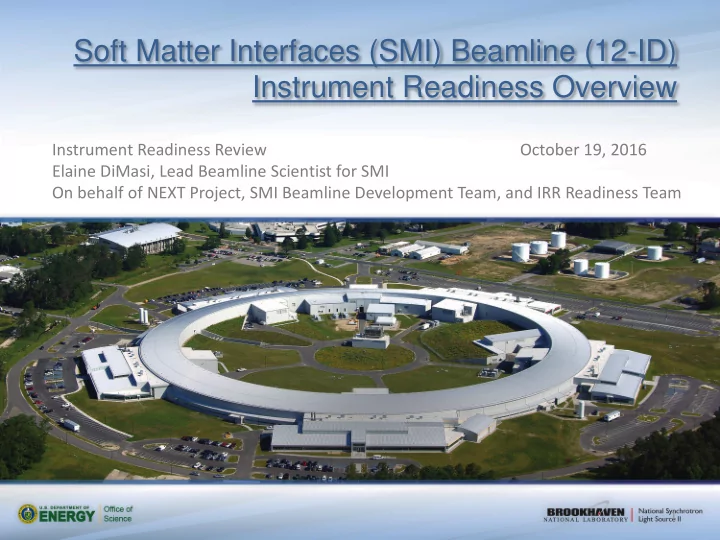
Soft Matter Interfaces (SMI) Beamline (12-ID) Instrument Readiness Overview Instrument Readiness Review October 19, 2016 Elaine DiMasi, Lead Beamline Scientist for SMI On behalf of NEXT Project, SMI Beamline Development Team, and IRR Readiness


slide-1
SLIDE 1

1

Soft Matter Interfaces (SMI) Beamline (12-ID) Instrument Readiness Overview

Instrument Readiness Review October 19, 2016 Elaine DiMasi, Lead Beamline Scientist for SMI On behalf of NEXT Project, SMI Beamline Development Team, and IRR Readiness Team

1

slide-2
SLIDE 2

2

Outline

  • Background
  • Scientific Program, SMI Scope, Beamline Layout, Commissioning Sequence
  • Pillar I: Documentation:
  • Ray tracing, FLUKA Calculation, RSC Review, Design Reviews, Hazard

Identification and Mitigation

  • Pillar II: Hardware

–Radiation Safety Components, Other Credited Controls, Utilities, EPS, Controls, Diagnostics

  • Pillar III: Personnel

–Beamline Commissioning Team

slide-3
SLIDE 3

3

NEXT Project and SMI Beamline Timeline

  • The NEXT Project (NSLS-II Experimental Tools)

–Scope: 5 beamlines (and 1 beamline design) –DOE funded project –Timeline:

  • CD-0 start date:

May 2010

  • Early completion date: January 2017
  • CD-4 date:

September 2017

  • SMI Beamline:

–Scope: Photon Delivery System, infrastructure, and sample and detector positioning –SMI beamline construction combines procurements with in-house mechanical design and fabrication

slide-4
SLIDE 4

4

Scientific Programs and Design Goals

SMI Beamline

Focus areas:

  • Hierarchical structures:

SAXS/WAXS

  • Functional soft matter

surfaces and interfaces: Grazing Incidence

  • Time-resolved studies:

reactions, hydration

  • Pioneering access to

P, S, K, Ca resonance: 1.2–24 keV energy range

Parameter Specification/Description

Insertion device: IVU23, 2.8-m, canted, high-β straight Operating energy range: 2.1 – 24 keV Monochromator: Fixed-exit Si(111) Beam size at sample (FWHM): Tunable down to 30 (H) x 2.5 (V) µm2; Low divergence mode < 300 µrad Flux at sample (500 mA ring current): ~1013 photons/s Detector readout rate: 500 Hz Pilatus 300K-W and Pilatus 1M Micro-focus optics: CRL Transfocator ~1.5m from sample Endstation configurations: 12-ID-C: Grazing-Incidence Small/Wide Angle X-ray Scattering (GI-SAXS/WAXS) with Micro-Focus and Low-Divergence Modes 12-ID-B: Diagnostics and Future Outboard Branch (PLS)

slide-5
SLIDE 5

5

IRR Scope

IRR scope includes:

  • 1. Photon Delivery System (GV2 through 12-ID-C)
  • 2. Enclosures: 12-ID-A, -B, -B-1, and -C
  • 3. Motion and monitoring system of PDS
  • 4. EPS (related to PDS), PPS, all infrastructure necessary for

commissioning Photon Delivery System

  • 5. WAXS Assembly: Sample and Detector Positioners

IRR scope exclusions:

  • 1. SAXS Assembly in 12-ID-C
  • 2. Pilatus Detectors
  • 3. X-ray Beam Position Monitors
  • 4. Beam conditioning (attenuators)

SMI WAXS assembly

slide-6
SLIDE 6

6

Self-identified Pre-start Findings

Pre-start findings:

None

Post-start findings:

None

slide-7
SLIDE 7

7

GISAXS/WAXS Experiment: 12-ID-C Diagnostics: 12-ID-B

  • IVU23 in downstream

section of long straight,

  • Asymmetric canting
  • Optimized for 2.1-24 keV

IVU23: IRR completed Feb 2016. Minimum gap: 6.1 mm

Optical Layout

beam

IVU23 source future

slide-8
SLIDE 8

8

Beamline Layout

  • First Optics Enclosure:

12-ID-A (lead lined hutch)

  • Steel Hutches:

12-ID-C: GI-SAXS/WAXS 12-ID-B: Diagnostics

slide-9
SLIDE 9

9

Commissioning Sequence

First light,

  • Nov. 7,

2016

  • Nov. 2016 –

February 2017 March – May 2017 June – August 2017 September – December 2017 Installations XBPMs, SAXS Assembly, Attenuators, Detectors (Dec.) CFN Partner CCD Detector (MAXS) Capabilities ~10 keV x-ray beam into 12-ID-C Hard x-rays, 6.5-24 keV NEXT KPP (by 31 Jan 2017) Time resolved GISAXS/WAXS Science Commissioning Multi-detector experiments; Microbeam experiments Full energy range available 2.1-24 keV Goal: GU Technical Commissioning Photon delivery system Time resolved GISAXS: Sample pos’n, Pilatus detector data acquisition Medium-angle x-ray scattering (MAXS); Micro-focus CRLs Tender x-ray energy range, 2.1-4.5 keV Liquid interfaces *pending successful completion of preceding activities

slide-10
SLIDE 10

10

Pillar I: Documentation

slide-11
SLIDE 11

11

Ray Tracing

PD-SMI-RAYT-0001

  • Prepared using Synchrotron and Bremsstrahlung Ray Trace Procedure

(PS-C-XFD-PRC-008)

  • Includes absolute positioning (±0.22 mm) and manufacturing (±0.14 mm)

tolerances; as-surveyed component locations are used.

slide-12
SLIDE 12

12

Shielding Concept: Dual Aperture Masks

  • SMI constructed with dual

aperture masks and wide stops for drop-in outboard upgrade

  • PPS aperture and Fixed

Aperture Mask ensure that wide SR fan ends at White Beam Stop

  • Outboard branch constrained

to similar optics (100µrad FAM, 25mm DCM step-up)

Horizontal, Synchr. Max Fan Ray Trace

slide-13
SLIDE 13

13

Shielding Concept: Primary Bremsstrahlung

  • Primary bremsstrahlung

shielding: tungsten collimator, tungsten stop

  • One instance where extremal

rays are close to tolerance

  • FLUKA calculations show that

this condition (i/b and u/s) is safe (close to ratchet wall)

Bremsstrahlung Ray Traces

slide-14
SLIDE 14

14

Shielding Concept: Secondary Bremsstrahlung (SGB)

Primary GB on WB Slit

dose on contact with downstream wall ≤ 0.4 mrem/hr)

  • Geometric analysis indicated

that SGB shields would be necessary

  • Shield 1: after WB Slits
  • Shield 2: after DCM
  • FLUKA analysis

performed with shields in model

  • GB on movable
  • ptics scatters

significantly

slide-15
SLIDE 15

15

Review held on 11 Oct. 2016

  • Findings:

Doses at FOE d/s wall in range 0.05-0.4 mrem/hr on contact (SGB from movable optics)

  • Response:

Incorporated into Radiation Survey Plan.

15

RSC Review

slide-16
SLIDE 16

16

  • NSLSII-12ID-PRC-001
  • GB Radiation Survey: IVU gap open, FE slits wide
  • Integrity 12-ID-A, GB on fixed components
  • GB on movable components (WB Slits, DCM 1st crystal)
  • Synchrotron radiation survey: IVU gap closed, FE slits wide
  • Integrity 12-ID-A, white beam on fixed components
  • White beam on movable components
  • Monochromatic beam surveys:
  • Configuration with beam in 12-ID-C experiment
  • Configuration with beam in 12-ID-B diagnostic
  • Plan first comprehensive radiation survey (CRS) at 100mA; will

enable SMI to work with ring current ≤ 300mA

16

Radiation Survey Procedure

slide-17
SLIDE 17

17

  • Documents maintained in Vault and Sharepoint

https://ps.bnl.gov/phot/BeamlineSupportDocs/SMI

  • All items closed out
  • Review flow:

17

Design Reviews

DOE Review Process BAT Meetings Formal PDR/FDR Beamline Package FDR Internal Design Reviews

CD-0, CD-1, CD-2, CD-3, and intermittent status reviews 5 BAT meetings

  • CD-2 was FDR for SMI
  • Remaining endstation

design work treated by internal reviews Held at BNL, with Subject Matter Experts attending

  • Radiation safety
  • Thermal mgt / FEA
  • 2 ES Design reviews
  • 2 Optics reviews

Recommendations tracked by project management Recommendations tracked by project management Recommendations tracked by project management Recommendations directly implemented into design (with QA as representative) Tracked by ATS Technical, schedule & financial Technical Technical, Schedule, & Safety Technical & Safety Technical & Safety Review Reports BAT Reports PDR, FDR, & Reports Meeting Notes & Reports Reports

Beamline PDR/FDR Package FDR Package FDR Package FDR Package FDR Package FDR Internal design review Internal design review USI screening Integrated Safety Management
slide-18
SLIDE 18

18 18

Hazard Identification and Mitigation

  • USI evaluation is negative
  • Relevant BNL/NSLS-II safety procedures and practices are

followed during design/construction and commissioning (SBMS & ISM)

Hazard Mitigation

Radiation Shielding, PPS, ARM Fire Future: fire suppression and fire alarm system in 4-ID-D for gas handling system (ESR) Cryogenics ODH system installed in 12-ID-A Hazardous material - Lead Painted and/or covered Pressure safety vessel FEA calculations, over-pressure tests (if appropriate), burst discs Electrical EEI, grounding, installation according to code

slide-19
SLIDE 19

19

Pillar II: Hardware

slide-20
SLIDE 20

20

Shielded Enclosures and Transport Pipes

  • Lead-shielded FOE: 10 mm roof, 18 mm sidewall, 50 mm downstream wall
  • Steel hutches B, C, and D: 3 mm roof, 6 mm side and downstream walls
  • Lead-shielded beam transport pipes, pump enclosures, and flange covers: 5 mm
  • Lead-shielded hutch interfaces: ≥ 10 mm
  • Hutch doors and one or more labyrinths per hutch are PPS-interlocked
  • Removable shielded beampipe in 12-ID-B, constructed like walkway transport

Inboard and outboard beam penetrations in 12-ID-B-1 Removable beam stop block and shielded beam pipe in 12-ID-B

slide-21
SLIDE 21

21

Radiation Safety Components

1. PPS Aperture/ Fixed Aperture Mask 2. GB Collimator 3. (White Beam Slits. Movable, SGB scatterers, not rad safety component) 4. (Pinhole aperture. FUTURE movable device, SGB analysis only, not RSCmpt, not installed) 5. SGB Shield 1 6. (DCM. Movable, SGB scatterer, not rad safety component) 7. SGB Shield 2 8. White Beam Stop 9. GB Stop

  • 10. Photon Shutter
  • 11. Guillotine

Mono beam enclosures:

  • 1. Guillotines
  • 2. Beam Stops
slide-22
SLIDE 22

22 22

Radiation Safety Components

PPS Aperture White Beam & Bremsstrahlung Stops; SGB Shield 2 Fixed Aperture Mask Mask and PPS Aperture

  • Critical components are surveyed into
  • position. All installations complete.
  • Components under configuration control

are labeled and inspected according to NSLS-II procedure PS-C-ESH-PRC-025

  • Checklist for 12-ID is PS-R-XFD-CHK-015
slide-23
SLIDE 23

23 23

Other Credited Safety Components

(c) Oxygen Deficiency Hazard (ODH) Monitor (a) Area Radiation Monitor (ARM) at 12-ID FE sliding door (b) ARM on 12-ID-A near door

slide-24
SLIDE 24

24 24

Utilities

  • Documentation: PD-SMI-UT-1500, Travelers
  • Electric: only ‘dirty’ power
  • Gases: gaseous nitrogen, compressed air (CA),

high-capacity CA for DCM Bragg theta air bearing

  • Cooling Media: DI-water (only FOE), process chilled

water (control racks, 12-ID-B/C and -D), LN2 in FOE (through cryocooler)

LN2 feed for DCM Cryocooler

  • n

mezzanine Utilities along pylons/ roof, roof labyrinths Hi-cap air 12-ID-A utilities 12-ID-A

slide-25
SLIDE 25

25 25

Equipment Protection System

  • Pressures,

temperatures, and flow rates are measured, recorded, and displayed

  • Easy-to-

understand screens allow beamline staff to monitor component status

  • Cryocooler is

fully integrated into the EPS system

Photograph of live monitor at SMI control station

slide-26
SLIDE 26

26 26

Controls

  • Motors and actuation required for first light have been tested
  • EPICS software ready
slide-27
SLIDE 27

27 27

Diagnostics

  • IRR scope:
  • White beam slit photocurrent
  • White beam stop phosphor + camera
  • HFM stripe photocurrent
  • Retractable fluorescent screen after HFM
  • Secondary Source Aperture slit photocurrent
  • Photodiodes + cameras in diagnostic and sample positions
  • November/December installation:
  • XBPM1 after DCM, XBPM2 after VFM, XBPM3 before SSA
slide-28
SLIDE 28

28

Pillar III: Staff

slide-29
SLIDE 29

29

SMI Beamline Staff

Lead Beamline Scientist Elaine DiMasi Authorized Beamline Staff Mikhail Zhernenkov (Assoc. Scientist) Sung-Leung Ivan So (Controls Engineer) Richard Greene (Program Technician) Beamline Supporting Staff Daniel Bacescu (Mechanical Engineer) Scott Coburn (Mechanical Engineer) All staff members have completed the required training (with the exception of training dependent on PPS completion)

slide-30
SLIDE 30

30

Summary

  • The Photon Delivery System + WAXS Ass’y in IRR scope
  • Commissioning will be carried out in five stages:
  • Photon Delivery System
  • Time Resolved GISAXS
  • Multi-detector acquisition + Microfocusing
  • Tender X-ray Energies
  • Liquid Interfaces
  • Beamline is ready for first light
  • Endstation installation is performed in parallel with

commissioning activities