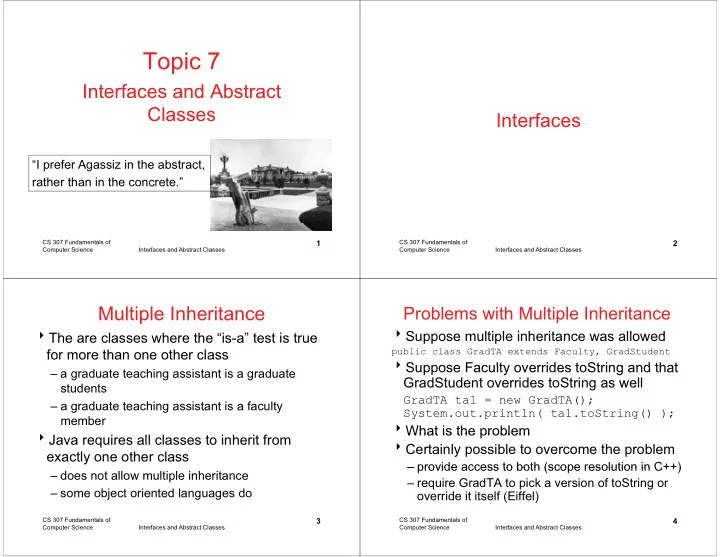
T Topic 7 i 7 Interfaces and Abstract Interfaces and Abstract - - PowerPoint PPT Presentation

t topic 7 i 7
SMART_READER_LITE
LIVE PREVIEW

T Topic 7 i 7 Interfaces and Abstract Interfaces and Abstract - - PowerPoint PPT Presentation

T Topic 7 i 7 Interfaces and Abstract Interfaces and Abstract Classes Interfaces Interfaces I prefer Agassiz in the abstract, rather than in the concrete. CS 307 Fundamentals of CS 307 Fundamentals of 1 2 Computer Science


slide-1
SLIDE 1

T i 7 Topic 7

Interfaces and Abstract Interfaces and Abstract Classes

“I prefer Agassiz in the abstract, rather than in the concrete.”

CS 307 Fundamentals of Computer Science Interfaces and Abstract Classes

1

Interfaces Interfaces

CS 307 Fundamentals of Computer Science Interfaces and Abstract Classes

2

Multiple Inheritance

The are classes where the “is-a” test is true for more than one other class

– a graduate teaching assistant is a graduate students – a graduate teaching assistant is a faculty member

Java requires all classes to inherit from exactly one other class

– does not allow multiple inheritance – some object oriented languages do

CS 307 Fundamentals of Computer Science Interfaces and Abstract Classes

3

Problems with Multiple Inheritance

S lti l i h it ll d Suppose multiple inheritance was allowed

public class GradTA extends Faculty, GradStudent

Suppose Faculty overrides toString and that Suppose Faculty overrides toString and that GradStudent overrides toString as well

GradTA ta1 = new GradTA(); GradTA ta1 = new GradTA(); System.out.println( ta1.toString() );

What is the problem What is the problem Certainly possible to overcome the problem

– provide access to both (scope resolution in C++) – provide access to both (scope resolution in C++) – require GradTA to pick a version of toString or

  • verride it itself (Eiffel)

CS 307 Fundamentals of Computer Science Interfaces and Abstract Classes

4

( )

slide-2
SLIDE 2

Interfaces – Not quite Multiple Inheritance Java does not allow multiple inheritance

– syntax headaches not worth the benefits

Java has a mechanism to allow specification

  • f a data type with NO implementation

yp p

– interfaces

Pure Design Pure Design

– allow a form of multiple inheritance without the possibility of conflicting implementations possibility of conflicting implementations

CS 307 Fundamentals of Computer Science Interfaces and Abstract Classes

5

A List Interface

What if we wanted to specify the operations for a List, but no implementation? Allow for multiple, different implementations. Provides a way of creating abstractions.

  • des a

ay o c eat g abst act o s

– a central idea of computer science and programming. p g g – specify "what" without specifying "how" – "Abstraction is a mechanism and practice to Abstraction is a mechanism and practice to reduce and factor out details so that one can focus on a few concepts at a time. "

CS 307 Fundamentals of Computer Science Interfaces and Abstract Classes

6

Interface Syntax

i i i public interface List{ public void add(Object val); public int size(); public Object get(int location); public void insert(int location, Object val); public void addAll(List other); public Object remove(int location); }

CS 307 Fundamentals of Computer Science Interfaces and Abstract Classes

7

Interfaces

All methods in interfaces are public and abstract

– can leave off those modifiers in method headers

No constructors No instance variables can have class constants can have class constants

public static final int DEFAULT_SIDES = 6

CS 307 Fundamentals of Computer Science Interfaces and Abstract Classes

8

slide-3
SLIDE 3

Implementing Interfaces

A class inherits (extends) exactly one other class, but … A class can implement as many interfaces as it likes

public class ArrayList implements List

A class that implements an interface must A class that implements an interface must provide implementations of all method declared in the interface or the class must be declared in the interface or the class must be abstract interfaces can extend other interfaces

CS 307 Fundamentals of Computer Science Interfaces and Abstract Classes

9

interfaces can extend other interfaces

Why interfaces?

I f ll h i f b t t d t t Interfaces allow the creation of abstract data types

– "A set of data values and associated operations that are precisely specified independent of any particular precisely specified independent of any particular

  • implementation. "

– multiple implementations allowed

Interfaces allow a class to be specified without worrying about the implementation

– do design first – What will this data type do? D ’t b t i l t ti til d i i d – Don’t worry about implementation until design is done. – separation of concerns

allow a form of multiple inheritance

CS 307 Fundamentals of Computer Science Interfaces and Abstract Classes

10

allow a form of multiple inheritance

The Comparable Interface

The Java Standard Library contains a number of interfaces

– names are italicized in the class listing

One of the most important interfaces is the Comparable interface

CS 307 Fundamentals of Computer Science Interfaces and Abstract Classes

11

Comparable Interface version 1.4

package java.lang public interface Comparable { public int compareTo( Object other ); public int compareTo( Object other ); }

compareTo should return an int <0 if the calling

  • bject is less than the parameter, 0 if they are
  • bject is less than the parameter, 0 if they are

equal, and an int >0 if the calling object is greater than the parameter

CS 307 Fundamentals of Computer Science Interfaces and Abstract Classes

12

slide-4
SLIDE 4

Implementing Comparable

Any class that has a natural ordering of its

  • bjects (that is objects of that type can be

sorted based on some internal attribute) should implement the Comparable interface Back to the ClosedShape example Suppose we want to be able to sort Suppose e a

  • be ab e o so

ClosedShapes and it is to be based on area

CS 307 Fundamentals of Computer Science Interfaces and Abstract Classes

13

Example compareTo

Suppose we have a class to model playing cards

– Ace of Spades, King of Hearts, Two of Clubs

each card has a suit and a value, represented by ints this version of compareTo will compare values first and then p break ties with suits

CS 307 Fundamentals of Computer Science Interfaces and Abstract Classes

14

compareTo in a Card class

public class Card implements Comparable { public int compareTo(Object otherObject) { C d th (C d) th Obj t { Card other = (Card)otherObject; int result = this.myRank - other.myRank; if(result == 0) result = this mySuit - other mySuit; result = this.mySuit - other.mySuit; return result } // other methods not shown // ot e et ods

  • t s o

}

Assume ints for ranks (2, 3, 4, 5, 6,...) and suits (0 is clubs, 1 is diamonds, 2 is hearts, 3 is spades).

CS 307 Fundamentals of Computer Science Interfaces and Abstract Classes

15

Interfaces and Polymorphism

Interfaces may be used as the data type for object variables Can’t simply create objects of that type Can refer to any objects that implement the Can refer to any objects that implement the interface or descendants

Ass me C d implements C bl Assume Card implements Comparable

Card c = new Card(); Comparable comp1 = new Card(); Comparable comp2 = c;

CS 307 Fundamentals of Computer Science Interfaces and Abstract Classes

16

slide-5
SLIDE 5

Polymorphism Again! What can this Sort? What can this Sort?

public static void SelSort(Comparable[] list) { Comparable temp; p p int smallest; for(int i = 0; i < list.length - 1; i++) { small = i; { ; for(int j = i + 1; j < list.length; j++) { if( list[j].compareTo(list[small]) < 0) ll j small = j; } // end of j loop temp = list[i]; list[i] = list[small]; list[small] = temp; } // end of i loop

CS 307 Fundamentals of Computer Science Interfaces and Abstract Classes

17

}

Abstract Classes Abstract Classes

Part Class, part Interface

CS 307 Fundamentals of Computer Science Interfaces and Abstract Classes

18

Back to the ClosedShape Example

One behavior we might want in ClosedShapes is a way to get the area problem: How do I get the area of something that is “just a ClosedShape”?

CS 307 Fundamentals of Computer Science Interfaces and Abstract Classes

19

The ClosedShape class

public class ClosedShape { private double myX; private double myY; public double getArea() { //Hmmmm?!?! } // } // Other methods not shown

Doesn’t seem like we have enough information to get the area if all we know is it is a ClosedShape.

CS 307 Fundamentals of Computer Science Interfaces and Abstract Classes

20

slide-6
SLIDE 6

Options

  • 1. Just leave it for the sub classes.

Have each sub class define getArea() if they want to.

  • 2. Define getArea() in ClosedShape and

simply return 0.

Sub classes can override the method with more meaningful behavior.

CS 307 Fundamentals of Computer Science Interfaces and Abstract Classes

21

Leave it to the Sub - Classes

// no getArea() in ClosedShape public void printAreas(ClosedShape[] shapes) { f ( Cl dSh h ) for( ClosedShape s : shapes ) { System.out.println( s.getArea() ); } } ClosedShape[] shapes = new ClosedShape[2]; shapes[0] = new Rectangle(1 2 3 4); shapes[0] = new Rectangle(1, 2, 3, 4); shapes[1] = new Circle(1, 2, 3); printAreas( shapes ); Will the above code compile? How does the compiler determine if a method ll i ll d?

CS 307 Fundamentals of Computer Science Interfaces and Abstract Classes

22

call is allowed?

Fix by Casting

// tA () i Cl dSh // no getArea() in ClosedShape public void printAreas(ClosedShape[] shapes) { for( ClosedShape s : shapes ) { if( s instanceof Rectangle ) System.out.println( ((Rectangle)s).getArea() ); else if( s instanceof Circle ) e se ( s sta ceo C c e ) System.out.println( ((Circle)s).getArea() ); } } ClosedShape[] shapes = new ClosedShape[2]; shapes[0] = new Rectangle(1, 2, 3, 4); shapes[1] = new Circle(1, 2, 3); i tA ( h ) printAreas( shapes ); What happens as we add more sub classes of ClosedShape? Wh t h if f th bj t i j t ?

CS 307 Fundamentals of Computer Science Interfaces and Abstract Classes

23

What happens if one of the objects is just a ClosedShape?

Fix with Dummy Method

// getArea() in ClosedShape returns 0 // getArea() in ClosedShape returns 0 public void printAreas(ClosedShape[] shapes) { for( ClosedShape s : shapes ) { System.out.println( s.getArea() ); } } ClosedShape[] shapes = new ClosedShape[2]; shapes[0] = new Rectangle(1, 2, 3, 4); shapes[1] = new Circle(1, 2, 3); printAreas( shapes ); What happens if sub classes don’t override getArea()? Does that make sense?

CS 307 Fundamentals of Computer Science Interfaces and Abstract Classes

24

Does that make sense?

slide-7
SLIDE 7

A Better Fix

We know we want to be able to find the area

  • f objects that are instances of

ClosedShape The problem is we don’t know how to do that if all we know is it a ClosedShape Make getArea an abstract method g Java keyword

CS 307 Fundamentals of Computer Science Interfaces and Abstract Classes

25

Making getArea Abstract

bli l Cl dSh public class ClosedShape { private double myX; private double myY; public abstract double getArea(); // I know I want it. // I know I want it. // Just don’t know how, yet… } // Other methods not shown M th d th t d l d b t t h b d Methods that are declared abstract have no body an undefined behavior.

CS 307 Fundamentals of Computer Science Interfaces and Abstract Classes

26

All methods in an interface are abstract.

Problems with Abstract Methods

Given getArea() is now an abstract method what is wrong with the following code? what is wrong with the following code? ClosedShape s = new ClosedShape(); p p () System.out.println( s.getArea() );

CS 307 Fundamentals of Computer Science Interfaces and Abstract Classes

27

Undefined Behavior = Bad

Not good to have undefined behaviors If a class has 1 or more abstract methods, the class must also be declared abstract.

– version of ClosedShape shown would cause a compile error

Even if a class has zero abstract methods a programmer can still choose to make it abstract

– if it models some abstract thing – is there anything that is just a “Mammal”?

CS 307 Fundamentals of Computer Science Interfaces and Abstract Classes

28

is there anything that is just a Mammal ?

slide-8
SLIDE 8

Abstract Classes

public abstract class ClosedShape public abstract class ClosedShape { private double myX; private double myY; public abstract double getArea(); // I know I want it. // Just don’t know how, yet… , y } // Other methods not shown

if a class is abstract the compiler will not allow constructors of that class to be called constructors of that class to be called ClosedShape s = new ClosedShape(1,2); //syntax error

CS 307 Fundamentals of Computer Science Interfaces and Abstract Classes

29

y

Abstract Classes

In other words you can’t create instances of

  • bjects where the lowest or most specific

class type is an abstract class Prevents having an object with an undefined behavior Why would you still want to have y

  • u d you s

a

  • a e

constructors in an abstract class? Object variables of classes that are abstract Object variables of classes that are abstract types may still be declared

ClosedShape s; //okay

CS 307 Fundamentals of Computer Science Interfaces and Abstract Classes

30

ClosedShape s; //okay

Sub Classes of Abstract Classes

Classes that extend an abstract class must provided a working version of any abstract methods from the parent class

– or they must be declared to be abstract as well – could still decide to keep a class abstract regardless of status of abstract methods

CS 307 Fundamentals of Computer Science Interfaces and Abstract Classes

31

Implementing getArea()

public class Rectangle extends ClosedShape p g p { private double myWidth; private double myHeight; public double getArea() public double getArea() { return myWidth * myHeight; } // other methods not shown } public class Square extends Rectangle { public Square() { public Square() { } public Square(double side) { ( id id ) } { super(side, side); } public Square(double x, double y, double side) { super(side, side, x, y); }

CS 307 Fundamentals of Computer Science Interfaces and Abstract Classes

32

{ p ( , , , y); } }

slide-9
SLIDE 9

A Circle Class

public class Circle extends ClosedShape { d bl dM R di { double dMyRadius; public Circle() { super(0,0); } public Circle(double radius) { super(0,0); dMyRadius = radius; y ; } public Circle(double x, double y, double radius) { super(x y); { super(x,y); dMyRadius = radius; } public double getArea() public double getArea() { return Math.PI * dMyRadius * dMyRadius; } public String toString()

CS 307 Fundamentals of Computer Science Interfaces and Abstract Classes

33

{ return super.toString() + " radius: " + dMyRadius; } }

Polymorphism in Action

public class UsesShapes { public static void go() { public static void go() { ClosedShape[] sList = new ClosedShape[10]; double a, b, c, d; int x; for(int i = 0; i < 10; i++) ( ) { a = Math.random() * 100; b = Math.random() * 100; c = Math.random() * 100; d = Math.random() * 100; x = (int)(Math.random() * 3 ); if( x == 0 ) sList[i] = new Rectangle(a,b,c,d); else if(x == 1) Li t[i] S ( d) sList[i] = new Square(a, c, d); else sList[i] = new Circle(a, c, d); } double total = 0 0; double total = 0.0; for(int i = 0; i < 10; i++) { total += sList[i].getArea(); System.out.println( sList[i] ); }

CS 307 Fundamentals of Computer Science Interfaces and Abstract Classes

34 } } }

The Kicker

We want to expand our pallet of shapes We want to expand our pallet of shapes Triangle could also be a sub class of ClosedShape.

it would inherit from ClosedShape – it would inherit from ClosedShape

public double getArea() { return 0.5 * dMyWidth * dMyHeight;}

What changes do we have to make to the code on the previous slide for totaling area so it will now handle Triangles as well? Inheritance is can be described as new code using

  • ld code.

Polymorphism can be described as old code i d

CS 307 Fundamentals of Computer Science Interfaces and Abstract Classes

35

using new code.

Comparable in ClosedShape

public abstract class ClosedShape implements Comparable public abstract class ClosedShape implements Comparable { private double myX; private double myY; public abstract double getArea(); public int compareTo(Object other) { int result; { int result; ClosedShape otherShape = (ClosedShape)other; double diff = getArea() – otherShape.getArea(); if( diff == 0 ) result = 0; result = 0; else if( diff < 0 ) result = -1; else result = 1; return result } }

CS 307 Fundamentals of Computer Science Interfaces and Abstract Classes

36 }

slide-10
SLIDE 10

About ClosedShapes compareTo

don’t have to return -1, 1.

– Any int less than 0 or int greater than 0 based on 2 objects

the compareTo method makes use of the getArea() method which is abstract in ClosedShape

– how is that possible?

CS 307 Fundamentals of Computer Science Interfaces and Abstract Classes

37