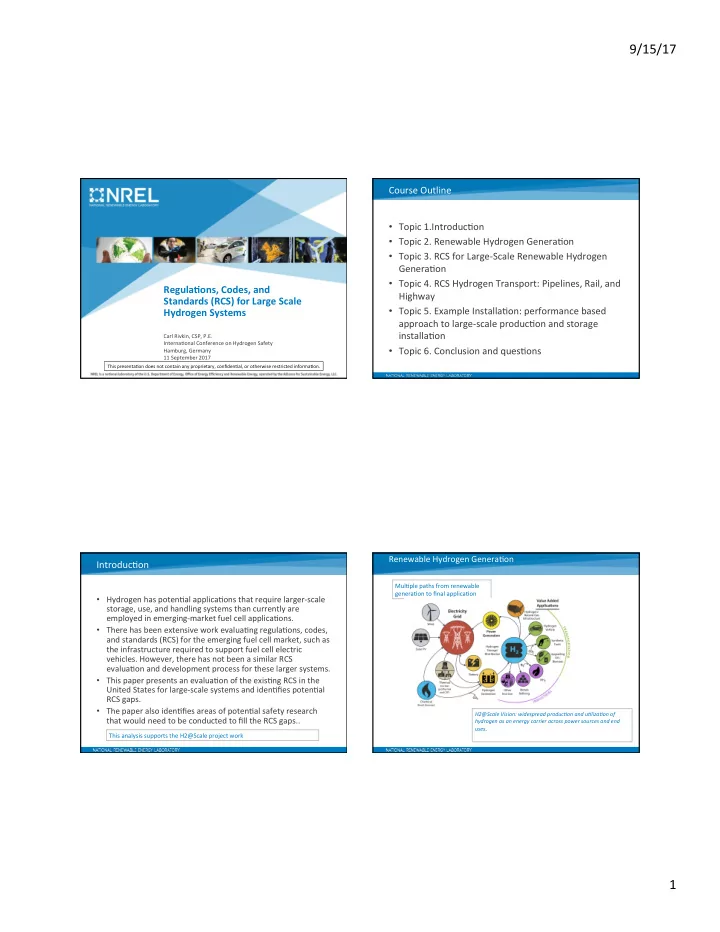
9/15/17 Course Outline Topic 1.Introduc8on Topic 2. Renewable - - PDF document

9 15 17
SMART_READER_LITE
LIVE PREVIEW

9/15/17 Course Outline Topic 1.Introduc8on Topic 2. Renewable - - PDF document

9/15/17 Course Outline Topic 1.Introduc8on Topic 2. Renewable Hydrogen Genera8on Topic 3. RCS for Large-Scale Renewable Hydrogen Genera8on Topic 4. RCS Hydrogen Transport: Pipelines, Rail, and Regula'ons, Codes, and Highway


slide-1
SLIDE 1

9/15/17 1

Regula'ons, Codes, and Standards (RCS) for Large Scale Hydrogen Systems

Carl Rivkin, CSP, P.E. Interna8onal Conference on Hydrogen Safety Hamburg, Germany 11 September 2017

This presenta8on does not contain any proprietary, confiden8al, or otherwise restricted informa8on.

  • Topic 1.Introduc8on
  • Topic 2. Renewable Hydrogen Genera8on
  • Topic 3. RCS for Large-Scale Renewable Hydrogen

Genera8on

  • Topic 4. RCS Hydrogen Transport: Pipelines, Rail, and

Highway

  • Topic 5. Example Installa8on: performance based

approach to large-scale produc8on and storage installa8on

  • Topic 6. Conclusion and ques8ons

Course Outline

  • Hydrogen has poten8al applica8ons that require larger-scale

storage, use, and handling systems than currently are employed in emerging-market fuel cell applica8ons.

  • There has been extensive work evalua8ng regula8ons, codes,

and standards (RCS) for the emerging fuel cell market, such as the infrastructure required to support fuel cell electric

  • vehicles. However, there has not been a similar RCS

evalua8on and development process for these larger systems.

  • This paper presents an evalua8on of the exis8ng RCS in the

United States for large-scale systems and iden8fies poten8al RCS gaps.

  • The paper also iden8fies areas of poten8al safety research

that would need to be conducted to fill the RCS gaps..

Introduc8on

This analysis supports the H2@Scale project work

Renewable Hydrogen Genera8on

Mul8ple paths from renewable genera8on to final applica8on

H2@Scale Vision: widespread produc5on and u5liza5on of hydrogen as an energy carrier across power sources and end uses.

slide-2
SLIDE 2

9/15/17 2

8

  • Referenced in the 2015

Interna8onal Fire Code

  • Referenced in NFPA 1 Uniform

Fire Code

  • These two Fire codes are used in

almost every jurisdic8on in the US

  • Federal facili8es o_en invoke

compliance with NFPA requirements

  • Covers almost all aspects of

hydrogen safety 194 Pages of Hydrogen safety Adopted in Most US jurisdic8ons

NFPA 2 Na8onal Hydrogen Code

NFPA 2 provides the base for hydrogen technologies including large systems

RCS for Large-Scale Renewable Hydrogen Genera'on

Chapter 13 of NFPA 2 has fairly limited requirements for produc8on

10

RCS FOR LARGE-SCALE HYDROGEN STORAGE SYSTEMS

  • NFPA 2 addresses bulk gaseous

storage in unlimited amounts and bulk liquid storage up to 283,906 L (75,000 gallons)

  • Systems that are larger than

current employed by industry may be considered to be outside

  • f the scope of the prescrip8ve

requirements in NFPA 2 Hydrogen Technologies Code

  • NFPA 2 give performance-based
  • p8on

Current Requirements Excerpt from NFPA 2 bulk liquid storage table

RCS HYDROGEN TRANSPORT: PIPELINES, RAIL, AND HIGHWAY

Pipeline network is very limited in the US to certain geographic areas

slide-3
SLIDE 3

9/15/17 3

12

  • Wind turbines capable of

genera8ng megawaas of power

  • Electrolyzers capable of

producing (combined with liquefac8on plant) 5,360 kg/day (20,000 gallons/day)

  • Storage system capable of

holding 26,800 kg (100,000 gallons) of liquid hydrogen

  • Transport capable of moving

5,360 kg/day (20,000 gallons/day)

  • Based on fuelling > 1000 vehicles
  • r supplying a small network of

sta8ons The basic parameters: Genera8on Por8on of Schema8c

Example Installa8on: performance based approach to large-scale produc8on and storage installa8on Key Elements of Performance Based Approach

Excerpt from summary

  • f performance based

requirements in NFPA 2 Hydrogen Technologies Code

Key Elements of Performance Based Approach

  • Very broad open-ended approach with qualita8ve

compliance targets

  • Will require data collec8on to evaluate hazards
  • Will require a significant effort to demonstrate

compliance

  • Will require working closely with enforcing authority
  • May be the only way to get large unique systems

approved

  • Component performance in large scale storage systems

is yet to be demonstrated for some components

  • Electrolyzer oxygen/hydrogen mixtures may present a

flammability hazard and require more detailed requirements in NFPA 2

  • Performance based compliance for systems outside of

current boundaries is an area that will require further work

  • Communica8ons for system to perform in an integrated

fashion may require further work

  • Hydrogen Wide Area Monitoring (HyWAM) to detect

releases in large storage systems is a technology that needs to be developed and demonstrated

Research Required to Deploy Large Systems

slide-4
SLIDE 4

9/15/17 4

  • Large scale systems not defined in RCS
  • Por8ons of large scale systems may fall outside of

the boundaries of current RCS

  • Approval process for these systems may require a

performance based approach similar to that applied to large LNG storage systems

  • No US na8onal system of hydrogen pipelines- filling

this gap will require addi8onal safety analyses

  • Research may be required in characterizing risk and

safety measures for large scale systems

CONCLUSION

Thank You and Ques8ons

  • Carl Rivkin, CSP, P.E. - Safety Research Team Lead

carl.rivkin@nrel.gov This work is supported by the DOE EERE Fuel Cell Technology Office!

17