Low-Power Neural Processor for Embedded Vision Applications. Michel - - PowerPoint PPT Presentation

low power neural processor for embedded vision
SMART_READER_LITE
LIVE PREVIEW

Low-Power Neural Processor for Embedded Vision Applications. Michel - - PowerPoint PPT Presentation

Low-Power Neural Processor for Embedded Vision Applications. Michel Paindavoine 1 (1) GlobalSensing Technologies (GST) Dijon, France www.gsensing.eu 1 MPSOC2016 M.Paindavoine July 13th 2016 Deep Neural Network Models ImageNet


slide-1
SLIDE 1

1 MPSOC2016 ‐ M.Paindavoine July 13th 2016
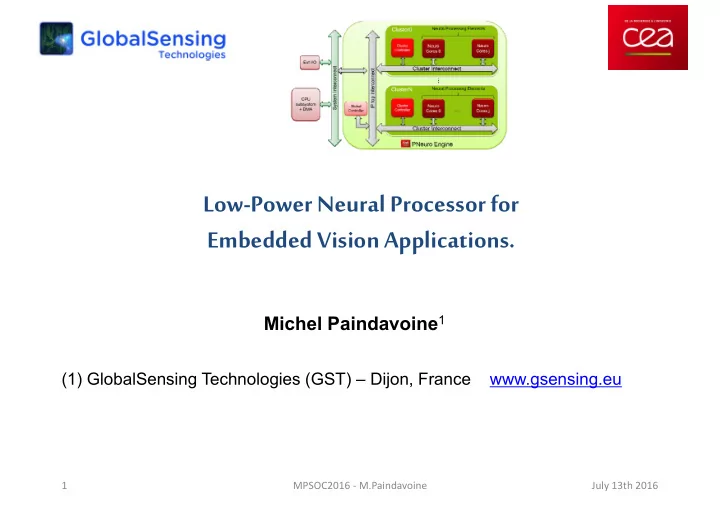
Low-Power Neural Processor for Embedded Vision Applications.

Michel Paindavoine1

(1) GlobalSensing Technologies (GST) – Dijon, France www.gsensing.eu

slide-2
SLIDE 2
  • ImageNet classification (Hinton’s team, hired by Google)

– 1.2 million high res images, 1,000 different classes – Top‐5 17% error rate (huge improvement)

  • Facebook’s ‘DeepFace’ Program (labs head: Y. LeCun)

– 4 million images, 4,000 identities – 97.25% accuracy, vs. 97.53% human performance

Deep Neural Network Models

Learned features

  • n first layer

July 13th 2016 MPSOC2016 ‐ M.Paindavoine 2

slide-3
SLIDE 3

CNNs Organization

… … … Deep = number of layers >> 1

July 13th 2016 MPSOC2016 ‐ M.Paindavoine 3

slide-4
SLIDE 4

State‐of‐the‐art in Recognition

  • State‐of‐the‐art are Deep Neural Networks every time

Database # Images # Classes Best score MNIST

Handwritten digits

60,000 + 10,000 10 99.79% [3] GTSRB

Traffic sign

~ 50,000 43 99.46% [4] CIFAR‐10

airplane, automobile, bird, cat, deer, dog, frog, horse, ship, truck

50,000 + 10,000 10 91.2% [5] Caltech‐101 ~ 50,000 101 86.5% [6] ImageNet ~ 1,000,000 1,000 Top‐5 83% [1] DeepFace ~ 4,000,000 4,000 97.25% [2] INCREASING COMPLEXITY

July 13th 2016 MPSOC2016 ‐ M.Paindavoine 4

slide-5
SLIDE 5

5 MPSOC2016 - M.Paindavoine July 13th 2016

Serre et al . Robust Object Recognition with Cortex‐like Mechanisms IEEE PAMI 2007

An otherNeuro-InspiredModel: The Hmax (a NeuroScience Approach)

slide-6
SLIDE 6

6 MPSOC2016 - M.Paindavoine July 13th 2016

Hmax : S1 and C1 layers

Serre et al . Robust Object Recognition with Cortex‐like Mechanisms IEEE PAMI 2007

slide-7
SLIDE 7

7 MPSOC2016 - M.Paindavoine July 13th 2016

Original Image Gabor Filters

slide-8
SLIDE 8

8 MPSOC2016 - M.Paindavoine July 13th 2016

Hmax Model performances

slide-9
SLIDE 9

9 MPSOC2016 - M.Paindavoine July 13th 2016

Hmax accelerator: Complexity

64 Gabor Filters

1 Mpixels Image complexity: S1: Optimized Gabor Filters: 2.9 GMAC C1: Max: 0.13 GOP RBF Neural Network : 0.4 GOP Total: 3.43 GMAC & OP One IP camera 1M pixels @ 30 fps: 103 GOP/sec

slide-10
SLIDE 10

July 13th 2016 MPSOC2016 ‐ M.Paindavoine 10

Pneuro accelerator

Objective: Design a processor integrating within the same chip signal processing functions and neuronal functions: Hmax, CNN (Joint Laboratory CEA & GST initiated in 2013)

… …… Cluster NeuroCores

Data In (Signals, Images) From Previous PNeuro To Next PNeuro Classification Result

PNeuro: A Cascadable Parallel Architecture

Cluster NeuroCores Cluster NeuroCores

slide-11
SLIDE 11

July 13th 2016 MPSOC2016 ‐ M.Paindavoine 11

PNeuro accelerator overview

slide-12
SLIDE 12
  • Fully‐programmable energy efficient hardware accelerator
  • Designed for DNN processing chains
  • CNN (OK), HMax (OK), RNN (under investigation)
  • Supporting traditional image processing chains (filtering, etc.)
  • Clustered SIMD architecture
  • Optimized operators for MAC & NL‐approximation
  • Optimized memory accesses to perform efficient data transfers to operators
  • ISA including ~50 instructions (control + computing)
  • Programming tools under development
  • Library including most‐common kernels with associated parameters (convolution,

max pooling, fully‐connected layers) to ease programming

  • Based on N2D2 platform with dedicated exports for PNeuro

PNeuro accelerator: Main Specifications

slide-13
SLIDE 13

July 13th 2016 MPSOC2016 ‐ M.Paindavoine 13

PNeuro accelerator: Performances

Profiling result: based on FDSOI 28 nm technology One cluster of 4 Neuro‐Cores @ 1GHz: 32 GMAC/sec with 70mW power consumption, including memories and the controller 32 Neuro‐Cores @ 1GHz: 1024 GMAC/sec – 2.2W  Energy Efficiency: 465 GMAC.s‐1/W Full Hmax One IP camera 1M pixels @ 30 fps: 103 GOP/sec Needs 4 clusters of 4 Neuro‐Cores (sup[103/32]) 280mW

slide-14
SLIDE 14

July 13th 2016 MPSOC2016 ‐ M.Paindavoine 14

Face Detection Application Example with Hmax

Complexity Calculation divided by 8 (merge 8 scales): One 1M pixels camera @ 30 fps: 12.9 GOP.sec‐1 (103 GOP.sec‐1 /8) Needs One Cluster with 2 NeuroCores: Power consumption < 35mW VGA Image @ 30 fps

  • nly 1 NeuroCore: < 20 mW
slide-15
SLIDE 15
  • First demonstration on a FPGA‐based Pneuro using ConvNet (CNN)
  • Single cluster configuration (4 Neuro‐Cores)
  • Embedded CNN application (60 neurons on the hidden layer, 450 KOps)
  • Faces extraction, 18000 images on the database, 96% recognition rate
  • Same application ported on 5 different architectures
  • Embedded CPU: Raspberry PI 2 B, Odroid Xu3
  • Embedded GPU: NVidia Tegra K1 (batch)
  • Desktop CPU: Intel I7
  • PNeuro, Quad Neuro‐Cores
  • Using an internal prototyping board
  • FPGA approach is already competitive with existing CPU & GPU solutions
  • First FPGA product developed for early 2017 by GST
  • Embedded FPGA: Artix 100 (~1W), 17.6cm² for the board, including one cluster

Target Freq (MHz) Energy Eff. (Images/W) Perf (Images/s) Intel I7 3400 160 5800 Quad ARM A15 2000 350 860 Quad ARM A7 900 380 480 Tegra K1 850 600 3550 PNeuro (FPGA) 100 2000 4960

Pneuro on FPGA

slide-16
SLIDE 16

16

NeuroFPGA-1 Camera Head 55 mm 55 mm Aptina CMOS Image sensor: 752 x 480 pixels @ 60fps FPGA

July 13th 2016 MPSOC2016 ‐ M.Paindavoine

Pneuro on FPGA: Using NeuroFPGA SmartNeuroCam

slide-17
SLIDE 17

July 8th 2016 GST ‐ TOYOTA 17

(mm)

RAM

256MBytes

Scalability Capacity

ARTIX7

RAM

256MBytes

ARTIX7

slide-18
SLIDE 18

IP top Interconnect System Interconnect

CPU subsyste m + DMA Ext I/O

Cluster Interconnect Cluster Interconnect Cluster0

Neuro Cores Neuro Cores j

Cluster Controll er

Neural Processing Elements

Global Controll er

  • 1 single‐cluster Pneuro fits into one NeuroFPGA‐2 board @100MHz
  • 4 NeuroBlocs included providing 32 operations/cycle

PNEURO LEVERAGING ON NEUROGPGA BOARD SCALABILITY

slide-19
SLIDE 19

IP top Interconnect System Interconnect

CPU subsyste m + DMA Ext I/O

Cluster Interconnect Cluster Interconnect Cluster0

Neuro Cores Neuro Cores j

Cluster Controll er

Neural Processing Elements

Global Ctrl

Cluster Interconnect Cluster Interconnect Cluster1

Neuro Cores Neuro Cores j

Cluster Controll er

Neural Processing Elements

  • Additionnal clusters can fit in daughters and communicates through high bandwitdh

multiboard interconnect

  • Up to 200 high speed links shared betweens daughter boards

PNEURO LEVERAGING ON NEUROGPGA BOARD SCALABILITY

slide-20
SLIDE 20

PNEURO LEVERAGING ON NEUROGPGA BOARD SCALABILITY

IP top Interconnect System Interconnect

CPU subsyste m + DMA Ext I/O

Cluster Interconnect Cluster Interconnect Cluster0

Neuro Cores Neuro Cores j

Cluster Controll er

Neural Processing Elements

Global Controll er

Cluster Interconnect Cluster Interconnect Cluster1

Neuro Cores Neuro Cores j

Cluster Controll er

Neural Processing Elements

Cluster Interconnect Cluster Interconnect Cluster2

Neuro Cores Neuro Cores j

Cluster Controll er

Neural Processing Elements

  • NN Scalability properties are completely exploited thanks to a Board & IP

Codesign between GST & CEA

slide-21
SLIDE 21
  • Caracterization chip in fabrication (tapeout

end of june) in FDSOI 28nm

  • Peak performances up to 1.8 TOPS/W

@500MHz

  • 0.4 mm² for a single cluster and its control,

with a power consumption under 35 mW@500 MHz

  • ASIC EVALUATION