SemEval-2019 Task 4: Hyperpartisan News Detection Johannes Maria - - PowerPoint PPT Presentation

semeval 2019 task 4 hyperpartisan news detection
SMART_READER_LITE
LIVE PREVIEW

SemEval-2019 Task 4: Hyperpartisan News Detection Johannes Maria - - PowerPoint PPT Presentation

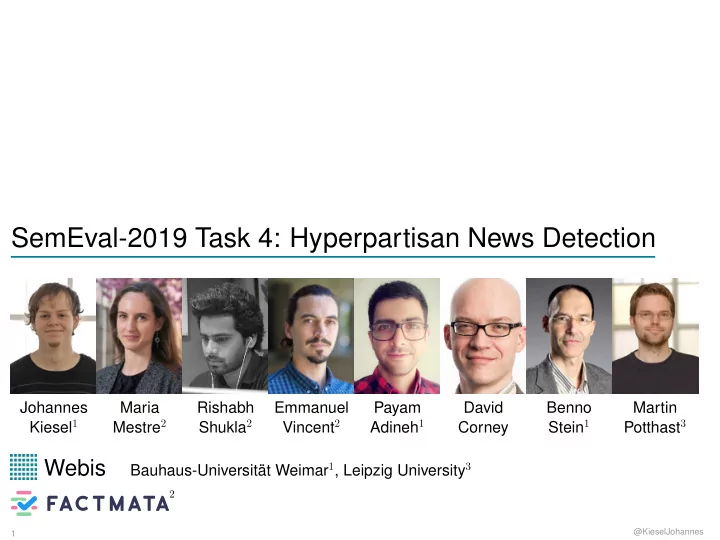
SemEval-2019 Task 4: Hyperpartisan News Detection Johannes Maria Rishabh Emmanuel Payam David Benno Martin Kiesel 1 Mestre 2 Shukla 2 Vincent 2 Adineh 1 Stein 1 Potthast 3 Corney Webis Bauhaus-Universitt Weimar 1 , Leipzig University 3


slide-1
SLIDE 1

SemEval-2019 Task 4: Hyperpartisan News Detection

Johannes Maria Rishabh Emmanuel Payam David Benno Martin Kiesel1 Mestre2 Shukla2 Vincent2 Adineh1 Corney Stein1 Potthast3

Webis

Bauhaus-Universität Weimar1, Leipzig University3

2

1 @KieselJohannes

slide-2
SLIDE 2

Task 4: Hyperpartisan News Detection

Background

The left-right political spectrum is a system of classifying political positions, ideologies and parties. Left-wing politics and right-wing politics are often presented as opposed, although either may adopt stances from the other side. [Wikipedia] A partisan is a politician who strongly supports their party’s policies and is reluctant to compromise with political opponents. [Wikipedia]

2 @KieselJohannes

slide-3
SLIDE 3

Task 4: Hyperpartisan News Detection

Is it Fake News?

We see fake news as “disinformation displayed as news articles”

3 @KieselJohannes

slide-4
SLIDE 4

Task 4: Hyperpartisan News Detection

Is it Fake News?

We see fake news as “disinformation displayed as news articles”

Image: Claire Wardle, First Draft

4 @KieselJohannes

slide-5
SLIDE 5

Task 4: Hyperpartisan News Detection

Is it Fake News?

We see fake news as “disinformation displayed as news articles”

Image: Claire Wardle, First Draft

5 @KieselJohannes

slide-6
SLIDE 6

Task 4: Hyperpartisan News Detection

Is it Fake News?

Motivations for mis- and disinformation:

Image: Claire Wardle, First Draft

6 @KieselJohannes

slide-7
SLIDE 7

Task 4: Hyperpartisan News Detection

Is it Fake News?

Motivations for mis- and disinformation: includes partisanship

Image: Claire Wardle, First Draft

7 @KieselJohannes

slide-8
SLIDE 8

Task 4: Hyperpartisan News Detection

Is it Fake News?

Motivations for publishing hyperpartisan news are not just partisanship

Image: Claire Wardle, First Draft

8 @KieselJohannes

slide-9
SLIDE 9

Task 4: Hyperpartisan News Detection

Data

Task: Given the text and markup of an online news article, decide whether the article is hyperpartisan or not.

doi.org/10.5281/zenodo.1489920

❑ Dataset Annotated by Article: 1 273 articles. ❑ Manual annotation of each article by crowdworkers.

– Articles from ∼500 US news publishers – Crowdworker reliability estimate by Beta reputation system (Ismail and Josang 2002) – 3 Annotations per article – Public set: 645 articles; hidden test set: 628 articles, balanced – No publisher-overlap between sets

9 @KieselJohannes

slide-10
SLIDE 10

Task 4: Hyperpartisan News Detection

Data

Task: Given the text and markup of an online news article, decide whether the article is hyperpartisan or not.

doi.org/10.5281/zenodo.1489920

❑ Dataset Annotated by Article: 1 273 articles. ❑ Manual annotation of each article by crowdworkers.

– Articles from ∼500 US news publishers – Crowdworker reliability estimate by Beta reputation system (Ismail and Josang 2002) – 3 Annotations per article – Public set: 645 articles; hidden test set: 628 articles, balanced – No publisher-overlap between sets

❑ Dataset Annotated by Publisher: 754 000 articles. ❑ Manual annotation of each publisher by journalists.

– Annotation of ∼400 US news publishers by BuzzFeed and Media Bias Fact Check – Crawling of article feeds – Content wrappers were implemented for each publisher – Filtering to political news, English, at least 40 words, correct encoding – Public set: 750 000 articles, balanced; hidden test set: 4 000 articles, balanced – No publisher-overlap between sets

10 @KieselJohannes

slide-11
SLIDE 11

Task 4: Hyperpartisan News Detection

Methods

Employed features N-Grams character, word, part-of-speech Embeddings BERT, Word2Vec, fastText, GloVe, ELMo, word clusters, sentences Stylometry punctuation, structure, readability, lexicons, trigger words Emotionality sentiment, emotion, subjectivity, polarity Named entities nationalities, religious and political groups Quotations count, discarded Hyperlinks lists of hyperpartisan pages Publication date year, month Detailed analysis of hand-crafted features: Borat Sagdiyev Classifiers Convolutional neural networks, Long short term memory, Support vector machines, Random Forest, Linear model, Naive Bayes, XGBOOST, Maximum Entropy, Rule-based, ULMFit

11 @KieselJohannes

slide-12
SLIDE 12

Task 4: Hyperpartisan News Detection

Results on dataset annotated by article Team Authors Acc. Prec. Rec. F1. Bertha von Suttner Jiang et al. 0.822 0.871 0.755 0.809 Vernon Fenwick Srivastava et al. 0.820 0.815 0.828 0.821 Sally Smedley Hanawa et al. 0.809 0.823 0.787 0.805 Tom Jumbo Grumbo Yeh et al. 0.806 0.858 0.732 0.790 Dick Preston Isbister and Johansson 0.803 0.793 0.818 0.806 Borat Sagdiyev Pali´ c et al. 0.791 0.883 0.672 0.763 Morbo Isbister and Johansson 0.790 0.772 0.822 0.796 Howard Beale Mutlu et al 0.783 0.837 0.704 0.765 Ned Leeds Stevanoski and Gievska 0.775 0.865 0.653 0.744 Clint Buchanan Drissi et al. 0.771 0.832 0.678 0.747 + 32 more

❑ 322 registrations ❑ 184 virtual machines assigned ❑ 42 software submissions from as many teams ❑ 34 papers ❑ Ongoing submissions in

TIRA

pan.webis.de/semeval19/ semeval19-web/leaderboard.html

12 @KieselJohannes

slide-13
SLIDE 13

Task 4: Hyperpartisan News Detection

Results on meta-learning dataset Team Authors Acc. Prec. Rec. F1. Fernando Pessa Cruz et al. 0.899 0.895 0.904 0.900 Spider Jerusalem Alabdulkarim and Alhindi 0.899 0.903 0.894 0.899 Majority Vote Kiesel et al. 0.885 0.892 0.875 0.883 J48-M10 Kiesel et al. 0.880 0.916 0.837 0.874 Bertha von Suttner alone Jiang et al. 0.851 0.901 0.788 0.841

❑ Meta-learning dataset created from

test dataset: 66% training, 33% test

❑ Higher accuracy (from 0.822) ❑ Baselines beat best single system ❑ Both participants beat the baselines ❑ They use a Random Forest and a

weighted majority vote, respectively

❑ Ongoing submissions in

TIRA

13 @KieselJohannes

slide-14
SLIDE 14

Task 4: Hyperpartisan News Detection

Results on meta-learning dataset Team Authors Acc. Prec. Rec. F1. Fernando Pessa Cruz et al. 0.899 0.895 0.904 0.900 Spider Jerusalem Alabdulkarim and Alhindi 0.899 0.903 0.894 0.899 Majority Vote Kiesel et al. 0.885 0.892 0.875 0.883 J48-M10 Kiesel et al. 0.880 0.916 0.837 0.874 Bertha von Suttner alone Jiang et al. 0.851 0.901 0.788 0.841

❑ Meta-learning dataset created from

test dataset: 66% training, 33% test

❑ Higher accuracy (from 0.822) ❑ Baselines beat best single system ❑ Both participants beat the baselines ❑ They use a Random Forest and a

weighted majority vote, respectively

❑ Ongoing submissions in

TIRA

Vernon Fenwick Bertha von Suttner Borat Sagdiyev yes no yes no yes no Howard Beale yes no Ned Leeds yes no 13 193 2 160 17 26 22 5 10 22 3 6

14 @KieselJohannes

slide-15
SLIDE 15

Task 4: Hyperpartisan News Detection

Results on meta-learning dataset Team Authors Acc. Prec. Rec. F1. Fernando Pessa Cruz et al. 0.899 0.895 0.904 0.900 Spider Jerusalem Alabdulkarim and Alhindi 0.899 0.903 0.894 0.899 Majority Vote Kiesel et al. 0.885 0.892 0.875 0.883 J48-M10 Kiesel et al. 0.880 0.916 0.837 0.874 Bertha von Suttner alone Jiang et al. 0.851 0.901 0.788 0.841

❑ Meta-learning dataset created from

test dataset: 66% training, 33% test

❑ Higher accuracy (from 0.822) ❑ Baselines beat best single system ❑ Both participants beat the baselines ❑ They use a Random Forest and a

weighted majority vote, respectively

❑ Ongoing submissions in

TIRA

Vernon Fenwick Bertha von Suttner Borat Sagdiyev yes no yes no yes no Howard Beale yes no Ned Leeds yes no 13 193 2 160 17 26 22 5 10 22 3 6

15 @KieselJohannes

slide-16
SLIDE 16

Task 4: Hyperpartisan News Detection

Results on dataset annotated by publisher Team Authors Acc. Prec. Rec. F1. Tintin Bestgen 0.706 0.742 0.632 0.683 Joseph Rouletabille Moreno et al. 0.680 0.640 0.827 0.721 Brenda Starr Papadopoulou et al. 0.664 0.627 0.807 0.706 Xenophilius Lovegood Zehe et al. 0.663 0.632 0.781 0.699 Yeon Zi Lee et al. 0.663 0.635 0.766 0.694 Miles Clarkson Zhang et al. 0.652 0.612 0.832 0.705 Jack Ryder Shaprin et al. 0.645 0.600 0.869 0.710 Bertha von Suttner Jiang et al. 0.643 0.616 0.762 0.681 + 16 more Robin Scherbatsky Marx and Akut 0.524 0.822 0.062 0.116 + 3 more

❑ 28 teams (of 42) ❑ Lower accuracy (from 0.822) ❑ Most teams focused on the other dataset ❑ Ranking very different ❑ Ongoing submissions in

TIRA

pan.webis.de/semeval19/ semeval19-web/leaderboard.html

16 @KieselJohannes

slide-17
SLIDE 17

Task 4: Hyperpartisan News Detection

Comparison of dataset rankings Team Authors Acc. Prec. Rec. F1. Tintin Bestgen 0.706 0.742 0.632 0.683 Joseph Rouletabille Moreno et al. 0.680 0.640 0.827 0.721 Brenda Starr Papadopoulou et al. 0.664 0.627 0.807 0.706 Xenophilius Lovegood Zehe et al. 0.663 0.632 0.781 0.699 Yeon Zi Lee et al. 0.663 0.635 0.766 0.694 Miles Clarkson Zhang et al. 0.652 0.612 0.832 0.705 Jack Ryder Shaprin et al. 0.645 0.600 0.869 0.710 Bertha von Suttner Jiang et al. 0.643 0.616 0.762 0.681 + 16 more Robin Scherbatsky Marx and Akut 0.524 0.822 0.062 0.116 + 3 more

❑ 28 teams (of 42) ❑ Lower accuracy (from 0.822) ❑ Most teams focused on the other dataset ❑ Ranking very different ❑ Ongoing submissions in

TIRA

40 39 38 36 34 32 30 29 27 26 25 24 22 21 20 16 15 14 13 11 9 8 7 6 5 4 3 1 Rank for dataset annotated by article 28 27 26 25 24 23 22 21 20 19 18 17 16 15 14 13 12 11 10 9 8 7 6 5 4 3 2 1 Rank for dataset annotated by publisher

17 @KieselJohannes

slide-18
SLIDE 18

Task 4: Hyperpartisan News Detection

Conclusion

❑ Two datasets, newest version downloaded ∼450 times

18 @KieselJohannes

slide-19
SLIDE 19

Task 4: Hyperpartisan News Detection

Conclusion

❑ Two datasets, newest version downloaded ∼450 times ❑ Features reported to be especially efficient: embeddings, n-grams, sentiment ❑ So far, 10 teams released their code open source

19 @KieselJohannes

slide-20
SLIDE 20

Task 4: Hyperpartisan News Detection

Conclusion

❑ Two datasets, newest version downloaded ∼450 times ❑ Features reported to be especially efficient: embeddings, n-grams, sentiment ❑ So far, 10 teams released their code open source ❑ Very high accuracy: 0.8 to 0.9 ❑ Submission still open!

20 @KieselJohannes

slide-21
SLIDE 21

Task 4: Hyperpartisan News Detection

Conclusion

❑ Two datasets, newest version downloaded ∼450 times ❑ Features reported to be especially efficient: embeddings, n-grams, sentiment ❑ So far, 11 teams released their code open source ❑ Very high accuracy: 0.8 to 0.9 ❑ Submission still open!

21 @KieselJohannes

slide-22
SLIDE 22

Task 4: Hyperpartisan News Detection

Conclusion

❑ Two datasets, newest version downloaded ∼450 times ❑ Features reported to be especially efficient: embeddings, n-grams, sentiment ❑ So far, 11 teams released their code open source ❑ Very high accuracy: 0.8 to 0.9 ❑ Submission still open!

22 @KieselJohannes

slide-23
SLIDE 23

Task 4: Hyperpartisan News Detection

Conclusion

❑ Two datasets, newest version downloaded ∼450 times ❑ Features reported to be especially efficient: embeddings, n-grams, sentiment ❑ So far, 11 teams released their code open source ❑ Very high accuracy: 0.8 to 0.9 ❑ Submission still open! ❑ Challenge ahead: explainability

23 @KieselJohannes